
Quick Take
- Ants coordinate highly complex foraging and traffic systems without any leaders, relying entirely on local interactions and chemical cues.
- Pheromone trails encode information about distance, food quality, and danger, allowing colonies to adapt and optimize paths in real time.
- Ant-inspired strategies, like ant colony optimization, inform human systems in computing, logistics, and urban planning.
A few months ago, I awoke to find a streak spanning the length of my kitchen wall that looked like it had been drawn there with thick black crayon. This was confounding, given that I live alone, save for three cats whom I was fairly certain hadn’t done this. On closer inspection, I realized that streak was not drawn at all—it was a trail of tens, perhaps thousands, of tiny ants.
The trail started at an electrical socket, stretched a dozen feet along the wall, and then across the floor to a tiny piece of food that had fallen there the night before. No, I do not want ants in my house; it was an unpleasant thing to wake up to. Yet, at the same time, it was an absolute marvel, and I couldn’t help but stand there and observe it for several minutes. I ultimately cleaned up the food they were after, and within seconds, the streak of ants was retreating to the electric socket from whence they’d come. Utterly amazing.
This was not a unique experience—that is just what ants do. Hundreds or thousands of them pour out of a nest, fan out, locate food, avoid hazards, adjust to obstacles, and somehow bring resources back home with remarkable efficiency. There is no visible ant boss giving orders. No foreman directing traffic, yet the system works with remarkable efficiency. This efficiency has fascinated engineers, computer scientists, and urban planners, who have spent decades trying to understand how ants achieve it.
The secret is communication—though not in the way we humans do it. Ants rely on chemical signals called pheromones to create what can be considered an external, digital information network. This network allows ants to share data about where food is, how good it is, how far away it lies, and how dangerous the route might be. Individually, each ant follows simple rules. Collectively, those rules produce complex, adaptive behavior that can lead to a twenty-foot trail of them across your kitchen that’s as organized—and, quite frankly, intimidating—as any army the world has ever seen.
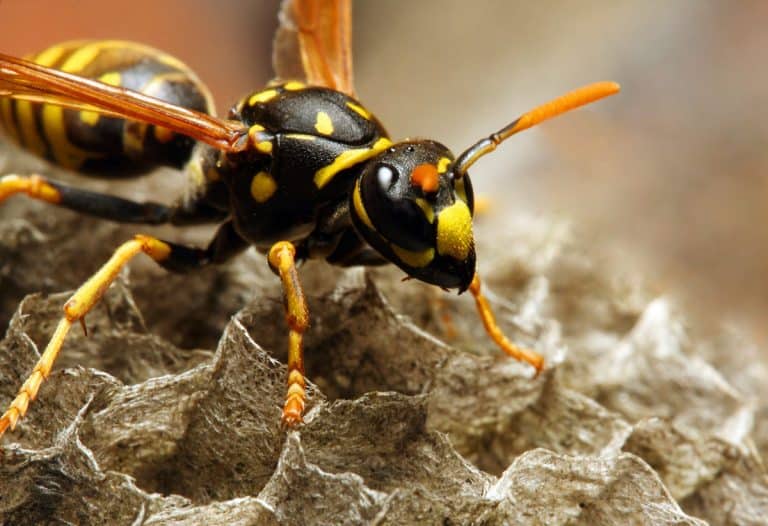
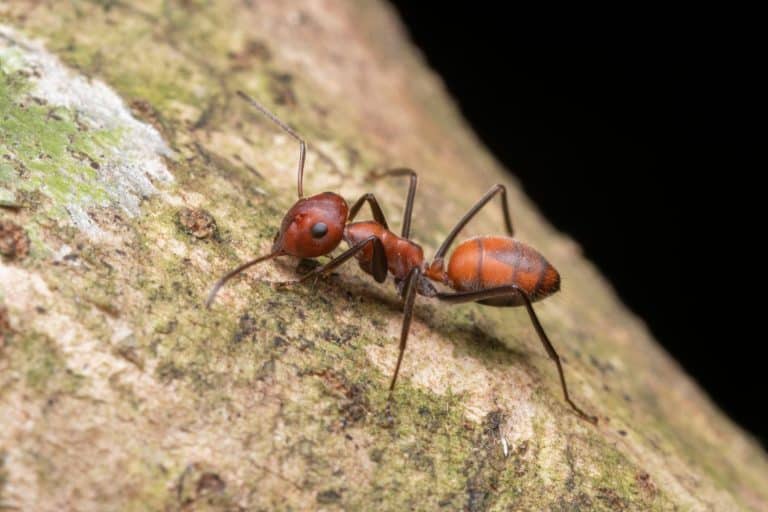
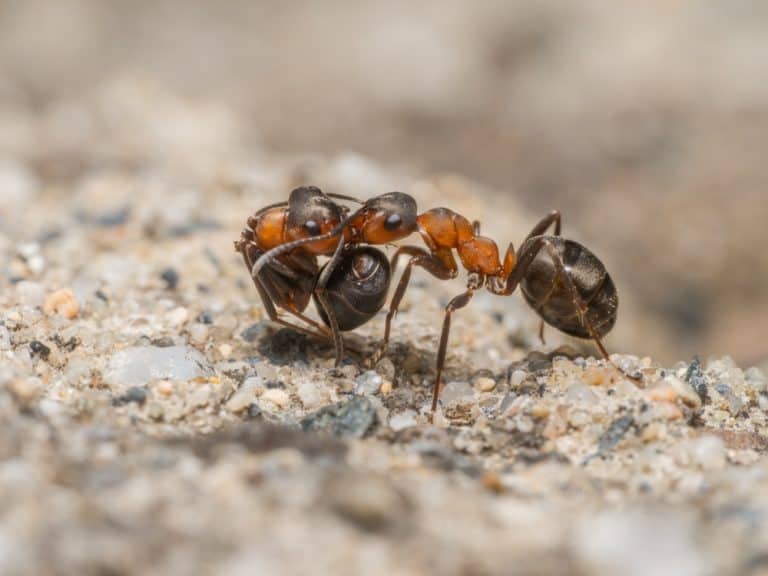
Ant colonies function efficiently without any single ant directing others, relying entirely on local interactions.
©dhtgip/Shutterstock.com
Success Without a Leader
One of the most surprising facts about ants is that most species don’t have leaders in any meaningful sense. You may ask, “But what about the queen?” Sure, queens exist, but their role is reproduction, not management. A queen doesn’t direct workers, assign tasks, or make strategic decisions. Not only is there no leader barking orders, but workers don’t issue commands to one another, either. Each ant operates based on local information and simple behavioral cues.
Despite this, ant colonies can perform tasks that seem well-coordinated by design. They find the shortest path to food. They adjust routes when obstacles appear. They allocate more workers to rich food sources and abandon poor ones. They even regulate traffic flow on busy trails to prevent congestion. Scientists refer to this as self-organization. Order emerges as a result of many small interactions, not from top-down control. The glue holding this system together is pheromones.
What Are Pheromones, and How Do Ants Use Them?
Put broadly, pheromones are chemical substances that animals release to influence the behavior of others of the same species. Ants produce many different pheromones, each serving a specific purpose. Some signal alarm, others mark territory, and others indicate food sources.
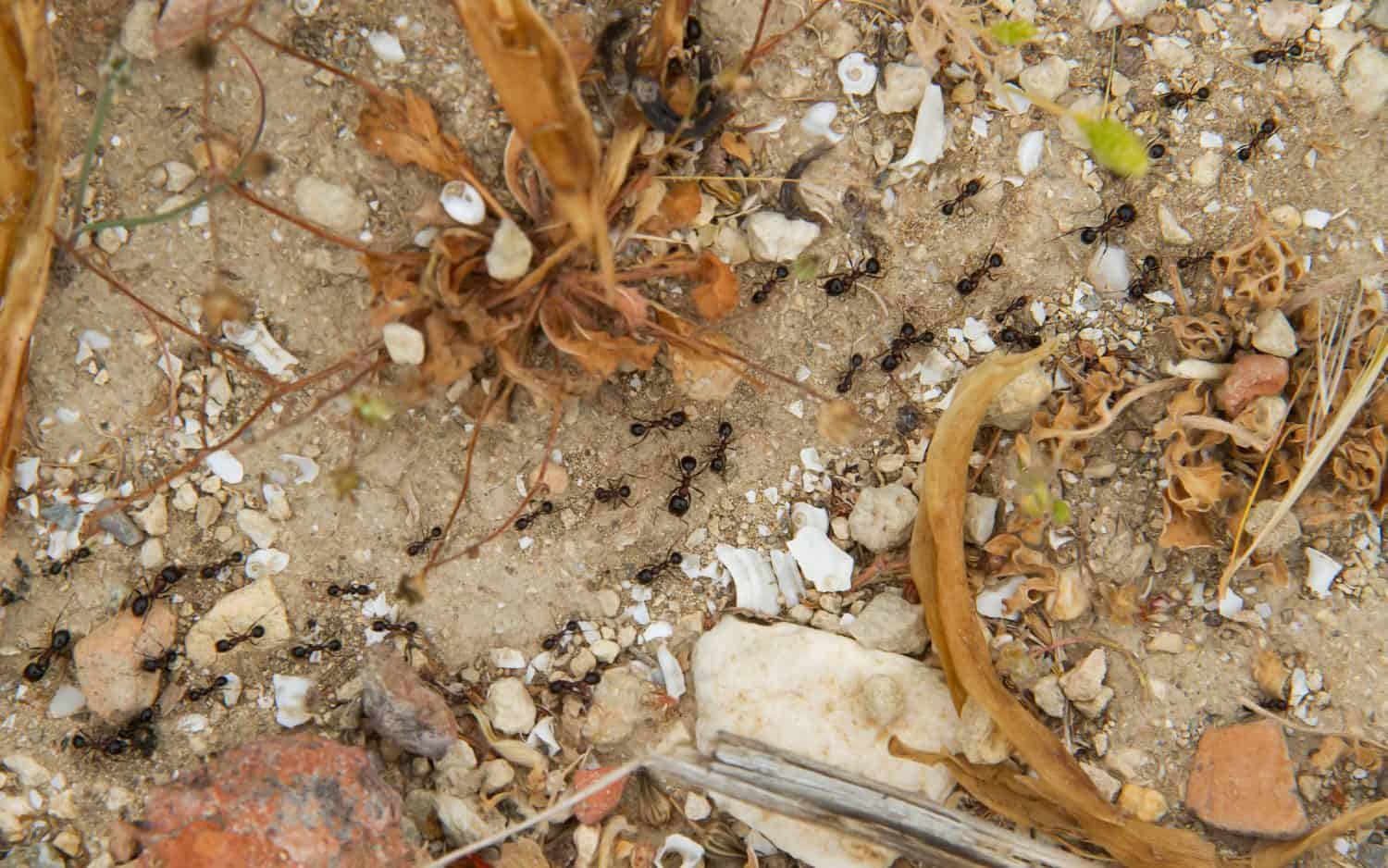
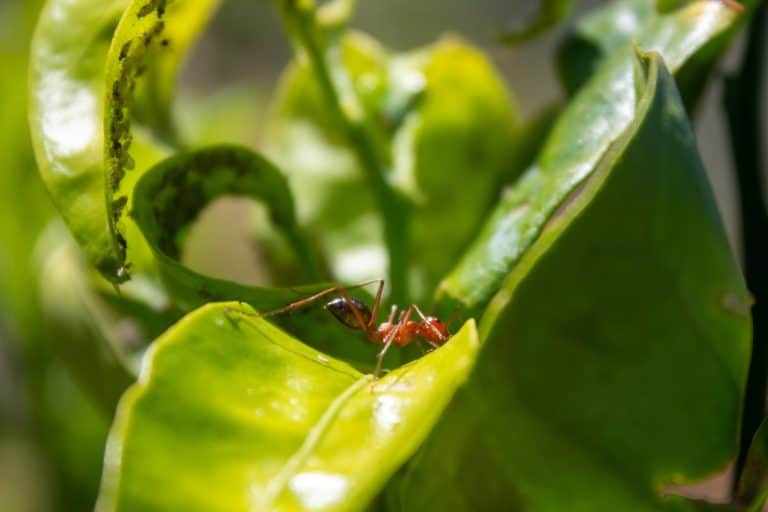
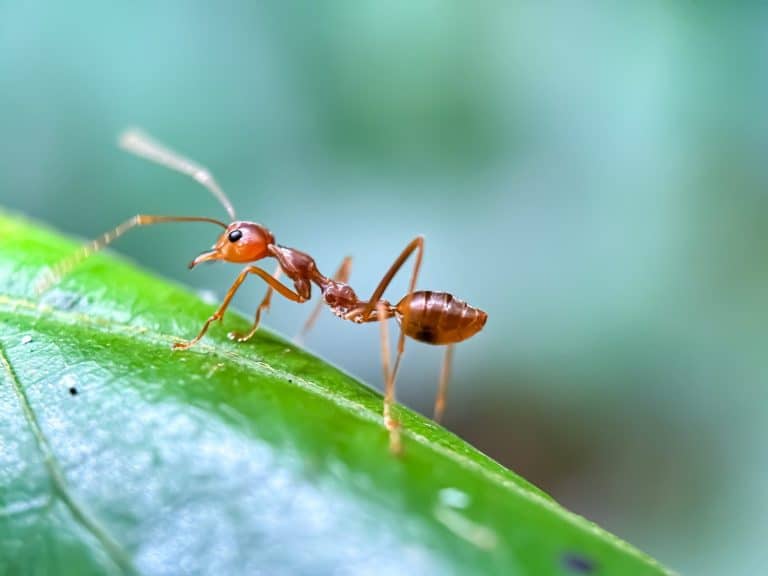
Ants “read” pheromone trails with sensitive antennae, detecting trail strength, freshness, and chemical cues.
©Matauw/Shutterstock.com
When an ant finds food, it often lays down a pheromone trail as it returns to the nest. But this trail isn’t just a simple line that says: food here. It contains layered information. Other ants can “read” a trail’s strength, freshness, and chemical makeup, allowing them to infer things like how many ants have used it, how recently, and whether it was laid after a successful find.
They interpret these pheromone trails using highly sensitive antennae that allow them to detect extremely small amounts of these chemicals. By touching the ground with their antennae as they walk, ants continuously sample the chemical landscape around them—like reading Braille with one’s fingertips.
What the Trails Communicate
Scientists sometimes describe ant pheromone trails as “digital.” A digital system is one where information is handled in separate, countable steps, not as a smooth, constantly changing signal. Ant trails operate in this way: each ant either adds pheromone to a path or adds nothing at all. As these individual deposits accumulate or fade, the colony’s shared information updates in distinct steps rather than as a smooth, constantly adjusted signal. In the most simplistic of terms, if a trail is worth following, the ant will lay down pheromones that say so; if it isn’t, they won’t. In this way, the colony essentially votes where to invest its labor.
Distance
Suppose there are two equally good pizza joints in your town: one half a block away, the other across town. You’re far more likely to go to the closer one. Ants are no different, but they don’t have Google Maps to tell them which food source is closer. This is where pheromones come in.
Distance is encoded indirectly through pheromone decay and travel time. Pheromones evaporate and break down over time. A trail that takes longer to travel will naturally weaken before it can be reinforced. This means closer food sources tend to develop stronger pheromone trails more quickly.
Some species also adjust the amount of pheromone they release based on how long they traveled or how exhausted they are when they return. Shorter trips often result in heavier pheromone deposits, which further biases the system toward nearby resources. The colony doesn’t calculate distance the way we do, but the chemistry of pheromones ensures that distance is automatically factored into its decision-making.
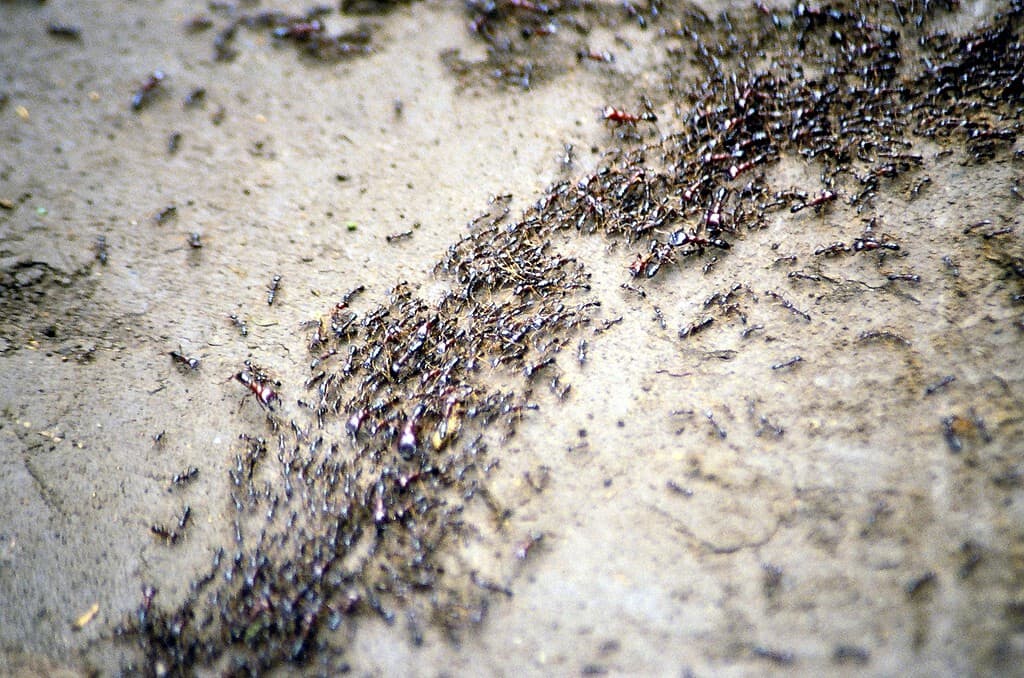
Pheromone strength naturally encodes distance, favoring nearby food sources without ants needing maps.
Food Quality
Sticking with our pizza metaphor, now let’s suppose there are two pizza joints side by side. One is delicious, and the other one tastes like cardboard. You obviously want the delicious one. Same for ants. But they don’t have the benefit of Yelp to tell them which is better. So how do they know? Again: pheromone.
You wouldn’t think so, but ants are surprisingly picky. Sugar-rich liquids, fatty seeds, and protein-heavy insects all offer different benefits depending on the colony’s needs. Higher-quality food sources prompt ants to release more pheromone per trip. Other ants encountering the trail respond by following it more eagerly and adding their own pheromone if they also find the food worthwhile.
In some species, upon returning to the nest, ants will exchange liquid food mouth-to-mouth—a process called trophallaxis. This allows nestmates to directly sample the food. If the food is valuable, more workers are stimulated to leave the nest and follow the trail. This, in turn, results in more pheromone being deposited. The result is a system that scales labor up or down based on real-time feedback.
Danger
Pheromones don’t only attract ants, they can also repel them. Many ant species use alarm pheromones to signal danger, such as predators or collapsing terrain. If ants encounter a threat along a trail, they may release alarm pheromones that cause others to hesitate, retreat, or take alternate routes. Over time, dangerous routes become chemically “marked” as undesirable, even if they once led to food. Safer routes gain more reinforcement, and the colony shifts traffic accordingly, allowing ant colonies to adapt to changing conditions without needing memory or centralized planning.
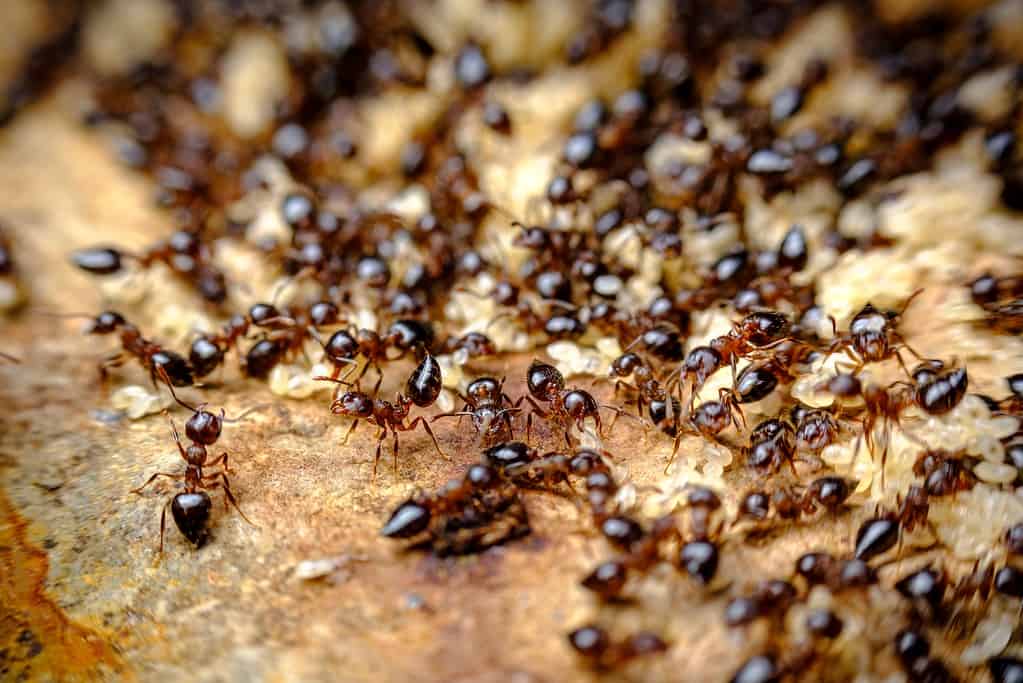
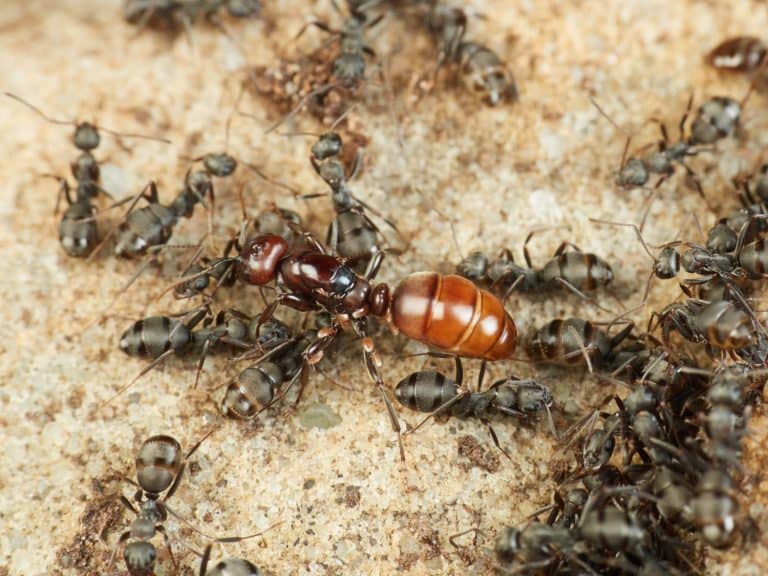
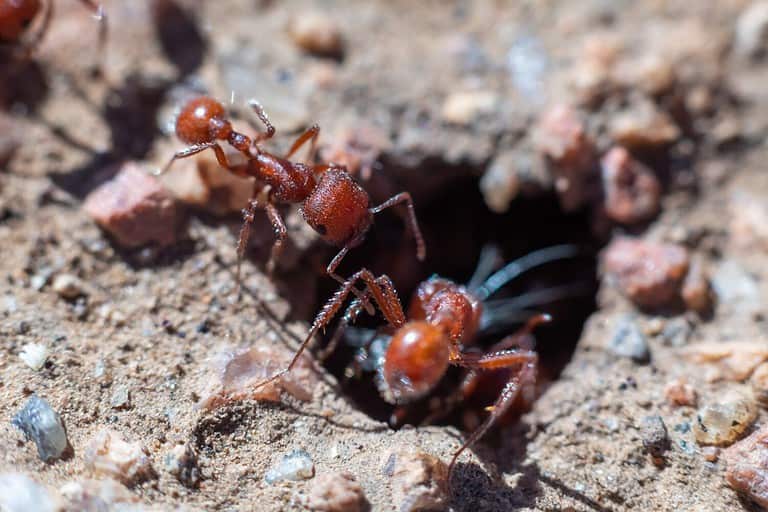
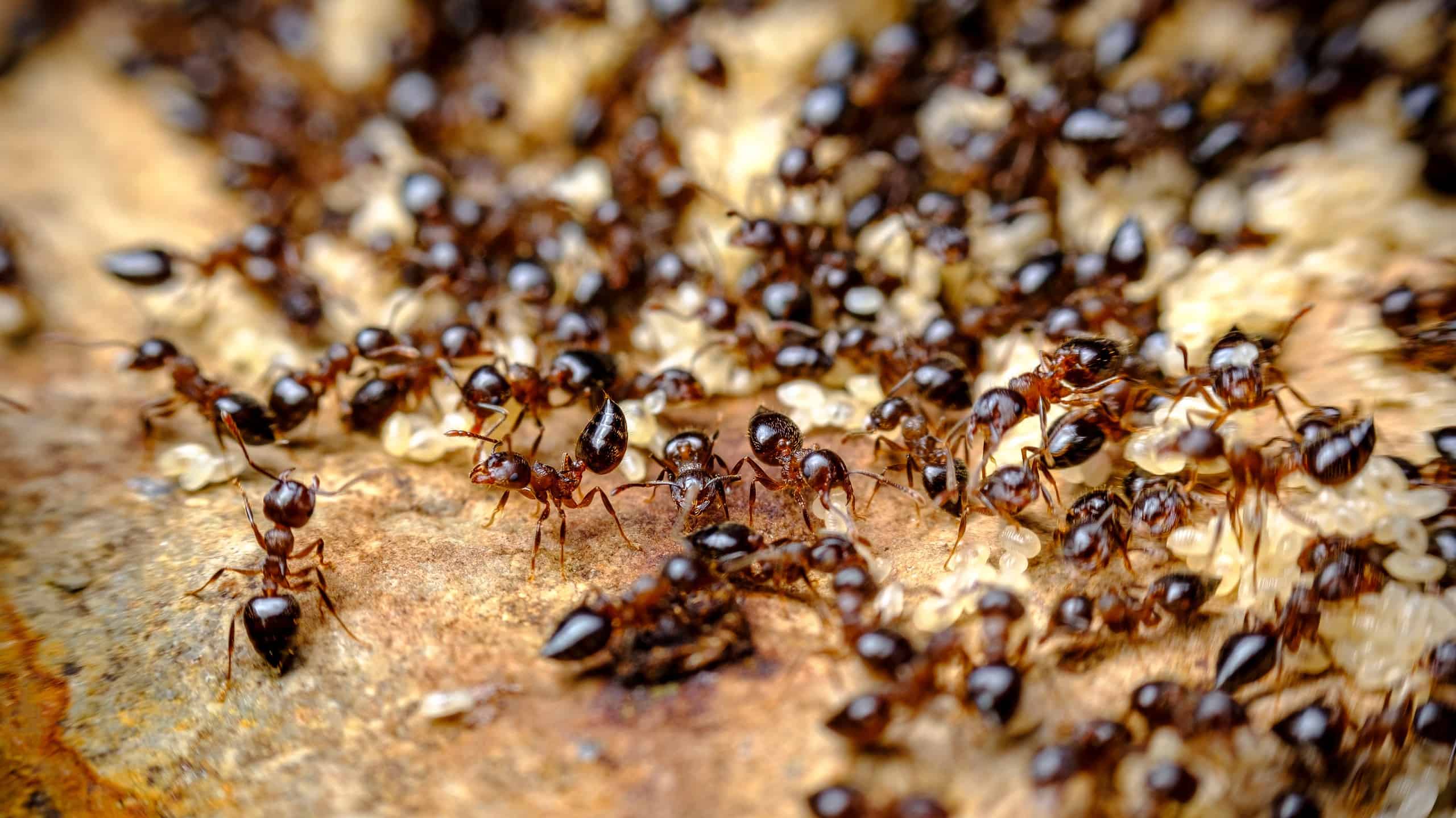
Alarm pheromones signal threats along a trail, causing ants to retreat or take safer routes.
©Ezume Images/Shutterstock.com
The Shortest Path
One of the most famous demonstrations of ant logistics involves path optimization. When ants are given two possible routes to a food source, one short and one long, they usually converge on the shorter route over time.
This happens because ants traveling the shorter path return faster and reinforce that trail more frequently. Even if ants initially explore both routes, small random differences get amplified through positive feedback. Eventually, almost all ants use the most efficient path.
This behavior has inspired algorithms used in computer science and logistics, often called ant colony optimization. These algorithms help solve problems like routing delivery trucks, scheduling airline flights, and managing internet traffic.
Traffic Management Without Stop Signs
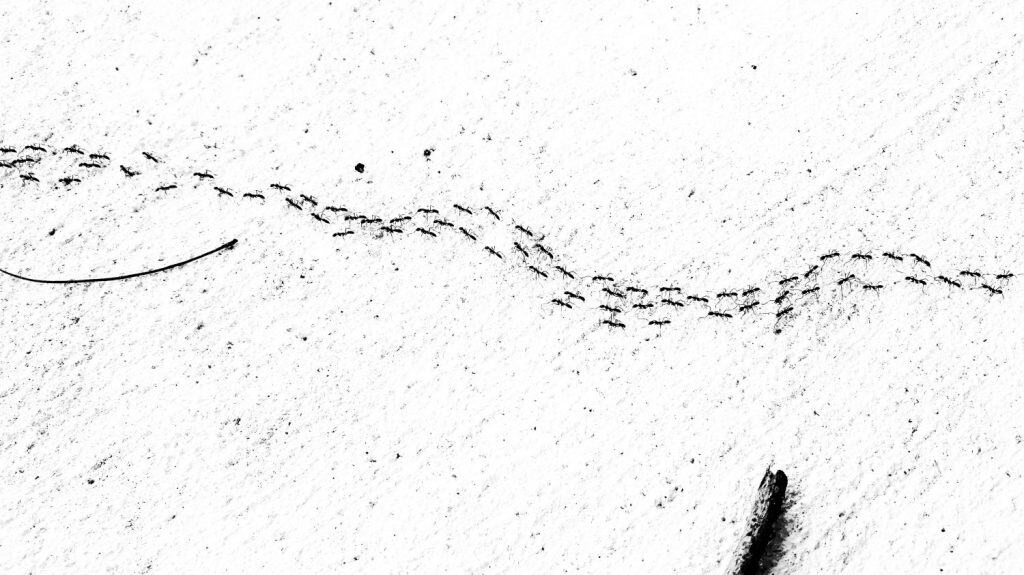
As clever as humans are, one thing we just can’t for the life of us figure out is how to quell traffic. Ants have quite outdone us in that department. Heavy ant traffic can become just as chaotic as the Hollywood Freeway at rush hour, but colonies have ways to prevent jams. On busy trails, ants often self-organize into lanes, with outbound and inbound ants keeping to different sides.
This behavior appears to emerge from simple avoidance rules. Ants slow down or adjust direction when they collide with others, and over time, stable flow patterns form. Pheromones help maintain these paths, reinforcing efficient movement and discouraging wandering.
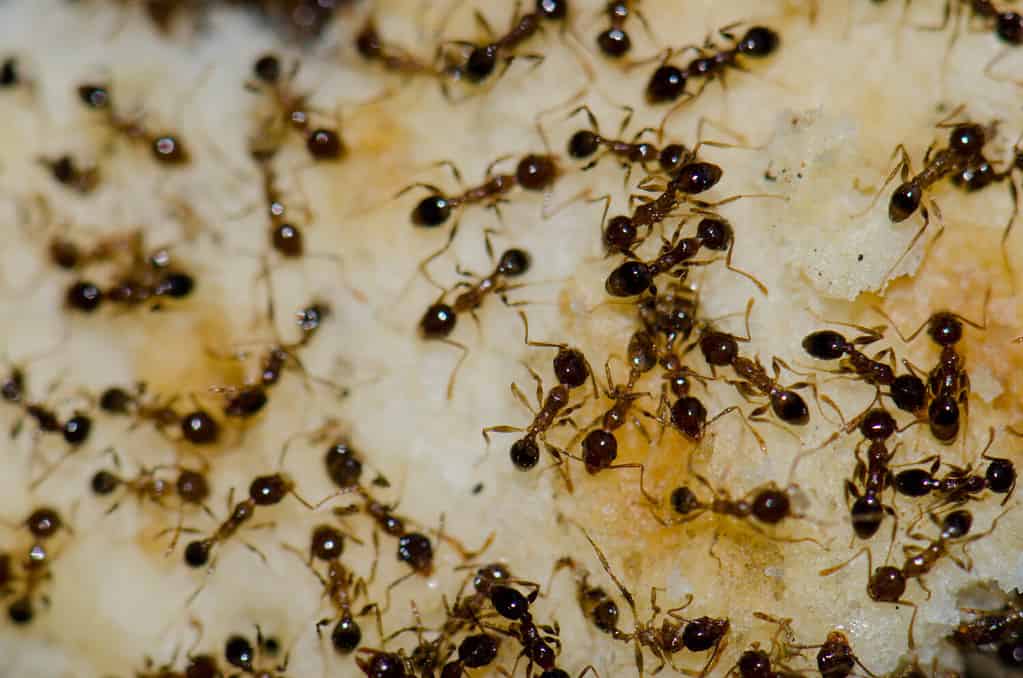
Colonies self-organize lanes and adjust outbound traffic based on congestion, avoiding jams without a leader.
©Victor Suarez Naranjo/Shutterstock.com
Some species even regulate how many ants leave the nest based on congestion. When returning foragers come back with food and leave strong chemical trails, it’s like a “come join us” signal, and more workers rush out to follow. If too many ants return empty-handed and the trails are faint, the colony slows down, sending fewer ants out to forage. Without any boss or schedule, the nest naturally balances traffic, responding to successes and failures as if the colony were a single, clever mind.
A Simple Yet Remarkably Efficient System
The power of pheromone-based communication lies in its simplicity and redundancy. No single ant holds critical information. If one ant dies, the trail remains. If conditions change, pheromones fade, and new ones replace them.
The system is flexible, scalable, and robust. It works just as well for dozens of ants as it does for millions. It also responds quickly to change, often faster than human-designed systems that rely on centralized control. There’s no red tape in the ant world. This is why ant colonies have thrived for tens of millions of years in environments that constantly shift.
And humans are taking note. Urban planners, software engineers, and logistics experts now borrow ideas from ant pheromone systems to design more resilient networks. No, humans will never navigate cities by sniffing the sidewalk, but the underlying principles of decentralized decision-making have proven surprisingly transferable.
Ants do not think the way humans do, but dismissing their achievements as simple instinct misses the point. Through pheromones, ants build a shared chemical language that turns individual actions into collective intelligence.
Every trail is a message. Every step updates the system. And every successful journey makes the colony just a little smarter than it was before. Ants have shown us that sometimes the most effective solutions don’t emerge from a plan, but from many small signals working quietly together beneath our feet. All that said, I’d still prefer they stay out of my kitchen.