
Quick Take
- Firework fear in dogs is a rational fight-or-flight response driven by loud, unpredictable noise and superior canine hearing.
- Prevalence varies; about 1 in 4 dogs are frightened by loud noises.
- At-home counterconditioning with treats during fireworks helps about 70% of dogs. Desensitization with firework-noise recordings can also help.
The unique excitement that fireworks create is one of the few childhood joys many people carry into adulthood, and I am one of those people! Be it New Year’s Eve, Diwali, 4th July, or Guy Fawkes Night in the UK, the popularity of fireworks is increasing globally. The sheer thrill of seeing millions of multicolored sparks lighting up the night sky with booming explosions, making my heart skip a beat, is something that never left me. That is, until I got a dog. Wilbur, my border cairn cross terrier, has changed my opinion on fireworks forever.
It all started so well, and Wilbur’s first experience of hearing fireworks was unremarkable. He pretty much ignored them. So far so good, I thought, Wilbur is clearly one of those dogs who is not bothered by them. How wrong could I be? When he was still a young dog, someone let off a firework near us while we were out on a walk. Wilbur was startled, clearly very distressed, and dragged me all the way home.
That was an experience from which he has never recovered, and fireworks have become the bane of his life—and therefore mine too. So, I set about researching why he was so scared when my friend’s dog was not bothered and what I could do to help Wilbur. My research led me into the fascinating world of canine behavior, stress genetics, and sound sensitivity scales. Let me share with you what I discovered about the science of canine firework phobia.
Firework Fear, Anxiety, and Phobia
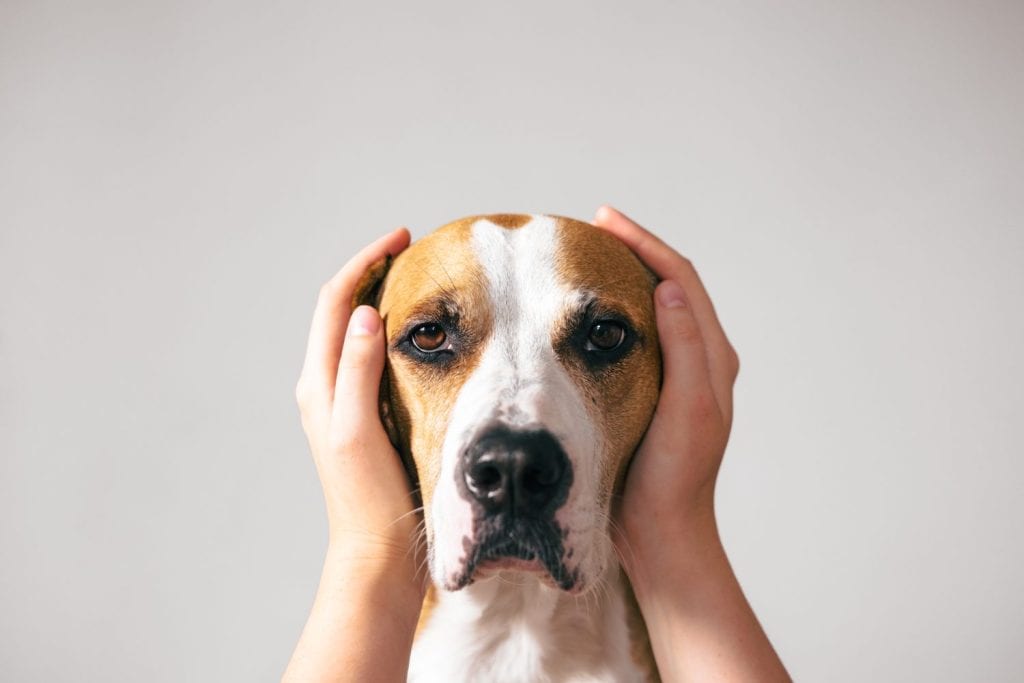
Fear, stress, and phobias are all different things.
©Aleksey Boyko/Shutterstock.com
I had to start by getting my head around the terminology in the scientific literature, which is not easy! The terms ‘fear’, ‘anxiety’, and ‘phobia’ are often used interchangeably in connection with canine response to fireworks. That is misleading because they mean very different things.
I found out that both fear and anxiety are emotional responses to a stimulus that the dog does not like. Their purpose is to make sure that the dog avoids a perceived threat. They are both subjective states, and the dog cannot tell you how it feels. So, researchers use behaviors and physiological responses to gauge how fearful or anxious a dog is.
A fear response can be defined as behaviors shown by the dog toward an actual or perceived danger. Anxiety, however, is an emotional state that the dog enters when it encounters a situation where there could be a threat.
In humans, the term phobia is used when the behavioral response to the threat is extreme, long-lasting, or triggered by a low-level stimulus. For example, people with arachnophobia are terrified if they see a spider across the room. However, the parallels with human phobias break down here because human phobias tend to be irrational. In the arachnophobia example, the spider is highly unlikely to hurt the person. In the case of a dog reacting to fireworks, however, the noise is loud, unexpected, and unpredictable. It is a perfectly rational fight-or-flight response for the dog to be scared. Don’t forget that a dog’s hearing is much better than ours, and they can hear things around four times further away.
Dogs Responding to Fireworks
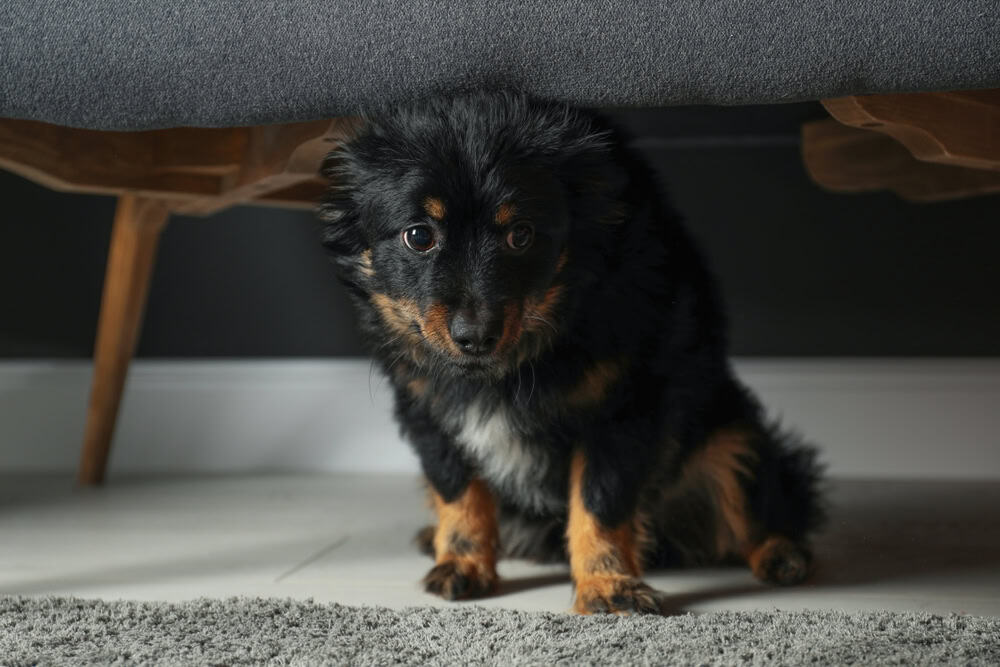
Scared dogs often hide away.
©New Africa/Shutterstock.com
As soon as fireworks start going off, Wilbur exhibits behavioral changes that show that he is fearful. When I looked up the potential responses in dogs to loud noises, he ticked a lot of boxes! Here are the most common, with Wilbur’s response in brackets.
- Soliciting human attention (Wilbur climbs onto my lap and presses against me)
- Hiding (Wilbur goes and hides in the wardrobe or under chairs)
- Trembling and shaking (Wilbur violently shakes)
- Salivating
- Panting (Wilbur pants through the firework display)
- Pacing and restlessness (Wilbur can find it impossible to settle)
- Pooping and peeing inside
- Escaping confinement (Wilbur hasn’t done this yet, but my social media feeds are full of posts after firework displays about missing dogs who have bolted from gardens)
- Loss of appetite
- Barking, howling, and whining
- Whale eyes and flattened ears
Although I have not measured Wilbur’s cortisol levels, studies have shown that dogs exhibiting behavioral responses to loud noises have elevated cortisol levels.
I had hoped that Wilbur would recover quickly once the fireworks had stopped, but that has not been my experience. He is still fearful of going out in the garden a month after the last fireworks were set off in my neighborhood. Again, my research has indicated that we are not alone in this. Recent studies have shown that around 12 percent of fearful dogs require 3–7 days to recover behaviorally, and about 3 percent take weeks or even months.
How Common Is a Fear Response to Fireworks?
I have friends whose dogs are not scared of fireworks, so I was interested to know if Wilbur was in the minority. I don’t think he is.
Researchers from the School of Veterinary Sciences at the University of Bristol in the UK surveyed 3,897 dog owners to try to find out the characteristics of dogs that were fearful of loud noises. Overall, 1 in 4 dogs were classified by their owners as being afraid of loud noises. However, when asked if their dog had “ever shown any fearfulness” to fireworks, 83 percent said their dogs had.
There is plenty of research linking adverse experiences with fear behavior in dogs. Dogs develop their fear response after 12 weeks of age. If they encounter something new after this that frightens them, they may well be scared of it for the rest of their lives.
Which Dogs Are the Most Scared?
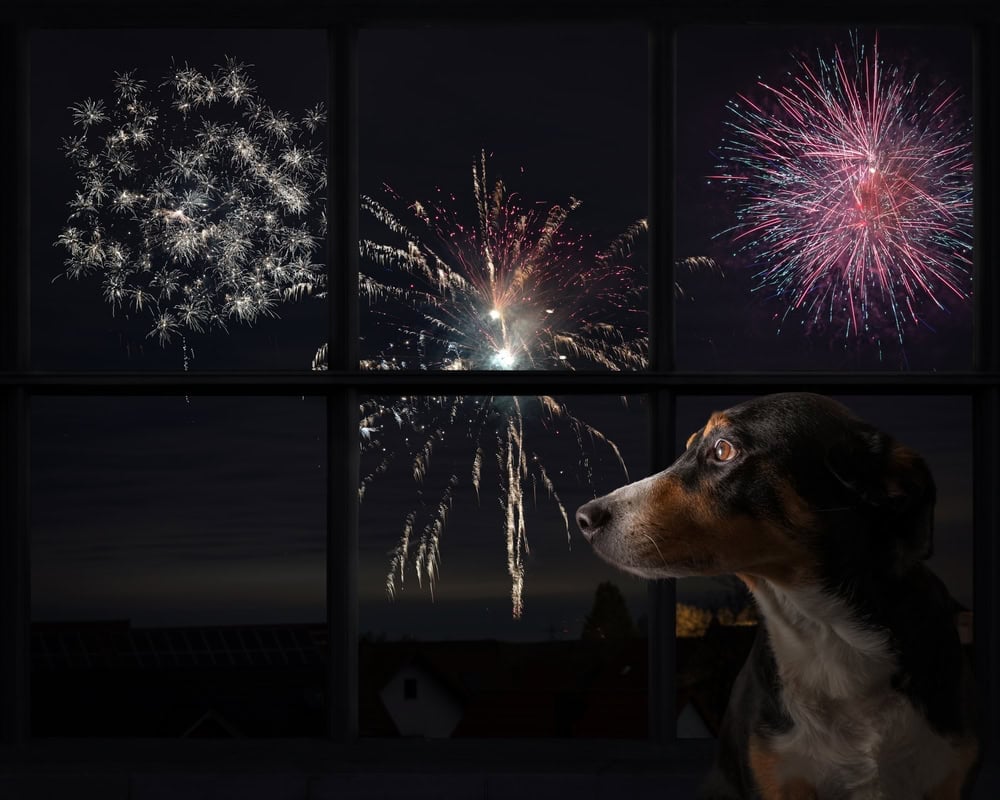
Gun dogs are less likely to be scared of fireworks.
©Vince Scherer/Shutterstock.com
Recent studies indicate that the average age at which dogs start displaying fearful behaviors is around 2.5 years, and the mean age of fearful dogs in large samples is about 4.8 years. This could be explained by older dogs being more likely to be in pain and, therefore, more sensitive to negative stimuli. Also, older dogs are not so good at detecting higher frequency sounds, and it is these that help them to determine direction. I can understand that a series of loud bangs is even scarier if you can’t figure out where they are coming from! One study has found that female dogs were more fearful than males.
It also makes sense that many of the gundog breeds are less likely to exhibit this behavior. After all, what is the point of having a gun dog that hates loud bangs? This would explain why Labrador retrievers, cocker spaniels, and springer spaniels are so unbothered. Other tolerant breeds are German and Belgian shepherds, poodles, and Siberian huskies. You will notice that there are no terriers on that list!
Stress Genetics and Temperamental Fear
A dog’s reaction to fireworks cannot be explained by past experiences alone. Temperament is likely to play a role too. This is a hardwired trait controlled by both genetics and early development – in other words, by epigenetics. Your dog’s temperament could predispose them to stress, anxiety, and fear. We know that if mother dogs have high levels of the stress hormone, cortisol, during pregnancy, it can adversely affect the pup. Also, we know that dogs that produce a lot of cortisol in response to loud noises are more likely to exhibit fearful behaviors. Others reach a state called ‘vital exhaustion,’ in which they experience constant anxiety and their internal stress mechanisms no longer respond.
What Can Be Done to Help?
The research that I have found clearly indicates that the best cure for firework fear is to prevent it from happening in the first place. However, it’s much too late for that in my case.
At-home counterconditioning has helped many dogs. As soon as the fireworks start, dish out the treats and act positively. One study found that this was successful in 70 percent of dogs. Combining this with desensitization (using recordings of firework noise to get the dog used to it) has proved successful for many dogs.
Interestingly, some dogs have become fearful of fireworks because their owners’ responses reinforced that fear. Even if your dog does not appear scared, start tossing treats around and act happy! You will not reinforce fear by doing this, because fear is an emotion, not a behavior.
A Combination of Remedies
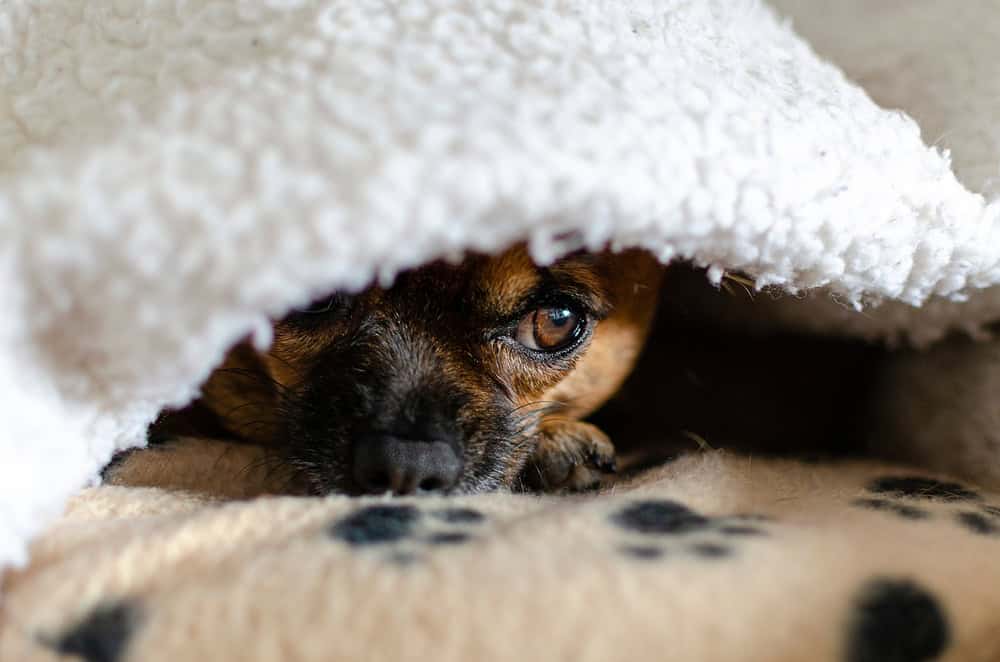
Dogs like to have a safe place to hide.
©Mlle Sonyah/Shutterstock.com
A tool called the Lincoln Sound Sensitivity Scale for dogs can be used to assess your dog’s reactivity to noise. It will help you accurately determine your individual dog’s fear level, which will help your vet select the most appropriate treatment.
There are so many potential options that it can be overwhelming; you may have to proceed on a trial-and-error basis. Here are some options:
- Environmental modification: close blinds, play loud music, provide a safe hiding place (I covered Wilbur’s crate with blankets, and he found that comforting).
- Feed and play: provide chews and treats, especially when bangs are loud.
- Interaction: body contact, talking, petting.
- Medication: This is something that you can discuss with your vet, but anti-anxiety medication is available for dogs.
- Others: calming nutrachemicals, pheromones, herbal products, pressure vests, relaxation training
In summary, my research has made me feel less despondent about Wilbur’s behavior. He is displaying a perfectly normal biological response to a stressful stimulus. Many other dogs behave in the same way, and it is not caused by anything that I have done. However, it is my responsibility to help him find something that makes him feel better. I’m currently doing this on a trial-and-error basis, but I think I may soon need to talk to my vet to get some further advice. I hope that Wilbur knows that now I’ve seen the misery fireworks can cause, I don’t like them anymore either!