Quick Take
- American beavers (Castor canadensis) mate in midwinter, when other mammals are dormant.
- Their adaptations for cold tolerance and construction of shelter sustain them at below-freezing temperatures.
- Observations of mating beavers are scarce, but suggest they court and mate at night, in the water, and multiple times per mating season.
- Beaver offspring are raised by the parents, plus siblings from the prior year, making reproduction an extended family affair.
While other animals are hibernating or hunkering down for the winter, beavers are spending intimate time in mating and reproduction. They mate in midwinter, when temperatures are at their coolest, after which a pregnant female gestates for about 100 days, according to the Maryland Department of Wildlife. Her offspring are nursed for at least two weeks and as long as 12 weeks. The young beavers, therefore, emerge from their dens for the first time just as the spring vegetation is coming back to life. Mating beavers have rarely been observed because much of the courtship and mating occurs underwater.
“I would say that we do tend to get more photos of beavers in the winter (i.e., during the mating season) than at other times of year. None of our photos features more than one beaver at a time, so there is no obvious sign of mating. It isn’t so surprising, since from what I understand, they usually mate at night and in the water, so not so easy to observe,” says Kurt Moser, President of the Four Mile Run Conservancy in Virginia, which is home to a population of beavers.
At other sites, observers have seen the male beaver repeatedly swimming around until he settles next to a female and feeds with her. After their snack, they embark on a long surface swim, with the male following the female, his nose close to her back. A 2025 study of Eurasian beavers (cousins to American beavers) published in microPublication Biology found that most mating occurred at night and involved repeat sessions of aquatic pursuit and copulation.
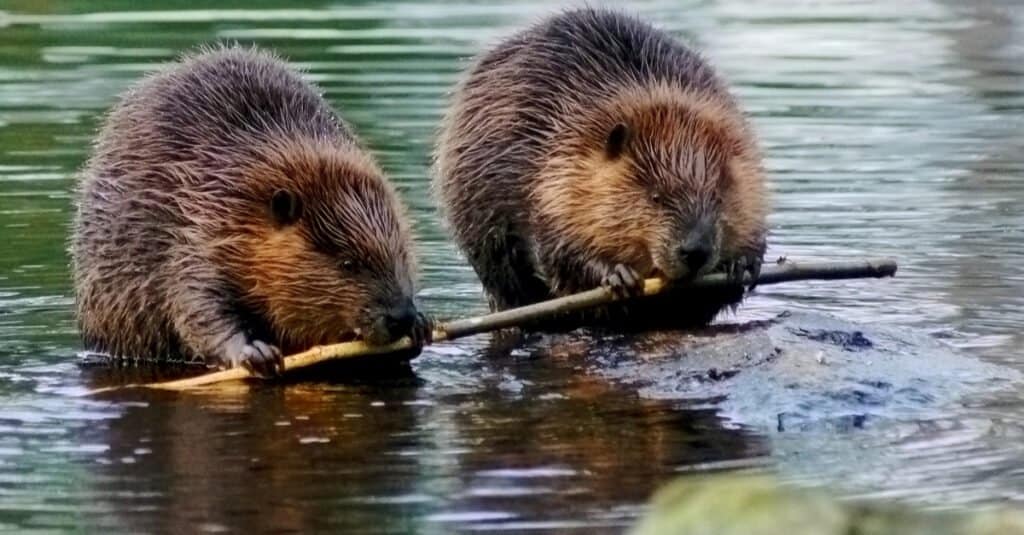
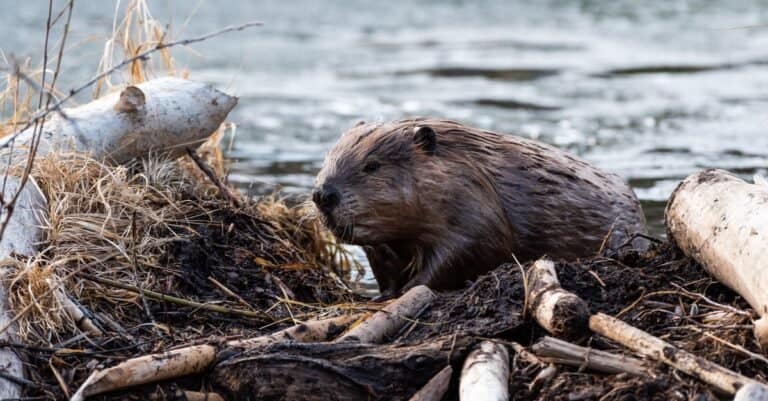
Beavers may share a meal before they court and mate.
©P Harstela/Shutterstock.com
You might think that such vigorous activity during the winter would deplete the couple’s fat reserves at a time when food is scarce. The streamside vegetation they favor dries up, and they can’t get the same nutrition from evergreen trees such as pines. However, beavers spend the fall preparing for winter by storing food in the muddy bottoms of their dens, where it remains preserved in the cold. The Western Beavers Cooperative reports that a single beaver requires 900 to 2,200 pounds of food annually, which must include a sufficient winter supply of stored food.
“This year, we did notice a dramatic change in activity in late summer and fall, a little after the time when beaver kits are typically born. The Four Mile Run beavers started to take down much larger trees than they had previously, and it leaves me wondering whether the family had grown,” adds Moser.
Therefore, if a beaver couple has been industrious in the fall, they are unlikely to suffer from winter starvation, as their den is stocked with branches from edible trees such as willows, alders, and cottonwoods. As early as a 1970 study in the Journal of Mammalogy, biologists also figured out that beavers store fat in their tails, which provides a source of calories in the absence of food. The oval tails of well-fed beavers appear swollen, while those of lean beavers look shrunken, suggesting the tail plays a role in fat storage and balance. The study results showed tail fat increasing by as much as sixfold during the winter.
I would say that we do tend to get more photos of beavers in the winter (i.e., during the mating season) than at other times of year.
Kurt Moser, President of the Four Mile Run Conservancy in Virginia
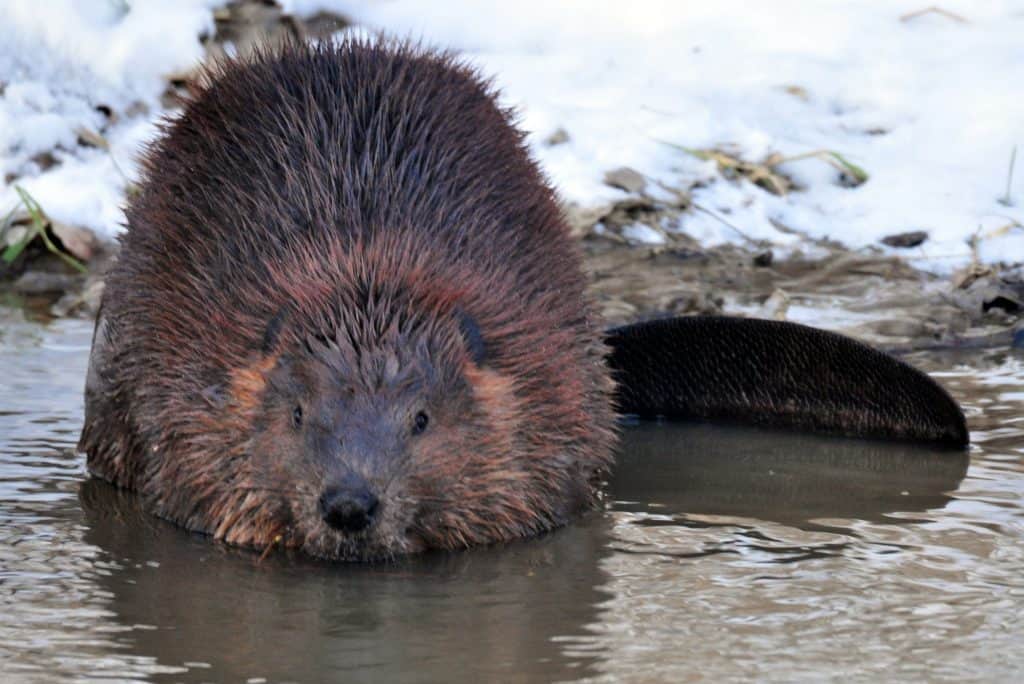
This beaver in Acadia National Park, Maine, appears to be using its fat tail to move mud.
Beavers are believed to be monogamous, often keeping the same mate throughout the breeding season, and sometimes for life. A 1989 study in Canadian Science Publishing studied the pair-bonding behavior of a population of beavers in Ohio. Desertion by one member of the pair was responsible for only 4% of the changes in mates. Otherwise, beavers changed mates either because the male died (39%) or the female died (61%). Thus, the primary reason for beavers changing mates was the death of one partner. New pairs formed when a beaver had lost a mate or never had one, such that most new pairs included a young beaver just entering the mating pool.
But how do courting beavers manage to withstand the cold and remain amorous? They are equipped with unusual cold tolerance. A 1989 study in Canadian Science Publishing recorded the metabolic rates and body temperatures of young and adult beavers during the winter in southeastern Manitoba, Canada. Newborn beavers were vulnerable to metabolic stress at temperatures below about 75 °F, but by 11–13 weeks of age, they could tolerate freezing temperatures. Even when air temperatures dropped as low as -4 °F, beavers at least a year old showed no signs of hypothermia or metabolic slowing. Therefore, adult beavers have the cold tolerance needed for a wintertime romance.
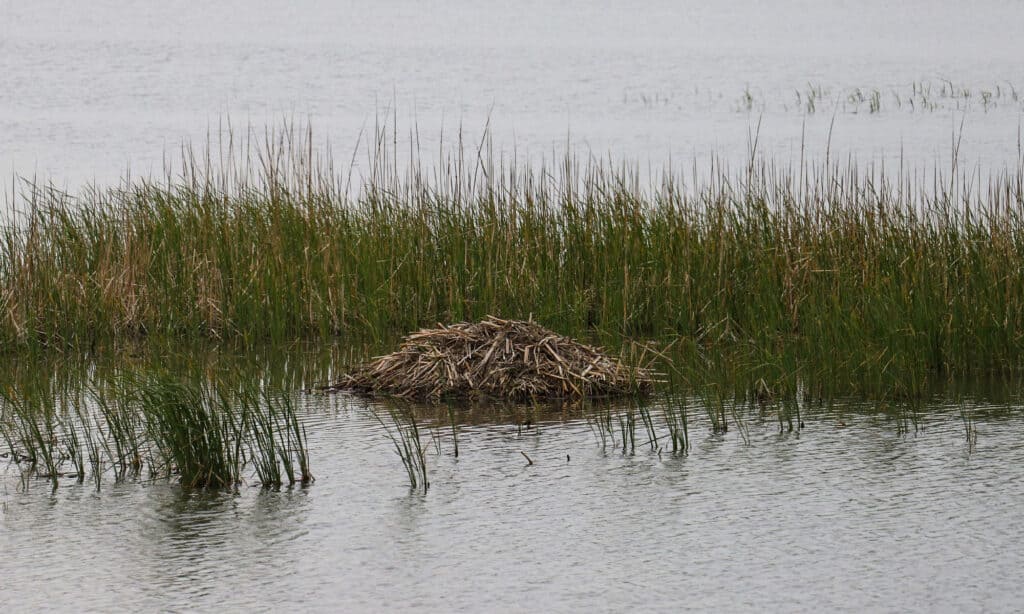
A beaver lodge provides a warm, safe refuge for an extended beaver family.
©iStock.com/Nancy Strohm
Additionally, when temperatures become too bitter for outdoor activity, beavers can retreat to the relative warmth of their lodges. The wood and mud construction, combined with the sharing of body heat among family members, creates a cozy refuge. A 1993 study in the Journal of Mammalogy found, “The construction and occupation of lodges by family groups of beavers provided these animals with year-round access to a thermoneutral microclimate.” While outdoor temperatures ranged widely over the year from -45 to 90°F, temperatures inside lodges stayed within a narrower range of 32°F to 96°F, never dipping below freezing.
Oxygen availability in beaver lodges remains at acceptable levels, too. A beaver lodge is a specialized feat of engineering, featuring a feeding area, a resting area, a continual source of fresh air, and two underwater entrance tunnels that help prevent beavers from being trapped inside by predators. Each lodge is occupied by a family group consisting of the breeding pair, their new kits, and offspring from the previous year (“yearlings”), who help care for the babies. By this time, two-year-old subadults have often dispersed from their families, although some may remain but do not breed.
“As of last summer, there were at least four, two full-grown adults and two younger ones [at Four Mile Run]”, adds Moser.
Overall, beaver reproduction is an extended family affair. Once a kit reaches about two years old, it heads off to establish its own colony. By the age of three, if not sooner, it seeks a lifelong mate and experiences its own winter mating season. Considered among the small minority—estimated at 3% to 9%—of mammals that are socially monogamous, beavers set an example for romantic partnerships.