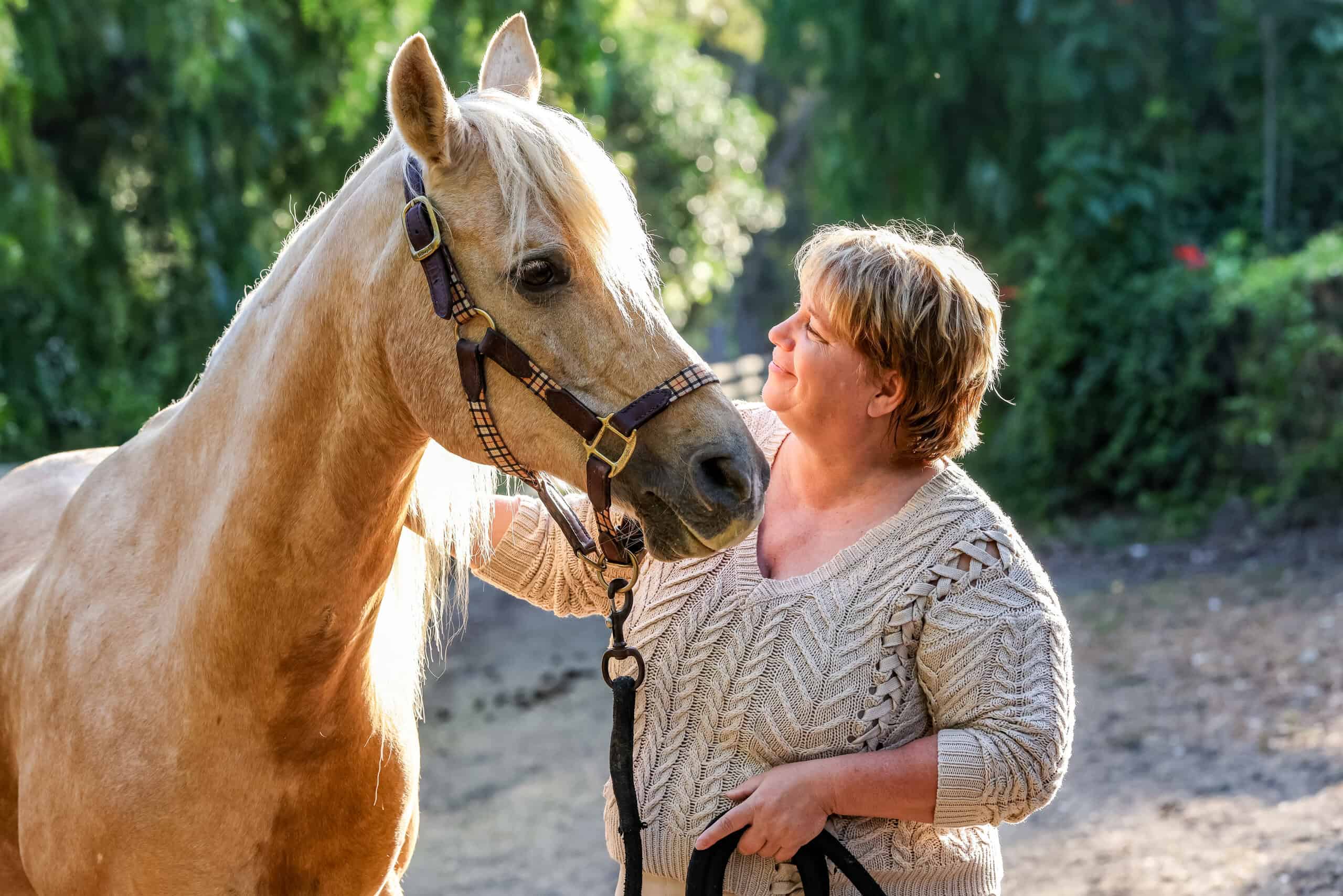

If your horse has ever had a mystery ailment that no X-ray, injection, or saddle swap could solve, meet Dr. Renee Tucker.
A licensed veterinarian with degrees in both veterinary medicine and bioengineering, Dr. Tucker spent her early years in practice with one persistent question: Why isn’t this working? Despite all the tools of traditional veterinary medicine at her disposal, she kept running into horses whose issues wouldn’t budge. It was like trying to solve a jigsaw puzzle with half the pieces missing.
That curiosity led her to become a chiropractor and later to create the Tucker BioKinetic Technique (TBT), a unique form of energy work that digs past the symptoms to find the real root cause. Today, Dr. Tucker travels the globe teaching this technique, helping owners, practitioners, and self-described skeptics unlock deeper healing for their animals — and asking a radical question along the way: What if the answer isn’t more tests or treatments, but listening differently?

Meet Chiropractor, veterinarian, and energy healer, Dr. Renee Tucker of Tucker BioKinectic.
©Tucker BioKinetic – Original
First, what inspired you to start your career in equine chiropractic?
I’ve been a veterinarian for 30 years. I graduated from the University of Tennessee in ‘95, and I got frustrated within a couple of years with what I could actually do. If you go to vet school, you should know everything to help horses, right? Not really, unfortunately. Veterinary medicine has plenty of good stuff, but there are other things that just don’t work that well. We can manage a lot of symptoms, but I didn’t know anything about saddle fit or alignment. So, I got interested because I was reaching a limit of what I could diagnose. And I like to fix everything.
At the same time, a lot of people were asking me what I thought of chiropractic work and who I would recommend. Finally, my brain put those things together.
Chiropractic is still fine; I don’t have anything against it. But I’d been doing it for two or three years and had horses with identical symptoms — chiropractic would fix one of them perfectly and forever, and only sort of help the other one. If you have real deep-seated patterns that keep coming back, those are coming from something else. So, I got it in my brain that I need to fight that root cause. Fixing the symptoms was a Band-Aid.
I kept taking random classes and ran into a type of energy work for people. There were no classes for animals at that time, at least anywhere that I found. And the energy work for people was interesting, but it didn’t quite work for the horses. I just kept learning more, and eventually found my energy technique.
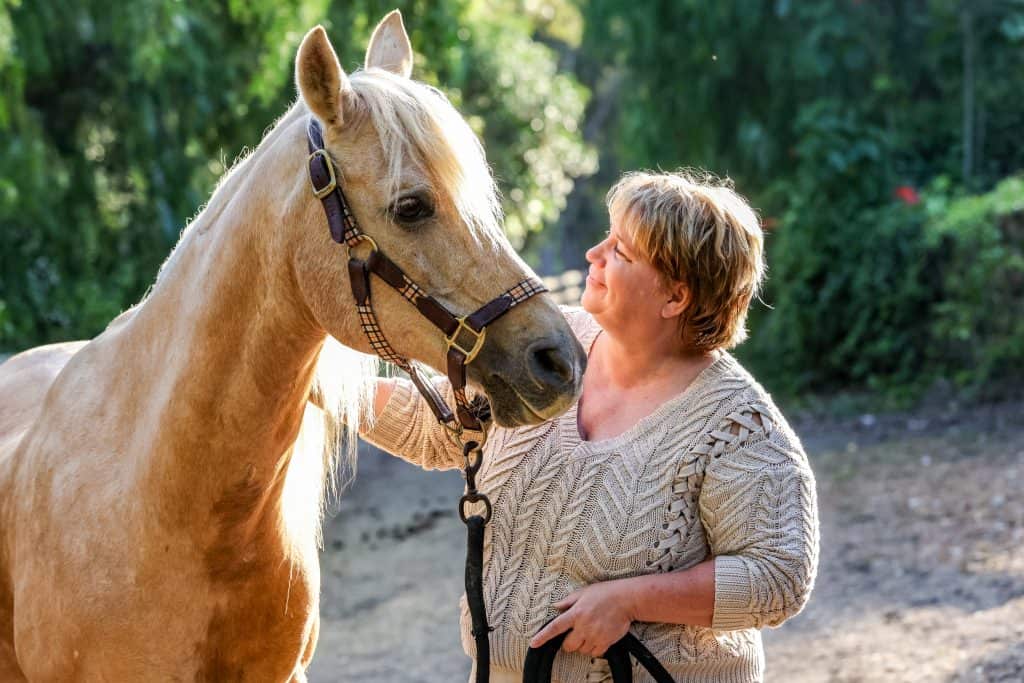
“I learned that chiropractic is just quackery,” says Dr. Tucker. “What I heard in vet school was, ‘Don’t let anybody touch your horse — not a chiropractor; there’s no science behind that.’ And in fact, there are gobs of scientific studies on chiropractic.”
©Tucker BioKinetic – Original
For those who are unfamiliar, how would you explain the difference between traditional chiropractic work and the energy work you’re practicing now?
Chiropractic is physical. It’s a really fast physical thrust. And when I say “thrust,” that sounds like this huge movement. It’s actually only a quarter inch in depth, but it’s really fast. That kind of stimulates the bone you’re working on to say, “Hey, wake up. You’re not in alignment!”
Oftentimes, it can help realign it. It stimulates the immune system and the nervous system to say, “Work right here.” So, if the bone is the primary problem, chiropractic is perfect. But if the bone is not the primary root cause, chiropractic might help a little, and then the problem will often come right back.
With energy work, we find the primary problem first, and then we fix that. That could be bones, tendons, or ligaments. It could be arteries or veins. The body won’t stretch out the leg if the artery is hurt. It doesn’t matter how much massage, chiropractic, or acupuncture work you do. So, we go through — using my TB technique — to find what it is.
What does a typical session look like when you’re working with a horse energetically? Is it hands-on or is it a non-physical approach?
Most of the ones I do are hands-on. People can do distance work, or hands-off; it varies from person to person.
You’ve said that energy work can resolve many issues that chiropractic can’t. Can you tell us about that?
Early on, it was fairly common that I would see a horse for chiropractic, and people would say, “My horses need their atlas adjusted every month, or they can’t do their canter or loping correctly.” The atlas is the first bone of the horse’s neck, so if it’s crooked, then their head is a bit crooked. Then they have difficulty getting into a canter, because they have to turn their head.
So, they would tell me it had to be adjusted every month, or he couldn’t do the left canter. I’m like, “Every month?” These are the little things that bug me! In doing energy work, I would find a ligament that was too tight and consistently pulling the atlas out. I would resolve the issue with the ligament, and then the atlas wouldn’t need to be reset every month because I fixed the underlying primary cause.
What I heard in vet school was, ‘Don’t let anybody touch your horse — not a chiropractor; there’s no science behind that.’ And in fact, there are gobs of scientific studies on chiropractic.
Dr. Renee Tucker, veterinarian, chiropractor, and energy healer
Are there any cool energy work stories you can tell us about?
There are plenty! I saw a 4-year-old quarter horse mare. They had me out because she was having an issue with her neck. As this horse was walking towards me, I was watching her right front leg, and it winged in and out. I thought, “What is happening here? I thought they called me for the neck.”
So I asked, “What’s up with her leg?” And they’re like, “Oh, she’s always done that.” She was 4, so they figured she was young, had always done that, and that’s just her. But anything asymmetrical is not “just the horse.”
I always do physical checkups to see the movement of the shoulders and the whole body, so I can feel the before and after. With energy work, I was able to figure out why the sternum was crooked. I did that energy work, and as I finished, the horse walked off — perfectly straight.
Skepticism around energy healing is still common. How do you address that?
I totally get that, because I was such a skeptic! I thought they were all wacko crazy people. I think we make plans and then God laughs at us. I thought, That’s ridiculous. You can’t possibly do that. And here I am doing it. So, I get it. I’m open to any questions. I understand the skepticism.
It’s like acupuncture. I’m using the energy from the acupuncture points with one hand, and with the other hand, I’m coaxing these bones to where they should go. That’s a very simple explanation, but it’s good to have a connection between something you’re familiar with and what I’m doing. Over time, nobody cares. They’re like, “I don’t know what you do, but just fix my horse.” They call me the Voodoo Lady and the Magic Hand Lady. But generally, what happens is that people can’t fix their horse, and they call energy people.
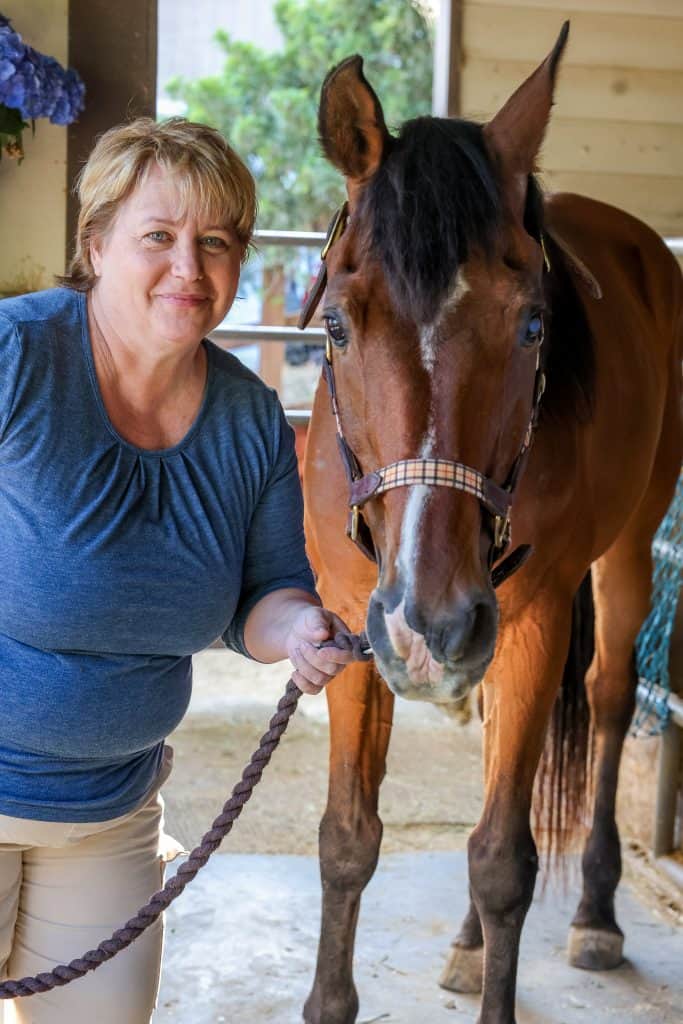
“As with any alternative modality, you want to go with your gut,” says Dr. Tucker. “I recommend people go, if possible, to watch the person work. You’re not necessarily going to understand what they’re doing and if they’re doing it right, but you can watch the horse. If the horse is relaxed and having a good time, it’s not hurting anything. Use your gut and watch your horse.”
©Tucker BioKinetic – Original
How do horses typically respond during a session?
When you connect with them energetically, they zone out. They relax, lower their head , and put their ears half-mast like they’re listening internally. Sometimes they’ll turn around and look at me, like, “What are you doing?” They lick and chew; they might fart. Sometimes, when you get to a certain point, they’ll do a lovely stretch — even downward dog. Things you wouldn’t expect. But they’re totally relaxed and into it, as opposed to people.
Do you extend your help to animals beyond horses?
I mostly do horses, but I have done other animals as well — dogs, cats, birds, whatever. The animals are all completely receptive.
Do you see a lot of emotional trauma in horses as a root cause of physical issues? How often does the problem go deeper than what’s visible to the eye?
Coming from vet school (which was my box for so long), thinking that emotion could cause a physical problem was beyond my understanding. And then I found out that if you go through massage school, they tell you that people might start crying or laughing during a massage, because sometimes emotional energy is stored in the body. So yes, I do see emotions.
As an example, I have a case report from a student. This family had had their horse for over a year. The daughter, an 8- or 9-year-old girl, just really wanted to love on this horse. And this horse was just standoffish and not interested in people — not mean, but emotionally withdrawn. My student worked on this horse one time and removed that extra emotional energy. It’s stuff the body could not process at the time. She did that, and the horse started nuzzling the girl, which she had never done. She wanted to cry — the horse was finally loving on her after she’d been trying for a year. It was beautiful.
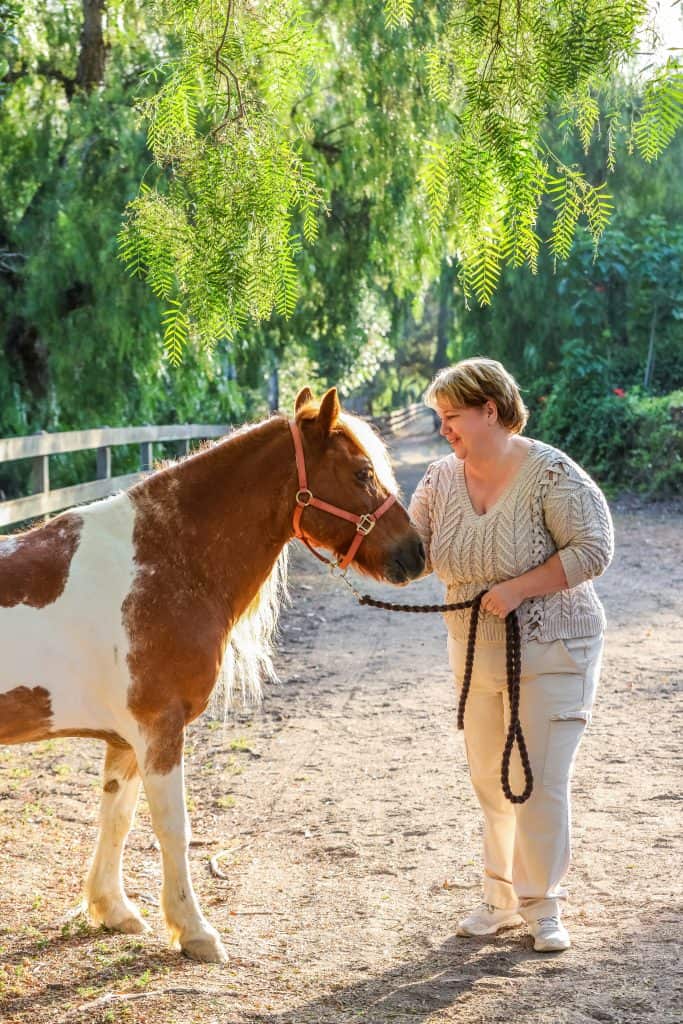
“It’s easier to work on animals than humans; they just seem to get it,” Dr. Tucker tells us. “Maybe they can just feel the intention is to help.”
©Tucker BioKinetic – Original
What advice would you give someone who’s just beginning to explore non-traditional modalities of healing for their animals?
I guess it kind of depends on what the issue is. If they have a sore back, you probably want to check your saddle fit.
If you take my course, my prerequisite course is What Does My Horse Want? It’s a very basic energy course on how to ask yes and no questions of your horse — super basic. Some people will jive with it, and other people won’t. But if you can just learn that, you can get into your energy field and ask yes and no questions. And I teach you the right way to ask questions. It’s not animal communication; it’s an energy-positive or -negative response. I’m not against animal communication. That just isn’t what this is. We’re not reading their minds; it’s an energy thing.
Learn more about Tucker BioKinetic on Dr. Tucker’s website, tuckerbiokinetic.com.