
Quick Take
- Island ecosystems such as that on the Mexican island of Cozumel are rich in biodiversity and vulnerable to ecological threats.
- In 2016, a non-native ocelot was captured on a camera trap; the animal was probably released by humans.
- If a breeding population is established, it would present a threat to vulnerable species such as the Cozumel raccoon.
- This presents a conservation dilemma because the ocelot is an endangered species in Mexico.
The arrival of an endangered species in a new territory would usually be a cause for celebration. It may indicate that the animal’s population numbers are increasing and that they are expanding into new areas. When an ocelot turned up on the Mexican island of Cozumel, however, conservation experts were concerned. Keep reading to learn why this is not the good news that it first appears to be.
What Do We Know About Ocelot Conservation?
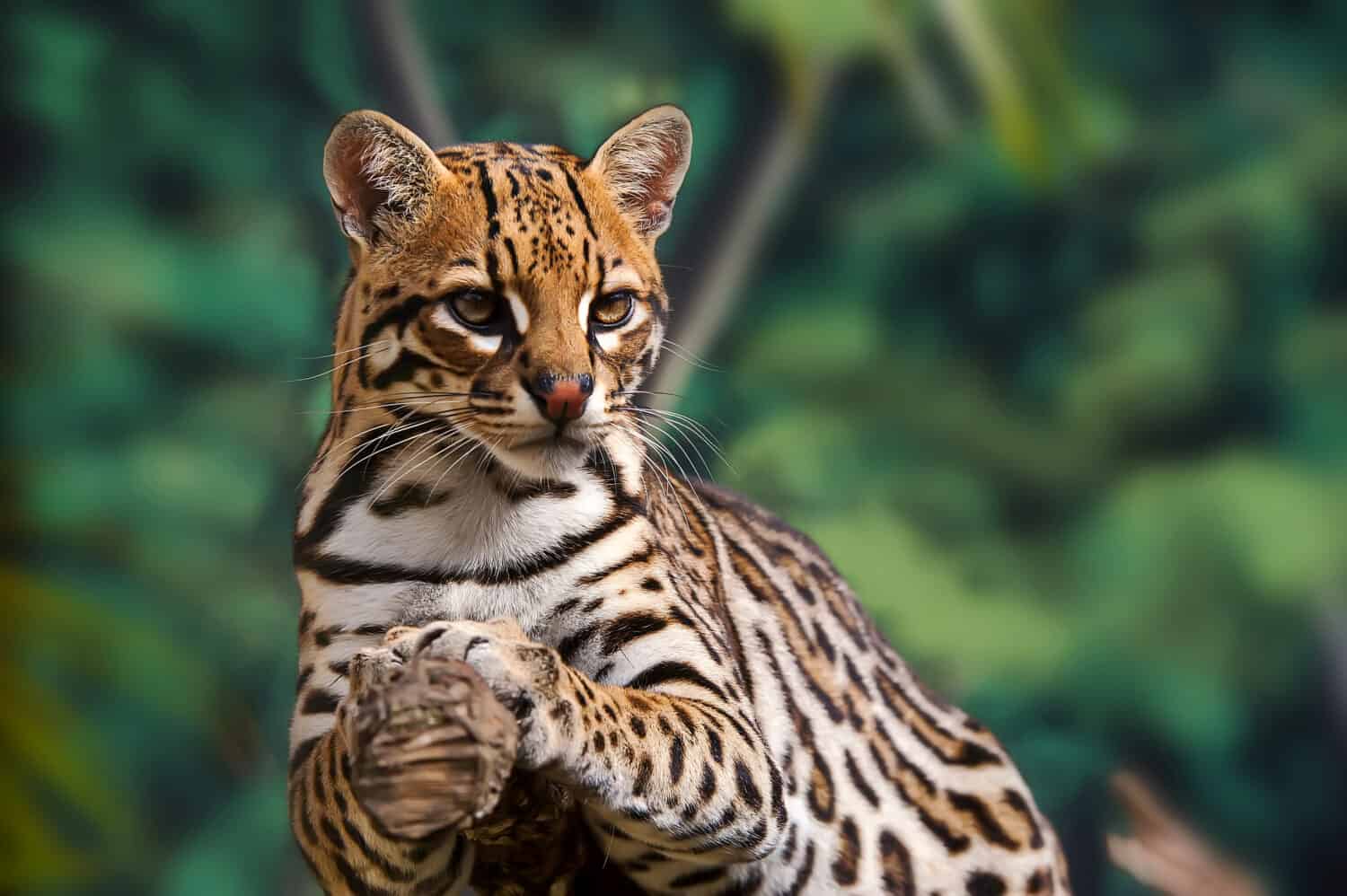
Ocelots are the largest members of the genus Leopardus, weighing between 18 and 35 pounds. Their coat (pelage) varies with habitat but has dark streaks, blotches, or rosettes arranged in small clusters around dark-colored areas that tend to run in parallel, horizontal chains.
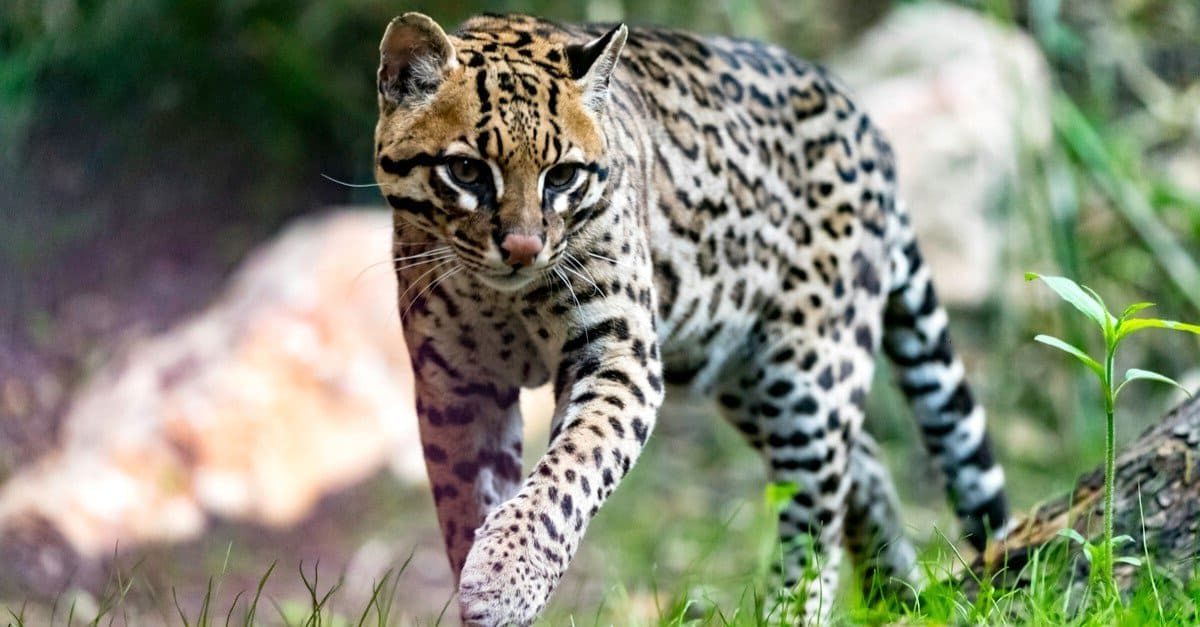
The ocelot is an excellent swimmer, climber, and runner, making it an almost perfect predator.
©Saad315/Shutterstock.com
These cats can be found from the southern United States (Texas, Arizona) to northern Argentina. Their conservation status, however, is complicated. In 2014, they were designated as of Least Concern by IUCN, but the population was noted to be declining. The threats to its populations included residential and commercial development, agriculture, and transportation.
At the same time, ocelots have been listed as Endangered under the U.S. Endangered Species Act since 1982, and a review carried out in 2025 recommended that no change was needed to the classification. In Mexico, ocelots are also federally listed as Endangered, where populations have become fragmented. These beautiful felines still face a high degree of threat from habitat loss, fragmentation, and vehicle collisions.
What Is So Special About Cozumel Ecology?
Islands are known for having species not found anywhere else (endemism). They are also hotspots of biodiversity related to increased ecological opportunity.
The island of Cozumel lies approximately 10.8 miles off the Yucatan Peninsula on the southeast coast of Mexico. It has a diverse terrestrial ecosystem, particularly rich in reptile and amphibian species. The main habitats are medium semi-deciduous Yucatan Peninsula forest and mangroves. The island is also home to three species classed as Critically Endangered by the IUCN. These are the Cozumel raccoon (Procyon pygmaeus), Cozumel thrasher (Toxostoma guttatum), and Cozumel harvest mouse (Reithrodontomys spectabilis).

Cozumel has a rich biodiversity.
©Sean Pavone/Shutterstock.com
Cozumel raccoons, also known as pygmy raccoons, are found only on Cozumel. Morphometrics and molecular investigations show that they are a separate species from the Guadeloupe raccoon (Procyon lotor), which is their mainland counterpart. Cozumel raccoons are listed as Critically Endangered by the IUCN, with a decreasing population recorded at just 192 mature individuals in 2016. The threats they face include residential and commercial development, transportation, climate change, invasive and other problematic species, genes, and diseases.
In particular, IUCN highlights the boa constrictor snake as a primary threat, as well as feral and domestic dogs. There is also the danger of introduced carnivores spreading parasites and disease. Now, there is another potential threat to add to the list: the ocelot.
Finding an Ocelot on Cozumel
Scientists have carried out long-term wildlife sampling on Cozumel since 1994. This has involved several methods, including camera traps, line transect sampling, road sampling, and extensive fieldwork. When reviewing camera trap footage in 2016, scientists were shocked to spot an ocelot!
This was an alarming discovery because ocelots do not occur naturally on the island. They are efficient nighttime hunters with highly developed night vision and a keen sense of smell. They are also very adaptable to disturbance and will walk on manmade trails. Ocelots are both good swimmers and excellent climbers.
Ocelots are opportunistic and generalist carnivores who target small, medium, and large prey. The Critically Endangered Cozumel raccoons, Cozumel thrashers, and Cozumel harvest mice are all potential targets. The Cozumel white-footed mouse (Peromyscus leucopus cozumelae), Cozumel harvest mouse (Reithrodontomys spectabilis), Cozumel rice rat (Oryzomys couesi cozumelae), dwarf peccary (Dicotyles tajacu nanus), and Cozumel curassow (Crax rubra griscomi) are also potential targets.
No one knows exactly how the ocelot arrived on the island, but it was likely from human activities. Possibly, it escaped from captivity or was released. Only one has been detected so far, but if a breeding population were established, it would be very concerning.
The Complexities of Conservation Dilemmas
This episode serves as an example of how complex conservation can be. An endangered animal can itself become a danger to other species in certain habitats. Difficult decisions have to be made regarding which species to prioritize.

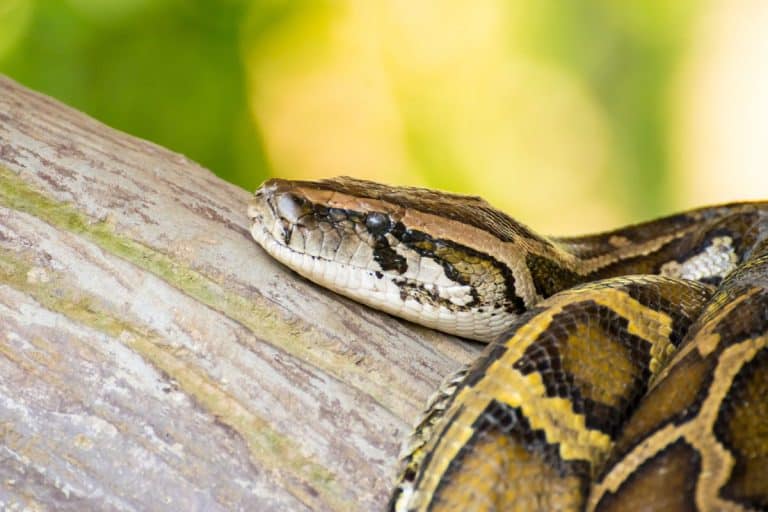
Boa constrictor is an invasive species on Cozumel.
©Alfredo Maiquez/Shutterstock.com
The animals that could be potentially hunted by the ocelot have no experience or natural defenses against such a predator. Ocelots, however, are not their only problem. Boa constrictors and potentially margays (Leopardus wiedii) have already established breeding populations here. There is evidence that a small number of boa constrictors were released on Cozumel around 50 years ago. While these snakes are classified as vulnerable in their native range, they have also been identified as a significant threat contributing to the decline of the Cozumel raccoon population, as well as the Cozumel harvest mouse and the Cozumel white-footed mouse, to name a few. Only time and further monitoring will tell if the ocelot also becomes a threat on the island of Cozumel.