
Quick Take
- Every leading theory explains part of why moths circle lights—but none tells the whole story. See the flawed theories →
- High-speed cameras filmed nocturnal insects around lights across three countries, and the flight patterns matched none of the existing scientific models. See the camera study →
- Nocturnal insects are missing a sensory system that even basic vertebrates have, and that absence is precisely why a single light bulb can doom them. Explore the missing sense →
- Fixing the mass disorientation of nocturnal insects by artificial light requires almost no effort. You just need to know which type of light is actually the problem. Find the simple fix →
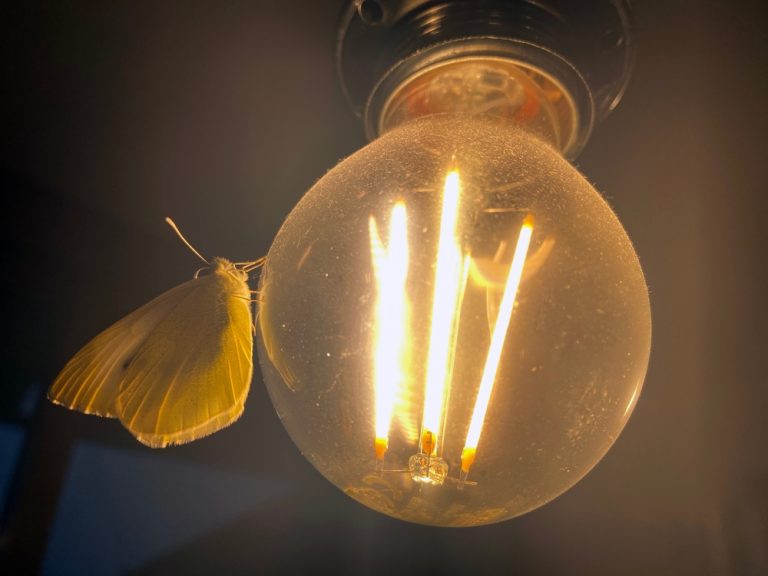
Like a moth to a flame. We have all seen it: their seemingly self-destructive attraction to light. Nothing seems to stop a moth or beetle from repeatedly flying into a light, often to their demise. But why? It’s easy to paint these bouts of fatal attraction as poetic or romantic, but it’s far more sobering to realize what happens when ancient adaptations face off against modern innovations.
Various explanations have been proposed for this behavior over the years, but not many of them stand up to testing. While some insects are attracted to fire, most nocturnal insects are equally attracted to cool lights. Another theory suggests that they are simply attracted to light in general, but this does not explain the common circling behavior. Another, more cosmic, theory suggests that insects use moonlight for navigation. However, this model does not explain why many nocturnal insects spiral inward toward lights until they collide. Suffice it to say, nocturnal insects’ attraction to light is more subtle and fascinating than it appears.
Transverse Orientation
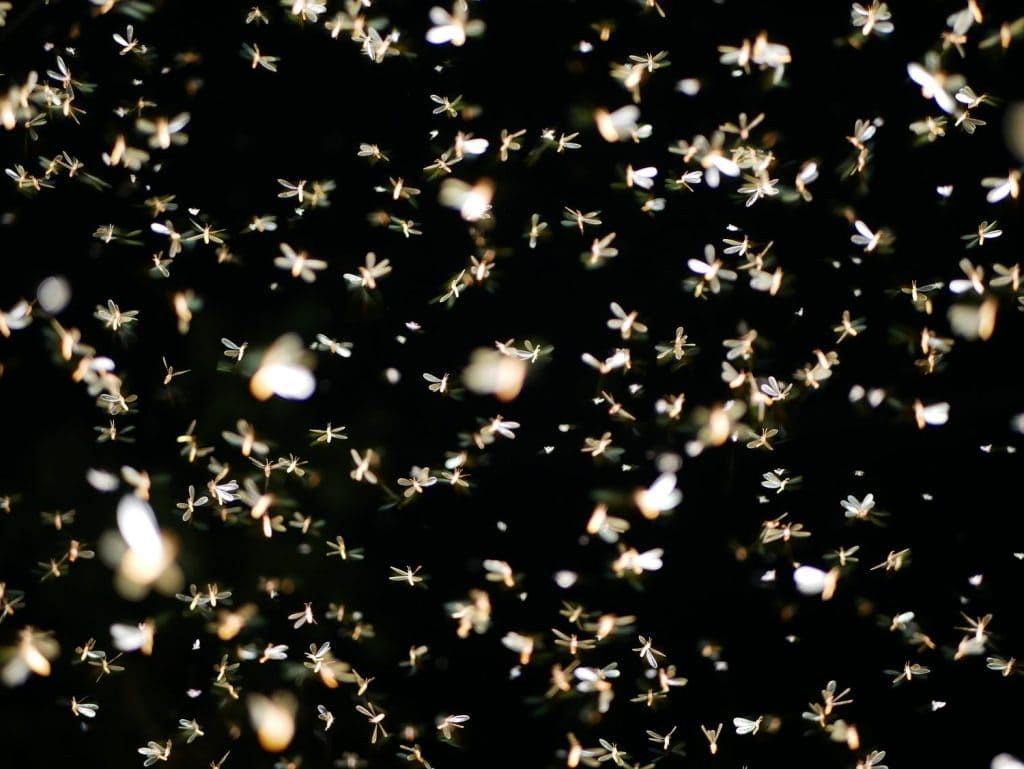
While models like celestial navigation and transverse orientation explain part of nocturnal insect attraction to light, they do not explain it completely.
©buddhawut/Shutterstock.com
There are theories for night insects’ attraction to lights called pyrophilia (attraction to fire) and phototaxis (attraction to light). While these theories offer simple explanations, they do not account for the strange movements nocturnal insects often display when approaching artificial lights. This is where transverse orientation comes into play.
Nocturnality implies activity in the dark, but it does not mean complete darkness. The moon and stars scatter light across the Earth’s surface in the form of countless parallel rays. Transverse orientation is the navigational response some nocturnal insects display when they encounter light. The moon or stars are typically in the upper part of an insect’s field of vision, allowing them to maintain a constant angle relative to these celestial light sources.
When artificial lights are introduced into the otherwise softly lit night sky, these ancient navigational calculations go haywire. The angle between nocturnal insects and artificial lights becomes considerably distorted. Furthermore, these lights are usually below the horizon line. When moths or beetles attempt to adjust their flight path toward the artificial light, they end up spiraling closer to it. However, transverse orientation is only part of the explanation.
New Findings
According to the mathematics of transverse orientation, nocturnal insects should keep spiraling into artificial lights until they collide. However, this does not occur in many of these creatures’ flight patterns. Scientists from Imperial College London, Florida International University, and the University of Florida set out to discover why.
A team of researchers set up high-speed video cameras to capture the movements of nocturnal insects around various light sources. They established a laboratory setup at Imperial College London and two field sites in Costa Rica. They found that flight patterns didn’t match existing models.
Instead, they found that most insects kept their backs oriented toward artificial lights. This behavior, known as the dorsal light response, normally helps insects stay oriented toward light from the sky, keeping them in a safe flight pattern. Artificial lights distort this process, causing nocturnal insects to loop around the light over and over.
Other nocturnal insects exhibited different behaviors. Some flew directly under an artificial light and arched upwards with their backs to the bulb, causing them to fly straight up, stall, and eventually fall. Some insects would instinctively flip upside down when flying over an artificial light, leading them to crash.
Why Artificial Lights Are So Disorienting
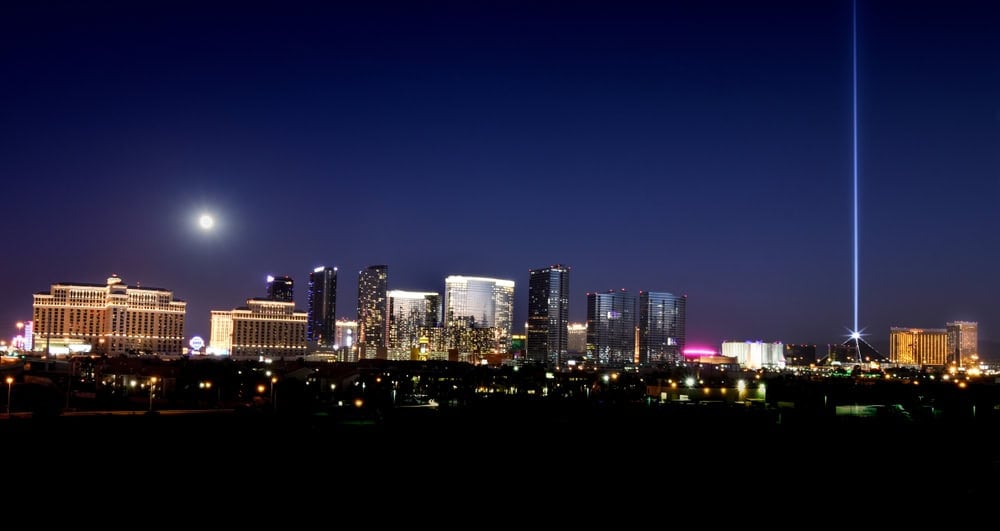
The more artificial lighting fills the streets, the more disastrous the effects on nocturnal insects.
©Jenelle Jacks/Shutterstock.com
Larger animals have sensory organs to detect gravity. Humans have the vestibular system of the inner ear to regulate balance and orient the body spatially. Nocturnal insects lack this luxury; instead, they have small sensory structures and must rely on the night sky for orientation.
Before the widespread use of artificial lighting, nocturnal insects could rely on the sky being brighter than the ground, which allowed them to maintain their orientation. However, artificial lights disrupt these ancient systems of balance and navigation, leading insects astray.
Safeguard Systems
Each year, more artificial lights illuminate the streets. The advent of inexpensive, broad-spectrum LEDs has accelerated this trend, making it so that developed areas rarely experience true darkness. This allows humans to enjoy activities later in the evening, but it spells disaster for nocturnal insects. Trapped by the lights, they are unable to find food, become more visible to predators, and often die before morning.
According to the researchers, fixing this problem is as simple as flipping a switch or converting harsh outdoor LEDs into targeted warm lights.