
Quick Take
- A recent study published in the scientific journal Ecology finds there is a new environmental habitat that exists in the Earth’s troposphere.
- Researchers dubbed it the “sky habitat.”
- Data provided by NEXRAD was the foundation for the study’s findings.
- Animal behavior in the sky habitat can be used to support future conservation efforts.
Look up at the sky—what do you see? During the day, it’s a vast expanse of blue with clouds drifting by. At night, it’s a blanket of stars. You might spot birds flying during daylight hours and bats darting across the starry backdrop after dark.
But is there more going on beyond what the naked eye can see? According to a new study published in the scientific journal Ecology, the answer is yes. Scientists and researchers from universities in the United States, Italy, and Canada, along with the Lincoln Park Zoo in Chicago, worked together to reveal that the sky above us is a vast habitat teeming with life. Funding for this study was provided by grants from the National Science Foundation, the Amon G. Carter Foundation, and NASA.
The team dubbed this new frontier the “sky habitat.” Their findings provide a new perspective on what’s happening above our heads, both day and night.
What Is the Sky Habitat?
The sky habitat is a term to describe the Earth’s lowest atmospheric layer, called the troposphere. The troposphere extends from the Earth’s surface up to between 7 and 12.5 miles, depending on latitude and season. It is where weather phenomena like clouds, rain, and storms form. The troposphere contains about 80 percent of the Earth’s total atmosphere and 99 percent of Earth’s total mass of water vapor.
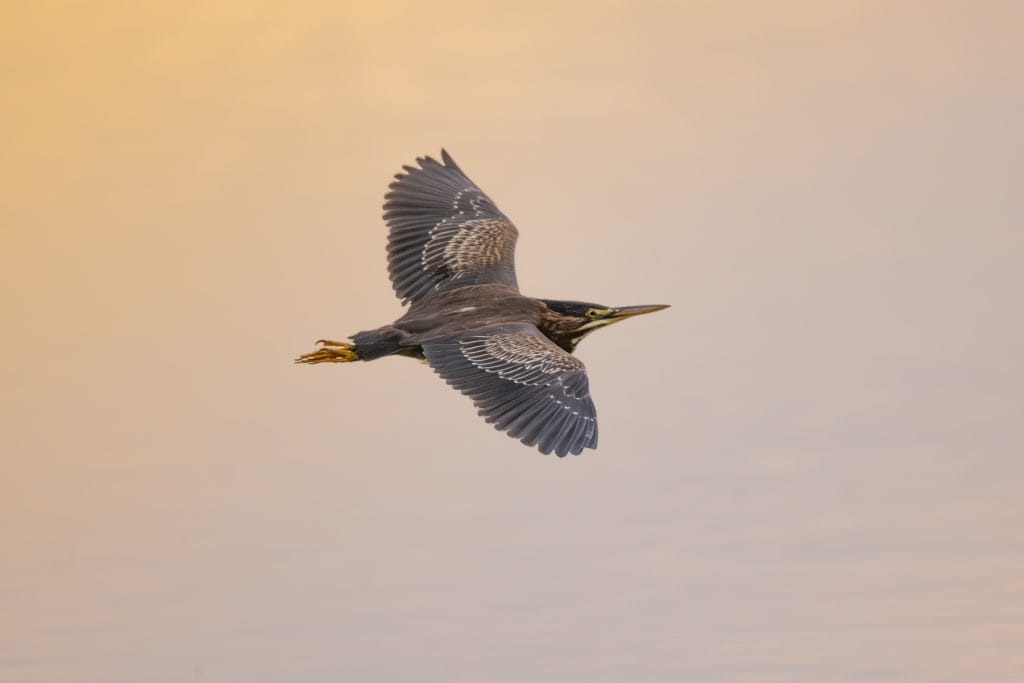
The green heron is among the many bird species that regularly traverse the sky during flight.
At its lowest altitudes, the troposphere is also home to a living, thriving community of birds, bats, and insects. This collection of species and their behavior patterns is the focus of the researchers’ scientific work.
How Did Researchers Study the Sky Habitat?
Kyle Horton, associate professor of forestry and natural resources at Purdue University, led the research and is a co-author of the article. His team relied on data collected by the National Oceanic and Atmospheric Administration’s weather surveillance radar network, the Next Generation Weather Radar (NEXRAD).
A series of 160 NEXRAD radar stations spans the United States and its territories, measuring rain and snowfall amounts while also collecting data on the birds, bats, and insects flying across the sky. Horton’s team analyzed more than 100 million radar observations collected by NEXRAD from 1995 to 2022. They then mapped daily cycles of aerial activity. This provided them with information about where and when the majority of this activity occurred.
NEXRAD radar stations provided the raw data for the study.
Researchers note that the radar scans provide a continental-scale view of how species use the airspace over a 24-hour period, a first for scientists studying aerial movement. Through the available data, the team was able to identify vertical layers where the majority of the activity occurs, compare the activity during the day versus night, and determine the most active flight patterns.
What Did Researchers Discover?
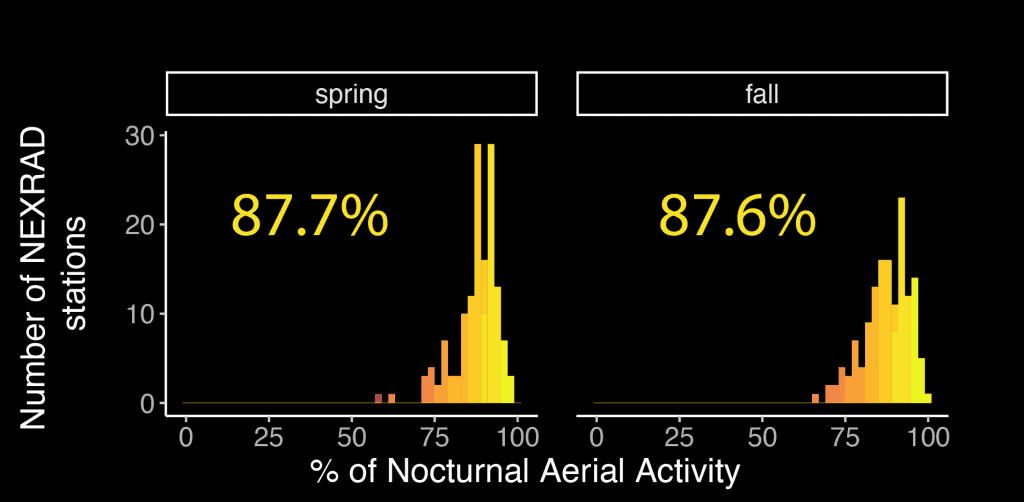
Horton’s team made some intriguing discoveries. One is the seasonality of tropospheric airspace use. Lead author Silvia Giuntini, a postdoctoral scholar in the Environment Analysis and Management Unit at Italy’s University of Insubria, says, “We found that airspace use is overwhelmingly nocturnal. In both spring and autumn, 88% of movement occurred at night, with summer showing a more even split at 54% nocturnal.”
The research team also discovered that there is a seasonal pattern to this use. During the spring and autumn, the peak use times tend to be four hours after local sunset. On average, half of all aerial movement was confined to a small portion of the troposphere—a narrow band just one-third of a mile wide, starting at around 1,000 feet above ground level.
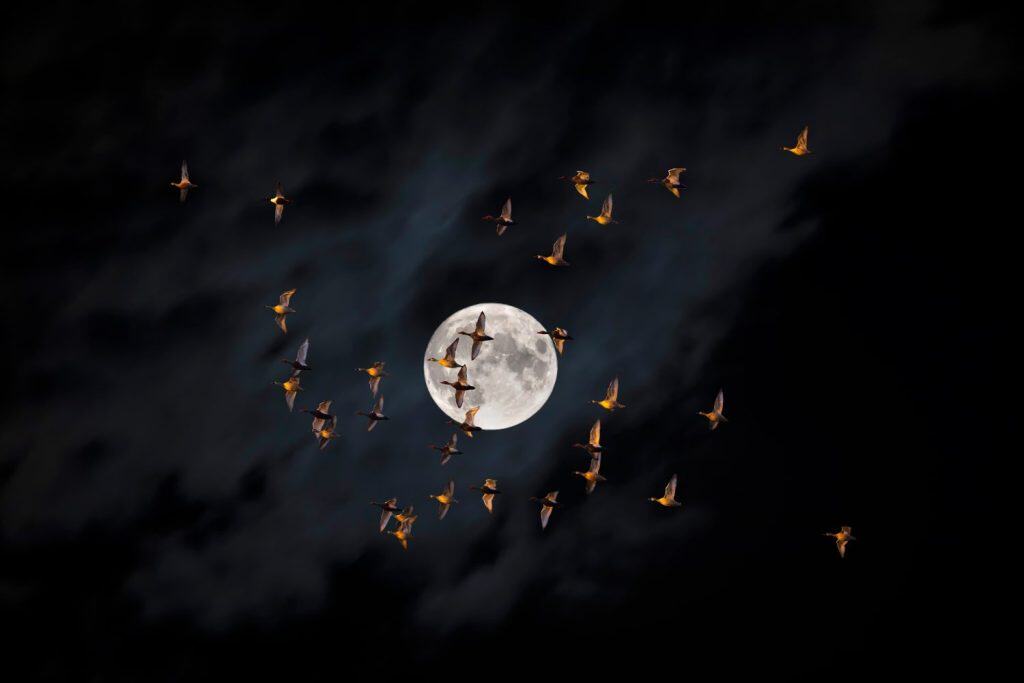
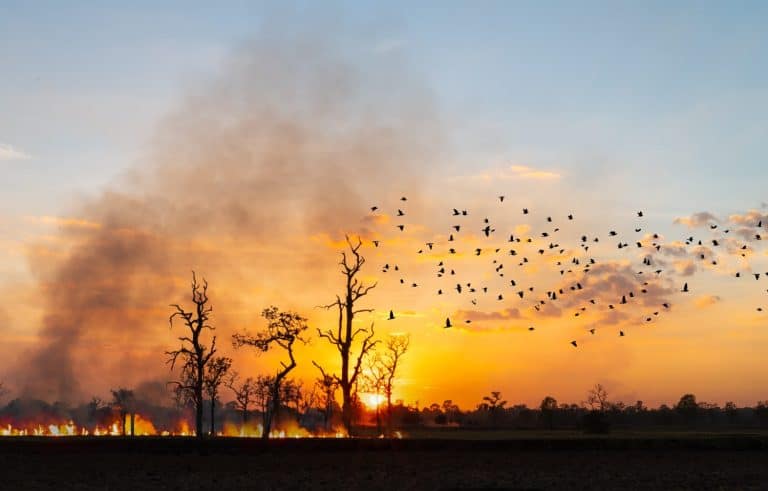
Peak sky habitat activity is four hours after local sunset in the spring and fall.
©smutan/Shutterstock.com
Scientists also found that many diverse species use the sky habitat in a surprisingly coordinated way, rather than competing for dominance. This contrasts with how different species typically interact in shared terrestrial habitats.
Giuntini notes, “What is striking about airspace is that it may be one of the few habitats where competition doesn’t dominate ecological dynamics. During flight, species appear to share a vast space, almost as if the sky were a nearly limitless resource, challenging how we traditionally think about ecosystems.”
How Can This New Data Help Conservation Efforts?
According to one of the study’s co-authors, the data analyzed has value beyond simply understanding how animals generally use the sky habitat. Carolyn Burt, co-author and clinical assistant professor of teaching and learning in Purdue’s Department of Forestry and Natural Resources, notes that the next step is to pair the radar data with species-specific tools to better understand how different animals interact to share the sky habitat.
She also sees it as equally important to use this data to inform conservation efforts. She says, “As we populate the sky with airplanes, wind turbines, drones, and artificial light, understanding how wildlife uses this space becomes essential.”
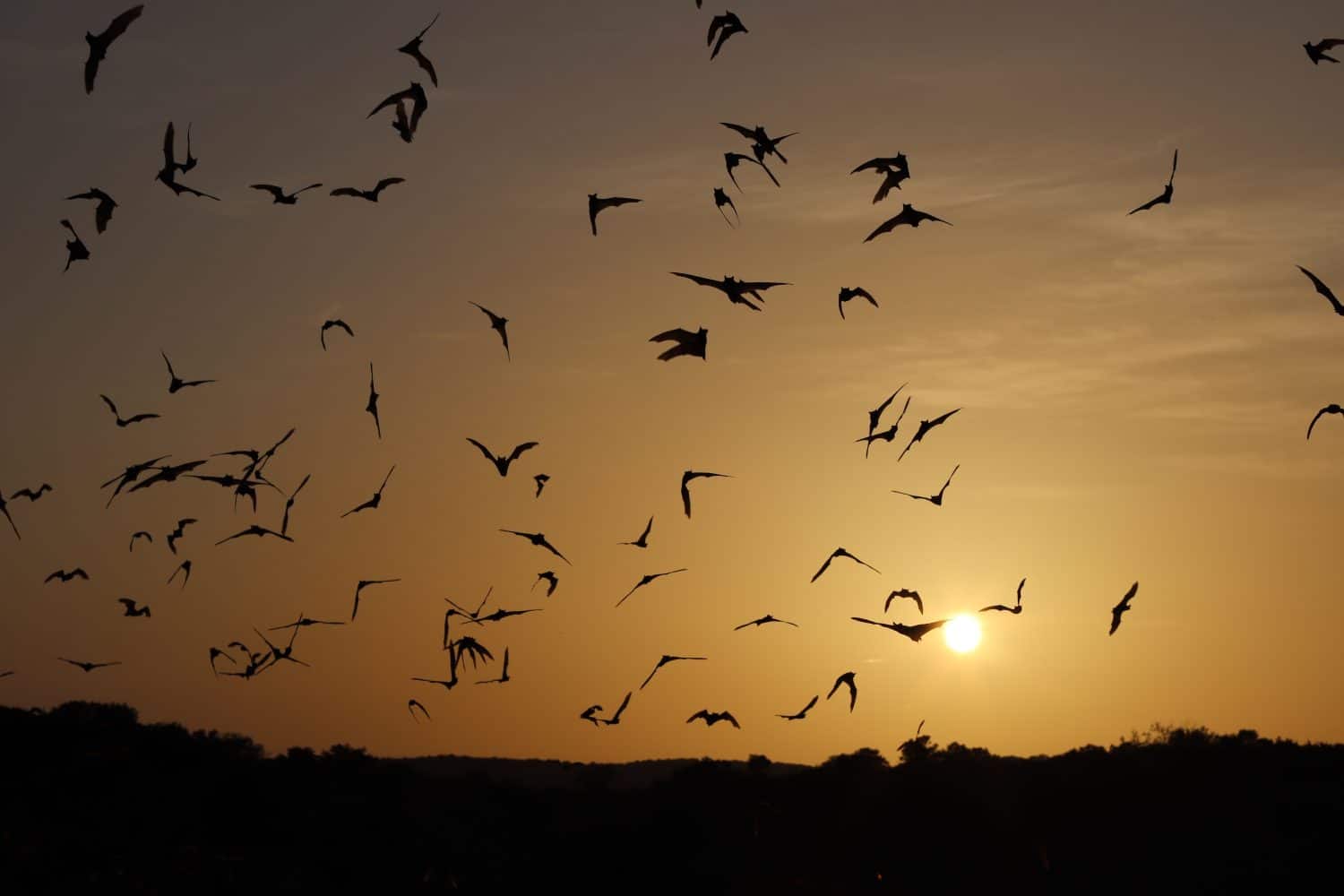
Bats are one of many users of the sky habitat.
©Alex555x/Shutterstock.com
Her colleague Horton agrees. “To protect species that rely on the sky, we first need to understand how they use it. Our work shows that the lower atmosphere isn’t empty — it’s a living, dynamic habitat, structured in ways we can now measure thanks to radar,” he says. “Viewing the sky this way opens the door to new conservation strategies, better forecasting tools, and a deeper appreciation for the life happening above us every night.”