
Quick Take
- Back-riding looks like pure instinct, but there's a third reason loon chicks do it that most people never consider. Discover the third reason →
- Loon parents split the workload in a specific way, and that division may be the deciding factor in whether chicks survive. See how parents divide duties →
- Laying fewer eggs sounds like a disadvantage, but for loons it is actually their survival strategy. Explore the egg-laying strategy →
- Loon chicks stop riding their parents at a very specific age, and what triggers that cutoff reveals something unexpected about their development. See the back-riding cutoff →
Loons form remarkably attentive family groups. Unlike some animal species, both the mother and father share the work of incubating eggs and caring for their chicks. Their efforts are rewarded as the chicks grow into healthy adults. This adorable Instagram reel by @rayyeargar.ryphotography shows two loon chicks riding on their mother’s back while their father feeds them. Read on to learn more about why and how loons raise their chicks.
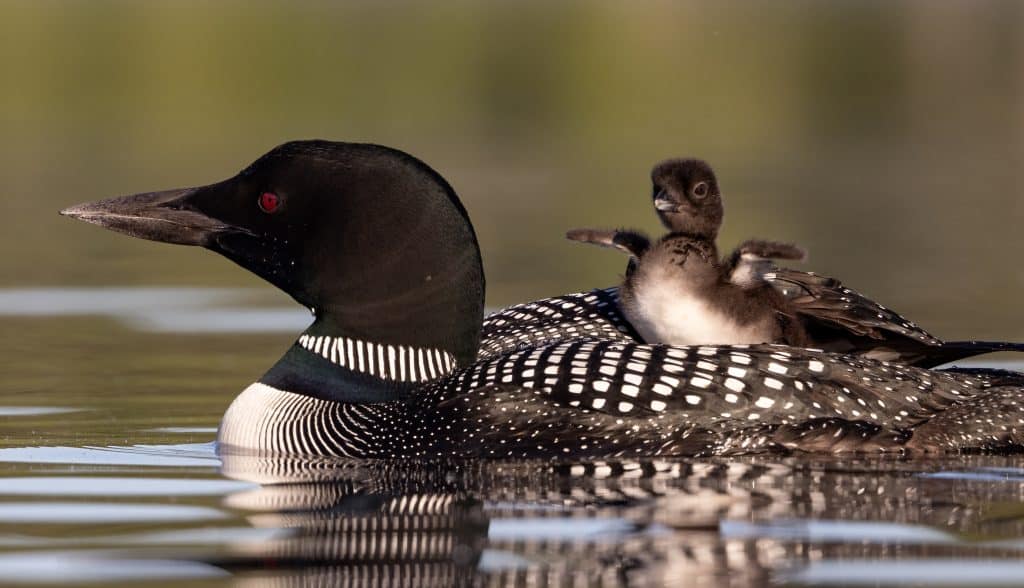
Loons carry their chicks on their backs in the water to help the baby conserve energy and avoid predators.
©Harry Collins Photography/Shutterstock.com
How Loons Raise Their Chicks
Loons are great at raising chicks as they divide the work amongst themselves. While the division varies between pairs, the fact that both parents are there and put in the effort is amazing. In species where both parents raise their young, survival rates are often a bit better. Some of the different responsibilities include incubating eggs, watching the chicks, feeding, and carrying them around. In the video above, the chicks are seen riding on their mother’s back. This is a common sight for loons and for aquatic birds as a whole. They do this for a few reasons, including keeping the chicks warm, protecting them from potential underwater predators, and helping the chicks conserve their energy. Chicks spend most of their first few weeks riding on their parents’ backs, stopping once they get too big at around three to four weeks old.
The video above also shows the chicks being fed by the father. Chicks have a similar diet to adult loons, but in smaller pieces. This includes small fish like minnows, insects, and crustaceans. While one parent watches the chicks above water, the other dives underwater to catch food. Chicks begin to catch their own food at around five to six weeks old and only become fully independent at about 12 weeks. Once the young loons can fly, they are considered fully independent. After this, the young loons will go on to start their own families. Loons usually lay only one or two eggs at a time, which benefits their offspring. Having fewer chicks means each receives more attention, helping to ensure their survival into adulthood.