
Quick Take
- Scientists scanning narwhal tusks expected a simple spiral structure, but what they found inside was so unexpected that the lead researcher assumed the data was wrong. See the surprising discovery →
- The same structural trick used in wind turbine towers and vaulting poles turns out to be hidden inside a narwhal's tooth, and nature got there first. Explore the structural trick →
- A narwhal's tusk quietly records decades of Arctic climate history, and scientists are only beginning to decode what it has been tracking. Decode the climate record →
- Despite centuries of study, scientists still disagree on what the narwhal's tusk is actually for. The answer may be stranger than anyone assumed. Unpack the tusk's purpose →
For centuries, the narwhal’s tusk has been one of the ocean’s greatest mysteries. During the Middle Ages, traders sold these unusual tusks as magical unicorn horns, claiming they could cure diseases and neutralize poison, which made them worth more than their weight in gold. This legend left a lasting cultural footprint. For example, Denmark’s Coronation Chair (used from 1671 to 1840) was constructed from narwhal tusks. A 16th-century Swedish cartographer even drew one of the earliest scientific depictions of a narwhal as a horn-bearing sea monster.
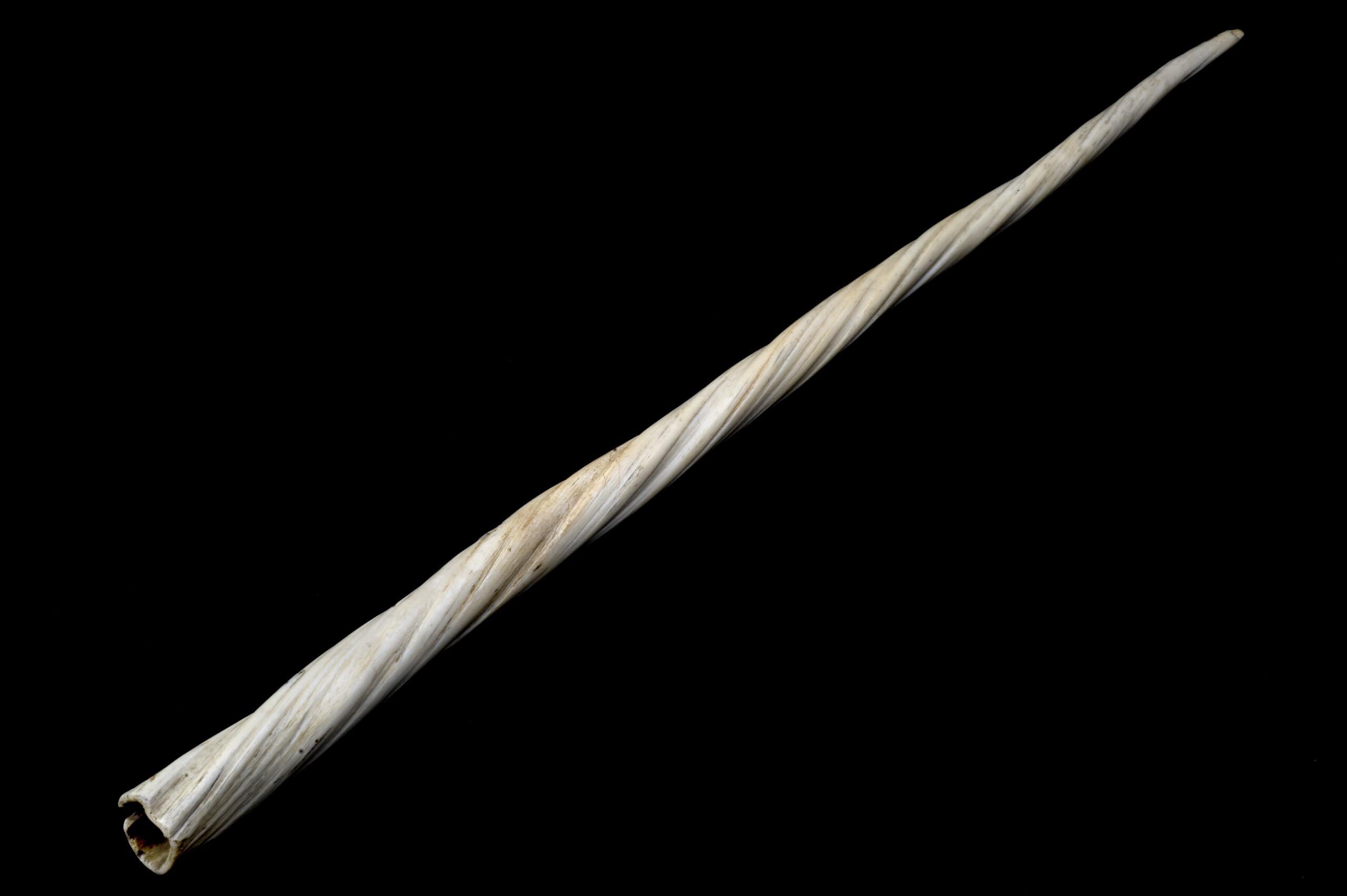
In reality, this iconic “horn” is actually an enamel-less left canine tooth that grows up to 10 feet long, primarily in males. Today, scientists are discovering that the complex architecture hidden inside this massive tooth is just as remarkable as the folklore surrounding it.
A Hidden Spiral Inside the Spiral
An international research team led by scientists at Aarhus University set out to investigate the narwhal tusk’s mysterious internal structure. Their study, published in Nature Communications in August 2026, used advanced 3D X-ray imaging to reveal the hidden spiral structures and material properties within the tusk.

Narwhal tusks are packed with millions of nerve endings.
©iStock.com/dottedhippo
The team analyzed tusks provided by Greenlandic Inuit hunters and the Greenland Institute of Natural Resources using high-powered synchrotrons — particle accelerator X-ray sources — in Sweden, Switzerland, and France. They also placed an entire narwhal skull and tusk into a CT scanner and used a specialized technique called tomography. This allowed them to map the tiny collagen fibers of the tusk’s internal framework.
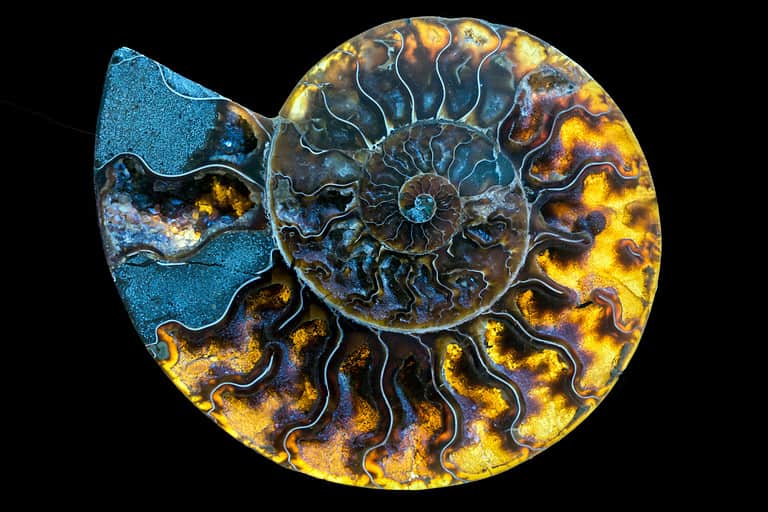
These scans revealed something completely unexpected: the narwhal’s tusk contains two opposing spirals. The outside of the tusk visibly twists to the left. But hidden inside, the tooth contains a second spiral that twists to the right.
The discovery was so surprising that the team initially suspected there had been an error in the data analysis.
Two Twists Working Together
This internal design gives the narwhal tusk a brilliant form of natural engineering. The tusk’s outer tissue layer (cementum) forms a left-handed spiral, while its inner core (dentin) twists in the opposite direction. At the junction of these two layers meet, collagen fibers run parallel along the length of the tooth. Rather than relying on a single uniform structure, these opposing layers create a counter-torque that balances internal stresses — a vital adaptation for a tooth that grows several feet long while staying remarkably straight.

A narwhal’s tusk is actually a very long tooth.
©Adwo/Shutterstock.com
Mechanical tests revealed that sections cut lengthwise were roughly 60 percent stiffer than crosswise cuts. By arranging collagen fibers and calcium nanoparticles in opposing directions, the tusk achieves an optimal balance of flexibility and strength. This allows it to flex under extreme forces without snapping.
In other words, the narwhal’s famous tusk isn’t just a long, spiraling tooth. It is an intricate natural structure engineered to handle the stresses placed on it.
A Lifetime Written Into the Tusk
This double-spiral design remains intact across the tusk’s annual growth layers, which form much like the rings of a tree. Because both opposing spirals persist throughout these layers, scientists believe this architecture is genetically programmed and maintained throughout the narwhal’s life.
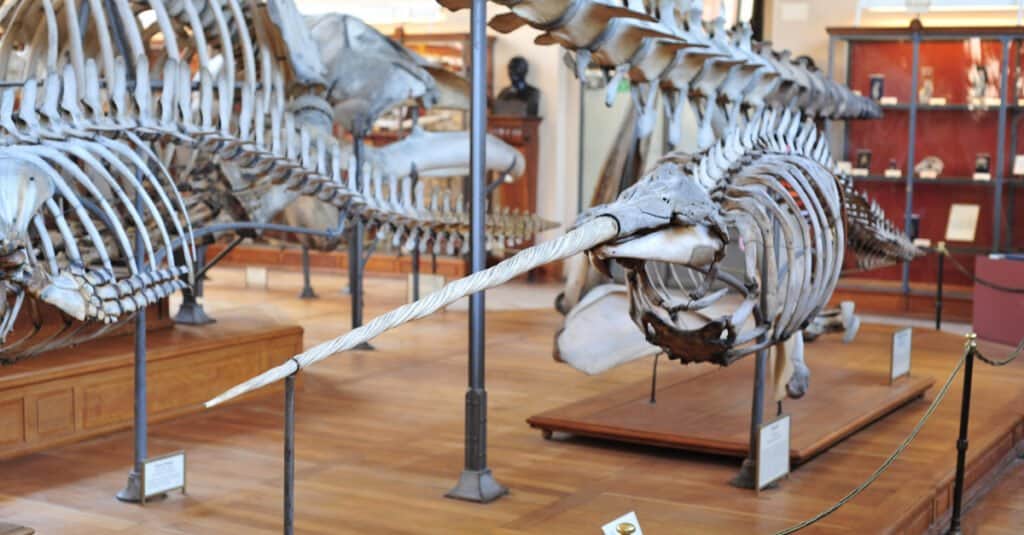
A narwhal’s tusk can grow up to 10 feet long.
©Obs70/Shutterstock.com
Beyond structural strength, these growth layers offer a detailed record of the animal’s life and environment. Chemical tracers and annual growth layers within the tusk can records changes in diet, mercury exposure, and some aspects of Arctic climate conditions and North Atlantic ocean environments over several decades.
Researchers hope to pinpoint exactly how and where this dual-spiral structure originates within the narwhal’s skull to better understand how its distinctive architecture develops.
A Natural Engineering Marvel
The narwhal tusk’s internal architecture is more than a biological curiosity; it is an example of nature solving a structural engineering problem in an unexpectedly elegant way.
Humans already use opposing spirals in structures such as wind turbine towers and jumping poles. The discovery of a similar large-scale structural design inside a narwhal’s tusk could inspire new approaches to developing stronger and more flexible materials for construction and medicine.

A narwhal can grow up to 17 feet long.
©Dotted Yeti/Shutterstock.com
While its structural secrets are coming to light, the tusk’s exact purpose remains a topic of study. Primarily found in males, it likely plays a key role in sexual selection and establishing social hierarchies. However, drone footage has also revealed narwhals using their tusks to prod fish, and the tooth may even double as a sensory organ.
For centuries, humans mistook the narwhal’s tusk for a legendary unicorn horn. Now, scientists are discovering something perhaps even more extraordinary: a real biological structure built from opposing spirals, collagen, and minerals that allows one of nature’s strangest teeth to grow long, strong, and remarkably straight.