
Quick Take
- Scientists had studied Weddell seals for decades, cataloged 34 distinct call types, and still missed an entire half of the conversation. See the full vocal catalog →
- These seals produce sounds at frequencies that challenge something scientists were certain pinnipeds couldn't do. Explore the ultrasonic range →
- The calls spike during months of near-total Antarctic darkness, a timing that points to a purpose researchers are only beginning to understand. Discover the seasonal pattern →
- Researchers fell asleep to these seal sounds through live audio feeds, entirely unaware that they were only hearing part of what was happening beneath the ice. How the discovery was made →
- What scientists found in this seal's acoustic range quietly raises an uncomfortable question about every other marine mammal species we think we understand. See the broader implications →
One fascinating creature spends its winters beneath four feet of Antarctic sea ice, diving to nearly 2,000 feet in water cold enough to kill an unprotected human in minutes… and it sings, emitting sounds that seem to mimic the score of a 1970s science fiction film.
The Weddell seal is the musician of the sea, creating vocals like vintage laser blasts, electronic trills, synth music, and chirping through frequencies faster than any instrument. The animal’s voice has been changing what scientists thought they knew about how marine mammals communicate. Here, we cover its highly unique voice and how it achieves such odd, electronic sounds.
The Most Vocally Unique Seal on Earth
Weddell seals are already known for having the most diverse vocal repertoire of any related seal species, with researchers cataloging their calls into an impressively complex list. As far back as 1982, scientists described 34 distinct sonic call types tied to social interactions, all within the range of human hearing.

The calls of the Weddell seal are so incredibly unique.
©Michelle Sole/Shutterstock.com
The Weddell seal has sounds so strange and beautiful that they served as ambient noise for polar researchers; workers at McMurdo Research Station reportedly fell asleep to the seals’ audible vocalizations piped in through live audio feeds from the underwater observatory below. However, as they drifted off to these bizarre deep-sea noises, what the researchers failed to realize was that those 34 identified call types represented only some of what the Weddell seal is capable of.
The Discovery of the Weddell Seal’s Synthesizer Voice
In 2017, University of Oregon biologist Paul Cziko completed installation of the McMurdo Oceanographic Observatory, an underwater monitoring system located 21 meters below the sea ice in McMurdo Sound, 850 miles from the South Pole. The observatory’s digital hydrophone was significantly more sensitive than equipment used in any previous seal study.
As the two-year recording project continued, the team encountered calls and sounds that didn’t fit any known or previously recorded category. The co-author of the research, Lisa Munger, who is a marine mammal acoustician, described the moment the team solved the mystery of these new sounds. “Finally, it dawned on us that the seals were actually using them quite regularly.”
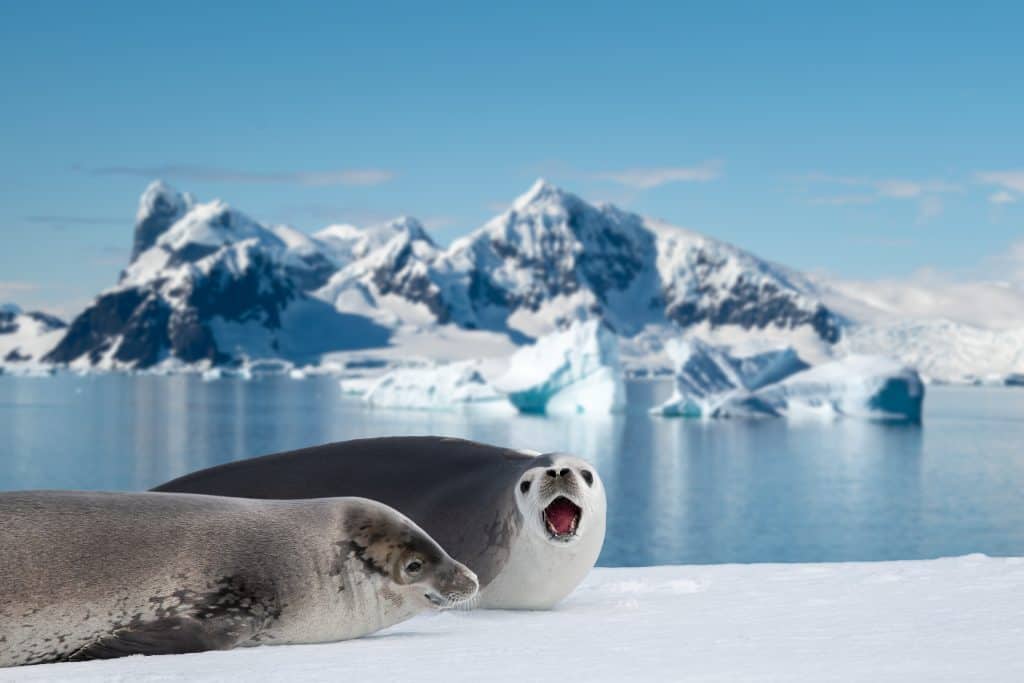
Weddell seals can produce sounds that humans cannot hear, which is why they have not been recorded in the past.
©Nancy Pauwels/Shutterstock.com
They determined that there was an acoustic roster of sounds produced by the seal, a roster that’s entirely above the threshold of human hearing. The study was published in the Journal of the Acoustical Society of America and identified nine recurrent call types with fundamental frequencies spanning an ultrasonic range of nearly 50 kHz, which is roughly the pitch of a dog whistle, and more than twice the highest note a human ear can detect.
Cziko described the effect of the seals’ full soundscape, noting that “It really sounds like you’re in the middle of a space battle in ‘Star Wars,’ laser beams and all.”
Eleven distinct vocal elements (like chirps or trills) also had ultrasonic frequencies at or above 20 kHz, with two exceeding 30 kHz and six consistently above 21 kHz. One whistle reached 44.2 kHz, and some chirps in another call type were at about 49.8 kHz.
You can actually hear what these vocalizations sound like in this audio sample from the research team, which has been adjusted to be within human hearing ranges.
Why Are Weddell Seals Making These Sounds?
This discovery had researchers immediately asking: why are these animals producing these bizarre calls, calls that the seals themselves can barely hear at close range? High-frequency sounds dissipate quickly in water, which means these ultrasonic vocalizations don’t travel far. Researchers dove into finding an answer.

Echolocation wasn’t thought to be possible for Weddell seals before this new research.
©juan68/Shutterstock.com
One theory is that the seals use this ultrasonic channel to communicate when lower frequencies are too busy with other sounds, sort of like switching to a quieter station when a main frequency is busy. The other possibility is more interesting: the vocalizations represent a form of echolocation, like the noises of dolphins and bats.
Previous research has argued that pinnipeds cannot echolocate because they lack the anatomy for producing and processing the necessary sounds, and their known calls don’t include the same identifiers as other echolocation calls. However, this new data posited that 17% of all recorded Weddell seal calls were ultrasonic, with repetitive ultrasonic chirp-based calls appearing to dominate during the Antarctic winter’s months of near-total darkness.
These ultrasonic calls may actually provide enough information to seals to help them return to breathing holes or locate food, even if their sound-processing is not specialized enough to qualify as true echolocation.
What This Discovery Means For the Weddell Seal
The discovery of an entire vocalization register within the Weddell seal, which had long been missed, ultimately raised multiple questions about how much may be overlooked in other species. As Cziko noted, “It was really surprising that other researchers previously had, in effect, missed a part of the conversation.”
There are still multiple questions that need answers, according to the research team. Who is producing the ultrasonic calls: males, females, juveniles, or all of the above? Do they occur in deeper offshore water as well as under coastal sea ice? Can specific call types be correlated with specific behaviors, such as prey capture or navigation?

There are plenty more questions that need answering about the vocalizations of the Weddell seal.
©vladsilver/Shutterstock.com
Answering these questions requires both more sensitive recording equipment and deployment across a wider range of locations and seasons, something the team is eager to do. Until then, the Weddell seal appears to be operating a private, synth-like acoustic channel, one working in frequencies no human has ever naturally heard.