
Quick Take
- The emerald ash borer (Agrilus planipennis) was first identified as an invasive species in the US in 2002.
- It is now found in over 30 states.
- These invasive beetles kill ash trees in just a few short years.
- The USDA is asking the public to report sightings of the beetle and signs of infestation.
- Signs of infestation include the presence of adult beetles, S-shaped burrows, and D-shaped holes where they have emerged.
A small beetle is responsible for the death and decline of billions of ash trees in North America, and the race is on to stop it from causing further damage. The USDA is hoping to spread the word so that members of the public can help in the fight to save our trees. Meet the highly destructive emerald ash borer.
What Is the Emerald Ash Borer?
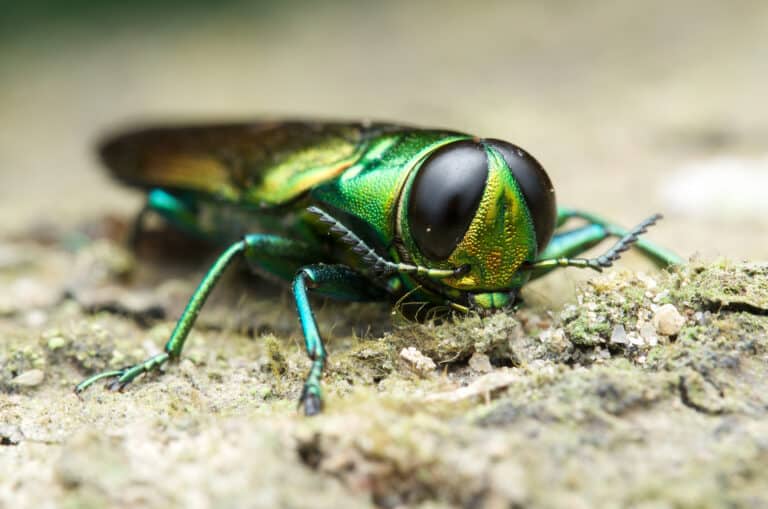
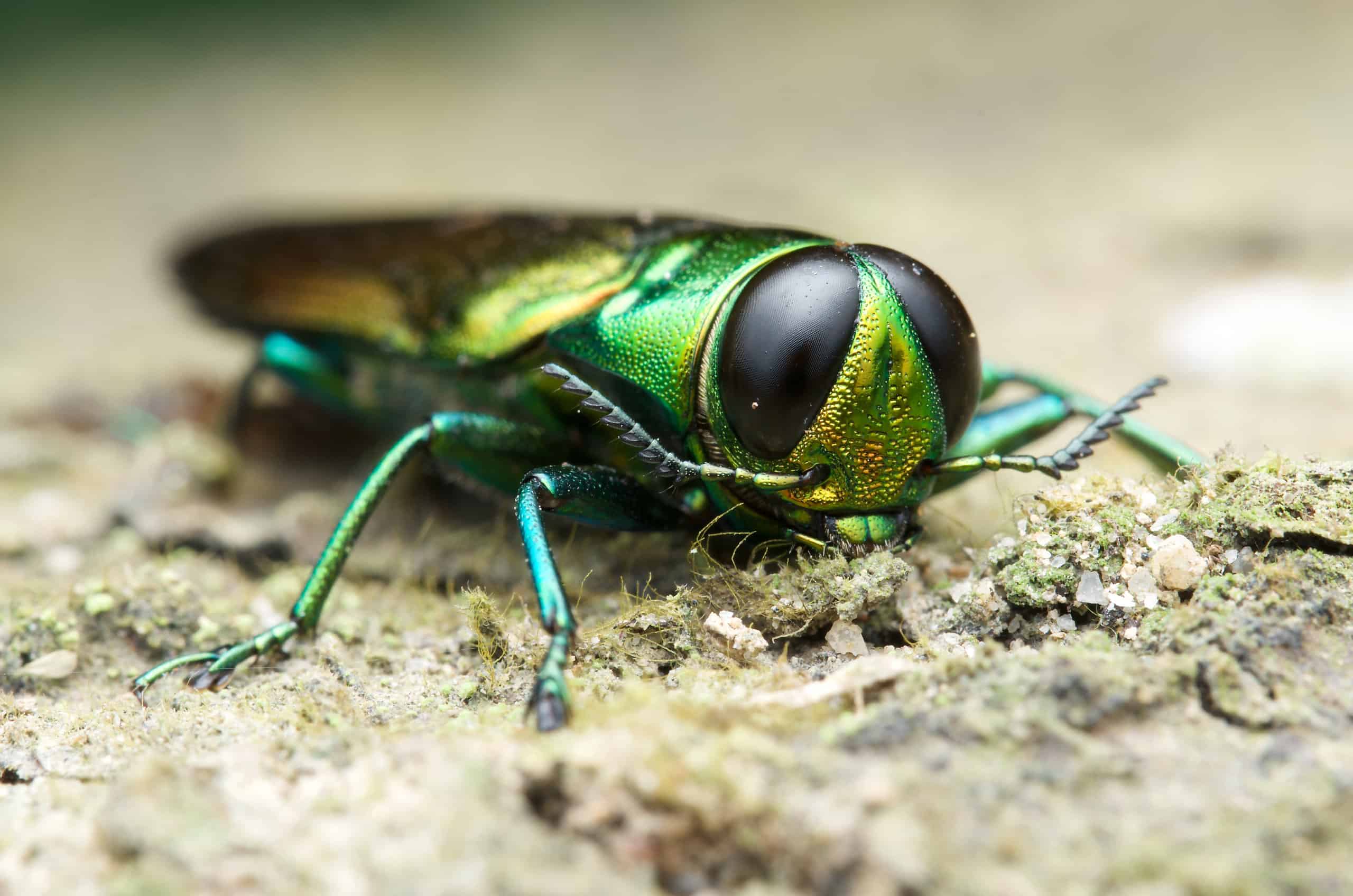
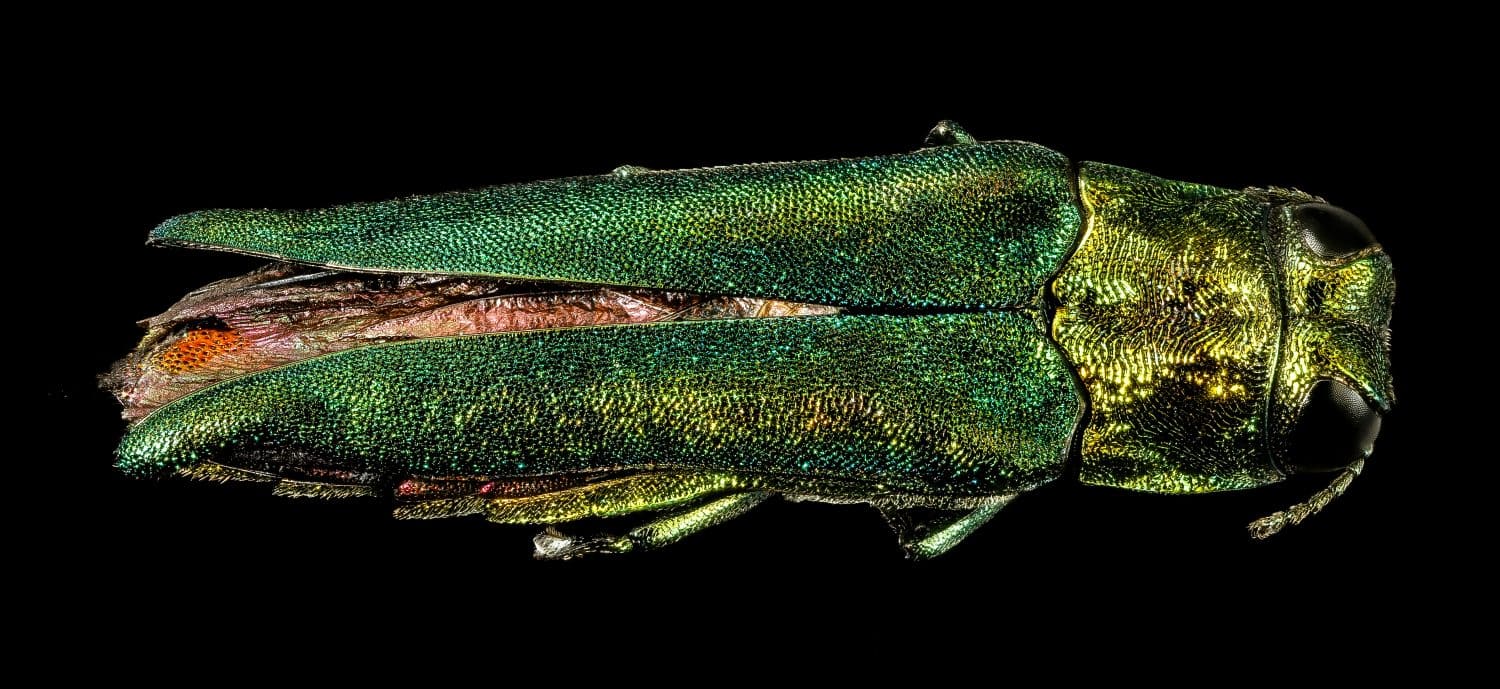
The emerald ash borer (Agrilus planipennis) is a long, slender, metallic green beetle. It measures between a quarter of an inch and half an inch in length and is a member of the beetle family Buprestidae.
These beetles are a native species of temperate north-eastern Asia. However, it is an invasive species in North America, where it was first detected in 2002 in southeast Michigan. This is still where its core population is located, but it has now spread to at least 30 States. The beetle does well in the US climate and is a good flyer, so it can travel over half a mile. This aids their dispersal.
It may boast a beautiful shade of green but the Emerald Ash Borer destroys ash trees with a vengeance.
©lego 19861111/Shutterstock.com
What’s more, people inadvertently spread it by moving infested firewood, logs, or nursery stock. They can hide in wood packaging material, wood chips, and firewood that contain bark strips and plants. It was most likely first introduced to Michigan in the 1990s (or even in the 1980s) in imported wooden packing materials such as crates.
Infesting Ash Trees
They mainly infest ash species (Fraxinus), including green ash, black ash, white ash, and blue ash. The infestation normally starts in the canopy and then progresses down the tree. By the later stages of infestation, the base and surface roots can be infested. In saplings, however, the trunk is attacked first.
An adult female emerald ash borer can produce between 60 and 90 eggs, which she lays singly or in small clusters in bark crevices. Around 7 to 10 days later, the eggs hatch, and the larvae do what has given this beetle their name. They bore into the bark and feed on the vessels that transport water and nutrients up the bark and along branches. The larvae are voracious eaters and carry on feeding until the fall. They generally spend the winter in the bark (as they pupate) and then emerge as adults ready to start the lifecycle all over again. When they emerge, they typically leave a D-shaped exit hole.
Meanwhile, they leave behind a very damaged tree. As further generations of beetle larvae eat more and more of the tree, they stop it from being able to transport water and nutrients. Eventually, the tree dies.
No Natural Control Mechanisms
These beetles are not a major problem in their native range, where people view them as merely a nuisance. In the US, however, they are a serious problem. This is because the ash trees here have little natural resistance, and the beetles have fewer predators. This means that populations can soon rise to damaging numbers. Emerald ash borers can kill ash trees within 3 to 6 years of infestation, and sometimes as quickly as 2 to 4 years for smaller trees.
Clues That Emerald Ash Borers Are Active
The USDA is asking the public to report sightings of the beetle and signs of infestation. But to do this, you need to know what you are looking for! Here are what you should look out for on ash trees. The infestations can occur in urban and suburban areas as well as in forests and rural settings.
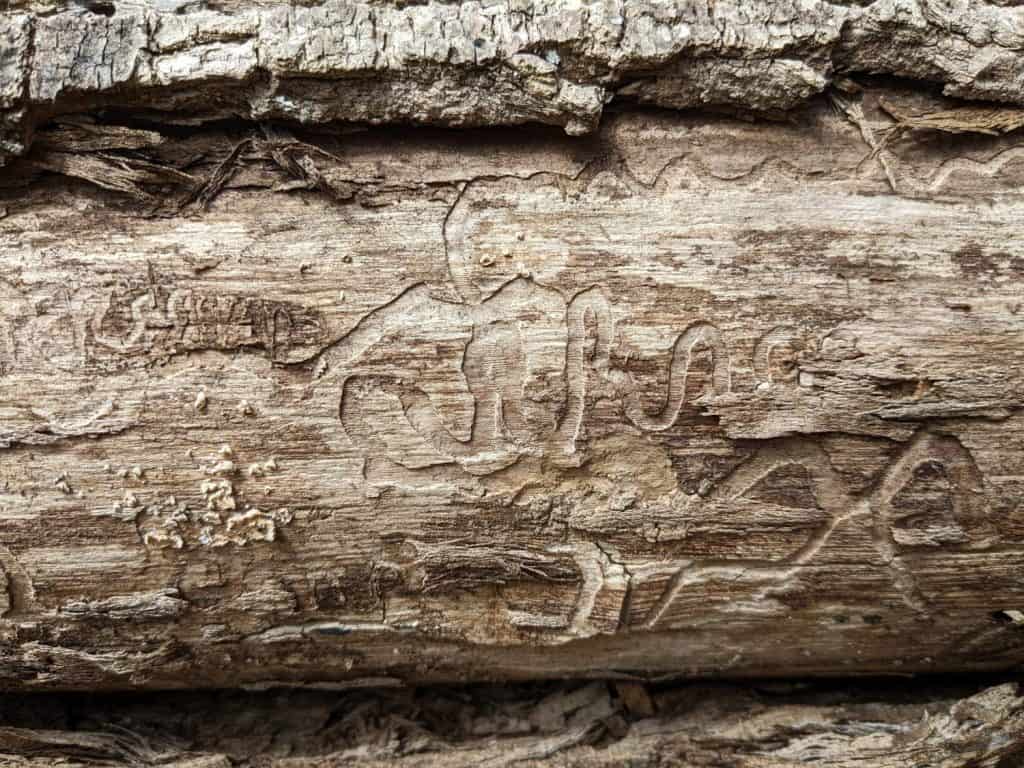
Galleries are a sign of an emerald ash borer infestation.
©Michael LaMonica/Shutterstock.com
- Spotting adult beetles: adults have a distinctive metallic green color and are about half an inch long. They are most active during the day, especially when the weather is warm and sunny. When it’s stormy, they hide in bark crevices or cling to foliage.
- Larvae burrow – when larvae burrow into the tree, they create S-shaped burrows (called galleries) and leave a D-shaped hole when they emerge.
- Infestation signs – infested trees have yellow foliage that turns brown prematurely. The tree crown looks thinner, the branches die, the bark splits and peels off, revealing galleries.
- Secondary bird damage – woodpeckers eat the larvae, but cause even more damage to the tree as they try to reach them. Simply seeing increased woodpecker activity on ash trees is a potential sign that the beetles are present.
Fight Back Against Emerald Ash Borers
The USDA has several approaches to control this pest. They are organizing detection surveys and launching public outreach and education programs. While pesticides can be used to kill beetles, you would need to repeat the treatment every year or so and treating forests in this way is not practical.
The USDA is rearing and releasing stingless wasps that prey on the beetles. Scientists with ARS, the Forest Service, and the Animal and Plant Health Inspection Service identified wasps that preyed on the beetles in their natural range. They chose Spathius galinae, which is a parasitic wasp. It lays its eggs in emerald ash borer larvae, but because it has no sting, it does not pose a danger to humans or other animals. When the eggs hatch, they eat the larvae and kill them! It has successfully parasitized 35 to 78 percent of emerald ash borers where it has been released.