
Quick Take
- Bats navigate cluttered environments by interpreting patterns in echo changes—known as acoustic flow velocity—rather than analyzing individual echoes.
- Experiments show bats adjust their speed based on perceived sound flow, treating acoustic cues like motion information.
- This biological strategy could inspire new drone navigation systems that work without GPS or detailed visual maps.
We all know that bats are masters of the night, with their high-pitched calls and whisper-quiet wings, weaving through tangled trees and swooping in on insects in total darkness. But exactly how they manage to make split-second decisions in such complex environments has been a mystery—not just to the layperson, but to scientists as well.
But a new study sheds light on this question. It reveals that bats don’t just listen to echoes the way we once thought, but also use something called acoustic flow velocity to judge their speed and surroundings in real time. Not only is this finding interesting and exciting for bat enthusiasts, but it could have a much broader reach: it’s already influencing how engineers think about designing drones that can fly through forests and cities without crashing.
The Problem: Too Much Echo Information
When a bat emits a sound, that sound hits objects in the environment and bounces back as echoes. In open space with few obstacles, a bat can use these echoes to tell where something is and how far away it might be. But in cluttered environments like forests, a single sound can bounce off dozens or even hundreds of leaves, branches, and trunks at once. That creates a chaotic mess of echoes that would overwhelm any animal’s senses if it tried to analyze every returning bounce individually.
Imagine shouting into a canyon and trying to pick out which of hundreds of returning echoes is the important one. It’s overwhelming, and for a bat flying at 20 miles per hour or more, there’s no time to sort through all that data. Thus, researchers have suspected for years that bats must use some smarter strategy to interpret echoes.

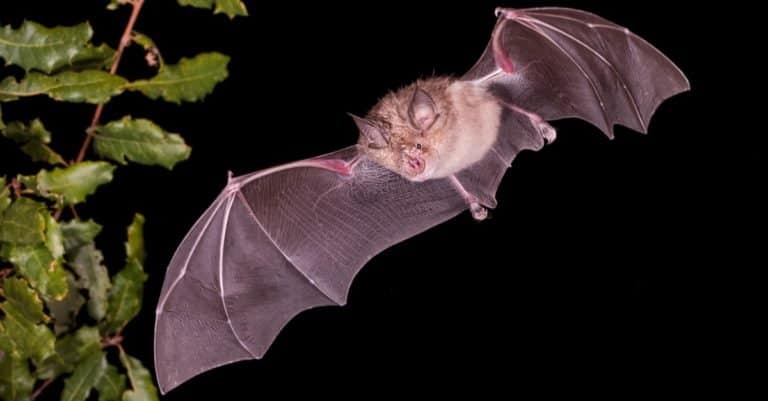
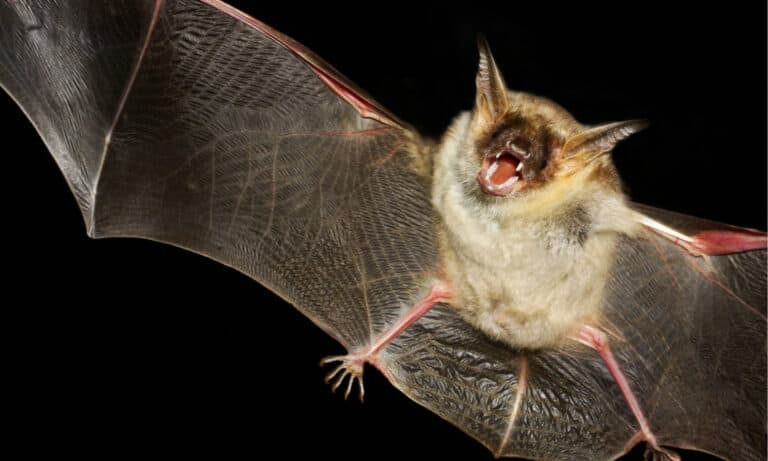
A bat flying through dense foliage may receive hundreds of overlapping echoes from a single call, far more information than it could process individually.
©Alex555x/Shutterstock.com
The Big Idea: Acoustic Flow Velocity
The concept the team focused on is acoustic flow velocity. That’s a bit like optic flow, the visual cue humans and other animals use to understand motion. When you’re in a car, trees and road lines seem as though they’re rushing by faster the faster you go—even though it’s the car that’s moving and these objects are stationary. That change in the visual scene’s speed is optic flow.
Bats don’t have that kind of visual information at night, so scientists wondered if they might instead use equivalent changes in sound. As a bat flies, the echoes coming back from the environment change in timing and frequency depending on how close objects are and how fast the bat is moving. Those changes create a kind of “sound flow” that the bat could listen to and interpret.
A key part of that sound flow is something called the Doppler shift. When an ambulance drives past you with its siren blaring, the pitch seems higher as it approaches and lower as it moves away. That’s Doppler shift in action. Bats might use similar shifts in the echo frequencies they hear to judge motion relative to their surroundings.
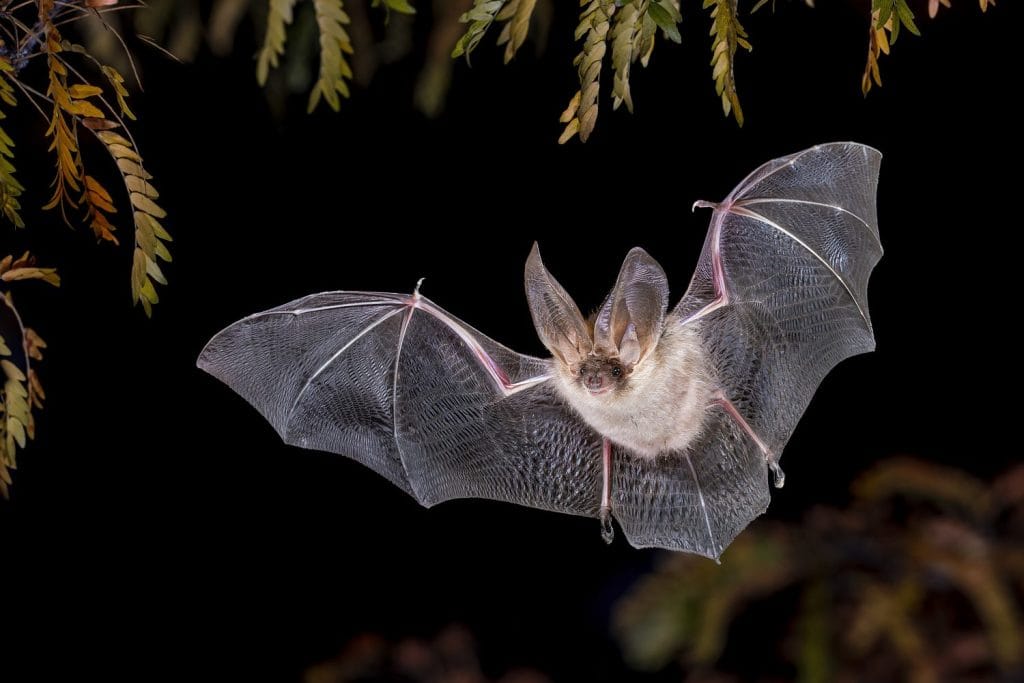
Just as optic flow helps humans sense speed while driving, bats rely on shifting echo patterns to understand motion through space.
©Rudmer Zwerver/Shutterstock.com
Testing the Idea: The Bat Accelerator Machine
To test whether bats really do use acoustic flow velocity, researchers at the University of Bristol built a clever experimental setup that they dubbed the Bat Accelerator Machine, a 26-foot-long flight corridor lined with nearly 8,000 tiny acoustic reflectors that mimicked the echoes you’d get from leaves on a hedge.
Over three nights, the team recorded 181 flight paths of common pipistrelle bats as they flew through this corridor. Of those, bats flew the entire length of the apparatus 104 times. Those flights were analyzed for how the bats responded to changes in the acoustic flow.
A feature of the setup is that the researchers could manipulate the perceived flow of sound. By moving the reflectors against the direction the bat was flying, they made it seem like the sound flow was “speeding up” relative to the bat’s motion. When they moved the reflectors in the same direction as the bat, they made it seem like the acoustic flow was slowing down.
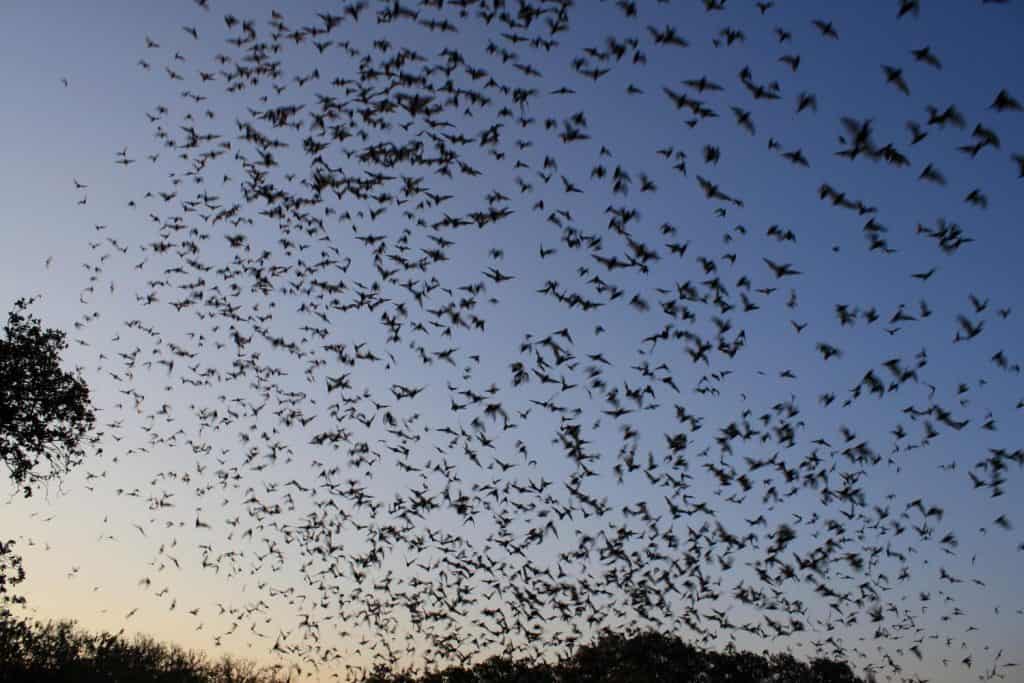
Researchers recreated hedge-like acoustic clutter using nearly 8,000 reflectors to study how bats respond to manipulated sound flow.
©freelancerChrisSobalvarro/Shutterstock.com
The bats responded to these manipulations in a striking way. When the acoustic flow was increased, the bats slowed down by up to about 28 percent compared to the induced change in sound flow. When the flow was reduced, the bats sped up.
In simpler terms, the bats treated changes in acoustic flow just like they would a change in their actual motion. Faster sound flow made them slow down, as if they perceived they were moving faster than they actually were. Conversely—and consistently—lower sound flow made them go faster, as if they perceived they were moving slower than they actually were. That strongly suggests bats are listening not just to where echoes are coming from, but to how the pattern of sound changes as they fly.
That helps answer the question of how bats navigate without needing to break down every single echo into a neat map. Instead, they tune into the flow of sound information around them and use that as a cue to guide their motion. From a biological perspective, this discovery helps explain how bats are able to pull off such impressive feats of flight. They can weave through trees, dodge each other in flight, and make split-second decisions in darkness because they’re not trying to build a full map of every tree branch.
Lessons for Technology and Drones
The tech world has been fascinated by animal navigation for years. Robots and drones struggle a lot with the same problems bats face every night. Current autonomous drones often rely on cameras, laser sensors, or GPS. Those tools can work well in open spaces or controlled environments, but they struggle in dense forests, urban canyons, or places with poor lighting or GPS signals.
That’s where acoustic flow comes in. A system modeled on what bats do could give drones a way to sense motion through cluttered spaces without needing a full visual or GPS map. By listening to how sound patterns shift as they move, drones might be able to make real-time adjustments to avoid obstacles.
Some researchers are already exploring this idea. There are early prototype systems for small drones that use ultrasonic sensors inspired by bat echolocation to estimate velocity and avoid collisions in tight spaces. Bat navigation strategies could speed up that work and make autonomous flight in forests or urban environments safer and more reliable.
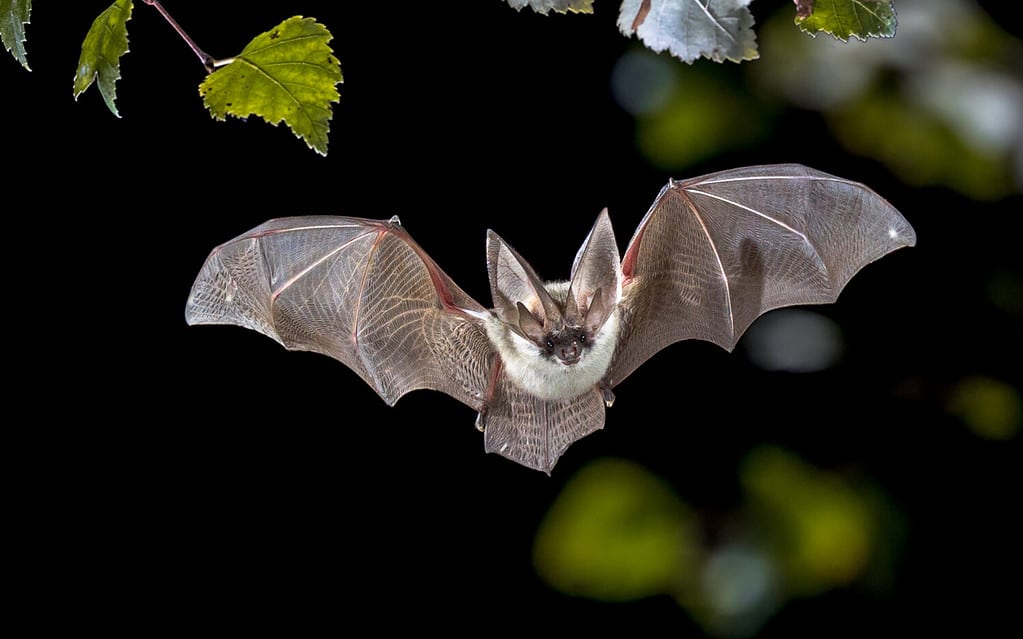
Unlike camera-based systems, bat-inspired acoustic navigation could help drones fly safely in darkness, fog, or GPS-dead zones.
©Rudmer Zwerver/Shutterstock.com
Lessons on How to Move Through a Crowd
In the end, the real surprise isn’t just that bats are good at flying in the dark—we already knew that—but how elegantly they do it. Rather than decoding every echo like a puzzle, they listen to the overall motion of sound and adjust on the fly. It’s almost the literal opposite of not seeing the forest for the trees. Sometimes the smartest way through a crowded world isn’t to understand everything in front of you, but to feel the flow and move with it.