Quick Take
- A self-taught museum curator, not a scientist, made one of natural history's greatest discoveries, and almost no one believed her at first. Discover her finding →
- The scientist who finally confirmed the coelacanth's existence then spent 14 agonizing years searching for something most colleagues thought he'd never find. Follow Smith's 14-year search →
- The coelacanth didn't just rewrite extinction science. Its rediscovery exposed a flaw in how confidently scientists declare something gone forever. See the scientific reckoning →
On the morning of December 22nd, 1938, a young museum curator in East London, South Africa, found something on the deck of a fishing trawler that she didn’t believe still existed. Among a pile of other, more recognizable sea creatures, she found a coelacanth—a fish the scientific world had declared extinct for approximately 70 million years.
This discovery became one of the most celebrated moments in the history of natural science—so significant that it moved a grown man to tears in front of a crowd. What is the coelacanth, and does this once-thought-extinct fish still exist today? Here’s everything you need to know about the remarkable fish that brought scientists to tears upon its rediscovery.
Finding the Coelacanth
32-year-old Marjorie Courtenay-Latimer was a self-taught curator of the East London Museum who regularly asked local fishermen to alert her whenever they caught something new or unusual. Captain Hendrik Goosen of the trawler Nerine found one such specimen and alerted Courtenay-Latimer. As she sorted through his haul, she found what she described as, “The most beautiful fish I had ever seen. It was pale mauvy blue, with faint flecks of whitish spots; it had an iridescent silver-blue-green sheen all over. It was covered in hard scales, and it had four limb-like fins and a strange puppy-dog tail.”
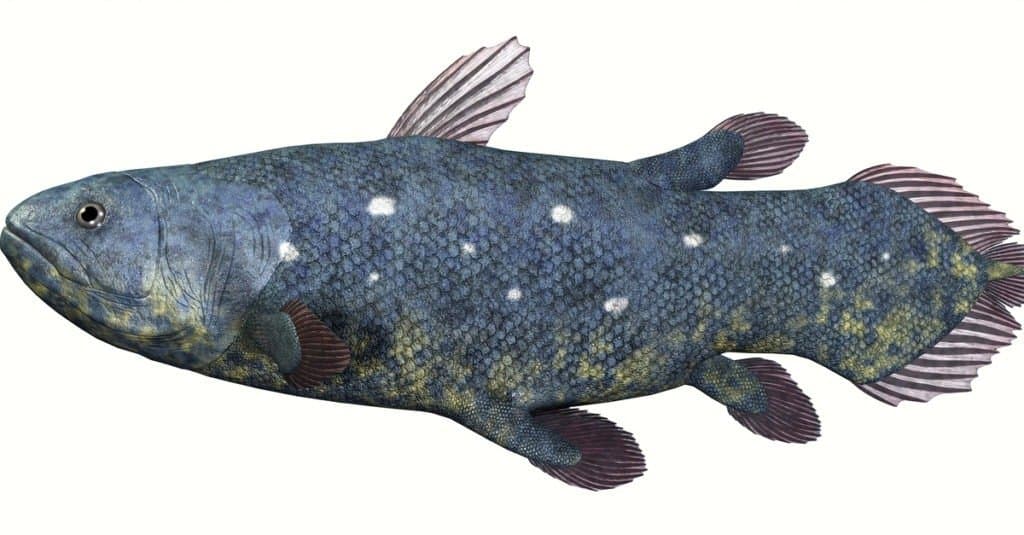
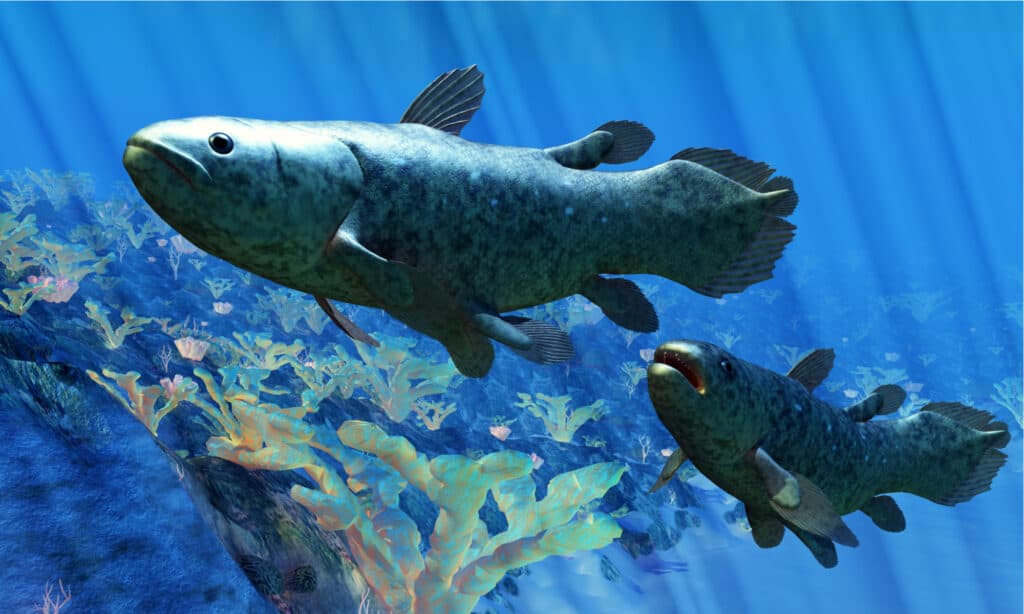
There were no coelacanth discoveries for decades, leading scientists to believe it was extinct.
©Catmando/Shutterstock.com
She brought the fish to her museum in a taxi and spent hours researching, only to find no other fish like it. To preserve this unusual specimen, she had it taxidermied and sent a sketch along with a letter to J.L.B. Smith, an ichthyologist at Rhodes University. When her letter finally arrived, he instantly recognized the creature as a coelacanth, a fish whose entire lineage had been known only from fossils. He immediately wrote back, “From your drawing and description, the fish resembles forms which have been extinct for many a long year. I feel it must be of great scientific value.”
The Long Wait for Further Proof of the Coelacanth
Unfortunately, the first specimen discovered by Courtenay-Latimer lost its internal organs to decomposition and the taxidermy process. Smith, therefore, needed another specimen to prove the species existed. He spent the next fourteen years searching, distributing thousands of reward pamphlets illustrated with the coelacanth’s distinctive profile along the coast of East Africa. He and his wife also explored thousands of miles of coastline in search of more examples, but to no avail.
However, in 1952, a telegram arrived from the Comoro Islands, a remote island chain west of Madagascar. An East African trader and skipper named Eric Hunt had received a fish from a local fisherman and recognized it from Smith’s pamphlet. Smith later recounted what happened upon his arrival in the original newspaper account published at the time, in Smith’s own words.
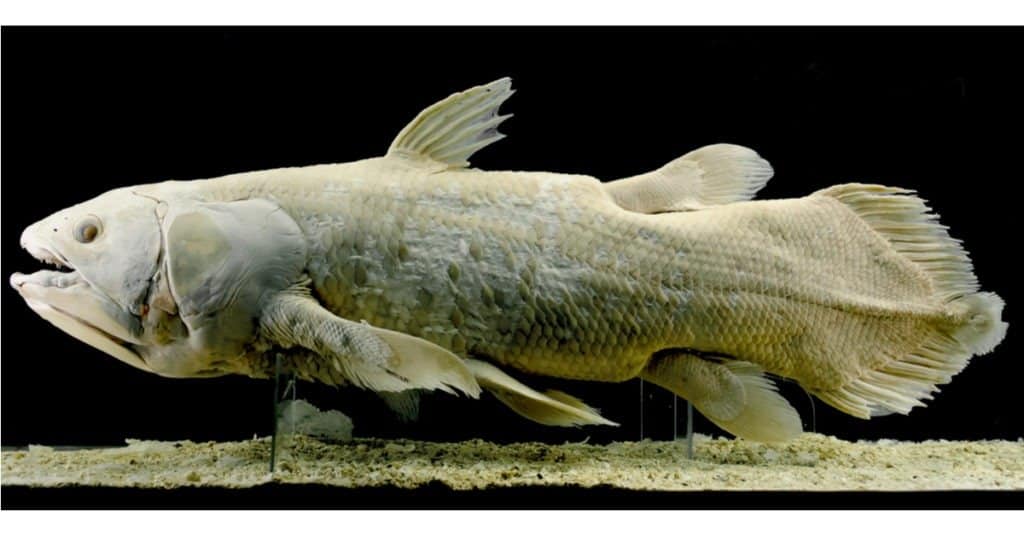
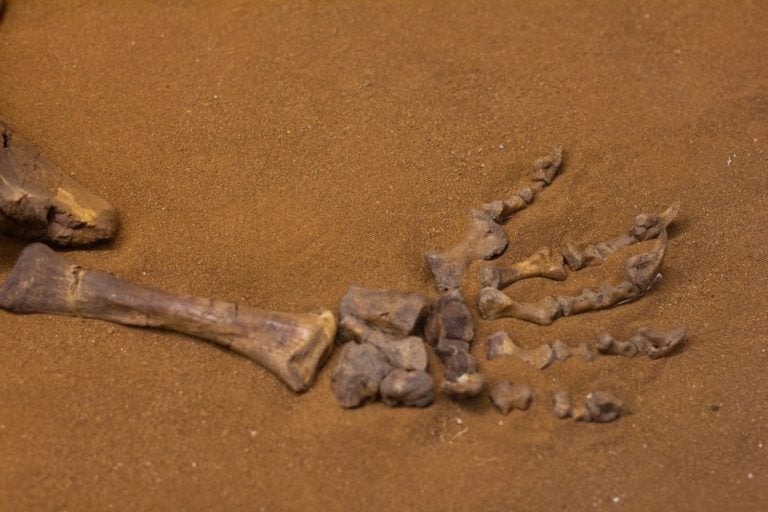
Fossils of the coelacanth were once the only options scientists had for studying it.
©Faviel_Raven/Shutterstock.com
“Hunt, who kept the fish in formalin for 10 days, took me on a boat, where he had the fish wrapped in cotton wool. I knelt down to look at it, and I am not ashamed to say that I wept. This culminates 14 years’ search.”
The specimen, which was five feet long and weighed 100 pounds, was nearly identical to the ancient fossils: “almost bone for bone and fibre for fibre with those which lived from 300,000,000 to 70,000,000 years ago.”
The Impact of the Coelacanth’s Rediscovery
The coelacanth is what scientists refer to as a Lazarus taxon—a species that vanishes from the fossil record only to reappear in our natural world. While its lineage first appeared approximately 400 million years ago, the coelacanth was absent for decades. Scientists speculated it might represent an evolutionary link between sea creatures and the first land animals, making its rediscovery a vital scientific breakthrough.
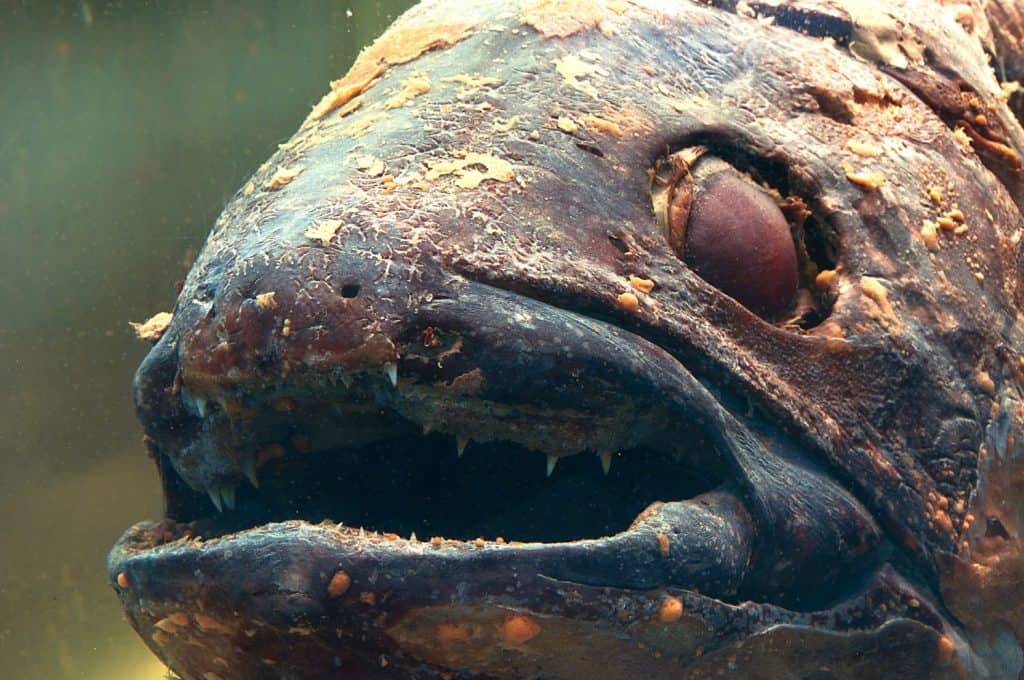
This ancient fish likely survived unnoticed because of its nocturnal behavior, spending its days in deep-sea caves.
©Openfinal/Shutterstock.com
As Smith explained, finding this living specimen intact and with so many indicators of a potential sea and land creature link, it “showed convincingly that scientists’ deductions and reconstructions had been uncannily accurate.” It also corrected previous scientific errors, resolved long-puzzled questions about vertebrate anatomy, and, according to Smith, “has made some scientists realise that it is unwise to be too dogmatic…The hope that other creatures, believed long extinct, may still lurk somewhere unknown.”
Does the Coelacanth Still Exist Today?
Additional coelacanth specimens have been caught in the Comoro Islands through the following decades, and the species has since been found along the coasts of Kenya, Tanzania, Mozambique, Madagascar, and South Africa’s KwaZulu-Natal. In 1998, a second coelacanth species, dubbed Latimeria menadoensis, was identified in the waters off Sulawesi, Indonesia, nearly 10,000 kilometers from the Comoros.
As recently as 2025, divers from UNSEEN Expeditions captured the first in-habitat footage of the Indonesian coelacanth in the North Maluku archipelago, expanding the species’ known range even further. Despite these discoveries, both species remain rare and vulnerable to extinction.
The fish appear to shelter in deep underwater caves during the day, venturing out at night to hunt at depths between 90 and 300 meters. This behavior is one reason they escaped scientific notice for so many years.
After so many years, researchers are now finding live coelacanths in their wild habitats.
©Catmando/Shutterstock.com
Courtenay-Latimer lived to the age of 97 and was celebrated throughout her life as the discoverer of the coelacanth. Because of her persistence, we can now study and learn from a fish that has inhabited our planet for roughly 400 million years.