
Quick Take
- Dogs experience basic emotions like joy, fear, anger, disgust, and attachment.
- Brain scans show reward centers light up when dogs smell familiar people or hear praise.
- Context and individual differences in dogs matter, and misreading emotional signs is common.
Ask most dog owners and they won’t hesitate to tell you: their pup feels as many emotions as humans do. The surprising news is that science mostly agrees, but only up to a point. There is clear evidence for basic feelings in dogs, but what’s the truth when it comes to canine cognition and emotional depth?
Modern tools like MRI scanners are giving us a glimpse into how dogs feel and process those feelings. Brain-imaging research combined with large surveys of dog owners are both helping scientists pin down which emotions dogs are actually feeling and which ones we might be projecting onto them. Are dogs just as human as we want them to be, or do they hold less emotional depth than we think?
To find out the truth, we sat down with Teagan Coleman, a dog behaviorist for over a decade and trainer at NLR Explore Dog Training. Using scientific studies, polls or statistics, and Coleman’s own expertise, we’ll discuss dog emotions across the board. Let’s get emotional with our pups!
The Emotions We Know Dogs Definitely Have (So Far)

Dogs are capable of having emotions similarly to that of a 2-3 year old child.
©Daniel Myjones/Shutterstock.com
The confirmed emotions experienced by dogs are placed into either of two categories: primary or basic. So far, the emotions that have been confirmed are joy, fear, anger, disgust, and something akin to affection or attachment. Articles summarizing this research, including Psychology Today’s overview of which emotions dogs actually experience, note that these are the same feelings we see in very young children, around age 2-3, before more complex social emotions develop.
However, this confirmation doesn’t mean dogs feel those emotions in exactly the same way humans do. What it does mean is that their brains and bodies react in consistent patterns, which we can use to better understand the potential emotions at work in a dog. Veterinary behavior resources such as the VCA’s guides to canine emotion and body language, describe signals that are universal enough for vets and trainers to rely on them in everyday practice.
Coleman posited that these emotions can still manifest in ways we don’t expect, given that we’re human. “Joy in a dog is obvious. You see it when a dog recognizes their person in a crowd or gets the zoomies. Fear is just as real, but people can miss it because they expect to see a scared dog. A lot of fearful dogs get still and quiet, or they’re capable of barking and lunging. The emotion underneath is the same.”
Joy, Love, and a Dog’s Reward Center
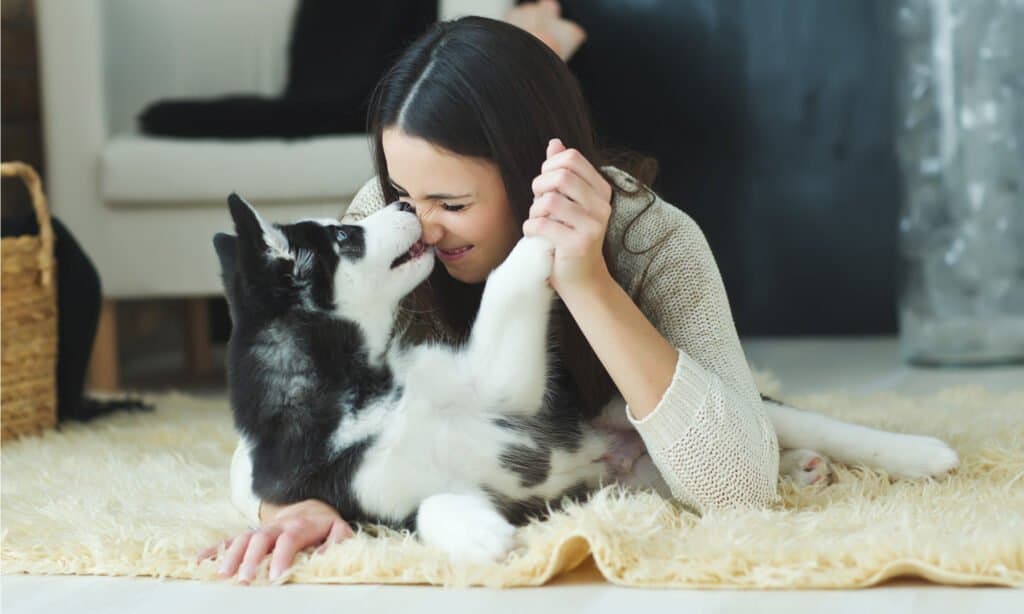
Dogs often show their affection by licking their owners, and affection is one emotion they’re capable of feeling.
©Nina Buday/Shutterstock.com
If you’ve ever wondered whether your dog is truly happy to see you or just plain hungry, brain scans and research have the answers. Researchers trained dogs to lie awake in an MRI scanner and offered them different smells, including their owner’s scent as well as unfamiliar humans and dogs. The results? The scan showed that the part of the brain associated with reward lit up most strongly when dogs smelled their familiar, beloved person.
Another fMRI study compared brain activity when dogs expected food versus praise from their owner. Many dogs showed just as much or even more activation in reward areas when they anticipated their person’s praise compared to when they anticipated food. Additionally, follow-up behavior tests found that many of those same dogs chose to go to their owner for affection as often as, or even more than, heading for their favorite treats, though individual preferences varied.
When I told Coleman my chihuahua mutt always chooses treats over my affection, she laughed. “Every dog is different and treat motivation goes a long way, but they still feel affection for you,” She reported. “There’s real pleasure and connection there, something they want to feel. I see it especially in pit bulls. They’ll lean their whole weight into you and really feel at peace when they can sense your heartbeat. At least, that’s how my girls are.”
Fear, Anxiety, and Stress

Our tone of voice and vocalizations are one of the main ways dogs pick up on emotions in humans.
©Lindsay Helms/Shutterstock.com
Fear is one of the best-documented canine emotions, with many sources pointing out that some dogs carry varied anxieties linked to noise sensitivity, nervousness, or fearfulness, much like anxious humans do. Environment and learning shape how those tendencies play out, with behavioral guides explaining that dogs can pick up on human stress and react with their own.
Dogs also respond strongly to emotional sounds and how we vocalize. In certain studies, researchers played positive and negative vocalizations from both humans and dogs, with the dogs’ behavior changing depending on what they heard. This ultimately meant they weren’t just noticing noise or the vague words their humans said, but the emotional tone in both humans and other canines.
Coleman said, in her experience, misunderstanding fear is incredibly common for dog owners. “People will say that their dog’s being stubborn, but I typically just see a dog who’s terrified of the tone that’s being used toward them, or overwhelmed by the environment they’re learning in. Fear shuts down learning faster than anything, but it may not always look like a cowering dog.”
Do Dogs Really Grieve?

Grief isn’t the word most researchers use when describing a dog’s emotional state, but their behaviors can shift following a perceived loss.
©iStock.com/Mumemories
For a long time, scientists dismissed grief in dogs as projection, something humans placed on them to further anthropomorphize man’s best friend. However, recent research proves that’s starting to change.
In 2022, a team in Italy surveyed more than 400 owners who had lost one dog in a multi-dog household. Their study ultimately uncovered that about 86 percent of surviving dogs showed at least one significant behavioral change. They either played less, slept and ate differently, or sought more attention. Additionally, the closer the relationship between the dogs, the more intense the changes tended to be.
Researchers are careful to avoid the word “grief” to describe this change in behavior, because we don’t truly know if dogs understand death the way humans do. However, these grief-like emotional patterns have been observed lasting for a few days to several months after a perceived loss. Whatever we end up calling it, the surviving dog’s mood and behavior are clearly affected.
Coleman said she’s seen this shift, both at work and within her own pack. “I’ve had dogs come into board-and-train after losing their packmate, and they’re just…muted,” she noted. “They follow you from room to room but don’t really engage at first. When my girls lost their packmate, it was like they kept leaving space for her, expecting her to show up. They clung closer to one another too, but it took months for them to stop leaving that hypothetical space for their lost sister.”
People will say that their dog’s being stubborn, but I typically just see a dog who’s terrified of the tone that’s being used toward them, or overwhelmed by the environment they’re learning in. Fear shuts down learning faster than anything, but it may not always look like a cowering dog.
Teagan Coleman, dog behaviorist for over a decade and trainer at NLR Explore Dog Training
Jealousy, Empathy, and More Complicated Feelings
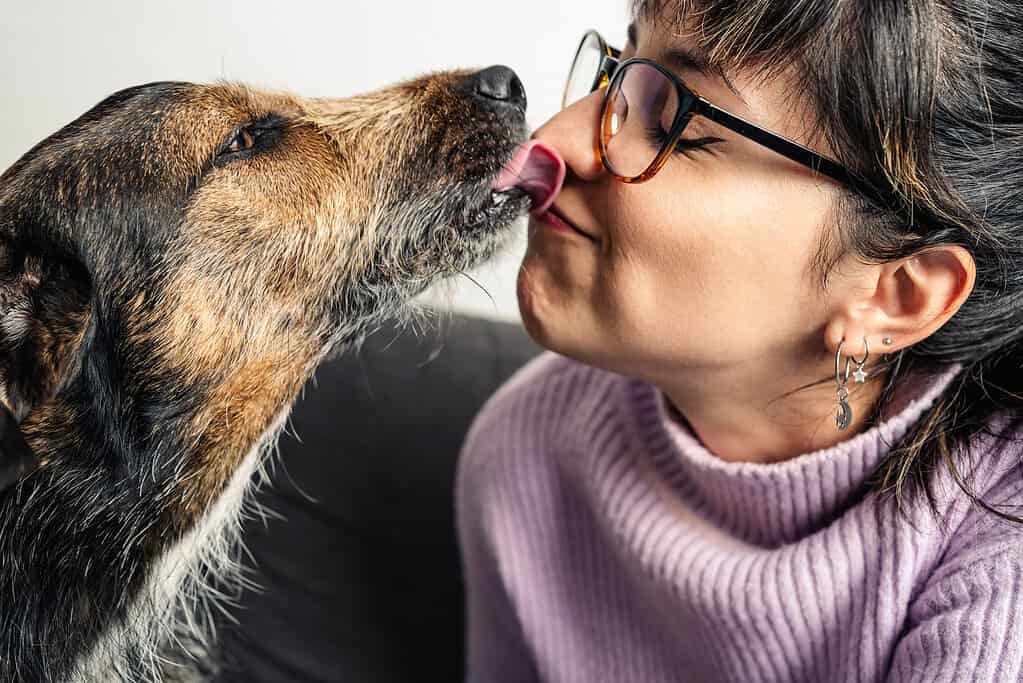
Dogs appear aware of our emotions, so much so that research suggests our stress levels may sync up.
©Andres Jacobi/iStock via Getty Images
Some emotions can be incredibly difficult to ascertain in dogs. Jealousy is one such emotion. In a widely discussed experiment from the University of California, San Diego, owners were asked to give affection to a realistic stuffed dog, while completely ignoring their own pet. The real dogs often tried to wedge themselves between the owner and rival, snapped at the fake dog, or otherwise tried to earn back some attention. This suggested dogs may experience a form of jealousy when a valued relationship is threatened.
Empathy is trickier, but there’s growing evidence that shows dogs can distinguish between happy and angry human faces and voices. Dogs also often respond to crying or distress by approaching and offering contact to their humans. Recent research on emotional contagion suggests that dogs’ heart rates and stress hormones can track with their owners’, a phenomenon now well-supported by scientific studies published in 2024 and 2025.
I asked Coleman about her experience with this phenomenon. “The bully breeds I work with, including my own girls, are famously empathetic. If you’re sick, they’re glued to you. If you’re crying, they’re there. Is that full human empathy? Science will argue about that forever. But for me and my experience with dogs, I treat it as a real emotional response that deserves our respect.”
What About Guilt, Spite, or Stubbornness?

Stubbornness isn’t quite an emotion dogs understand, and guilt is the same way.
©220 Selfmade studio/Shutterstock.com
Complex social emotions such as guilt, shame, pride, spite, or revenge are ones still meriting further study. Many of these emotions require a level of self-awareness and understanding of rules that dogs probably don’t have or at least have not demonstrated to us yet.
Coleman told us that she spends a lot of time translating these misunderstandings for clients. “If we label a dog as stubborn, we’re basically blaming them for having feelings and unmet needs, which is why I ask owners to rephrase and recontextualize what they’re seeing. When you ask, ‘Is this dog scared, confused, frustrated, or under-exercised?’ you find solutions instead of excuses.”
That “guilty look” after your dog shreds the trash? Studies, including a 2025 Guardian feature, suggest it is appeasement behavior and fear in response to your tone and body language, not a true awareness of having broken a rule. Likewise, what looks like spiteful behavior is almost always stress, separation anxiety, or lack of appropriate outlets; both behaviors are rooted in simple fear.
Reading Your Dog Without Over-Humanizing Them

While dogs have emotions, understanding how these emotions manifest differently from human emotion is necessary.
©Prostock-studio/Shutterstock.com
So how can you honor your dog’s emotional life without turning them into a human? Coleman’s advice was this: “Pay attention to what your dog’s happy baseline looks like. How do they move, how do they greet people, what’s their normal energy level? When something is ever off in terms of these things, you can catch emotional shifts early and help their overall happiness in the long run.”
Journalists who cover this topic, like the authors of a recent Washington Post feature on misreading dog emotions, report that humans often rely too much on situational context and not enough on the actual behavioral cues dogs display. Tail wagging direction, eye shape, and muscle tension can all shift with emotion, and dogs notice these details in each other and us, even when humans don’t.
“Once you accept that your dog has a rich inner life, but not as complicated as a human one, you can meet them where they are,” Coleman reported. “I want people to look at their dog and truly start paying attention to what their dog is capable of feeling, because they do have emotions. Their emotional needs are just always going to manifest differently from ours, but it’s always possible to meet those needs.”