
Quick Take
- Their talons dwarf one of nature's most feared predators, which is a comparison that is harder to believe than it sounds. See the talon comparison →
- Female harpy eagles are dramatically larger than males, a size difference whose evolutionary reason flips most instincts about predator size. Explore the size difference →
- Harpy eagles gave up something critical to become deadly hunters in the rainforest canopy, and their wing design reveals what that trade-off was. See the wing trade-off →
- One of the world's most powerful eagles can sit motionless for an almost absurd stretch of time before it strikes at 50mph. Discover the hunting strategy →
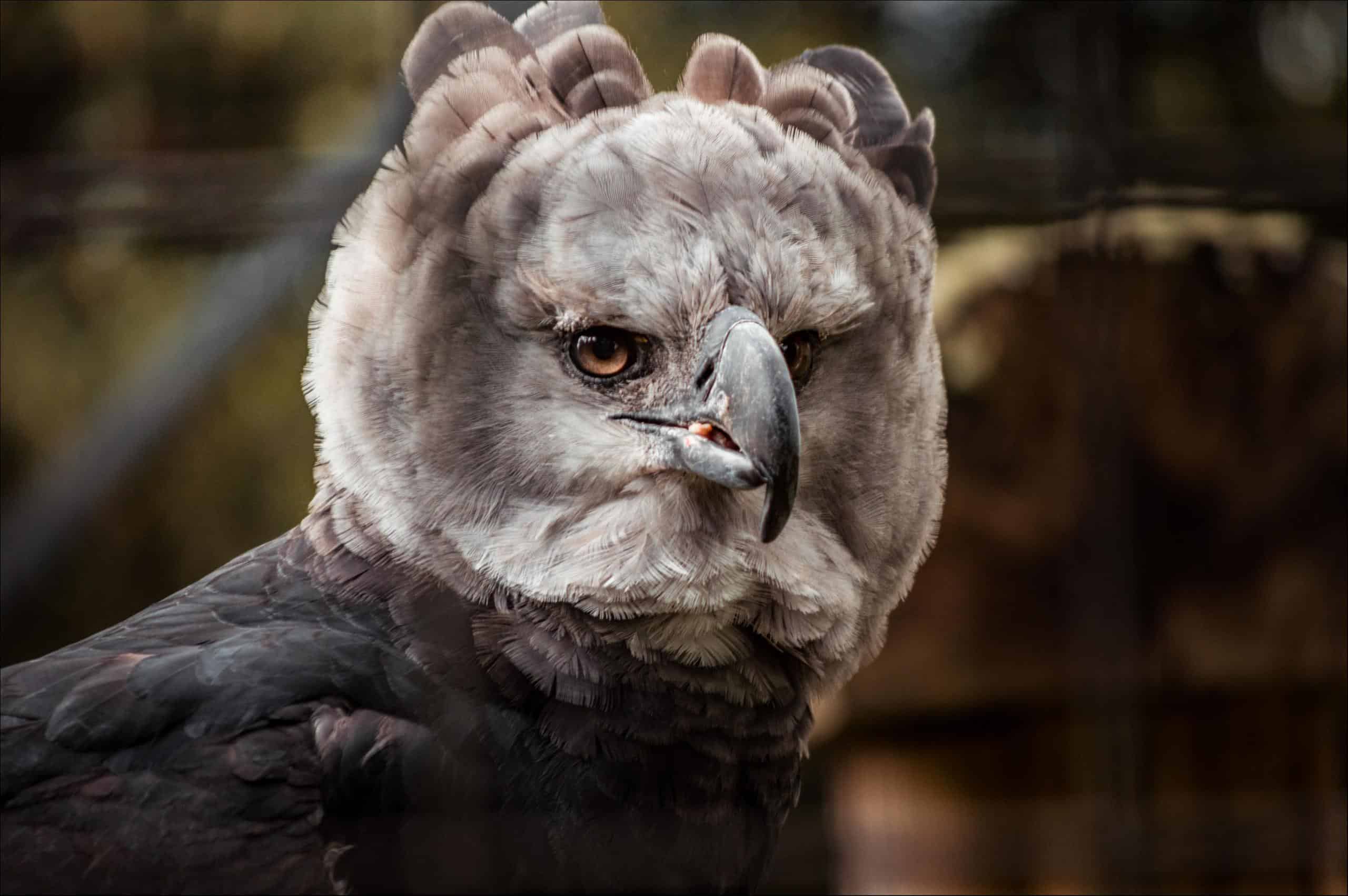
Harpy eagles (Harpia harpyja) are among the largest flying birds in the world. With their slate-grey and white feathers, large, hooked beaks, and plumed crests, these eagles are easily recognizable. They were named after the harpy of Greek legend, a half-woman, half-bird monster. Below, we take an in-depth look at the wingspan and size of the harpy eagle to discover just how big these birds really are.
Harpy Eagle Wingspan and Size
Harpy eagles are sexually dimorphic when it comes to size, meaning the females are larger than the males. This is common in most raptor species and allows males to hunt more easily while females defend the nest. Female harpy eagles can weigh between 14 and 20 pounds, while males only weigh 8.5 to 12 pounds. They stand 2.9 to 3.4 feet tall, with females typically being taller.
Most sources indicate harpy eagles have a wingspan of 6.5 feet, though some sources suggest it could be larger. Their powerful legs are as thick as a child’s wrist. Their talons can grow up to 5 inches long, which is longer than a grizzly bear‘s claws.
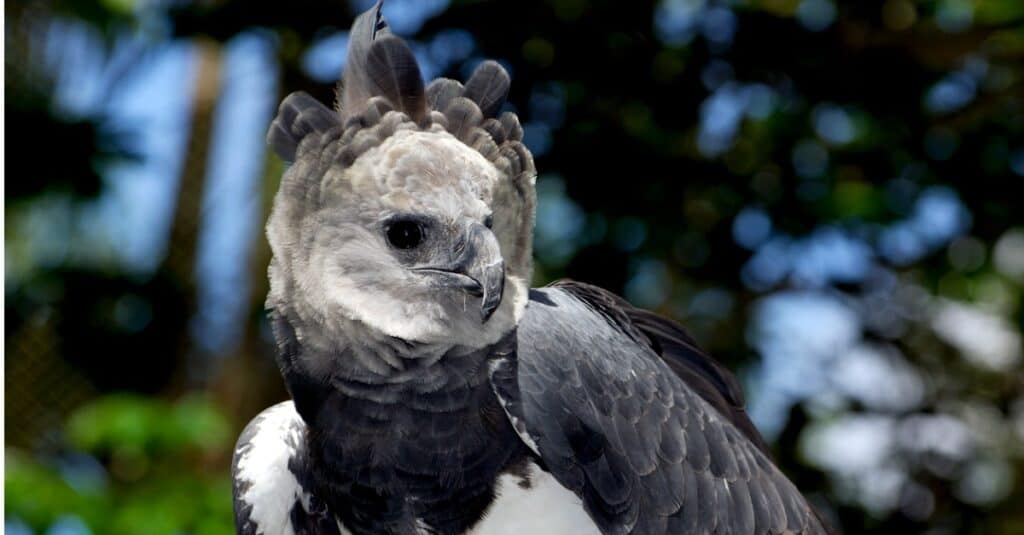
Harpy eagles live in the rainforests of Central and South America.
©Alfredo Maiquez/Shutterstock.com
Harpy Eagle Habitat
The harpy eagle’s range historically extended from southern Mexico through Central America and into South America as far south as northern Argentina. However, today their populations are fragmented and they are rare or entirely absent from many parts of their former range. As nonmigratory birds, they continuously hunt within their established territory.
Harpy eagles inhabit rainforests, building their nests 90 to 140 feet above the ground. They favor trees with wide branches for easier landings and takeoffs. Because harpy eagles live primarily under the rainforest canopy, they must quickly maneuver and hunt prey through dense trees. Relative to their size, harpy eagles have shorter but broader wings, which makes them significantly more agile than other eagle species. The drawback is that they are not suited for the types of flight other eagles perform, such as flying at high altitudes or soaring long distances.
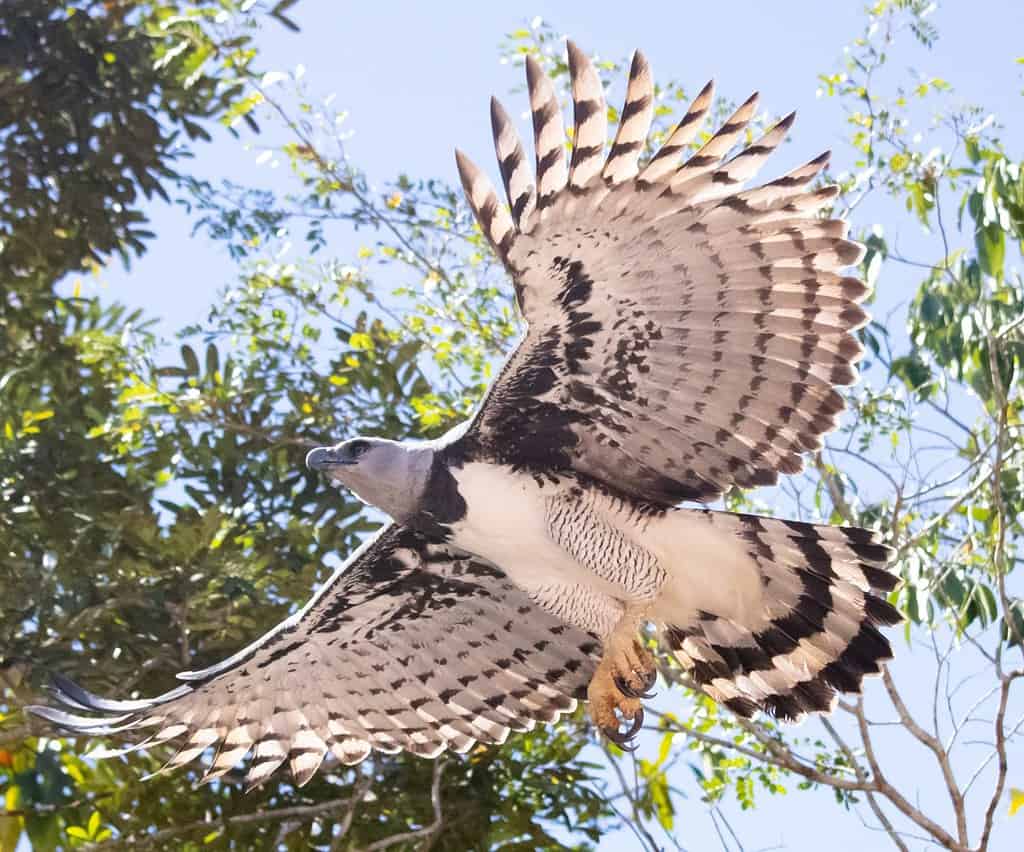
Designed for agility, harpy eagles can fly up to 50mph through dense canopy cover.
©Alves-Silva K. R/Shutterstock.com
How Far and Fast Can a Harpy Eagle Fly?
Harpy eagles do not travel great distances to find food and therefore do not typically fly for long periods. Instead, they sit perched in trees, waiting for movement in the canopy. Harpy eagles have been known to perch and wait for up to 23 hours at a time.
When they finally see prey, they can reach speeds of 50mph and snatch large animals right from a tree. They are among the strongest of all eagle species, capable of killing and carrying prey as large as or larger than themselves. When a harpy eagle strikes, its talons can exert hundreds of pounds of pressure, often killing its prey instantly.