
Quick Take
- Vulturine guinea fowl’s blue and white plumage comes from feather structure, not pigments, creating vivid, long-distance visual signals.
- Bright colors and high-contrast patterns help birds recognize group members, maintain cohesion, and communicate quickly in open savanna habitats.
- Plumage also signals health and can confuse predators, linking appearance directly to survival and social behavior.
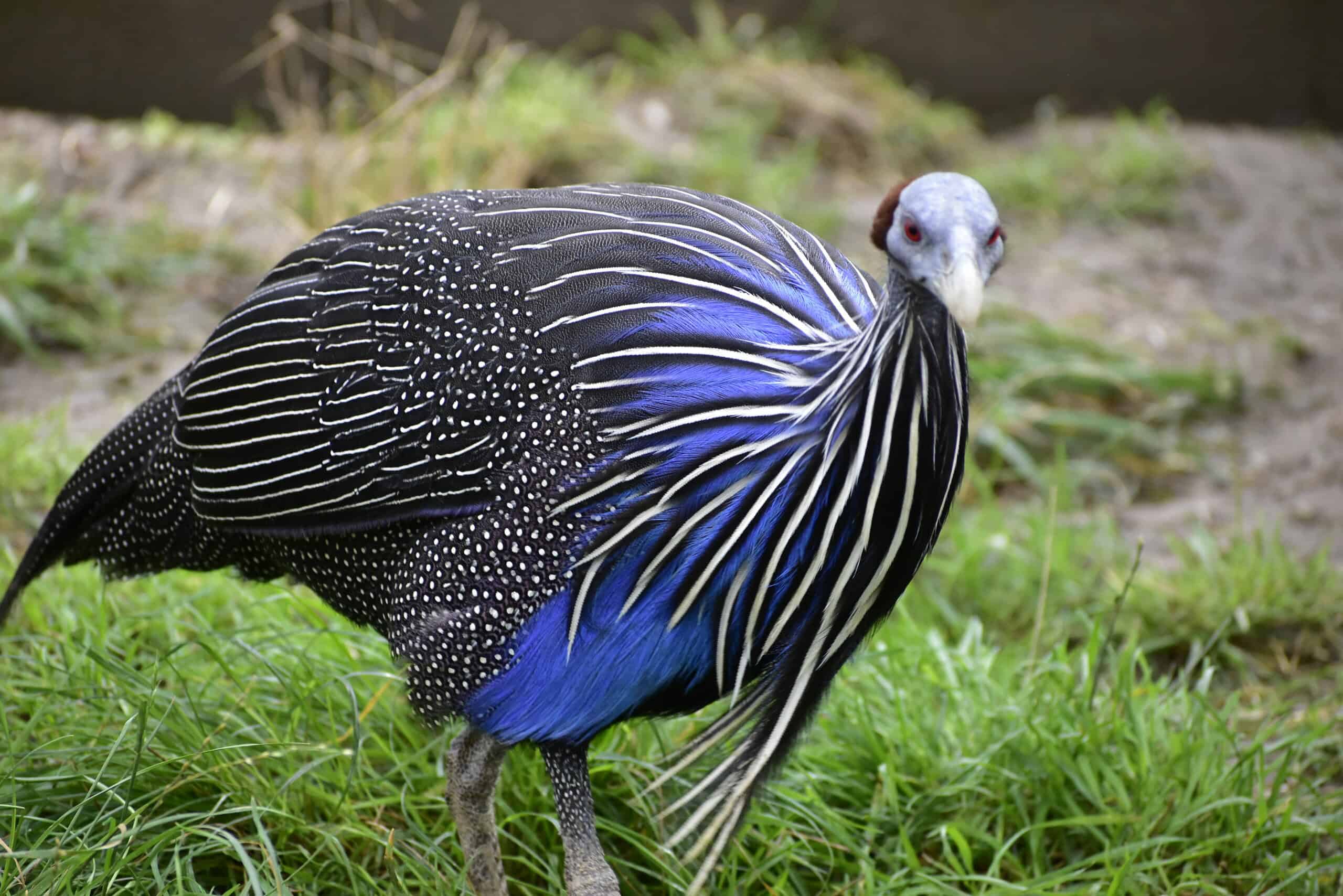
On the open savannas of East Africa, a flock of vulturine guinea fowl looks almost unreal. Bodies are patterned with crisp black and white lines. Chests and backs glow a deep, cobalt blue. Against the dry grass, dust, and acacia trees, the birds seem impossibly vivid. But this bold plumage doesn’t exist just to look good; it shows a complicated interplay between physics, biology, and social behavior. It helps these birds communicate, coordinate, and survive in some of the most exposed habitats on Earth. By examining feather coloration alongside behavior and ecology, we see how the guinea fowl’s appearance provides insight into how evolution shapes communication systems in response to predators, social living, and harsh environments.
Feather Coloration
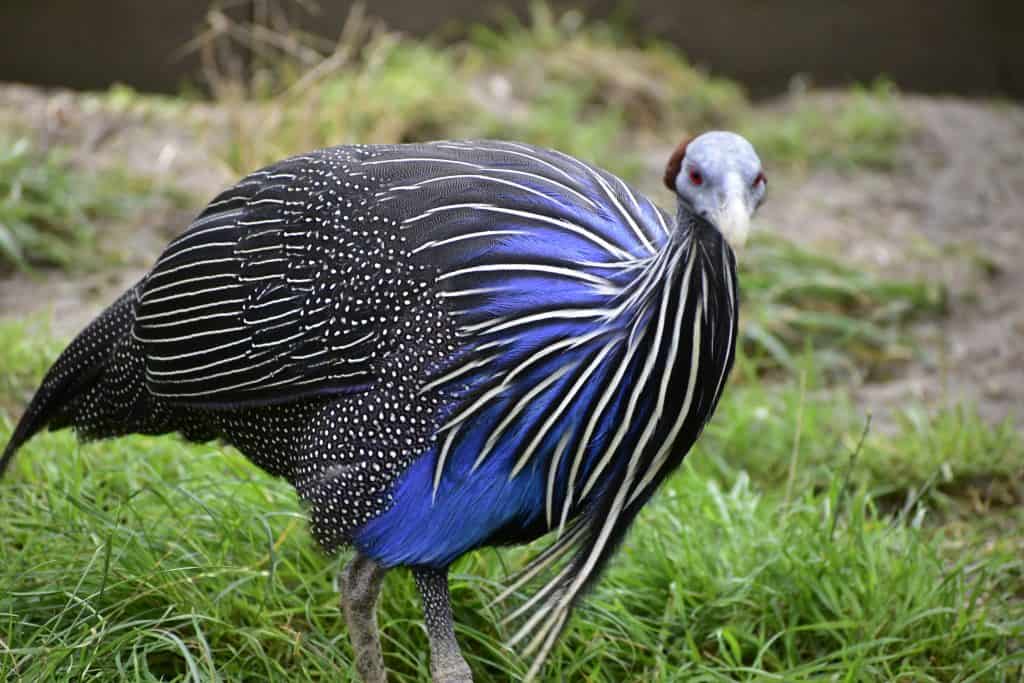
Blue in vulturine guinea fowl comes from microscopic feather structures that scatter light, not pigments.
Bird feathers can produce color in two fundamentally different ways: through pigments and through structure. Pigment-based colors come from chemical compounds that absorb or reflect certain wavelengths of light. Melanins create blacks, browns, and grays, while carotenoids produce reds, oranges, and yellows. These pigment-based colors are relatively straightforward: the molecule itself determines the color seen. Notice, though, no mention of blue.
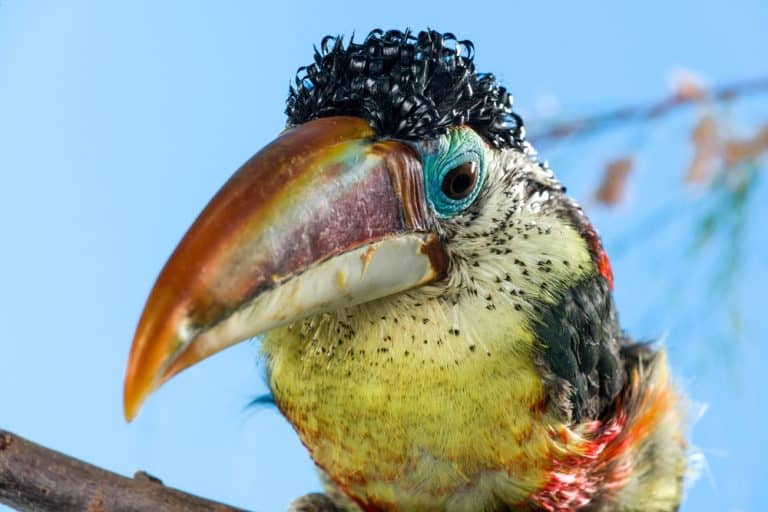
Blue feathers usually work differently. In most birds, blue isn’t created by a blue pigment; it’s produced through structural coloration. At a microscopic level, feather barbs are structured such that they scatter incoming light so that shorter wavelengths—blue light—are reflected back to the observer, while longer wavelengths—not blue—are absorbed. In simple terms, the feathers absorb and hide all other colors, leaving only the blue for the eye to see. It’s the structure of the feathers, not chemistry, that results in this vivid blue.
Structural colors behave differently from pigment colors because they interact with light. They can appear brighter or duller depending on the angle of the sun or the viewer’s position. For vulturine guinea fowl, this works to their advantage. Their blue feathers stay bold and easy to see even under the intense, overhead sunlight of the savanna. The color does not flash or shimmer like a hummingbird’s feathers, but it remains consistently visible, making it effective for communication in open landscapes.
Why Is Blue So Rare in Birds?
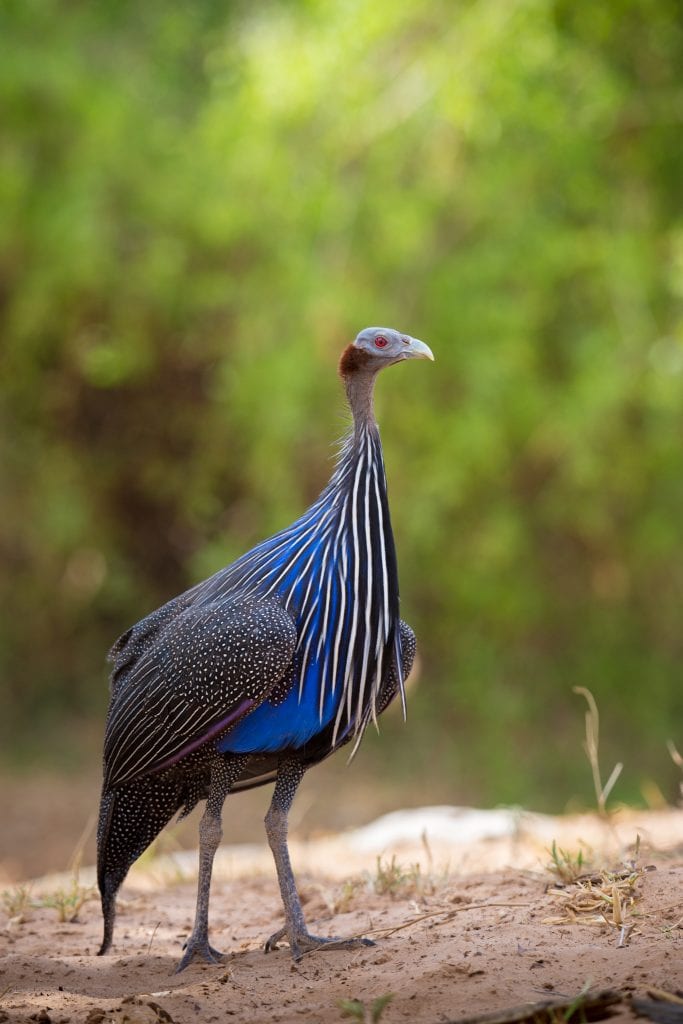
Structural blue requires precise feather growth, making it rarer than pigment-based colors and a sign of good health.
©Sumeet Moghe, CC BY-SA 4.0 – License
Why aren’t more birds blue? Given how striking it is, one would think natural selection would favor it. A lot of it has to do with the precision required to produce structural coloring. Even the tiniest changes in spacing or organization can shift the blue toward dull gray or green. Maintaining these structures during feather growth may be more demanding than depositing pigments. This is especially true in environments where nutrition fluctuates—without proper nutrition, their bodies may not be able to produce the tiny layers of keratin necessary to uphold the delicate structure.
Pigments also tend to be more versatile. Melanins strengthen feathers and provide resistance to wear and ultraviolet radiation. Carotenoids, which are diet-dependent, can also indicate health or foraging ability. Structural blue offers visual impact, but it doesn’t provide these additional benefits. As a result, blue might only evolve when the social advantages of visual signaling outweigh the costs—like standing out as easy prey—of being conspicuous.
Another important point is how the color looks against the surroundings. Blue really stands out on the dry, brown grasslands and savannas where vulturine guinea fowl live. But in dense forests with many green leaves and shadows, bright blue may not be as helpful—and could even make a bird more visible to predators. Many blue birds do live in forests, but their coloration is usually effective only at close range, such as when signaling to a nearby mate. The vulturine guinea fowl is unusual because it is bright blue and lives in open areas, where it can be seen from far away, and there are few places to hide.
The Distinctive Pattern
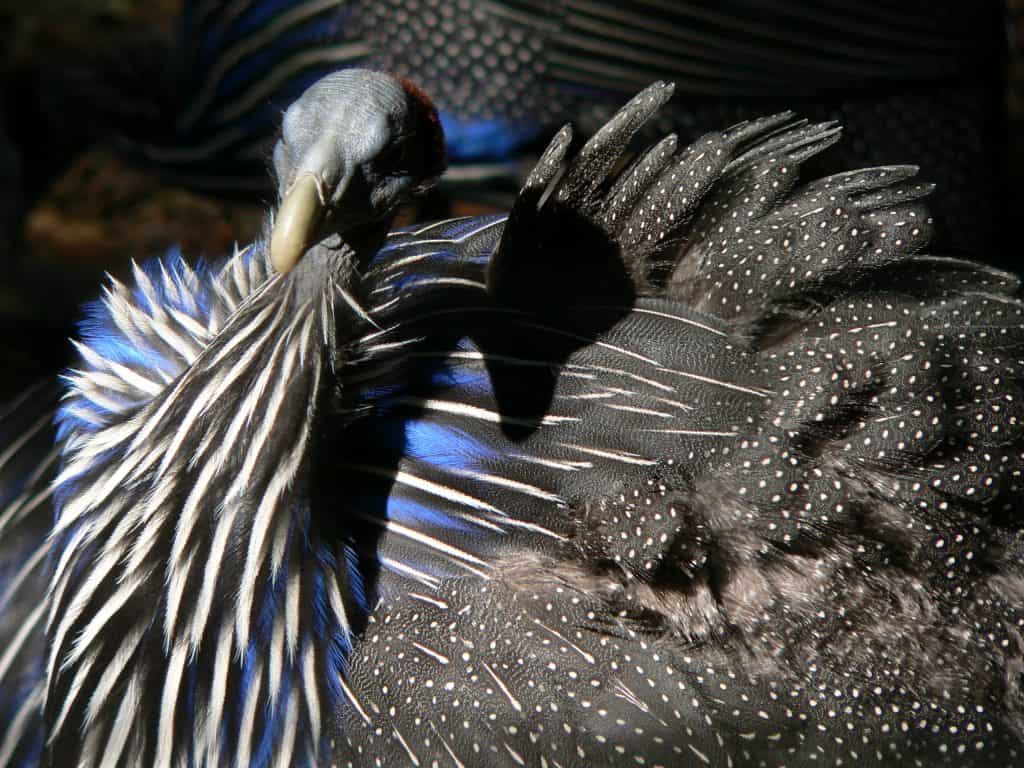
Bold blue and black-and-white stripes help birds recognize group members and stay coordinated in tall grass.
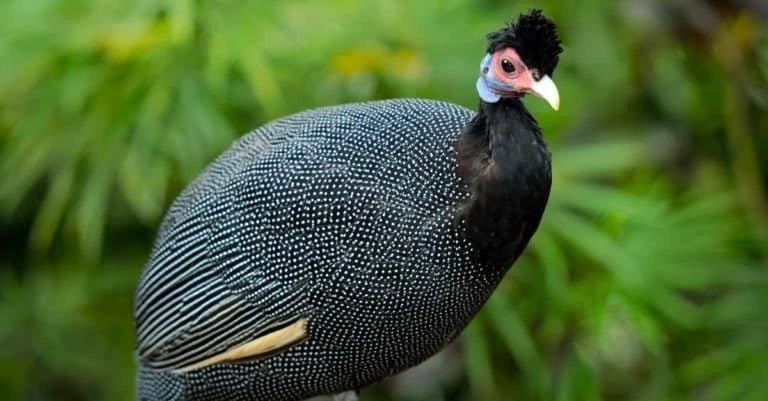
The guinea fowl’s feathers aren’t just blue—they are carefully patterned. Its body has black and white stripes that look like tiny scales, while the blue feathers cover the chest and upper body in a solid, bright patch. The head and neck have little or no feathers, which makes the colors stand out even more.
These patterns aren’t just for show. While guinea fowl also use calls to communicate, sounds don’t always travel far or clearly. Visual signals, like feather patterns, are fast and reliable, especially in open spaces with lots of sunlight. High-contrast colors and bold designs make it easier for birds to see each other from far away or in tall grass. This is especially important because vulturine guinea fowl spend most of their time on the ground in open areas, where there’s not much to hide behind.
Unlike birds that live in forests, where hiding is easy, being brightly colored in the open savanna can be risky. However, for guinea fowl, the benefits of being easily seen by their group outweigh the risks. Standing out helps them stay together and communicate quickly, which is more important for survival than blending in. Vulturine guinea fowl are highly social. They live in groups that can include dozens of birds, with smaller subgroups often remaining together over time. Group living helps them find food and watch for predators. For this reason, it is important for each bird to quickly recognize group members. Bright feathers facilitate this recognition. The blue and striped patterns act like a uniform, allowing birds to identify group members at a glance. Even small differences in brightness or feather quality may signal age, health, or status to other birds.
Unlike some birds, both male and female vulturine guinea fowl look very similar. This suggests that the colors are not primarily for attracting mates, as is often the case with colorful birds. However, the feathers can still signal health. Growing bright blue feathers requires good nutrition and proper feather development, so a bird in poor condition may have dull or uneven feathers. Other birds can interpret these signals, which may influence leadership, social bonds, and resource sharing within the group.
Behavioral Advantages in Open Habitats
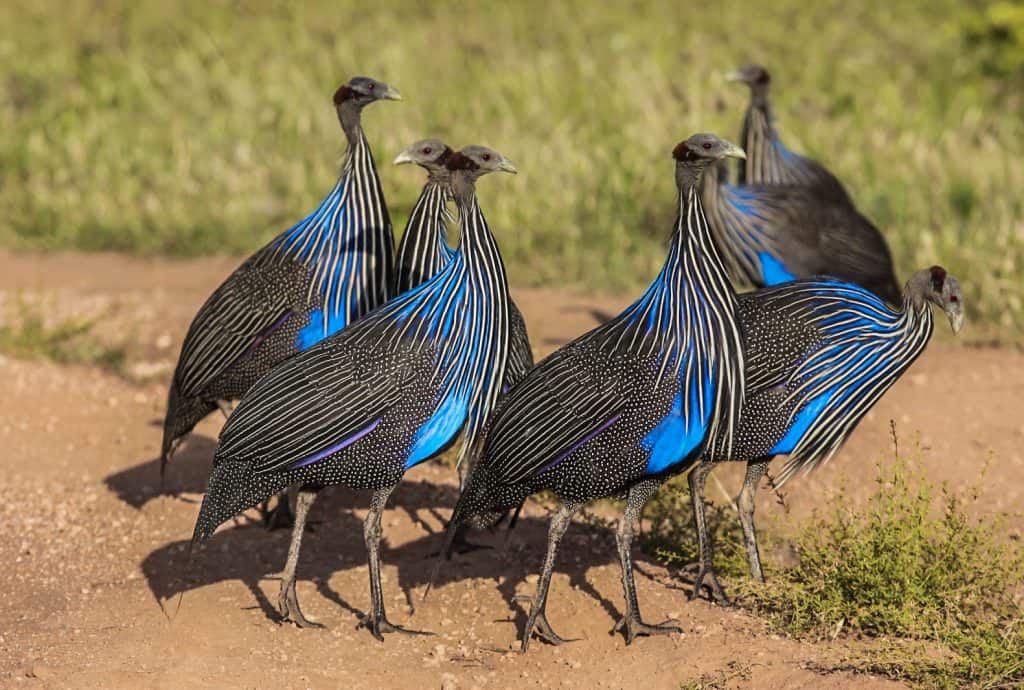
High-contrast plumage helps the flock react to predators and can confuse attackers by making it hard to target one bird.
Living on the open savanna is risky. There are few places to hide from predators like lions, hyenas, or eagles. But the bright colors of the guinea fowl can actually help. When one bird notices danger, it moves or calls, and the rest of the group can see the signal right away. The bold feathers make these movements easier to spot, helping the whole flock react quickly. Being bright can also confuse predators. When many similarly patterned birds move together, it’s hard for a predator to pick out a single target. This “confusion effect” gives the group a better chance of escaping.
The Language of Feathers
The vulturine guinea fowl’s striking blue and white plumage is more than just a beautiful display; it is a tool shaped by evolution that allows birds to communicate, stay coordinated, and survive in the open savanna. The bright, patterned feathers help individuals recognize friends, signal health, and move as a group, while also confusing predators and improving reaction times. Unlike flashy colors used mainly for attracting mates, these feathers serve both sexes, linking appearance directly to behavior and survival, not just reproduction. In the harsh landscapes of East Africa, the guinea fowl’s color is a language written in feathers—a language that tells who belongs, who is healthy, and how the group moves together. Every stripe and flash of blue carries meaning essential for life on the plains.