

Quick Take
- Two notoriously solitary tigresses are sharing childcare duties, a behavior whose underlying reason reveals something unsettling about conservation success. See the tiger "mommune" →
- Nepal nearly tripled its tiger population, but that victory quietly created a problem no one planned for. How success created overcrowding →
- A male tiger was caught on camera doing something textbooks say his species never does. See the male tiger footage →
- The researchers who cracked open these tiger secrets weren't scientists, and their methods are reshaping how conservation gets done. Meet the Queens of the Jungle →
Tigers are famous for being solitary predators that hunt, defend territory, and raise cubs entirely on their own. However, deep in Nepal’s Bardia National Park, a tigress named Goma is proving that isn’t always the case.
Captured by drone footage for the BBC series Tiger Island, Goma was filmed caring for five cubs at once — two of her own and three belonging to another tigress, Jugini. While Jugini was away hunting, Goma stepped in to babysit, creating a rare wild tiger “daycare.”
A Tiger “Daycare” That Defies the Textbooks
During the filming of the BBC documentary Tiger Island in Nepal’s Bardia National Park, researchers captured tiger behavior once considered impossible. The film crew focused on a small, 1.5-square-mile river island — an unusually crowded habitat for such territorial cats.

Bengal tigers primarily live in Nepal, India, Bhutan, and Bangladesh.
©Thes2680/Shutterstock.com
Using thermal cameras, night vision, and long-range drones, they discovered two neighboring tigresses, Goma and Jugini, sharing parenting duties. While Jugini was away, Goma was filmed lounging with all five cubs — her own two and Jugini’s three — in a single “cuddle puddle.” Researchers dubbed this tag-team childcare system a “mommune,” which allows one mother to hunt and rest while the other guards the young.
Why Would Tigers Cooperate?
This unusual setup raises a big question: why would two notoriously solitary predators team up? Researchers suspect the answer comes down to space and safety in Bardia’s crowded habitat.
Female tigers usually need vast territories of their own, but overcrowding may be forcing them to adapt. Working together offers a crucial tactical advantage: defense against rival males, who often kill cubs to sire their own. By sharing childcare, Goma and Jugini created a far stronger defense for their young.
Scientists also suspect the two tigresses might be related — possibly as mother and daughter — which could explain their unusual bond. However, co-parenting remains extraordinary, even among family members.

Female Bengal tigers typically weigh 220 to 350 pounds.
©pmvtisl/Shutterstock.com
Goma Isn’t the Only Tiger Breaking the Rules
The wild tiger “daycare” wasn’t the only surprise captured on Tiger Island. Thermal imagery showed an alpha male named Badheil gently playing with his cubs while Goma rested, challenging the long-held belief that males take no part in raising their young. Night-vision cameras also captured footage of a tigress hunting deer alongside her cub.
While shocking, male involvement isn’t completely unheard of. In 2006, a male Bengal tiger named T-25 famously raised and protected two orphaned cubs after their mother died. Together, these groundbreaking observations suggest that tiger social lives are far more flexible and cooperative than previously thought.
Nepal’s Tiger Success Created a New Challenge
The surprising discoveries in Bardia come on the heels of an incredible conservation success. In 2009, Nepal had just 121 wild tigers. The nation set out to double that number by 2022 but ended up nearly tripling it — reaching 355 tigers by 2022 and a record 429 tigers by 2026. Strict anti-poaching measures, restored grasslands, new waterholes, and wildlife corridors all drove this amazing recovery.

Nepal’s Bengal tigers mainly live in lowland Terai parks.
©iStock.com/Rajkumar Natarajan
However, a growing tiger population creates more competition for space. In Bardia, a single female tiger typically needs 6 to 8 square miles of territory, while males require up to 27 square miles. With available land shrinking relative to their numbers, tigers are forced into tight quarters. Experts at the Nepal Tiger Trust believe these habitat constraints and shifting territorial boundaries are driving tigers toward unprecedented cooperation.
Climate change is further compounding the problem. Shifting temperatures and drying water sources are pushing tigers into higher, unfamiliar terrain — with some spotted as high as 10,826 feet in the mountains.
The Women Tracking Nepal’s Tigers
Three local sisters — Sushila, Manju, and Ranju Mahatara — were instrumental in capturing this groundbreaking tiger footage. As some of the region’s first female wildlife guides, they pair traditional tracking techniques (reading prints, scat, and animal alarm calls) with modern thermal drones.

A large number of Nepal’s tigers live in Chitwan National Park.
©Wailani/Shutterstock.com
Nicknamed the “Queens of the Jungle” by the film crew, their deep understanding of Bardia’s tiger population made these discoveries possible, proving that local community involvement is a crucial part of Nepal’s conservation success.
Protecting Tigers Means Protecting Their Neighbors
While Nepal’s growing tiger population creates valuable jobs through ecotourism, living alongside dangerous wildlife isn’t easy. Sushila’s own family knows this firsthand; a wild elephant destroyed their original mud home. They were only able to rebuild a sturdy concrete house using earnings from wildlife guiding.
Sustainable tourism, anti-poaching roles, and community-managed forests give local residents a real financial stake in protecting wildlife. For example, eco-lodges like Burhan Wilderness Camp funnel tourism revenue back into local villages to support habitat conservation. Global attention from shows like Tiger Island can also help boost ecotourism — which directly strengthens the community-led effort to save tigers.
A New Look at a “Solitary” Predator
For generations, tigers have been viewed as the ultimate loners that live, hunt, and raise their young entirely alone. But new observations reveal a far more complex reality.
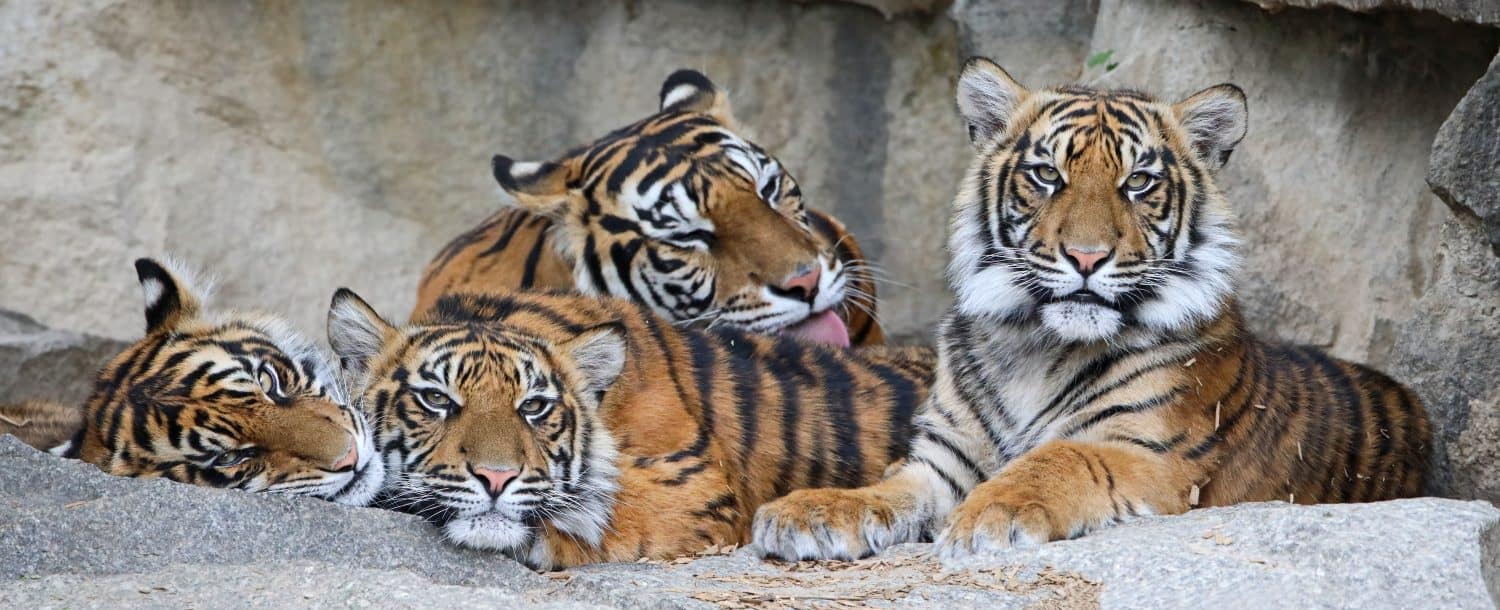
Bengal tigers typically have two to four cubs at a time.
©Henner Damke/Shutterstock.com
Modern tools like thermal imaging and long-range drones are capturing behaviors rarely seen in textbooks — such as a tigress babysitting another mother’s cubs, a father playing with his offspring, and young tigers hunting with their mothers. Whether these habits are new adaptations or long-hidden behaviors finally caught on camera, one thing is clear: when survival demands it in crowded environments, even these iconic solitary predators can adapt and cooperate.