Quick Take
- One beetle on this list never eats a single meal as an adult, yet it is the largest of them all. Meet the non-eating giant →
- Body length alone doesn't crown the heaviest beetle, and the actual record-holder will surprise you. See the heaviest beetle →
- Some of these beetles spend years as larvae but survive only weeks as adults, a contrast far more extreme than you'd expect. Larval years vs. adult weeks →
- At least one beetle on this list can stretch past nine inches, though its body is barely a third of that length. See the nine-inch antenna span →
Beetles are some of the most diverse animals in the world, with around 300,000 known species living in a wide variety of habitats. They are known for their particularly hard exoskeleton and powerful mandibles. However, some species are also known for reaching impressive sizes. With that in mind, we’ve compiled a list of the largest beetles in the world, ranked by body length.
European Stag Beetle
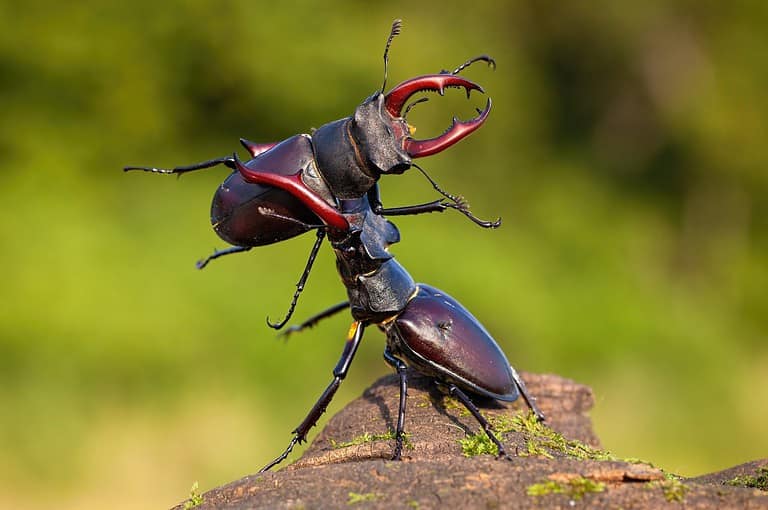
The European stag beetle (Lucanus cervus) is also known as the greater stag beetle. These beetles have a body length of approximately 5–9 cm (2–3.5 inches) in males and 2.8–5.4 cm in females, and are black with reddish-colored forewings and reddish mandibles in males.
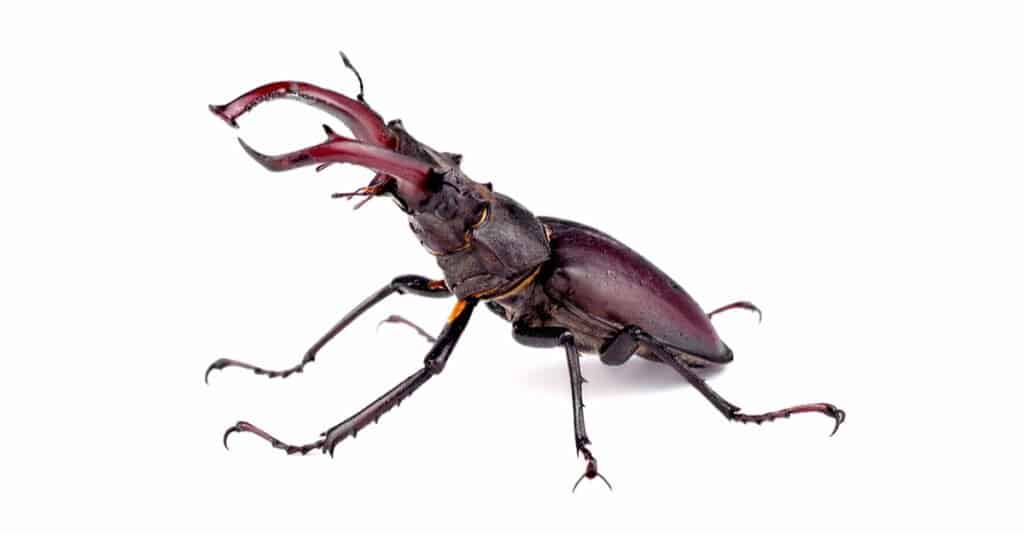
European stag beetles are around three inches long.
©Oleksandr Khalimonov/Shutterstock.com
As their name suggests, European stag beetles are found in Europe, although they are absent from several countries, including Ireland. They inhabit forest regions, where they eat fruit, decaying wood, and tree sap. European stag beetles have a particularly long lifespan in the larval stage, living from three to five years. However, they only survive for a few weeks as adults.
Hercules Beetle
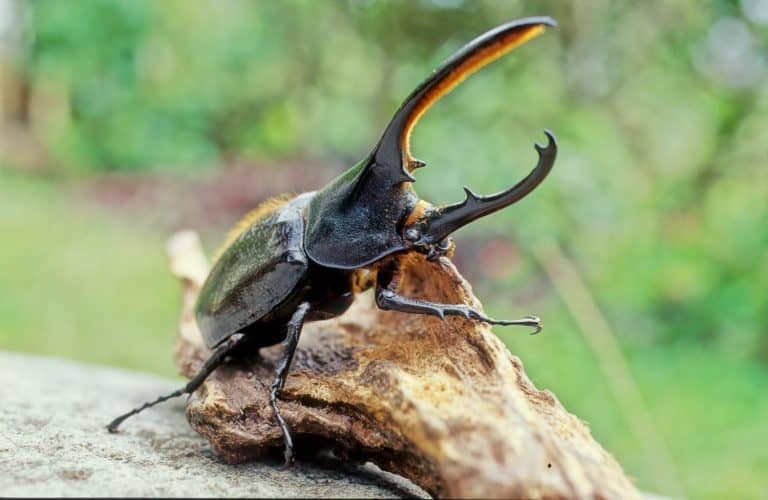
The Hercules beetle (Dynastes hercules) has a body length of around three inches, excluding the male’s extremely long horns, meaning their total length can reach seven inches. Males often use their horns to fight other males for mating rights, sometimes injuring each other in the process.

Male Hercules beetles use their horns to fight each other.
©feathercollector/Shutterstock.com
Hercules beetles are a species of rhinoceros beetle, and they have tan or greenish-colored elytra, which sometimes have a mottled appearance with small black spots. They inhabit the rainforests of Central and South America. Their larvae eat decaying wood, but the adults eat tree sap and rotting fruit.
Wallace’s Long-Horn Beetle
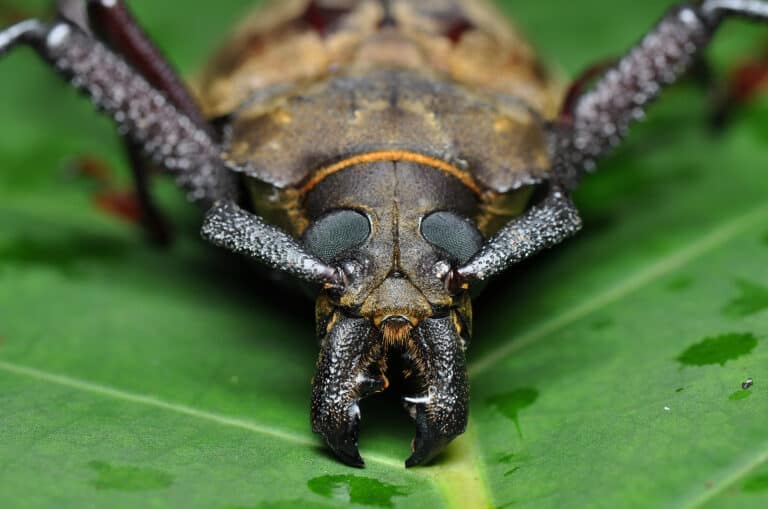
One of the most unusual beetles on the list is Wallace’s long-horn beetle (Batocera wallacei). These beetles have a body length of around 3.3 inches, but a total length of more than nine inches when its exceptionally long antennae are included.

Including their long antennae, Wallace’s long-horn beetles can measure up to nine inches.
©ALEX S/Shutterstock.com
Wallace’s long-horn beetles are grey or brown with white markings. They are named after Alfred Russel Wallace, who first discovered them on Indonesia’s Aru Islands in 1858, but they can also be found in Australia and Papua New Guinea.
Goliath Beetle
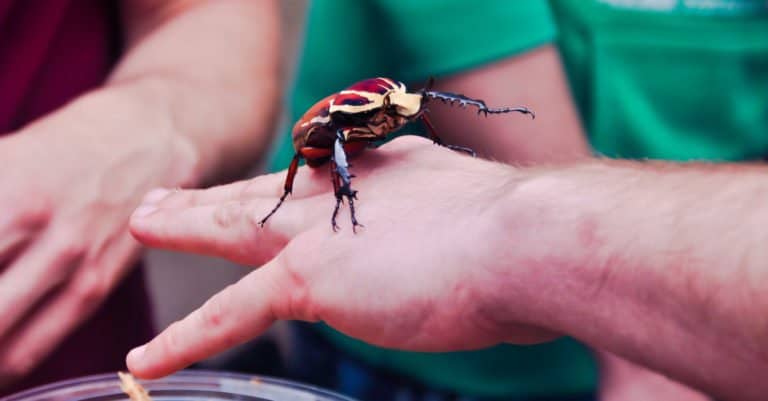
Goliath beetles (Goliathus spp.), which reach 4.5 inches long, are the heaviest beetles in the world, weighing up to 3.5 ounces in the larval stage, although they are only around half this weight as adults.
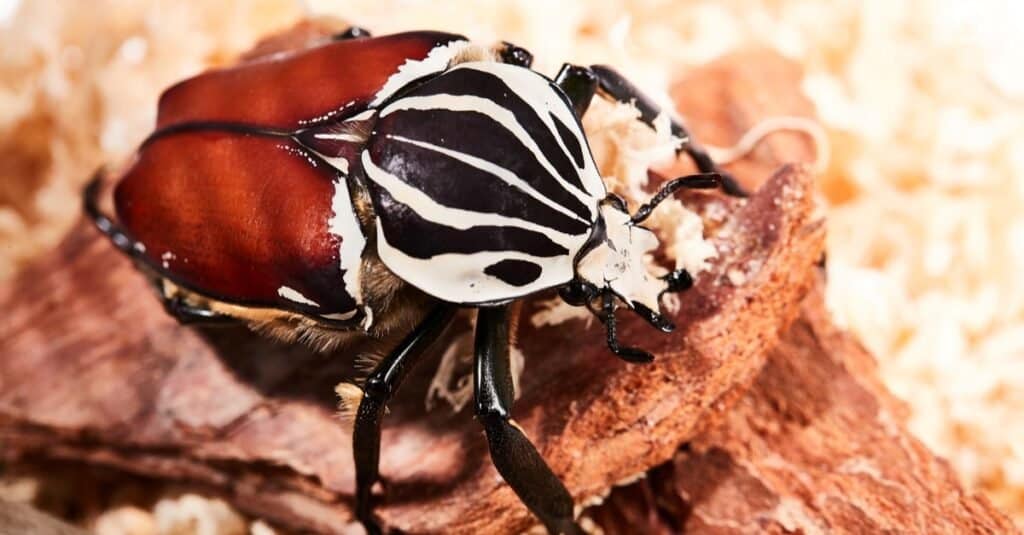
Goliath beetles are the heaviest beetles in the world.
©Yan Lv/Shutterstock.com
There are five species of Goliath beetles, and they are native to Africa, where they live in tropical forests. Although their appearance differs slightly between species, Goliath beetles all have striking white markings on their thoracic shield, while their other colors typically consist of brown, reddish-brown, and black. Males also have a Y-shaped horn on their heads, while females do not. As adults, Goliath beetles eat food with a high sugar content, such as rotten fruit and tree sap.
Giraffe Stag Beetle
Giraffe stag beetles (Prosopocoilus giraffa) are the largest species of stag beetle, with a body length of 4.7 inches. They can be reddish-brown to black as adults, while the larvae are white with orange heads.
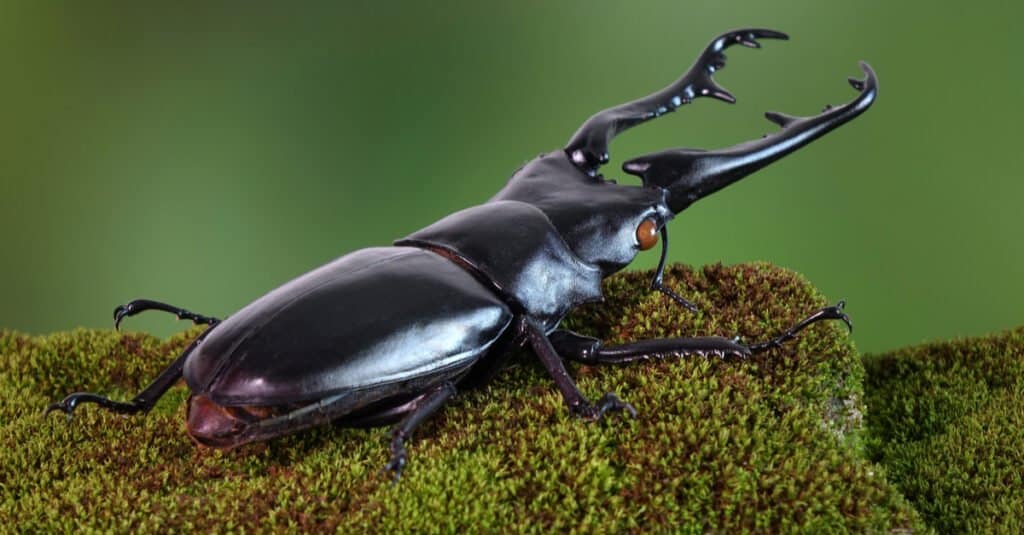
The giraffe stag beetle has mandibles with serrated edges.
©Mark Brandon/Shutterstock.com
These beetles have long mandibles with distinctive serrated edges. The males use these as weapons in fierce fights with other males when competing for females. Giraffe stag beetles are native to the tropical forests of Asia, where the adults feed on fruit and tree sap.
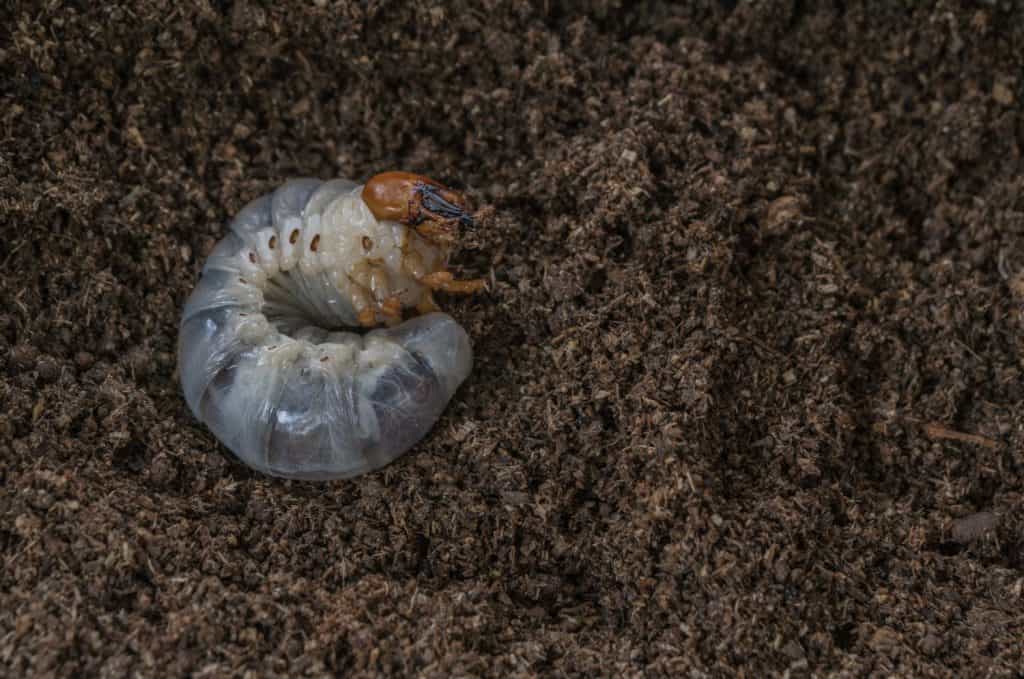
Giraffe stag beetle larvae are white with orange heads.
©sattra yothakhammee/Shutterstock.com
Actaeon Beetle
Actaeon beetles (Megasoma actaeon) are typically two to 4.7 inches long, although males can exceed five inches when including the length of their horns. They have a dark brown or black appearance and a wide, stocky body.
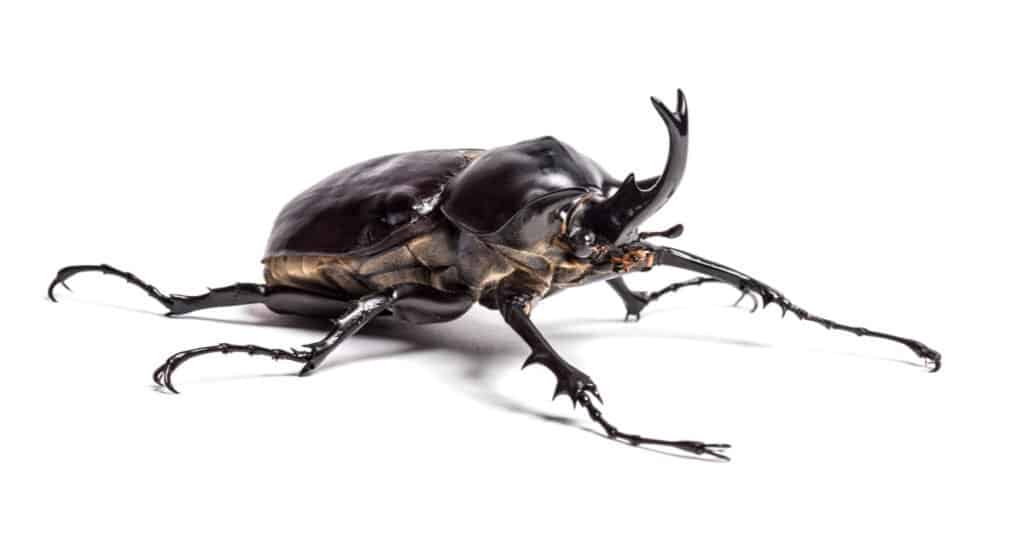
The Actaeon beetle lives for up to three years in the larval stage.
©Eric Isselee/Shutterstock.com
Actaeon beetles inhabit the tropical forests of South America, where they eat a variety of fruit and tree sap. Their larval stage can last up to three years, but adults live for only approximately 100 to 150 days.
Atlas Beetle
The atlas beetle (Chalcosoma atlas), which is a species of scarab beetle. Atlas beetles are native to Southeast Asia and inhabit tropical rainforests, where they are often found on fruit trees.

Male atlas beetles have three prominent horns.
©Mark Brandon/Shutterstock.com
They have rounded bodies and a glossy black appearance. Males have three horns, with the two outer ones being curved inwards to form a U-shape. The horns are used for fighting other males for mating rights with females. Atlas beetle larvae are particularly aggressive toward each other and will also attempt to bite anyone who tries to handle them.
Elephant Beetle
The elephant beetle (Megasoma elephas) can reach 4.75 inches long, with males being larger than females. Their bodies are black but covered with very fine hairs, giving them a yellowish appearance.

The elephant beetle is named for its central horn, which resembles an elephant’s trunk.
©Feathercollector/Shutterstock.com
Elephant beetles are a species of rhinoceros beetle, and males have three horns, one protruding from the prothorax and two from the head. They get their name from their central, longest horn, which closely resembles an elephant’s trunk. Elephant beetles live in the rainforests of Central and South America. Their larval stage lasts for up to three years, but they only live for around four months as adults.
Caucasus Beetle
The Caucasus beetle (Chalcosoma chiron) inhabits Indonesia and Malaysia. Male Caucasus beetles are longer than females and can reach 5.1 inches long, while females are only two to 2.5 inches long.
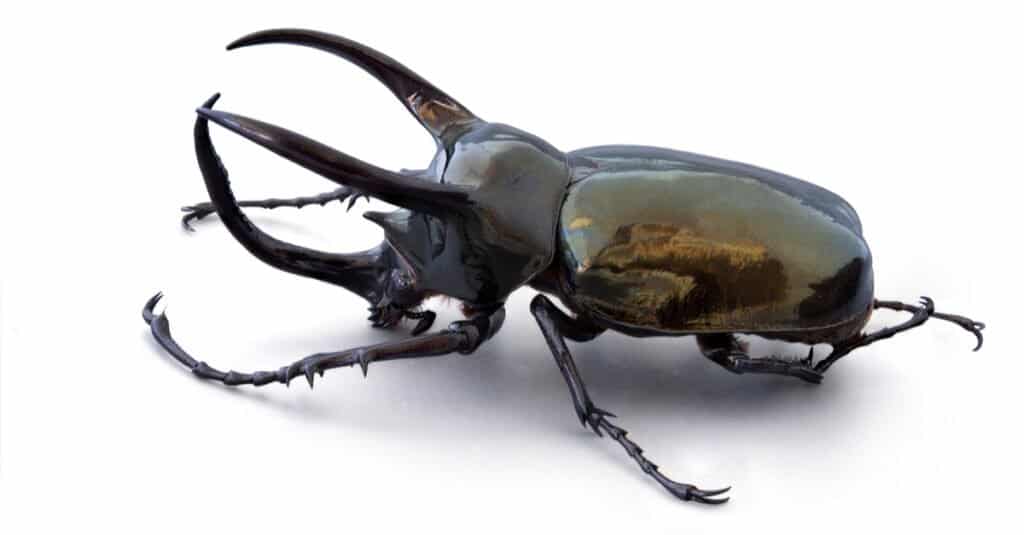
The male Caucasus beetle can reach 5.1 inches long.
©Sanit Fuangnakhon/Shutterstock.com
The males also have a set of curved horns, which they use to fight other males. Caucasus beetles eat tree sap and a variety of fruits.
Titan Beetle
The largest beetle in the world is the titan beetle (Titanus giganteus), which can reach a length of 6.5 inches. These huge beetles are dark reddish-brown with a black abdomen and sharp mandibles. They use their mandibles to defend themselves from predators, and also have a series of sharp spines that can deter attackers.
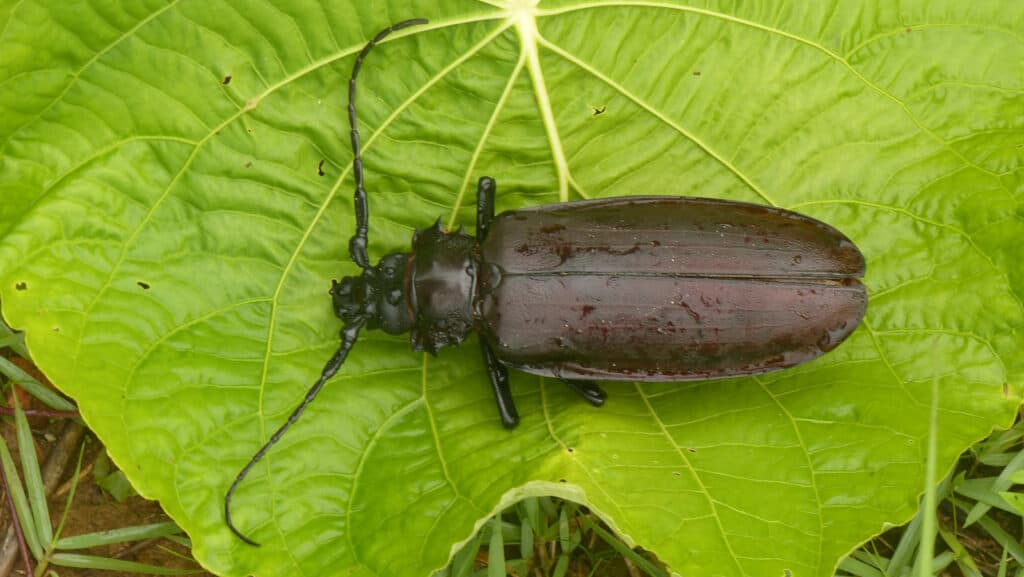
Titan beetles reach 6.5 inches long.
©guentermanaus/Shutterstock.com
As larvae, titan beetles eat decaying wood and plants. However, they do not eat anything in their adult form and live for only a few weeks. Titan beetles are native to South America, where they inhabit tropical rainforests, including the Amazon rainforest. Due to their forest habitat, they face threats from deforestation and climate change, although they are not classified as a threatened species.