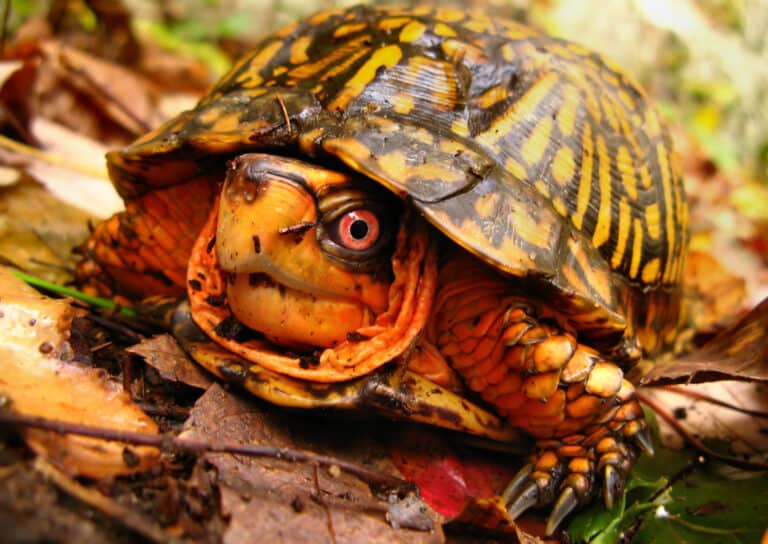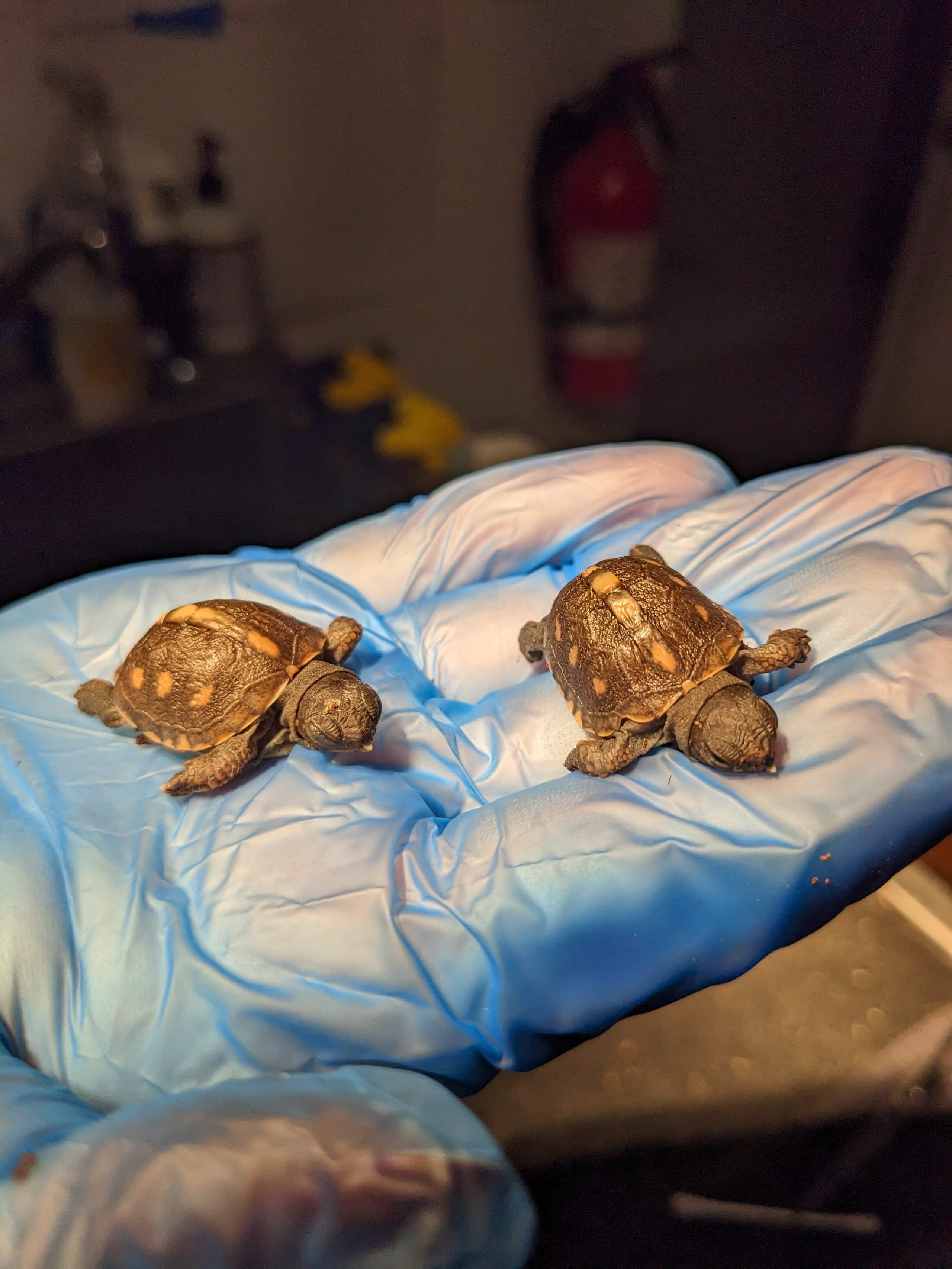

At the Southwest Virginia Wildlife Center in Roanoke, Virginia, a mother turtle recovering from an ear abscess recently surprised staff with a clutch of eggs. A couple of months later, those eggs gave way to something even more surprising: four tiny eastern box turtle hatchlings, one of them containing twins.
Chester Leonard, the center’s executive director, is clearly still amazed as he recounts the hatchlings’ story. “The eggs were laid by their mother, who is currently going to be overwintering with us due to being brought in with an ear abscess,” he explains. “When she laid the eggs, they were separated from her and kept in their own terrarium with humidity and temperature control until they hatched a couple of months later.”
For a threatened species already facing steep odds in the wild, every successful hatch matters. And twins? That’s icing on the (very tiny) turtle-shaped cake.
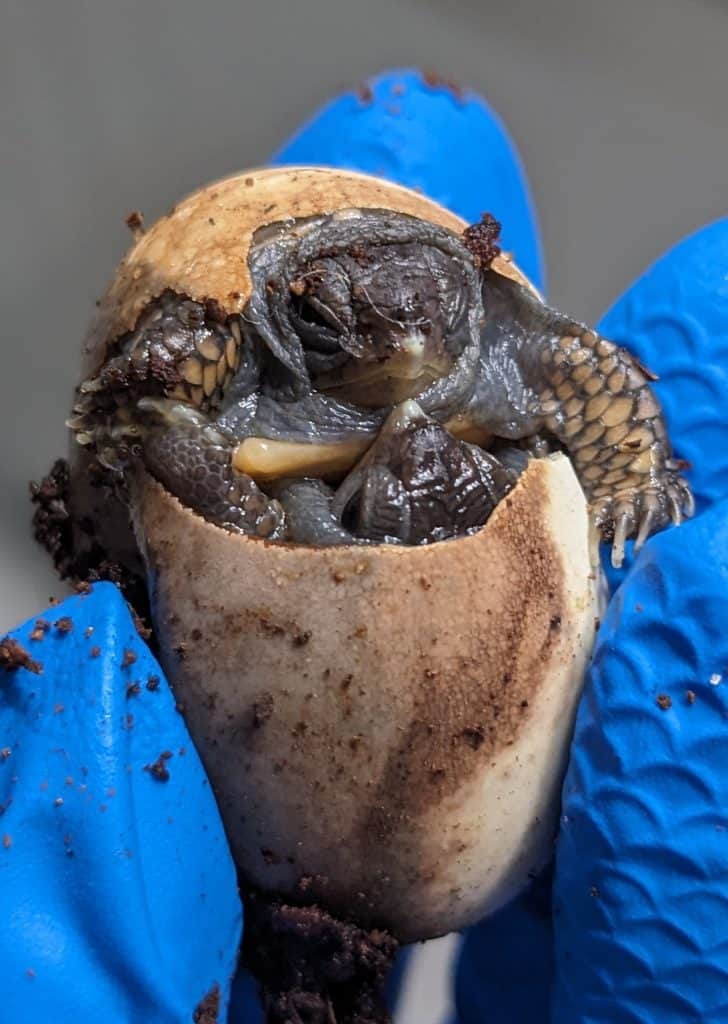
These hatchlings are fresh out of the shell and already making conservation history!
©Southwest Virginia Wildlife Center
A Rare Pair
Twins are unusual in any species, but in turtles, they’re something of a biological curveball. These two hatchlings shared the same yolk sac and had to be surgically separated with sutures.
“They’re slightly smaller than their siblings because they had to share the same space in the egg,” Chester explains. “When born, they weighed 3 grams, and their siblings were double at 6 grams. We expect that they will soon catch up to their siblings’ weight and don’t expect them to have any extra difficulties while in the rehab setting.”
In other words, despite their unusual start, the turtle twins are on track for a healthy future. And if they continue eating and growing as expected, they’ll eventually join their siblings in the wild.
It’s Tough to Be a Turtle
If you’ve ever spotted a box turtle inching across a hiking trail or pausing in the middle of a road, you might not realize just how precarious their survival has become.
Eastern box turtles were listed as threatened in Virginia in 2021. According to Chester, their decline is tied to several overlapping pressures:
1. The pet trade. “Prior to 2021, you could go out in the woods, find a box turtle, bring it home, and make it your pet,” he says. “This led to a severe decline in their numbers because when you remove a single turtle from the environment, you’re removing a breeding member of that species population. And these turtles take five to 10 years to reach sexual maturity.”
2. Smuggling. Unfortunately, the demand for these turtles doesn’t stop at state borders. “They are highly desirable in foreign markets and have been known to go for as much as $2,000 per turtle!” Chester explains. Some cultures view them as medicinal, while others collect them for their unique patterns.
3. Cars. “The majority of the turtles that we admit are from being run over by a car or truck,” Chester says. Road mortality remains one of the species’ biggest killers.
4. Habitat loss and pesticides. Development has carved up turtle habitat into fragments, while chemical use in yards and farms often leads to ear infections. “That prevents the turtle from being able to retract its head back into the carapace,” Chester adds.
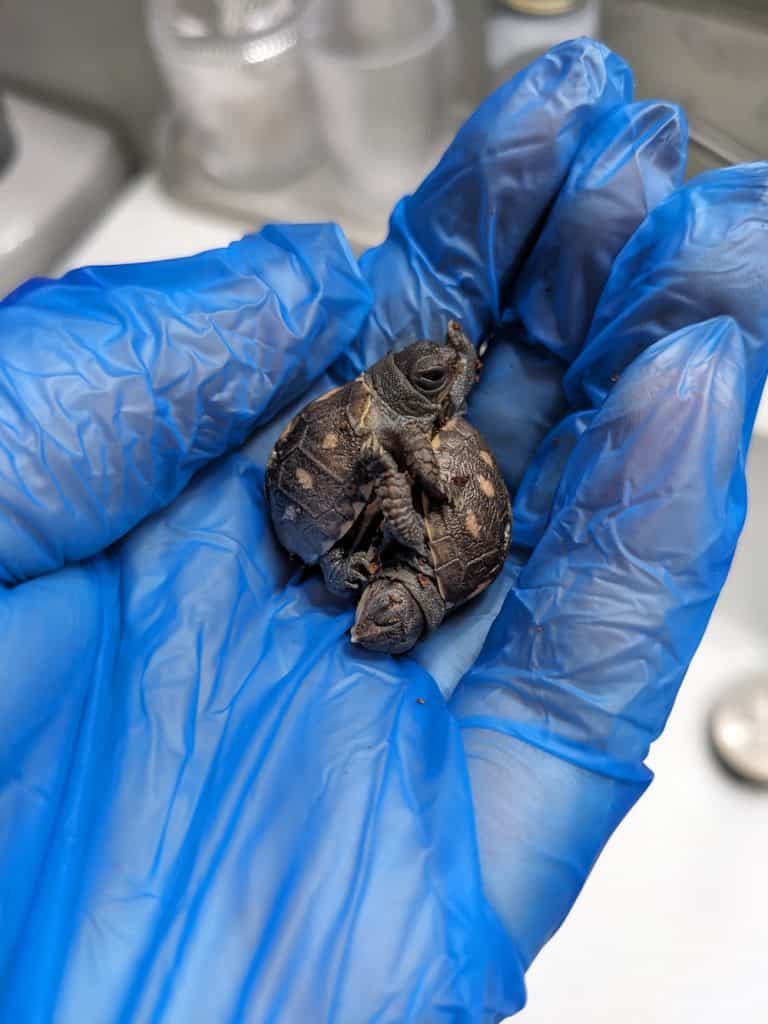
The challenges turtles face offer a grim list. But hatchlings like the ones just born at the center bring a little hope and a reminder of what’s at stake.
©Southwest Virginia Wildlife Center
Raising the Odds
Even in pristine conditions, baby turtles don’t have it easy. They’re bite-sized snacks for raccoons, snakes, and birds. In fact, some estimates suggest fewer than one in a thousand make it to adulthood in the wild.
That’s why the Roanoke team is keeping these hatchlings in their care through the winter. “Because they have to be kept over winter, it will allow them some extra time to put on weight, which will ultimately increase their chances of survival in the wild,” Chester says.
They are highly desirable in foreign markets and have been known to go for as much as $2,000 per turtle!
Chester Leonard, executive director, Southwest Virginia Wildlife Center
Come spring, when the weather warms up, the youngsters will be released in accordance with state regulations. The center doesn’t outfit them with GPS trackers, but each turtle’s unique shell markings are photographed and logged. “This species spends its entire life in less than a one-mile radius, and some studies suggest even smaller, around three football fields,” Chester explains. “So when we release them, we know exactly where to bring them back.”
Funding and the Future
If all of this sounds like a lot of work for four turtles (and it is), the center takes it in stride. After all, Chester and his team see thousands of wildlife patients yearly, from hawks and owls to opossums and foxes.
The catch? They do it without any federal, state, or local funding. “All of our work is done from donations and the occasional grant,” Chester says. That makes public support — and public education — essential.
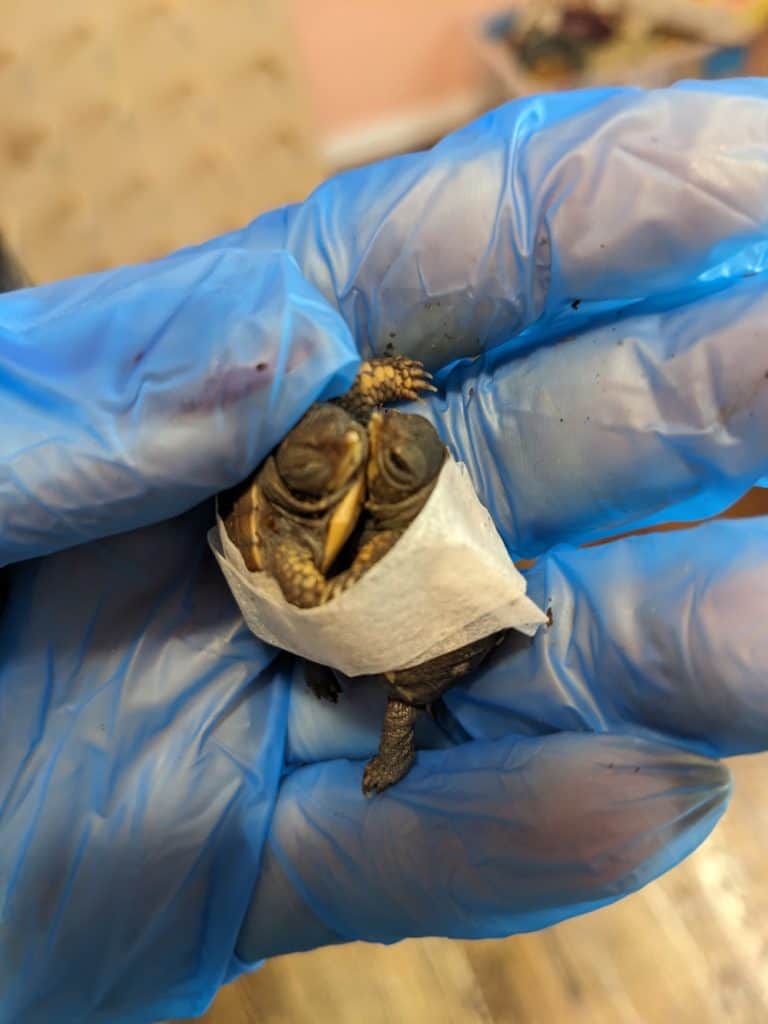
Double the shells, double the hope. These rare turtle twins were just three grams each at birth.
©Southwest Virginia Wildlife Center
To that end, the center regularly hosts programs using its 12 education ambassador animals, including two unreleasable eastern box turtles named Rosie and Rio. “We continue to use our public outreach arm of our nonprofit to educate thousands of people every year through in-person programs about the importance of wildlife conservation,” Chester says.
What You Can Do
Want to help? Chester’s advice is refreshingly practical. “Drive carefully,” he says. If you see a turtle on the road, move it to the other side — always in the direction it was heading. Don’t relocate it elsewhere; these turtles live their entire lives within a tiny range and may not survive if displaced.
Leave wild nests alone. Hatchlings are designed to make it without parental care. Interfering, even with good intentions, often does more harm than good.
Support local rehab centers. Donations, volunteer time, and spreading the word all help facilities like the Southwest Virginia Wildlife Center continue their work.
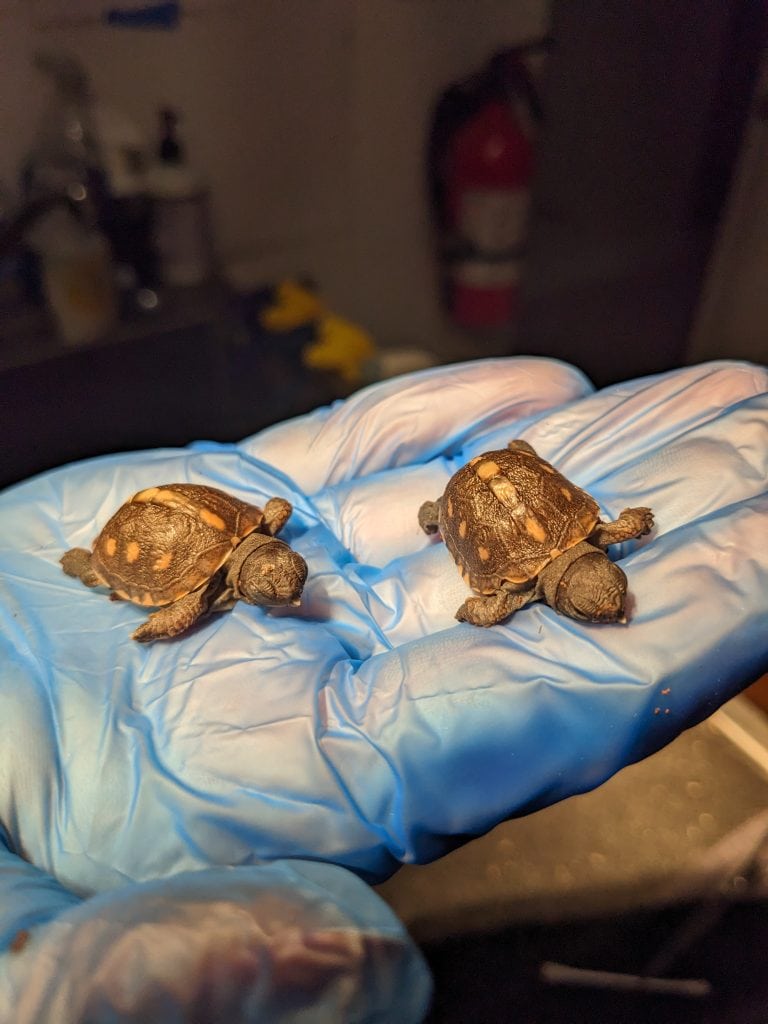
They may have tiny shells, but their impact is huge. Every hatchling is a step toward species survival.
A Tiny Miracle with Big Meaning
The odds may be slim, but these four hatchlings (including the surprise twins) are more than just a feel-good story. They’re proof of resilience in a species that needs every break it can get. As Chester puts it, each turtle that survives adds one more shot at the future.
They may be tiny, but with a little help, these patterned shells are carrying the hopes of an entire species.