Quick Take
- The Smithsonian National Zoo recently discovered its first painted river terrapin hatchling, a major milestone for the critically endangered turtle species.
- Painted river terrapins live in Southeast Asian river estuaries and mangrove habitats but face threats from fishing nets, habitat loss, and illegal trade.
- Because multiple terrapins breed during mating season, keepers currently cannot determine which of the four adult turtles are the hatchling’s parents.
Sometimes it’s scary to think that the many species we see today might not be around in twenty years. Or, if we don’t focus more on conservation efforts, some species may disappear even in the next few years. If you’re curious about which animals are at risk, take a look at the International Union for the Conservation of Nature (IUCN) Red List. The IUCN Red List assesses various considerations to separate species into nine categories based on their extinction risk.
Painted river terrapins, also called painted terrapins, are among the large population of turtle species listed as Critically Endangered. Essentially, being critically endangered means painted terrapins are at risk of becoming extinct in the wild. Losing this beautiful turtle would not only reduce biodiversity but also significantly affect the ecosystems they belong to.
This status is one of the reasons why an announcement from the Smithsonian’s National Zoo & Conservation Biology Institute in early 2026 is so exciting. A new painted river terrapin hatchling was found in the terrapin exhibit on August 26, 2025. The hatchling is thriving, says Matt Evans, assistant curator of the Reptile Discovery Center. “We’re really happy with how it’s growing,” Evans adds.
What Are Painted River Terrapins?
Painted river terrapins (Batagur borneoensis) are, as their name suggests, a type of river turtle. This species is native to Southeast Asia. Specifically, painted terrapins are native to Malaysia, Indonesia, Borneo, Sumatra, and Thailand. Unlike sea turtles, which have specialized glands to help them excrete salt, painted terrapins cannot excrete salt and therefore must live in freshwater or brackish environments.
As a result, they must live in freshwater or brackish water environments with minimal salt levels. These turtles are typically found in mangrove swamps or river estuaries. They are largely herbivorous and support their ecosystems by cycling nutrients, consuming plants that might otherwise choke the river, and dispersing seeds.
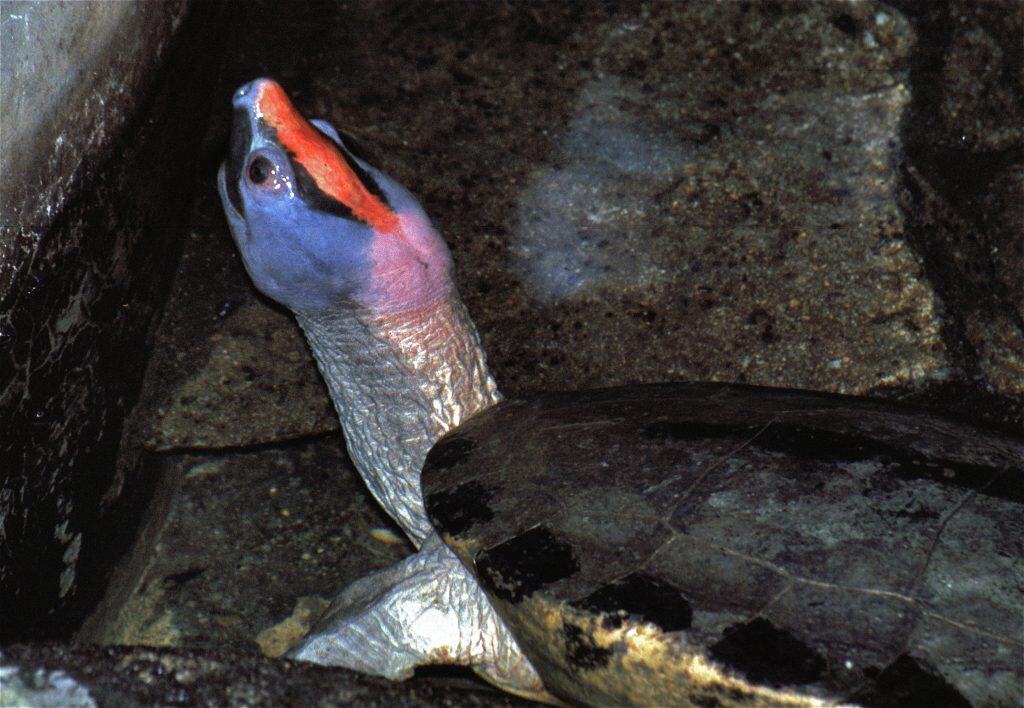
Male painted river terrapins change from duller colors to a bright red stripe on their head during mating season.
For most of the year, painted river terrapins are dull in color: gray and olive. However, during mating season, male painted terrapins become brighter in color. “Their shells change, too, and become streaked with prominent green, white, and black stripes. They look a bit like a watermelon!” Evans says.
Females remain the same dull color. This is an example of sexual dimorphism, where males and females of a given species display different characteristics.
Reproductive Habits of Painted Terrapins
According to the National Zoo, painted river terrapins have two main breeding seasons: over the summer and over the winter, which aligns with the new hatchling’s arrival. Male and female painted terrapins may mate with multiple partners during the mating season. As such, it can be difficult to determine which turtles are the parents of which offspring.
The National Zoo currently houses two male and two female painted river terrapins.
“Normally, males would try to breed with the largest female. However, our females are about equal in size. Both males pursued both females, so the parents could be any combination of moms and dads,” Evans says. “Terrapins breed a couple of feet below the water’s surface. Because of this, it can be challenging for us to know exactly when breeding occurs, unless we happen to be in the right place at the right time. Outside of breeding season, we’ve observed males trying to pursue females—but the females just climb out of the water to get away from them.”
After mating, the female terrapin lays her eggs. Evans notes that female turtles can be extremely picky about where they lay their eggs, wanting to maximize the chances that the eggs survive. They typically bury their clutch of 20–30 eggs in sandy areas.
“Female painted river terrapins create nests by using their back legs to dig down deep into the sand. Then, they deposit their eggs and cover them with sand, hiding the nest. Just like sea turtles, they typically do this under the cover of night,” Evans says.
In the case of the National Zoo terrapins, the female terrapin laid her clutch in a heated basking area near the back of the exhibit.
The fact that our animals are breeding and producing healthy offspring is a good barometer that we’re meeting all their needs and doing things right.
Matt Evans, assistant curator of the Reptile Discovery Center
Introducing the National Zoo’s New Terrapin
At the end of August 2025, keepers at the Reptile Discovery Center noticed a small terrapin hatchling swimming around in the parents’ pool.
“I was amazed that this hatchling was able to sense where the water is,” Evans says. “I imagine it was quite a trek to the pool, as it had to go around a giant log, up and down sand dunes, and climb over the lip of the pool—no easy feat for such a tiny turtle.”
Evans also notes that the hatchling still had its egg tooth, a temporary tooth-like structure on the beak that helps the turtle break its egg when hatching. Since the egg tooth normally falls off after a few days, Evans could tell that the hatchling was just a day or two old.
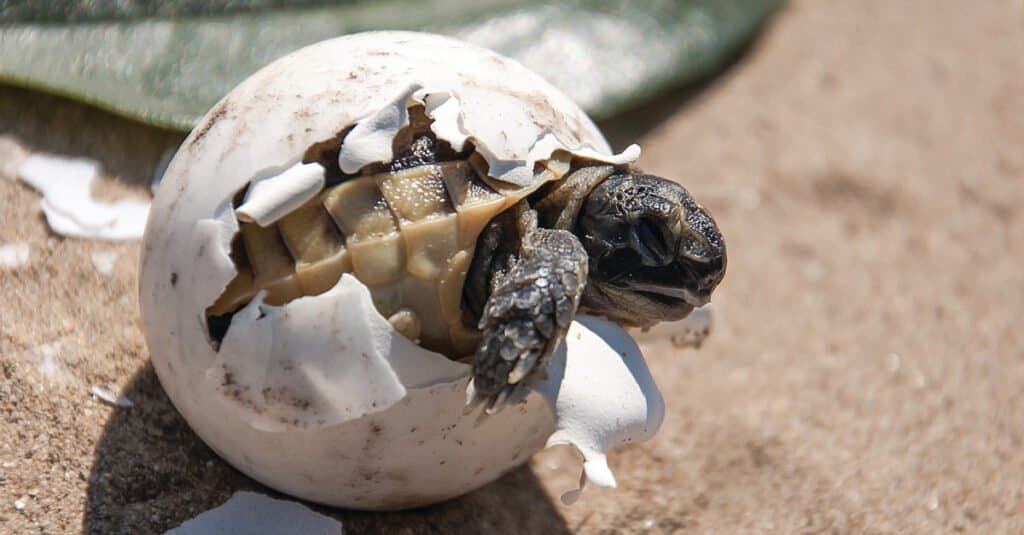
Although 20 eggs were found, the hatchling is currently the only one that has hatched.
©Attila N/Shutterstock.com
Right now, it’s hard to tell the hatchling’s sex. “The color of the hatchling’s shell looks more like a male’s, but the shape of the shell is similar to a female’s. As it matures, we will be able to definitively know its sex,” Evans says.
Is the Hatchling On Exhibit?
The hatchling is currently not in the main enclosure. Instead, it is being cared for by the Reptile Discovery Center team. Evans explains that this is for the hatchling’s safety. First, the pool is a bit deep for the hatchling. Second, the hatchling needs food to grow, but it’s too small to compete with the larger terrapins. Finally, the terrapin exhibit also includes a tomistoma, or false gharial.
“At 10-15 grams, a terrapin hatchling would be ‘snack’ size for a tomistoma. The adults are not on the tomistoma’s menu, though. They can weigh between 26 and 33 pounds and are way too big for her to eat,” Evans says.
Evans believes that the terrapin hatchling will be large and healthy enough to return to the exhibit in August 2026.
Painted Terrapin Conservation Efforts
The arrival of the hatchling is huge news for the National Zoo. “The fact that our animals are breeding and producing healthy offspring is a good barometer that we’re meeting all their needs and doing things right,” Evans says.
But, considering the status of painted river terrapins, investing in conservation initiatives on a broader scale is also incredibly important. Painted terrapins currently face many threats.
“Because they live in river estuaries and mangrove swamps, they frequently come into contact with fishermen and get caught in nets,” Evans says. “They are impacted by the illegal trade market and are often sold as pets or used in traditional medicines. And, their nesting grounds are in danger. Companies mine the sand and sell it commercially, reducing the availability of suitable nesting spots.”
If you want to help painted river terrapins, consider supporting organizations like the SatuCita Foundation, the Turtle Conservation Society of Malaysia, and the Turtle Survival Alliance (a partner of the National Zoo!).