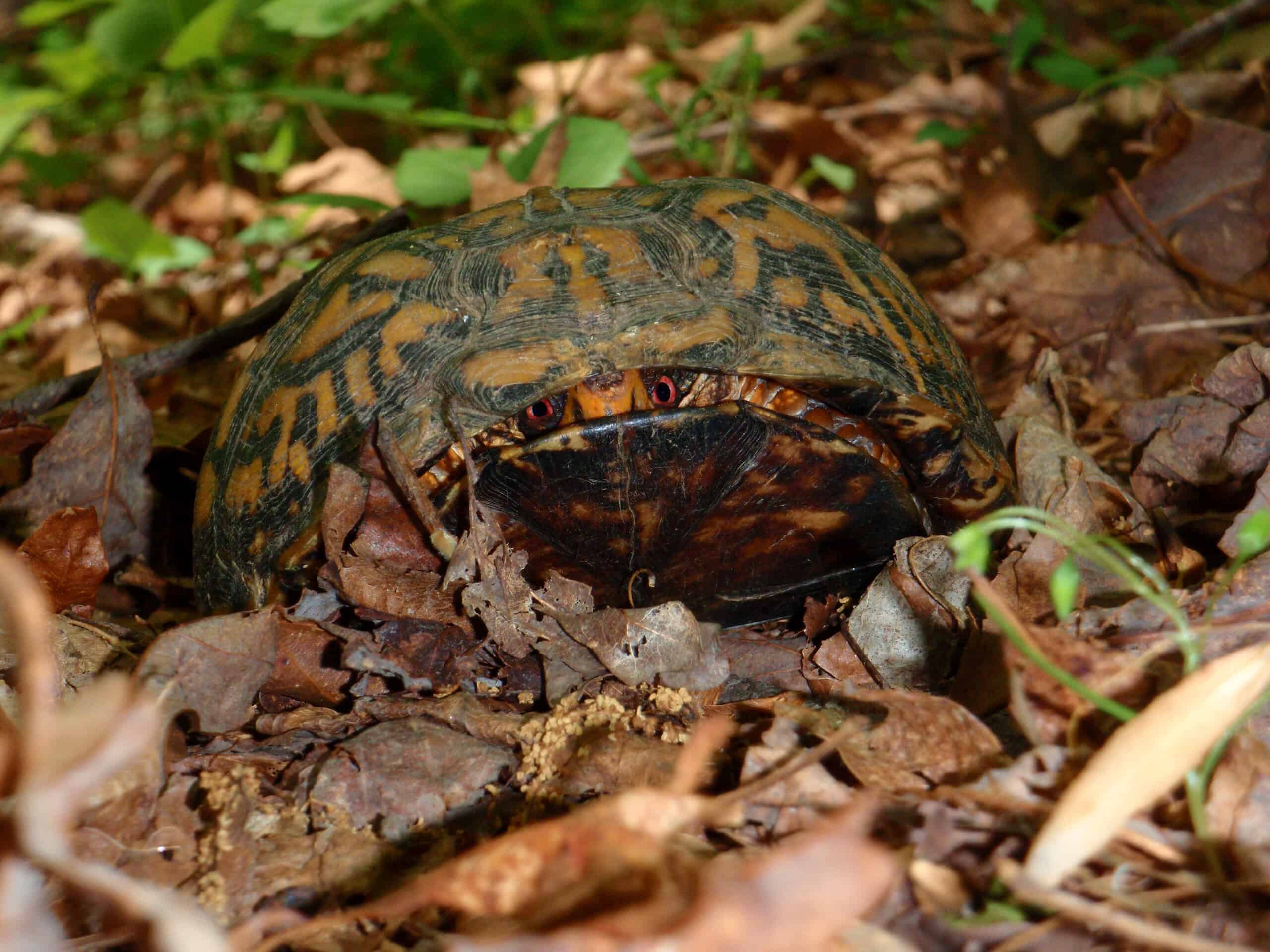

Box turtles are so named for their distinctive shells. All turtles have a top shell (carapace) and bottom shell (plastron) that connect via “bridges” on each side. But box turtles are the only group of turtles that can completely contract into their shells with no head, limbs, or tail showing. Thanks to a hinge on the plastron, a box turtle can close up like a box with the limbs safely protected inside. When other turtles pull their limbs in, you can see soft parts sticking out between the top and bottom shells. Still, you might think that turtles would be relatively immune to predation. However, a variety of predators with sharp claws or beaks, such as raccoons, opossums, and crows, can eat a turtle right out of its shell.
Pros and Cons of the Box Turtle Shell
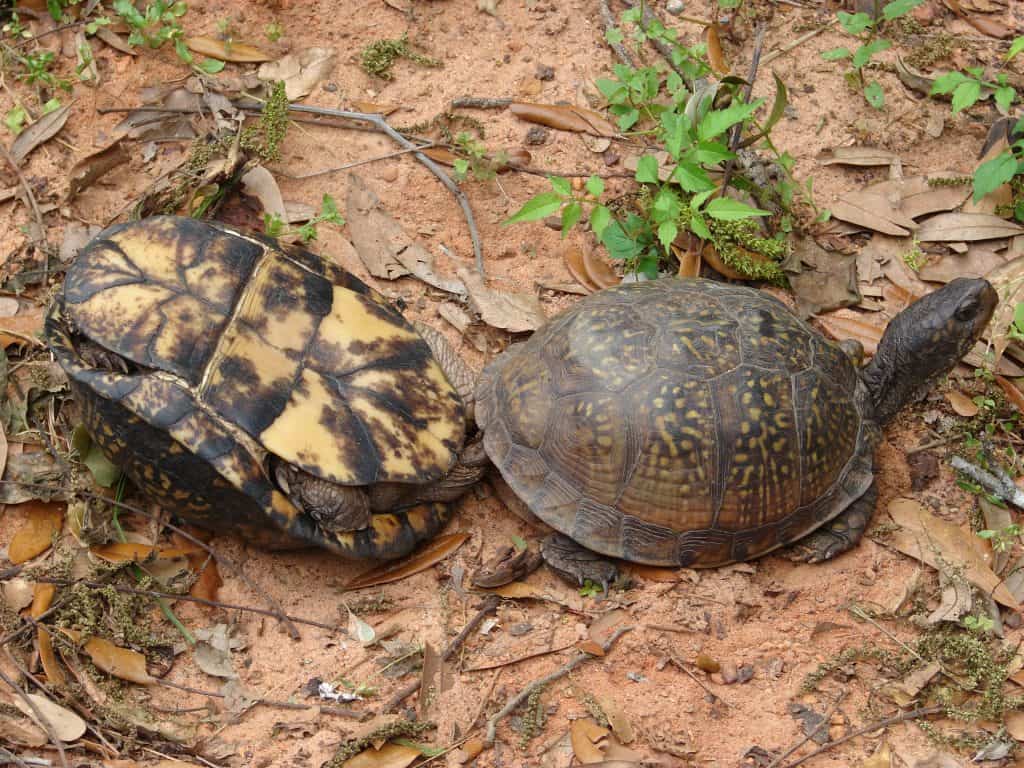
A male box turtle (left) fell on his back while trying to mate with a female (right).
The box turtle’s “morphology” (shape) is a great defense against predators and also an adaptation to resist dehydration in dry conditions. A box turtle can batten down the hatches to reduce evaporative water loss. However, having such a full covering poses challenges for reproduction. Like all turtles, a male box turtle mounts the female from behind, with the curve in his plastron allowing him to nestle over her carapace to position himself for mating. During this maneuvering, males risk falling over, landing on their backs, and potentially becoming stuck. Their high, domed carapaces make it difficult for them to right themselves, and a turtle flipped over for too long may die from hunger or dehydration.
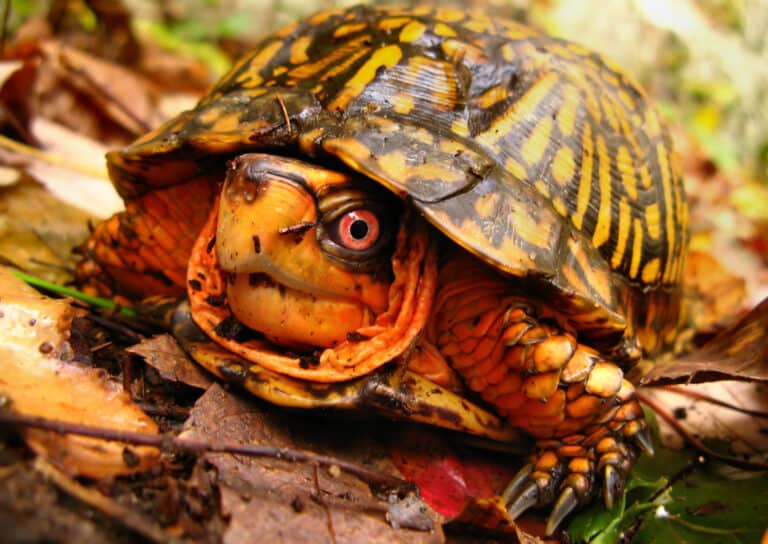
Common Box Turtle (Terrapene carolina)
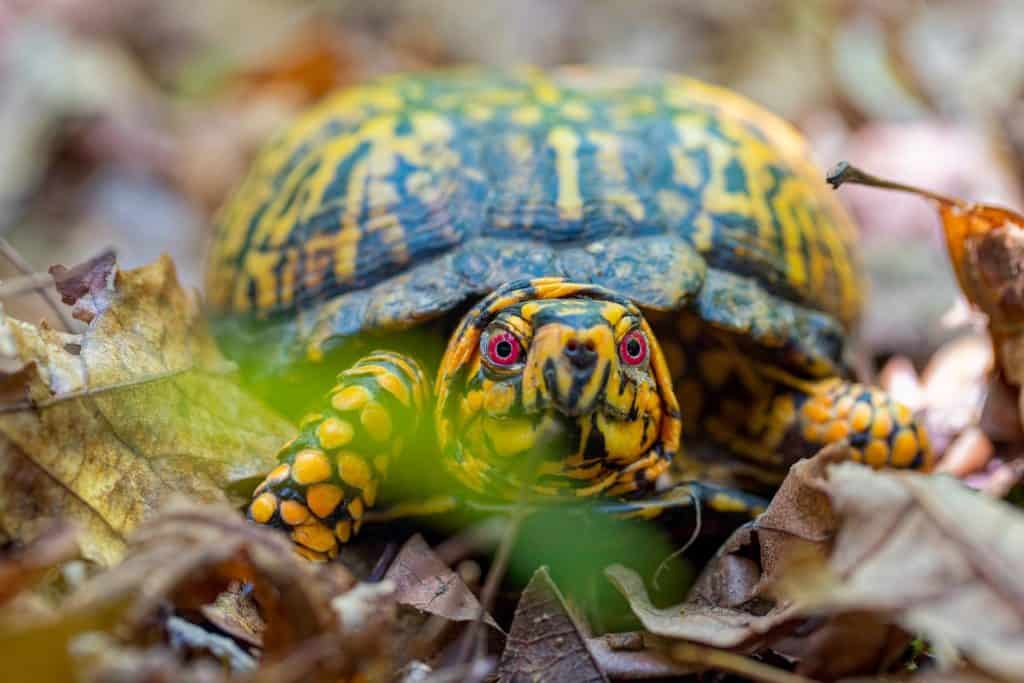
Male common box turtles have red eyes, while females typically have brown eyes.
©Karel Bock/Shutterstock.com
Most box turtles you’ll see in North America are common box turtles—Terrapene carolina—which were given their scientific name in 1758 by Swedish biologist Carl Linnaeus, who was also responsible for creating the scientific naming system still in use today. In Linnaeus’s time, box turtles would have been extremely abundant, but they are currently listed as “Vulnerable” by the International Union for the Conservation of Nature (IUCN), with their populations in gradual decline.
Box turtles suffer from a wide range of impacts, including being hit by cars, collected as pets, poisoned by pesticides, and stranded by deforestation. Because they’re easy to catch and unable to defend themselves, box turtles are often grabbed for turtle races, without people recognizing the harm caused by separating an animal from its familiar habitat, food, shelter, and mates. As omnivores, box turtles rely on a range of wild foods, including mushrooms, fruits, leaves, flowers, and roots, plus small animals like snails, worms, and insects.
Common Box Turtle Subspecies
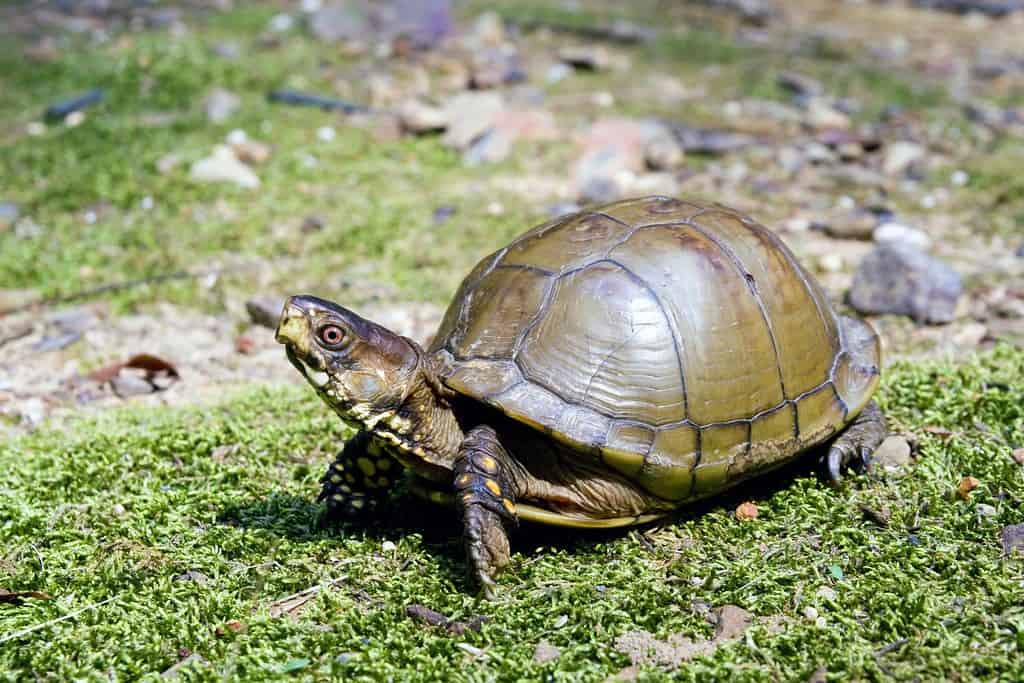
A three-toed box turtle has a plain-colored upper shell (carapace) compared to most other subspecies.
©IrinaK/Shutterstock.com
Since the formal description of the species Terrapene carolina, scientists have identified six distinct subspecies, which occur in different regions. They share the basic box turtle shape of a domed carapace and hinged plastron that allows for complete withdrawal into the shell, but show subtle variations in color, body features, habitats, and life histories.
- The Woodland Box Turtle (T. carolina carolina) lives in the eastern U.S., ranging all the way from Florida to Maine and west to the Great Lakes. They mostly live in forests with humid forest floors, where they burrow under leaf litter during certain times of the year. Woodland box turtles, depending on which part of the range they occupy, must enter a dormant state of “torpor” when winter temperatures fall too low for them to remain active. By shimmying under leaf litter, they gain some insulation plus a refuge for staying hidden while torpid.
- The Florida Box Turtle (T. carolina bauri) is found almost entirely on the peninsula of Florida and into the Florida Keys, although there are a few records from over the border into northern Georgia. Like the western box turtle, it has yellow stripes on a darker background, but the Florida subspecies tends to have thicker stripes.
- The Gulf Coast Box Turtle (T. carolina major) lives on the coasts of the Gulf of Mexico, including in Alabama, Georgia, Louisiana, Mississippi, and Florida. It grows up to seven inches long, larger than the other subspecies of common box turtle (which range from about 4-6 inches long). Like the Yucatan box turtle, Gulf Coast box turtles face large seasonal swings in rainfall and humidity. A study published in Chelonian Conservation Biology found that adult turtles on Egmont Key, Florida, were active when humidity was at least 24 percent, whereas juveniles required 58 percent or more, since their higher surface area to volume ratios make them more susceptible to water loss.
- The Three-Toed Box Turtle (T. carolina triunguis) lives from Kansas southward through Oklahoma into Texas and southeastward through Missouri, Tennessee, and Georgia. It has only three toes instead of four on its hind feet and only a faint pattern of orange marks on its otherwise brownish carapace. Three-toed box turtles are found in grasslands and damper areas, such as around marshes. Unlike the common box turtles that share part of their range, three-toed box turtles hunt for aquatic insects in shallow water. They also eat terrestrial insects, slugs, and plants.
- The Mexican Box Turtle (T. carolina mexicana) lives only in parts of eastern Mexico (San Luis Potosí, Tamaulipas, and Veracruz). Adult males have unique gray-blue coloration on their heads. A large species, they grow to more than seven inches long. Mexican box turtles tend to stay in vegetated areas near rainforest puddles and bodies of water, where their insect prey are concentrated.
- The Yucatan Box Turtle (T. carolina yucatana) is the only fully tropical box turtle, living only in the Yucatan state of Mexico in scrub forests and grasslands. Tracking studies have found them favoring taller, more humid forests with leafy and woody debris on the ground. Farmers may run across them when they’re burning crop fields to prepare them for replanting. Yucatan box turtles are active only during the rainy season, which runs from June to November, and spend the remaining months estivating (resting in a dormant state). A study published in BMC Ecology and Evolution found that their monthly movements positively correlated with the amount of rainfall. Like all box turtles, Yucatan box turtles have an omnivorous diet, feeding on both plants and animals.
Aquatic Box Turtle (Terrapene coahuila)
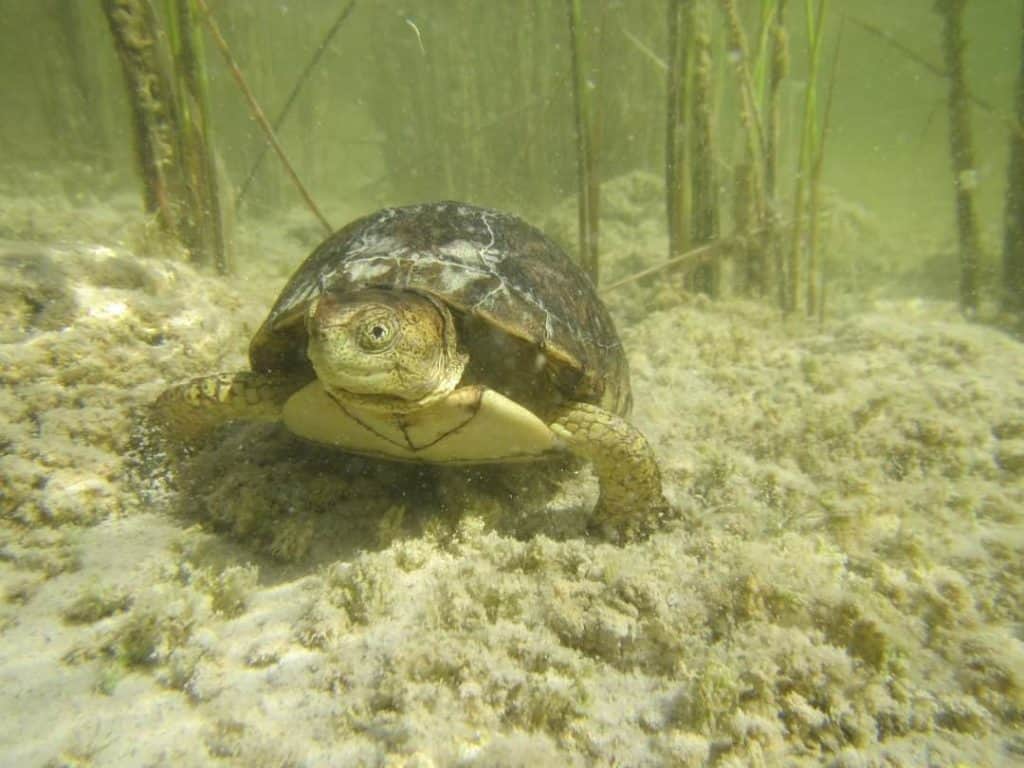
An aquatic box turtle walks on a mucky wetland bottom.
Box turtles, like tortoises, are fully terrestrial, making their living on land, except for one species: the aquatic box turtle, or “Coahuilan” box turtle. It lives in Coahuila, on the northern border of Mexico, where it spends nearly all its time in water, as evidenced by the growth of algae on its shell. Aquatic box turtles favor marshlands, where they forage for aquatic insects like fly larvae and dragonfly nymphs, as well as marsh plants, burrowing into the mud to stay cool. Unlike other box turtles, they even tend to mate in shallow water.
Aquatic box turtles have an all-brown shell with faint yellowish markings and blackish brown skin with faint spots, lacking the bright shell and/or limb coloration of other box turtles. They inhabit the Cuatro Ciénegas basin in Coahuila, a unique wetland system covering several hundred square kilometers. With their already limited habitat increasingly converted to agricultural land, aquatic box turtles are listed as endangered by the IUCN. Only about 2,000 individuals remain. As water is increasingly drawn out to supply human populations around Coahuila and beyond, some of the wetlands and streams that support aquatic box turtles are drying out.
Despite the whole Cuatro Ciénegas basin being designated an IUCN Category IV location in 1994, which calls for conservation of its habitats and species, development around the basin continues to impact the aquatic box turtle.
Spotted Box Turtle (Terrapene nelsoni)
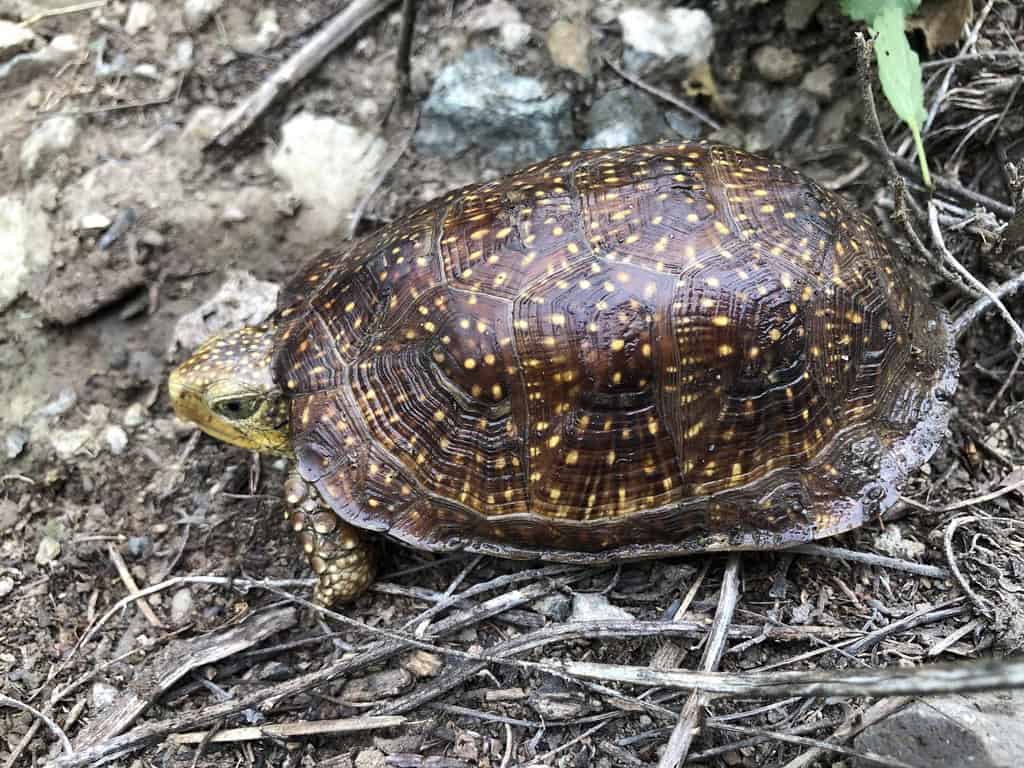
This Northern spotted box turtle was encountered in Sonora, Mexico.
The spotted box turtle, like the aquatic box turtle, is confined to a single location: Sierra Madre Occidental, a desert mountain range in western Mexico. This species is recognizable by the constellation of tiny, creamy yellow spots on its shell. People have rarely studied this species or even seen it, so the information about its life history is limited. There is some evidence that spotted box turtles are only active during the monsoon season and are therefore threatened by prolonged droughts in their tropical dry forest habitat.
The northern and southern populations are classified as separate subspecies based on their geographic locations, although information on their characteristics is scant:
- Northern Spotted Box Turtle (T. nelsoni klauberi)
- Southern Spotted Box Turtle (T. nelsoni nelsoni)
Western Box Turtle (Terrapene ornata)
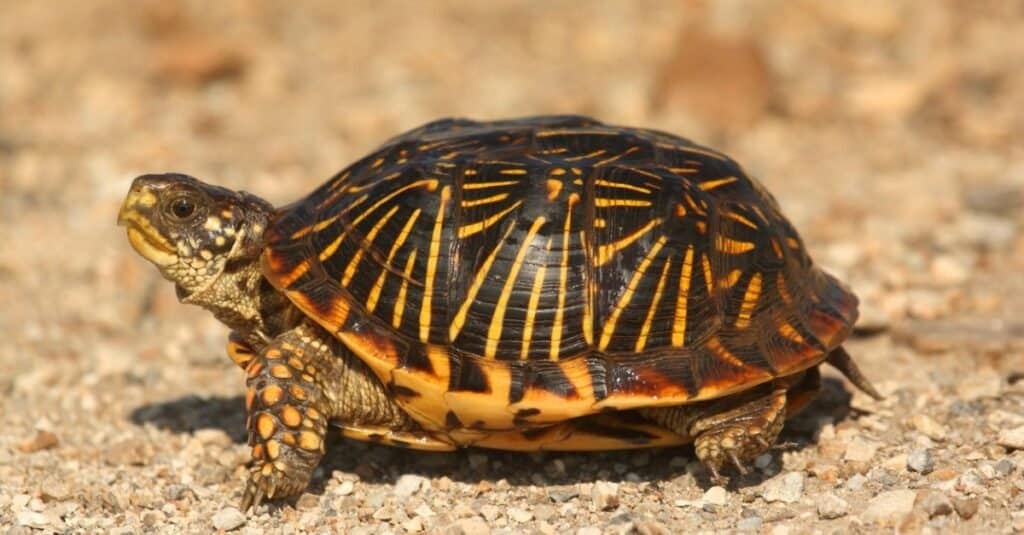
Western box turtles, such as this one in the Flint Hills of Kansas, have flatter shells than other species.
©iStock.com/SteveByland
If you find a box turtle in the grasslands of the west-central U.S., it is likely a western box turtle (also called an “ornate” box turtle). Southern South Dakota and southern Wisconsin make the northern boundary of its range, which extends southward into northwestern Mexico. Like other box turtles, western box turtles have dome-shaped shells. However, western box turtles are somewhat flatter in profile than others, and their carapaces are marked with vivid sprays of vertical yellow lines. They are small (up to five inches long), making them vulnerable to predators. Even adults, despite their strong shells, may fall prey to coyotes, foxes, or dogs.
Western Box Turtle Subspecies
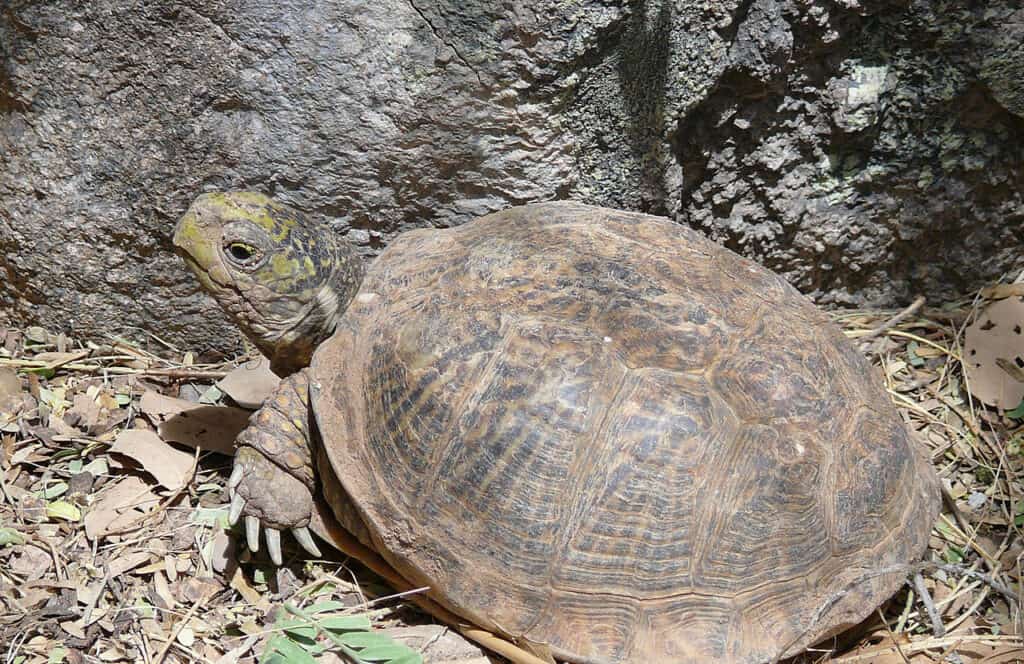
Note the greenish head of this captive male desert box turtle at the Arizona-Sonora Desert Museum.
The two known subspecies of the western box turtle differ in their habitats, although their ranges overlap in the Great Plains.
- The Ornate Box Turtle (T. ornata ornata) inhabits prairies in the Central U.S., including in Kansas, Nebraska, Oklahoma, and Texas. It has yellow spots on its head and thick, yellow borders on its “scutes” (tile-like sections of the top shell). Males have a greenish hue on their heads, while females have brown or black heads. Depending on the local climate, ornate box turtles are active from about April through October, taking refuge in small “forms” (burrows) they dig next to vegetation or along ditch edges. They spend the cooler months hibernating. A study published in Wildlife Biology found that, for hibernation, ornate box turtles chose hibernacula (places to hibernate) with sand, soil, and leaf litter, which kept their bodies above freezing even when outside temperatures dropped below 32 degrees Fahrenheit.
- The Desert Box Turtle (T. ornata luteola) has more yellowish stripes on its shell than the ornate box turtle, but males also have green-hued heads. Of all box turtle species, the desert box turtle inhabits the driest areas, such as the deserts of New Mexico, Arizona, and Texas, where it lives in sand dune burrows. Typical vegetation in its habitat includes cacti such as prickly pear and yucca, as well as creosote bushes. To escape hot temperatures, a desert box turtle may shimmy under the sand to cover itself with an insulating layer. A study published in the Journal of Herpetology showed that desert box turtles in southeastern Arizona were only active during the summer monsoon season (July – September). For the remaining nine months, the turtles take refuge in burrows made by mammals—such as kangaroo rats—where they remain in a state of torpor (inactivity) until the rains return. At the start of the monsoon season, when turtles emerge from the burrows, they are severely dehydrated. So, desert life, even for a turtle, is challenging.
North American Box Turtles into the Future
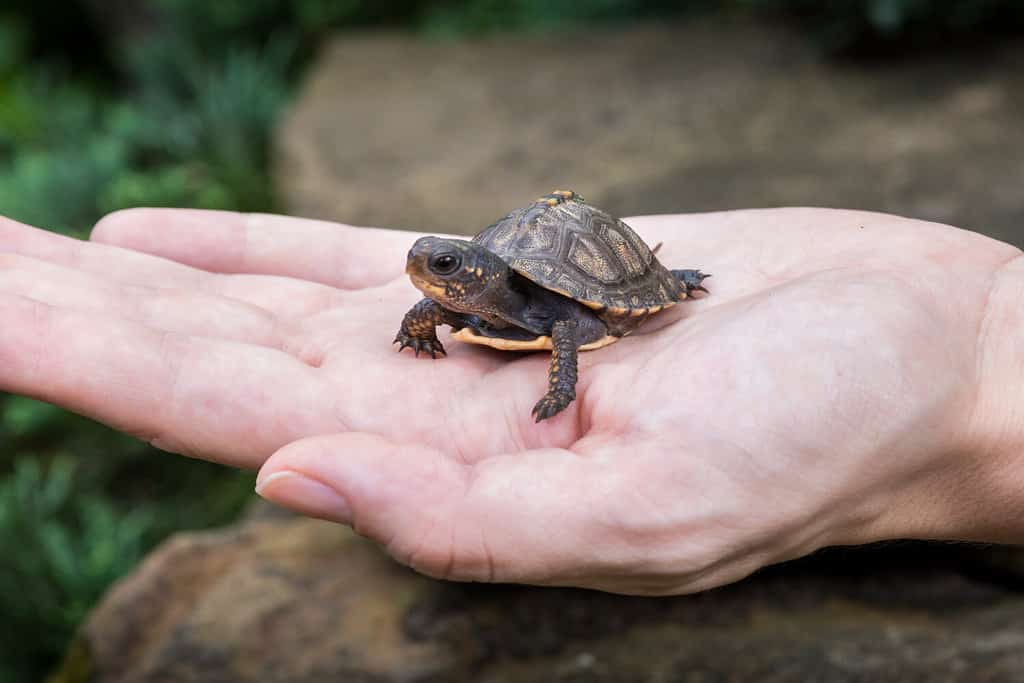
This hatchling baby woodland box turtle (Terrapene carolina) has the potential for a long life.
©JasonYoder/Shutterstock.com
Box turtles can live for decades, sometimes more than 100 years. As a species group, box turtles have inhabited Earth for some 40-50 million years. They used to be common and abundant, but are now, argues herpetologist Kenneth Dodd, “losing their battle against extinction.” Multiple conservation efforts across the U.S. hope to bring box turtles back from the brink by reducing impacts to their populations and restoring habitats. The myriad challenges they face, from traffic violence to the pet trade to introduced predators, will require an all-hands-on-deck approach to their survival.