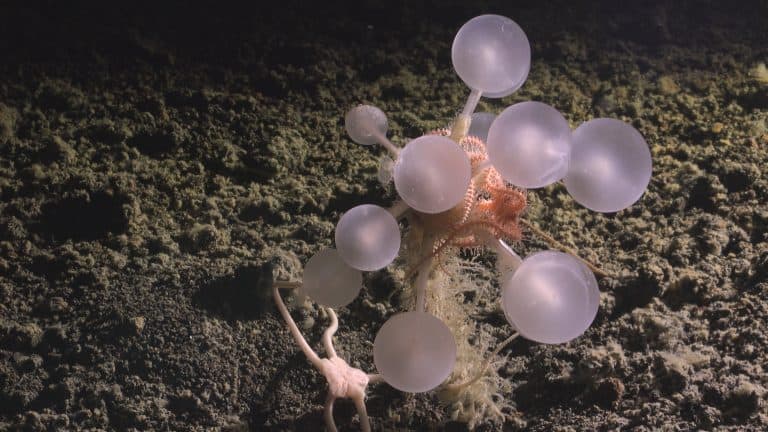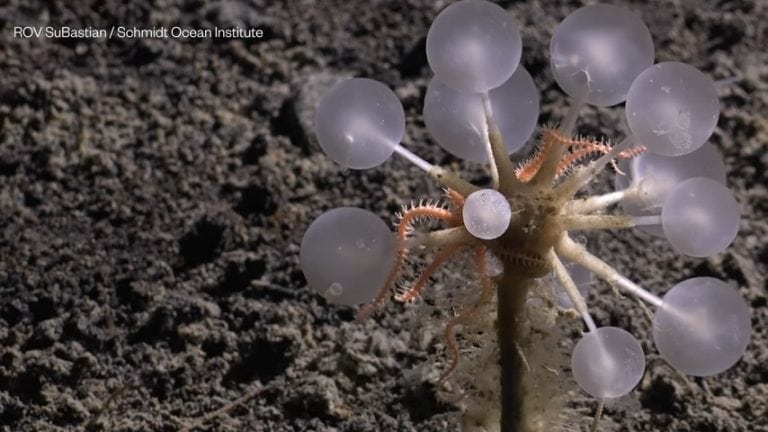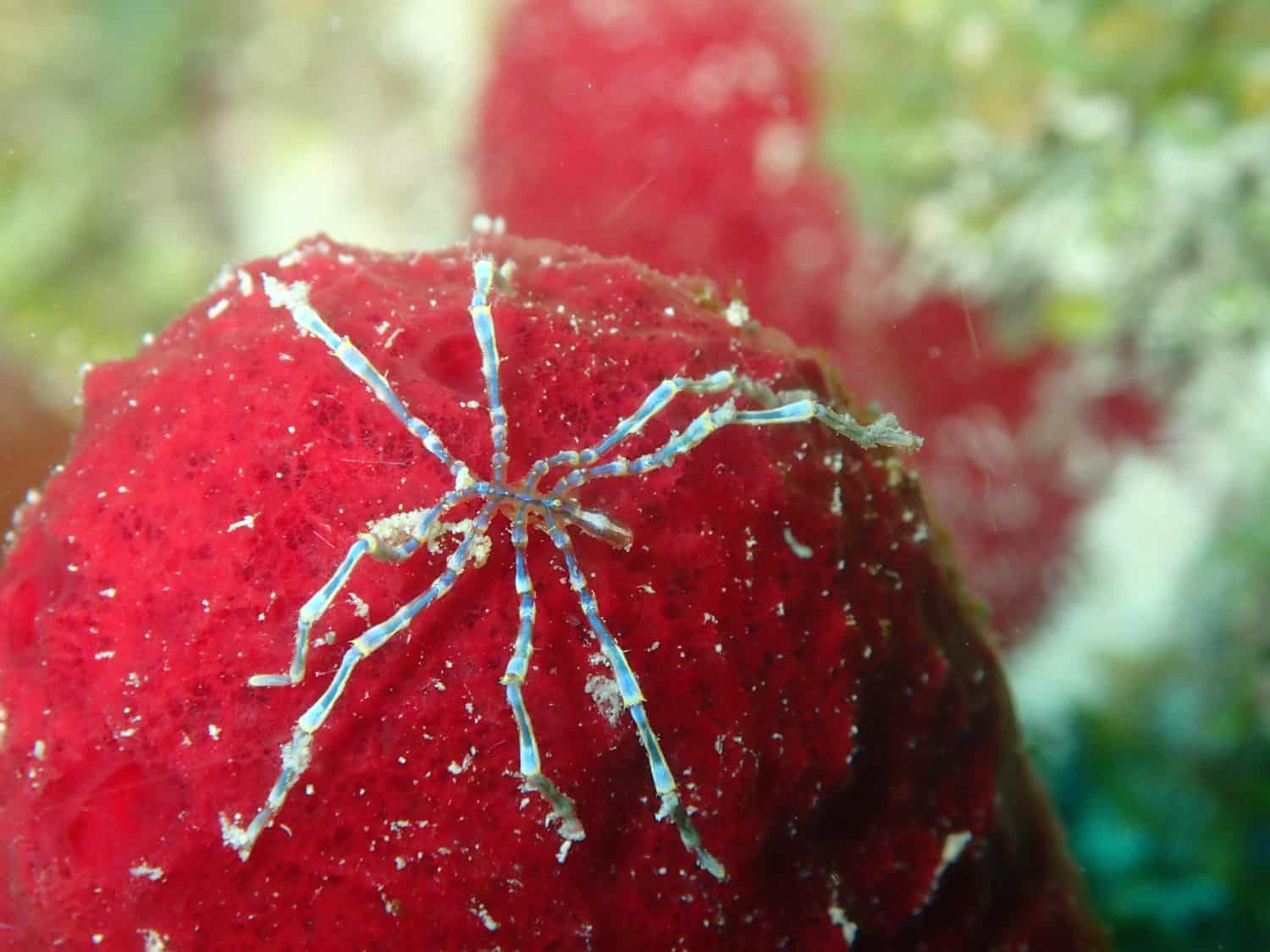

Nature finds a way. Even in the most inhospitable conditions on Earth, life figures out how to not only survive but flourish. Take sea spiders, for example. A new study by researchers at Occidental College and Caltech has not only discovered a new species of sea spider but also illustrated the remarkable way it obtains its food near methane seeps.
According to the study, “Methane-powered sea spiders: Diverse, epibiotic methanotrophs serve as a source of nutrition for deep-sea methane seep Sericosura,” these yet-to-be-officially classified sea spiders hang around deep-sea methane seeps. There, they grow methane-absorbing bacteria on their exoskeletons and farm them for food. A-Z-Animals got a chance to speak with one of the researchers who worked on this study to learn more about this new species and the inventive way they make their meals.
Meet Bianca Dal Bó

Researcher Bianca Dal Bó helped bring this exciting discovery to fruition.
©Bianca Dal Bó
Bianca Dal Bó currently works in a lab and is hoping to apply for graduate school. As an undergraduate majoring in Biology at Occidental College, however, Dal Bó got an opportunity to work on a groundbreaking research project. After taking a zoology class taught by Dr. Shana K. Goffredi, the current chair of Occidental’s Biology department, Dal Bó joined Goffredi in the microbial symbiosis lab.
While studying the relationship between deep-sea invertebrates and microbial relationships, sea spiders stood out. “Sea spiders sort of came through as an interesting group who seemed to have something going on nutritionally,” Dal Bó says.
A previous trip had netted Dr. Goffredi several sea spider specimens, but the research team needed more to better understand these creatures and their manner of subsistence. In 2023, Dal Bó, Goffredi, and several collaborators from Caltech, UCLA, and the Scripps Institution of Oceanography ventured out into the ocean to find more.
The Expedition

The researchers gathered specimens from the Del Mar Seep, a series of methane vents on the ocean floor off the coast of San Diego, California.
©Kyle Sprague/Shutterstock.com
During the team’s two-week expedition, they visited several seeps along the coast of Southern California. Aboard the (R/V) Atlantis, a formidable 274-foot research vessel (U.S. Navy-owned and Woods Hole Oceanographic Institute-operated), the team trawled the Southern California coast for sea spider specimens.
Most of the study’s specimens came from the Del Mar Seep, a series of methane seeps on the ocean floor around 30 miles west of Del Mar, California. These vents are located 1,018 meters deep, so the team used the Atlantis research vessels’ human-occupied submersible (Alvin) to reach the ocean floor. “It fits one pilot and two scientists. We used that to dive down to the seep locations,” Dal Bó says.
It’s a tricky endeavor to collect small spider-like creatures from the ocean floor and bring them to the surface with all the bacteria affixed to their exoskeletons intact. Surprisingly, the specimens and their bacterial farms survive the pressure shift with relative ease. “We don’t find they have been greatly disturbed by the process, but also you’re trying to gently handle things and immediately preserve them so that you don’t lose too much of their natural community,” Dal Bó says.
Deep Sea Ecosystems

Sea spiders foster farms of bacteria on their exoskeletons, which they use as a source of food.
©shoma81/Shutterstock.com
These ocean floor seeps are host to incredible ecosystems. While hydrothermal vents discharge geothermally heated water, methane seeps are much cooler, releasing fluids rich in methane, hydrogen sulfide, and other hydrocarbons. The ocean floor lacks sunlight, so the process that plants undergo to convert sunlight into food takes a different form.
“That becomes microbes that can do chemosynthetic types of metabolism,” Dal Bó explains. “They’re taking chemical compounds like methane and using them to create energy. Animals that live down there, some of them feed on these bacteria that are growing in the environment or feeding on each other, and it becomes the whole complex food web.”
One such creature is the sea spider. It lacks the ability to feed on methane effusions directly, so it outsources the work to different epibiotic methanotrophs. It hosts the bacteria on its exoskeleton and essentially farms them for food. “It’s like a life hack to access this new nutrient source that an animal can’t harness on its own, right? It needs that bacterial intermediate,” Dal Bó says.
Exoskeleton Farms

The study discovered three new, yet-to-be-named species of sea spiders.
©Bianca Dal Bó
Sea spiders are arthropods of the class Pycnogonida. This class comprises over 1,300 species. They are incredibly tiny, usually no longer than a millimeter, and most of that mass is in their long, spindly legs. Sea spiders breathe through their legs and use a proboscis to vacuum up nutrients like a hummingbird guzzling sugar water.
That DNA work happens in the lab, and you start to be like, ‘oh wait, there’s something cool happening here.’
Bianca Dal Bó, Occidental College
Once the specimens were plucked from the seeps and taken back to the research vessel, Dal Bó and her teammates conducted some initial tests while the sea spiders were still alive. “We exposed them to methane, and saw that methane was being used up; the spiders were taking it in, and carbon was being transferred into their tissues,” Dal Bó says.
Since the spiders can’t undergo this process on their own, these preliminary tests allowed them to track the process of the nutritional relationship. But this testing is tricky because, as Dal Bó says, “when you pick the spider up, you’re not sure yet what’s going on with it.” Upon arriving at the lab, real findings appeared.
The Results

Finding bacteria associated with sea spiders’ exoskeletons was exciting.
©Bianca Dal Bó
Using electron and fluorescence microscopy, the team was able to see the bacteria living on the sea spiders up close. “I was looking through this microscope for hours and hours, then I came across something that means bacteria are associated with the outside of the exoskeleton consistently, says Dal Bó. When you finally see something specific and concrete like that, it’s so exciting.”
What’s more, the DNA testing done on the sea spider specimens resulted in the discovery of three new sea spider species. DNA sequencing, the classification of “A’s, T’s, G’s, and C’s that make up a creature, those will be very specific to that creature,” says Dal Bó.
This leads to questions like, “Does this sea spider already exist out there?” and “Is there a sequence for it?” It turns out that no, there wasn’t a DNA sequence for these sea spider specimens. As such, the team discovered three new species in the class Pycnogonida. “That DNA work happens in the lab, and you start to be like, ‘oh wait, there’s something cool happening here,'” Dal Bó explains.
Scientific Implications

Methane-powered sea spiders may provide scientists with potential strategies for mitigating methane emissions in the atmosphere.
©Harald Schottner/Shutterstock.com
The three new species of sea spider lack names, but that process is underway at Scripps Institution of Oceanography by one of the study’s collaborators. Even if they currently lack official titles, the study’s findings suggest wide-reaching scientific implications.
The study provides further insight into the complex biogeochemical cycles that make the Earth run. Creatures use this process of carbon, nitrogen, and methane transfer to live, but it also suggests there might be a way to mitigate the consequences of methane emissions in the atmosphere. Recently, at a conference, Dal Bó heard a talk about similar strategies. “Methane-oxidizing bacteria to mitigate methane emissions in, like, a climate change protective way was a topic of discussion,” she says. “[The study] doesn’t necessarily apply directly to that, but I think it gives us more insight into the realm of methanoxidizing bacteria.”
Studies like this one about methane-powered spiders speak to the scientific progress of connecting the micro and the macro. A lot can be learned from these minuscule sea spiders and the harsh environment in which they thrive. “I think it goes to show just how much there is left to learn about the deep sea,” Dal Bó says. “It’s kind of like our outer space, but on the planet.”