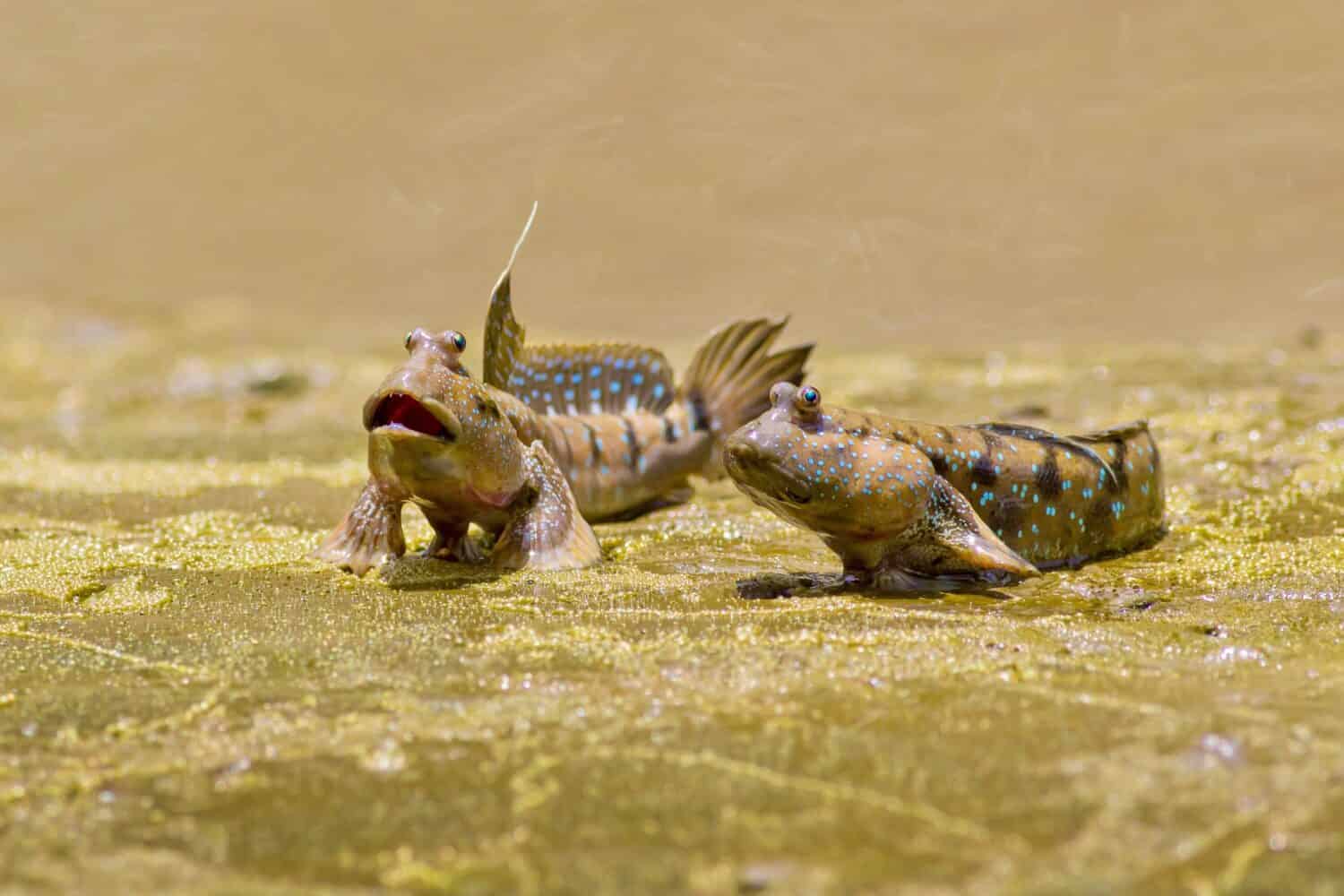

The old idiom of being a fish out of water is never a positive thing. Instead, it paints a picture of being uncomfortable or awkward. This is how most fish feel when they are removed from their aquatic environments as they struggle to breathe to survive. Not all fish feel this way, however. One in particular not only enjoys being terrestrial but thrives doing so. Consequently, the mudskipper, a real fish out of the water, is more apt to be found on land. This makes the mudskipper a true anomaly among a sea full of other fish.
Terrestrial Creatures
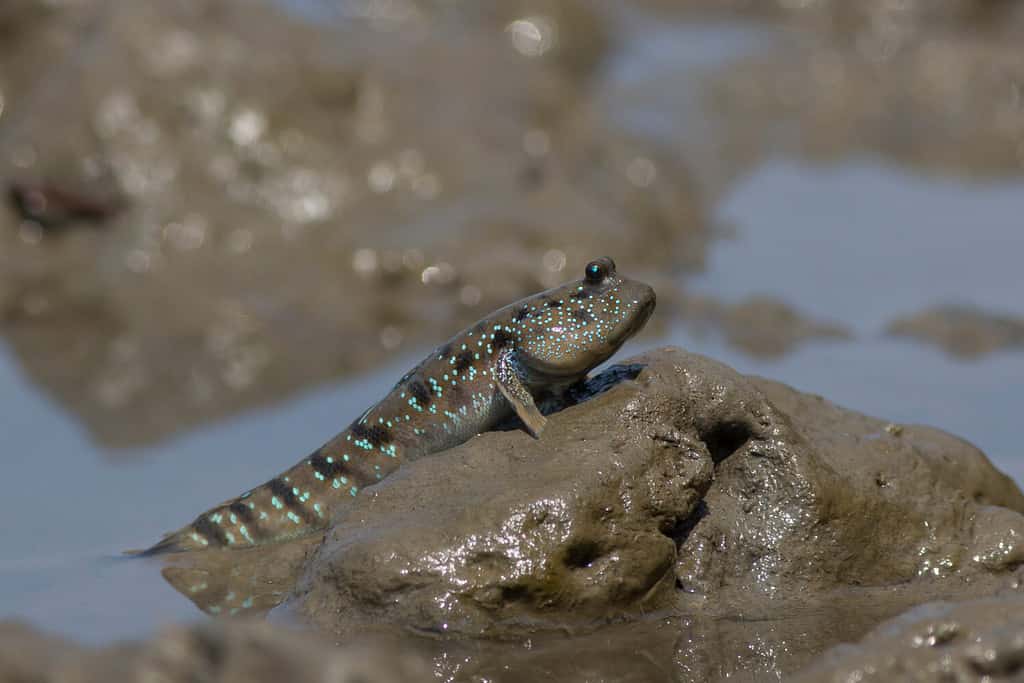
Mudskippers live happily both above and below the water.
©aDam Wildlife/Shutterstock.com
It seems odd to think of a fish that not only thrives in water but also on land. That thought becomes even stranger when the fish prefers to be above water, rather than below. But that is exactly the situation for the mudskipper, a fish-like creature that can be found both out of and in the water. Mudskippers inhabit the subtropical areas of Australia, Asia, and Africa. In these regions, the intertidal habitats are where mudskippers call home. Mudskippers are able to flourish and easily transition in the ever-changing environment with the tides ebbing and flowing.
As the tides recede and leave mudflats behind, the mudskippers emerge from their mud burrows to walk on land. The mudskippers accomplish this by using their pectoral fins to propel themselves forward and their pelvic fins for balance. This maneuverability helps mudskippers to move across both flatlands and on the roots of mangrove trees seamlessly.
There are more than 30 different types of mudskippers, and no two species are the same. While the average length is 12 inches for the creature, some species are both longer and shorter than the average. All have eyes on the top of their heads that allow them to see above water, even when submerged. Unlike other fish, mudskippers blink, a function that helps to keep eyes lubricated when out of the water. When the tide begins to come back in, mudskippers retreat to their mud burrows. There, the fish have pockets of oxygen they have stored to wait comfortably until the high tide has passed.
Risk of Drowning

Mudskippers must take breaths of air when in the water; if they do not, they will drown.
©GoranE/Shutterstock.com
It is strange to think of a fish living out of the water. What is even stranger still is a fish that will actually drown if it does not leave the water. The mudskipper is a fish that requires oxygen to survive. While this does not mean they have to come on land to get oxygen if the fish are unable to grab a gulp of air while in the water, they will drown. This makes them unique from other fish, which require being submerged at all times to survive.
Other fish, such as the betta, lungfish, Barca snakehead, and more, also need to gulp air. However, these fish are not equipped to stay out of the water as long as the mudskipper is. This is because betta can live out of the water for a short time, but need to be in water to survive. Lungfish can stay out of the water for months, but to do this, they need to hibernate in mud burrows until water returns. Barca snakeheads can stay out of the water for days on end, but they lack the ability to be mobile like the mudskipper. This is why mudskippers do so well out of water, whereas other, seemingly similar fish do not fare as well.
How Mudskippers Spend Their Time

Mudskippers spend the majority of their lives on land versus in the water.
©Rich Carey/Shutterstock.com
Mudskippers are not just fish that spend a bit of time out of the water as they look for a mate or food. Instead, mudskippers spend three-quarters of their lives out of the water, making them a truly interesting fish indeed. Some species of fish jump out of the water and slither to a new home when conditions in the old body of water are no longer favorable to them. However, the goal is to get back into the water and not spend a long time on land. Other species can survive if they are taken out of the water for a short time, but need to live in the water to thrive.
Mudskippers prefer to be on land. While the walking fish do have to work to keep their bodies moist, they do not have to return to the water to maintain this condition. As long as the area they are living in on land has plenty of mud, mudskippers are very comfortable staying out of the water. While on land, mudskippers will hunt. Some of the favorite prey of mudskippers include:
- Insects
- Crustaceans
- Sandworms
- Small crabs
- Worms
In the water, mudskippers will also eat small fish and algae. Thankfully, mudskippers have perfected being able to breathe both in and out of the water, given their desire to spend so much time on land versus in the sea.
Mudskippers Breathe in Water and on Land

Mudskippers use their gills for oxygen while underwater and their skin to circulate oxygen when on land.
©Polbkt/Shutterstock.com
Mudskippers are truly unique creatures. While there are other fish that breathe air and even slither across land, mudskippers are the only fish-like animals that are capable of doing this for days at a time. Unlike other fish whose gills collapse when they get out of the water, mudskippers have reinforced gills that do not collapse when they are on land. However, the gills are not used for breathing when on land. Gills are instead used to “excrete waste products.”
Mudskippers are actually able to breathe through their skin when they are on land. This is done through “cutaneous respiration.” The oxygen is captured and absorbed through their wet skin and the linings of the throat and mouth. As long as the mudskipper keeps its skin wet, it is able to stay out of water for long stretches of time.
Why Mudskippers Need Mud

Mudskippers have to constantly roll in mud to keep their skin moist.
©aDam Wildlife/Shutterstock.com
Mudskippers may spend the majority of their lives out of the water, but that does not mean they do not need water. In fact, shallow water and mud are vital for mudskippers to survive. While mudskippers can remain out of the water for up to three days at a time, during that time they need to find ways to keep their skin moist. Consequently, mudskippers will roll around in shallow water and mud to keep their skin moisturized. It does not take long for mudskippers’ skin to dry out. Therefore, the fish-like creatures will consistently roll to their sides or backs to ensure they are healthy as they walk along the muddy intertidal habitats looking for food or mates.
Underground Nests

Male mudskippers jump high in the air to attract a mate.
©Anake Seenadee/Shutterstock.com
Mudskippers mate on land, rather than in the water. When they do so, the male will jump up high in the air, sometimes up to two feet, to signal his intentions to take a mate. When a female is interested, she will follow the male mudskipper into a mud burrow to procreate. When the eggs are laid, they are laid in the mud burrow, where the male mudskipper tends to the eggs for approximately one week. While water fills the burrows during this time, the water is very low in oxygen. On its own, it is not conducive to supporting the life growing in the eggs.
However, thanks to the male mudskipper, the water can be oxygenated. The male will suck in large amounts of air into his mouth and deposit the oxygen into the chamber where the eggs are located during low tide. Over the week, as the babies grow, the mudskipper will repeat this process. When the eggs are ready to hatch, the male will remove the oxygen from the mud burrow, and it fills with water. As this happens, the eggs begin to hatch. The newly hatched larvae will make their way to live among plankton for approximately 50 days. However, how the larvae manage to escape from the mud remains a mystery, one that scientists are still working to solve.