
Quick Take
- The Key deer is the smallest subspecies of white-tailed deer and lives only in the Lower Florida Keys, with a population of roughly 600 animals.
- Once reduced to just a few dozen individuals, the species rebounded thanks to federal protection and the creation of the National Key Deer Refuge.
- Today, vehicle collisions, disease, hurricanes, sea level rise, and human interaction remain major threats to its survival.
When you think of Florida Keys wildlife, you probably think of sea turtles, dolphins, manatees, or colorful coral fish. Maybe you imagine a bright green gecko. Perhaps you’ve heard about the wild chickens that roam the streets of Key West. Maybe you even think of the dozens of cats that live at Ernest Hemingway’s house. But you probably don’t think of deer, though you should. The Florida Keys are home to a deer so specific to the region that they even share a name: Key deer.
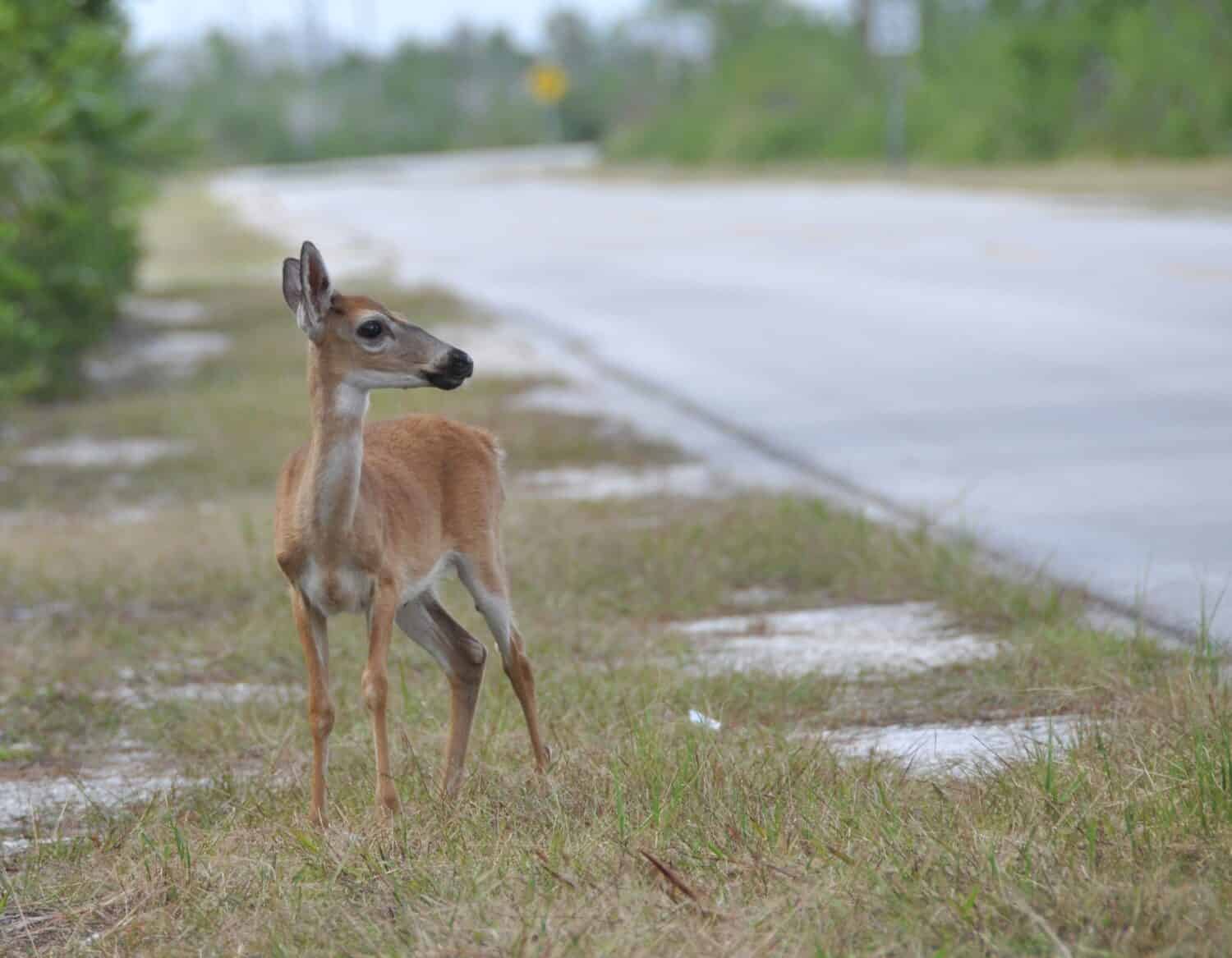
On March 11, 2026, conservation groups, wildlife officials, and Florida residents will pause to recognize Key Deer Awareness Day. At just about 30 inches tall at the shoulder, the Key deer looks like a full-grown deer scaled down to snack size. With only around 600 individuals left in the wild, the Key deer is one of the rarest deer in North America.
Found only in a small stretch of the Florida Keys, this endangered animal continues to survive thanks to decades of focused conservation work and a community that has learned to share the road and the landscape. Here’s what makes the Key deer so special, what threatens its survival, and what’s being done to make sure this tiny icon doesn’t disappear.
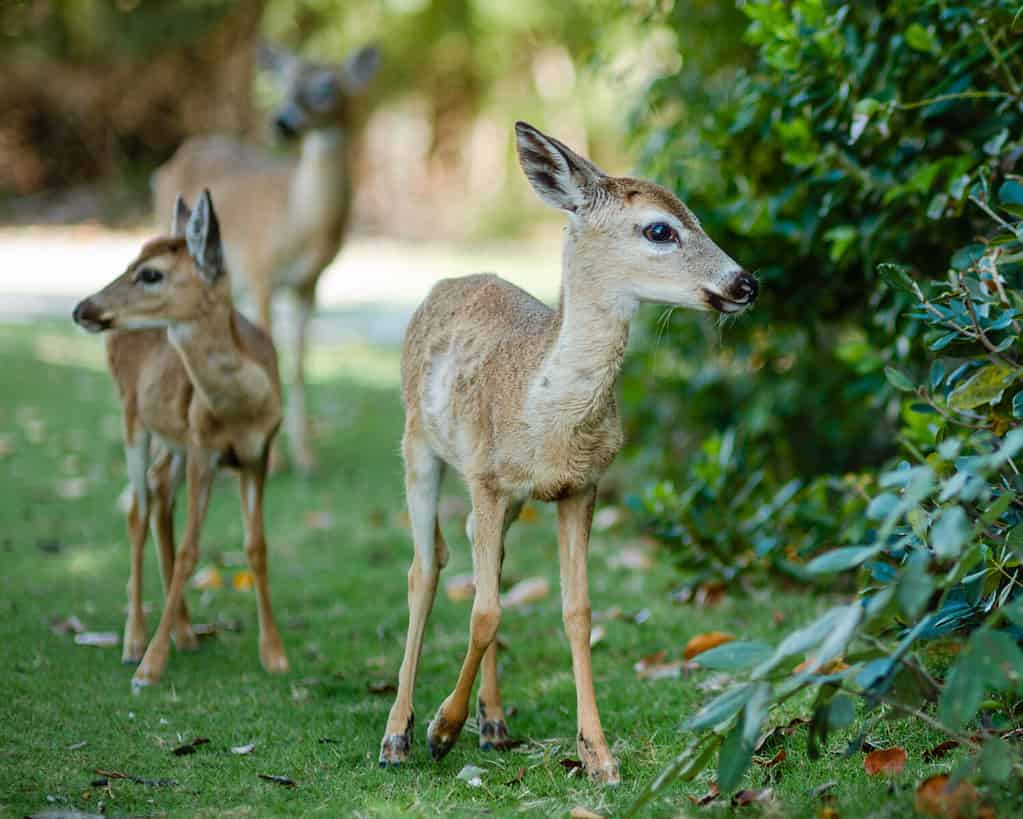
Adult Key deer stand only about 30 inches tall at the shoulder, making them the smallest subspecies of white-tailed deer in North America.
©Abigail Marie/Shutterstock.com
A Deer That Lives Nowhere Else on Earth
The Key deer is a subspecies of the white-tailed deer, having evolved in isolation in the lower portion of the Florida Keys. Over thousands of years, limited resources and island life favored smaller bodies, resulting in the smallest subspecies of white-tailed deer in North America.
Adult males, called bucks, typically stand about 28 to 32 inches tall at the shoulder and weigh between 55 and 75 pounds. Females are even smaller, often weighing between 45 and 65 pounds. For comparison, a typical mainland white-tailed deer buck can weigh well over 150 pounds. They look delicate and dainty, but they’re still true deer—with slender legs, large ears, and the familiar white underside of the tail that flashes when they run.
Today, most Key deer live on Big Pine Key and several surrounding islands in the Lower Keys. The heart of their habitat is the National Key Deer Refuge, a protected area established in 1957 specifically to save them from extinction.
How Close Did They Come to Disappearing?
In the 1940s and early 1950s, Key deer were on the brink. Unregulated hunting, habitat destruction, and human settlement had reduced their numbers to an estimated few dozen animals. Some accounts suggest the population may have dropped to fewer than 30 deer.
The creation of the refuge and the passage of the Endangered Species Act in 1973 marked turning points. The Endangered Species Act gave federal protection to the Key deer, making it illegal to harm or harass them. The refuge protected crucial habitat from development and hunting. Over time, the population slowly rebounded.
By the early 2000s, estimates suggested the herd had grown to around 700 to 800 individuals. For a small, isolated population, that was a remarkable comeback. But island life comes with ongoing challenges, and the number has fluctuated in recent years due to disease, storms, and human-related threats. Current estimates from the U.S. Fish and Wildlife Service put the population at roughly 600 animals. That may sound like a decent number, but for a species confined to just a few islands, it represents a fragile margin.
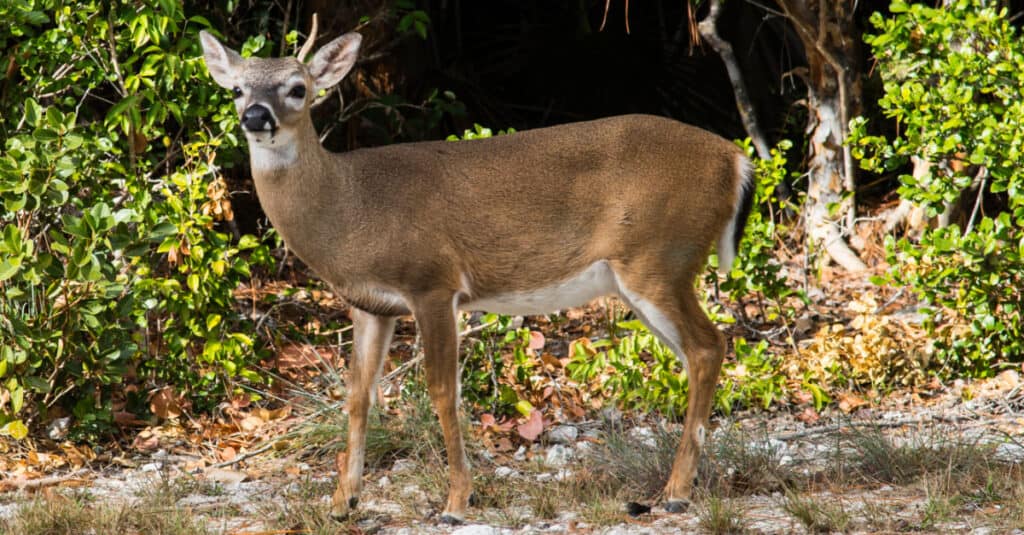
By the 1950s, fewer than 30 Key deer may have remained before federal protection helped the population recover.
©iStock.com/SloMoe
Life in the Lower Keys
Key deer inhabit pine rocklands, tropical hardwood hammocks, freshwater wetlands, and mangrove forests throughout the Lower Florida Keys. Because freshwater is limited on small islands, they rely on natural freshwater “solution holes” in limestone and man-made freshwater sources, especially during dry months.
They’re herbivores and feed on more than 150 plant species, such as leaves, shoots, fruits, and mangrove vegetation. In neighborhoods, they sometimes browse on ornamental plants—a pesky habit that can create tension with homeowners.
Unlike many mainland deer, Key deer have adapted to living near people. It’s not uncommon to see them wandering through yards, crossing quiet streets, or resting in the shade under raised houses. That familiarity can be charming, but it also puts them at risk.
The Biggest Threat: Cars
Vehicle collisions are one of the leading causes of death for Key deer. U.S. Highway 1, the Overseas Highway, runs directly through their habitat on Big Pine Key. Even with reduced speed limits and wildlife crossings, deer are still struck and killed each year.
Key Deer Awareness Day was originally created in part to remind drivers to slow down. Speed zones as low as 35 miles per hour have been established in Key deer areas, and law enforcement actively monitors these zones. Flashing signs warn motorists when deer are nearby. Wildlife underpasses and fencing help guide deer safely across busy roads. Still, collisions remain a persistent problem. On a small island, even the loss of a few breeding adults can significantly impact the entire population.
Disease and Parasites
In 2016, biologists confirmed the presence of New World screwworm in Key deer. This parasitic fly lays eggs in open wounds, and the hatching larvae then feed on living tissue. The outbreak was devastating. More than 100 deer died before an aggressive response brought the situation under control.
Federal and state agencies released millions of sterile male screwworm flies to stop reproduction, a technique that has been used successfully in the past to eradicate the pest elsewhere. Checkpoints were set up to prevent the movement of potentially infected animals off the islands.
The outbreak was contained, but it served as a tragic reminder that small, isolated populations are especially vulnerable to disease. With limited genetic diversity, there’s less resilience when something new appears.
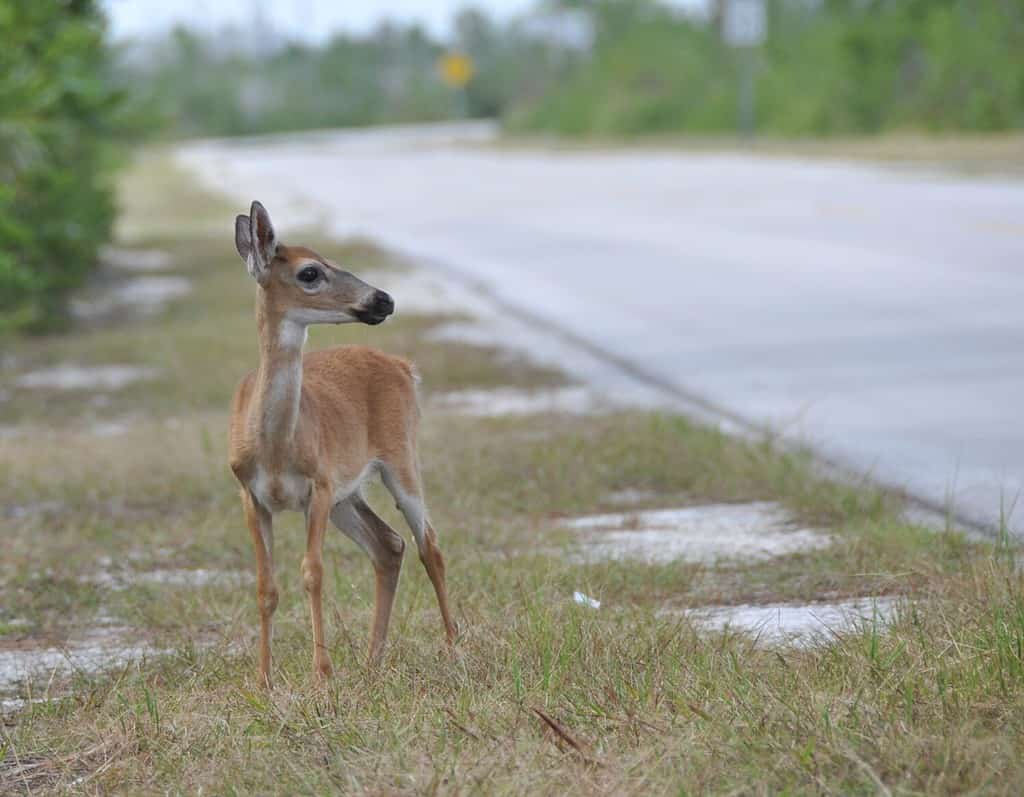
U.S. Highway 1 cuts directly through Key deer habitat, and vehicle collisions remain one of the leading causes of death.
©Chuck Wagner/Shutterstock.com
Hurricanes and Rising Seas
Living on low-lying islands also means living with hurricanes. When Hurricane Irma struck the Keys in 2017, it brought storm surge, flooding, and habitat damage. Some deer drowned, while others lost access to freshwater and food sources in the aftermath.
Sea level rise presents a slower-moving but equally serious concern. Much of the Key deer’s habitat sits only a few feet above sea level. Saltwater intrusion can kill native plants and contaminate freshwater sources. As higher ground becomes scarcer, deer may be pushed closer to roads and residential areas, increasing the risk of human conflict. Conservation planning now includes long-term strategies to identify and protect higher elevation habitat within the refuge and surrounding lands.
Human Interaction: Feeding Is a Hidden Danger
It can be tempting to feed a Key deer that wanders into your yard. They’re small, calm, and often unafraid of people. But feeding deer is illegal and harmful.
Hand-feeding encourages deer to approach cars and congregate near roads. It can also lead to poor nutrition if they rely on processed foods instead of native plants. Over time, habituation reduces their natural wariness and increases the likelihood of vehicle collisions.
Public education campaigns emphasize a simple message: enjoy them from a distance. Don’t feed them. Don’t approach them. Let them stay wild.
Conservation in Action
The U.S. Fish and Wildlife Service manages the National Key Deer Refuge and works with Monroe County, the State of Florida, and nonprofit partners to protect habitat and monitor the herd.
Efforts include:
- Land acquisition to prevent development in critical habitat areas
- Prescribed burns to maintain healthy pine rocklands
- Population surveys and health monitoring
- Enforcement of speed limits in key deer zones
- Public outreach through schools and community events
Community involvement also plays a major role. Local residents report injured deer, support habitat protection measures, and advocate for responsible driving. Over the decades, that collective effort has turned the Key deer into a symbol of the Lower Keys.
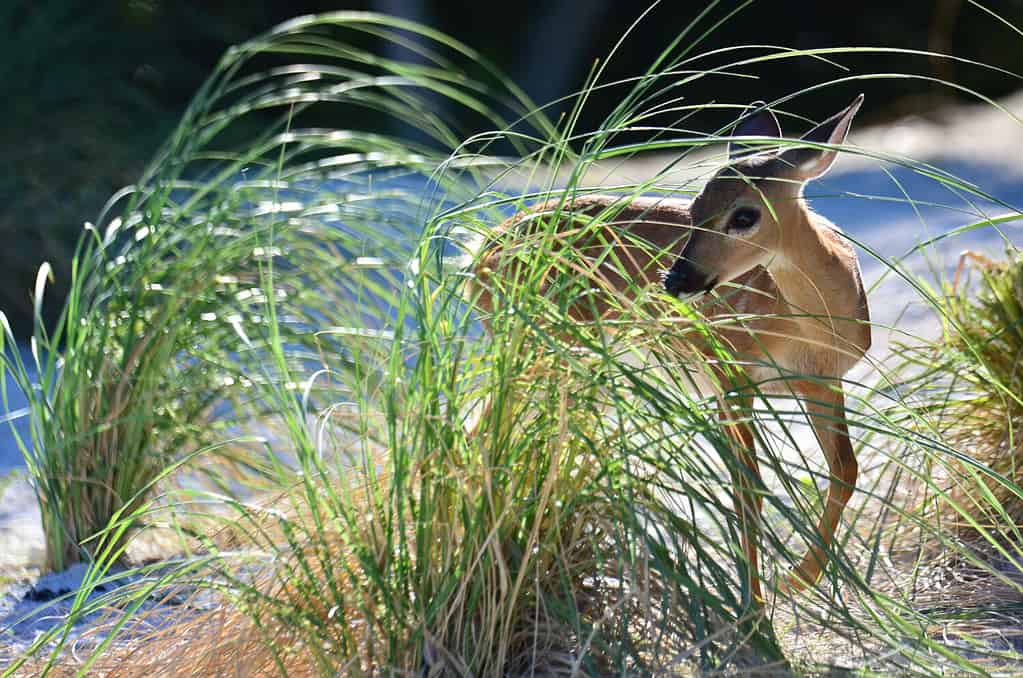
The National Key Deer Refuge was established in 1957 to protect critical habitat for this endangered island deer.
©Virginia Blount/Shutterstock.com
A Tiny Deer With a Big Problem
On March 11, while we celebrate Key Deer Awareness Day, let’s also think about how quickly a species can slip toward extinction and how determined conservation can pull it back. The Key deer’s future isn’t guaranteed. It depends on careful habitat management, responsible tourism, and continued public support. Sometimes, saving a species starts with something as simple as slowing down.