
Some amazing examples of camouflage exist in the wild, with animals seamlessly blending into their surroundings through patterns and textures. One of these amazing creatures is the twig snake, also known as the vine snake. As the name suggests, this snake blends in with the trees around it, making it excellent at hunting prey or avoiding predators. This video by Reptiles of South Africa – Tyrone Ping shows this snake in its everyday life, slithering through the trees. Read here to learn more about these snakes, their habitat, venom, and more.
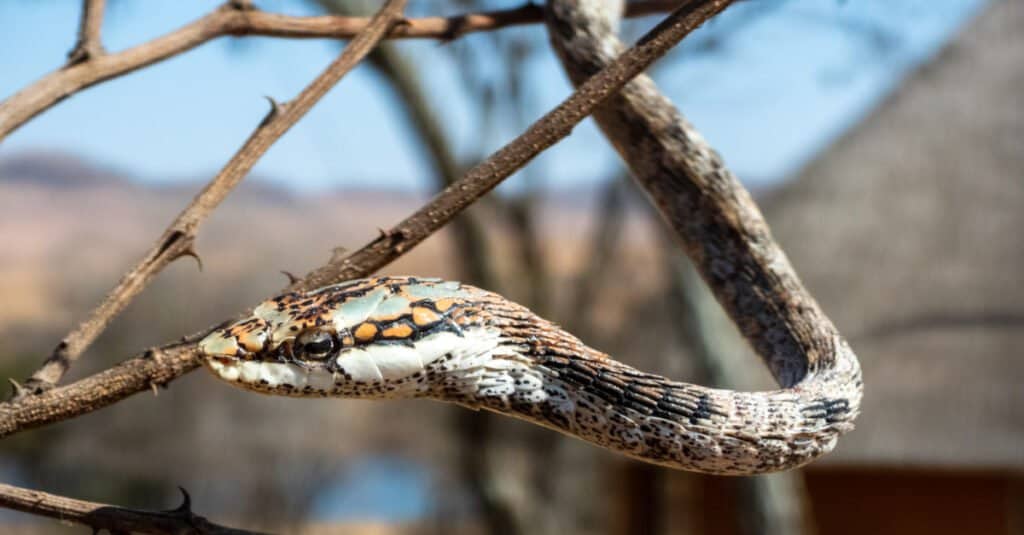
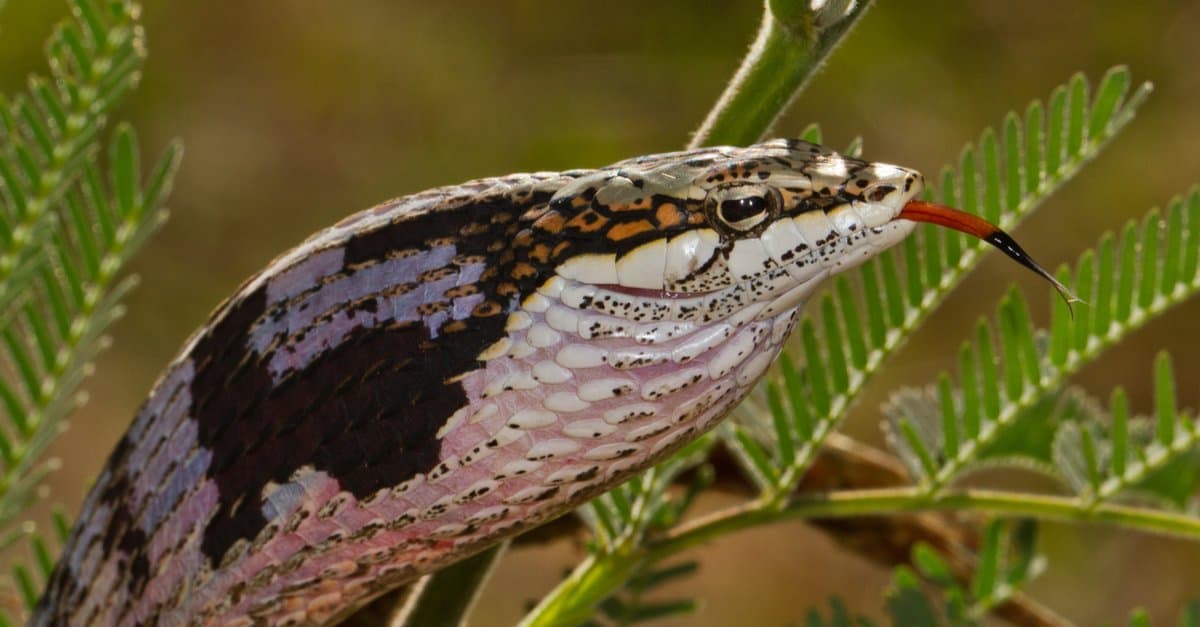
Twig snakes are characterized by thin, elongated bodies, with extremely long tails and a sharply triangular-shaped head.
©Willem Van Zyl/Shutterstock.com
All About the Twig Snake
Native to the trees and bushes of sub-Saharan Africa, twig snakes are considered low-risk and have amazing camouflage abilities. Known scientifically as Thelotornis capensis, these snakes have long, thin bodies. This makes them resemble a twig when they are positioned among branches. They can grow to around four to five feet in length and are a brownish-green color. Their pointed snout makes them look spiky and branch-like, but it is their pattern that gives them a hard-to-decipher appearance. With an elaborate pattern of scales in different hues, similar to a tree branch, the twig snake will wiggle back and forth in the tree. They do this to mimic the sway of branches in the wind.
Twig snakes have a variety of prey and predators. Their main prey consists of smaller animals such as small birds, frogs, and lizards. They also feed on rodents and, rarely, small snakes as well. Using their camouflage, they ambush their prey with a quick and deliberate bite. After their venom subdues their prey, the snake will swallow it whole. The camouflage that helps them ambush prey also helps them hide from predators. Like most snake species, their biggest threat comes from birds of prey such as hawks or eagles. Hiding among thick branches can help the snake avoid being swooped down on and grabbed before it has a chance to defend itself.
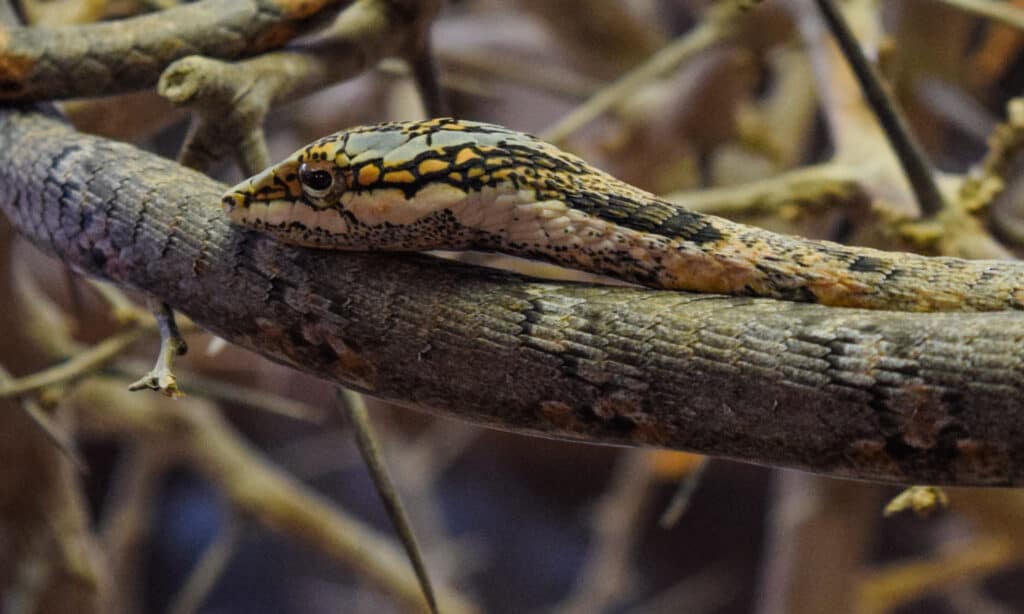
Twig snakes have a unique pattern that blends well with tree branches.
©Authentic travel/Shutterstock.com
Dangerous Venom
Twig snakes are typically considered low risk. Normally, they only bite humans when provoked or handled improperly. In the wild, they are shy and will hide away from humans rather than approach. This is because of their fang structure. Twig snakes have a rear-fanged structure, which means that their fangs are located in the back of the mouth rather than the front. Because of this, the snakes must bite deeply and chew on their prey to inject venom. While bites from these snakes may not happen often, their venom is extremely dangerous.
Twig snake venom is hemotoxic, meaning it disrupts the body’s ability to clot blood and can cause severe internal and external bleeding. What makes this even more concerning is that there is currently no antivenom for twig snake bites, so treatment relies on supportive care. While the venom is extremely dangerous, fatalities are very rare. Symptoms include bleeding from the nose or mucous membranes, as well as bruising. Although they usually avoid humans, it is best to stay alert for these hard-to-spot snakes to ensure your safety.