When two different species procreate, hybridization is at play. It is a practice that is not uncommon in the wild but is far more commonly known to happen in captivity, where species that would otherwise never have had contact with one another cohabitate an environment together. In a rare occurrence, a Canada goose and a greater white-fronted goose found one another at an Oregon regional park. The Canada goose was receptive to the greater white-fronted goose and the two procreated, taking park rangers, biologists, and even birders by surprise.
A Canada Goose and a Greater White-Fronted Goose Surprisingly Procreate

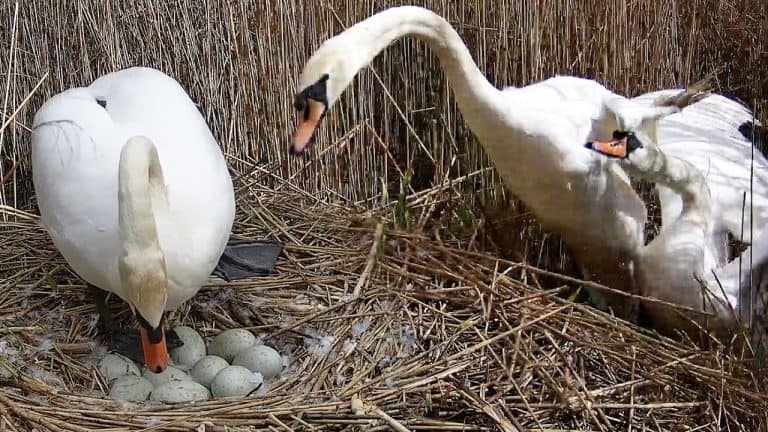
The Canada goose nests while the greater white-fronted goose stands guard.
©Oregon Public Broadcasting – Original
It is not uncommon for waterfowl to create hybrids of their species. Be it snow geese and specklebellies, the mallard and pintail, or the Canada goose and snow goose, waterfowl are known for creating hybrids of themselves as a form of survival. What is not as common is to see two separate species bond and nest together. However, this is what happened in Portland, Oregon, this year when a Canada goose and a greater white-fronted goose were spotted together nesting.
In April 2025, a park ranger named William McDonald was doing his normal rounds at Blue Lake Regional Park. It was the time of year when geese and ducks were plentiful at the park because it was nesting season. Consequently, it was normal to see a Canada goose nesting in the grass near the water. What was not so normal to see was the goose that was protecting the nest. Instead of the nesting Canada goose having another Canada goose partner, the partner was instead a greater white-fronted goose.
“Last week I walked down to Swim Beach and I happened to see that there was a Canada goose on one corner of the point there and there was a greater white-fronted goose that was acting as a barrier between myself and the goose,” McDonald explains. “It piqued my interest. I started paying a little more attention.”
It was odd that the two had paired up, given that the geese are of two completely different species, according to Katy Weil, a senior natural resource scientist for Metro, the agency that manages the park where the goose pair was discovered. But the two geese were receptive to one another and laid eggs together.
“Most people think that two different species can’t breed and produce viable offspring,” Weil states, “but we’re wrong, and I love that about science is that we learn something every day.”
What brought the geese together is open for speculation. Many believe that Canada geese may have raised the greater white-fronted goose via parasitism. Another working theory is that the greater white-fronted goose, which should have migrated further north than Portland, was injured and found the park to be a safe place to rehabilitate. During his rehabilitation, he came into contact with a Canada goose, which was receptive, and eggs were laid. Whatever the reasoning for the pair being together, they created quite an attraction at the regional park, with birders and scientists alike excited to see the outcome when the eggs hatched.
What Happened to the Eggs Remains a Mystery

Two of the Canada goose and greater white-fronted goose eggs hatched, but there were no hatchlings seen.
©FotoRequest/Shutterstock.com
With the Canada goose and greater white-fronted goose having produced six eggs, both scientists and the public were waiting with anticipation to see the hatchlings as they entered the world. But then something very strange happened. There were no goslings.
In early May, locals who had been keeping an eye on the geese noticed that two of the six eggs had hatched. However, there was no sign of offspring. Additionally, the remaining four eggs did not hatch. Weil and her team took the remaining four eggs and examined them. What they found was that the eggs were never fertilized. Given it was early in the season, it is possible, according to Weil, that the couple could try again to have more eggs.
“So many people who love the park are keeping an eye out for them,” Weil explains. “They’re rooting for them. We have park rangers doing the same.”
Given that geese generally mate for life, it may just be the beginning of a long relationship for this pair.
Is Hybridization of Geese Common?

Geese will naturally participate in nest parasitism to help guarantee the survival of their offspring.
©Danita Delimont/Shutterstock.com
As a whole, it is not uncommon for waterfowl to participate in hybridization. It occurs naturally for geese, given that they are known for nest parasitism, which is the act of laying an egg in another goose nest. This gives the goose laying the egg a better chance of having her hatchlings survive by being spread across more than one nest.
When the hatchlings grow, if they are of another species, they will still likely look for a mate that resembles their mother, which perpetuates hybridization.
However, two different species of geese choosing to mate is far less likely to happen. But it is when this does happen that there is a “bridge for interspecific gene flow.” What this means is that by creating a hybrid between two species of geese, there is a higher chance of there being a larger population of the hybrids. If the hybrids prove to have better adaptability to the environment, in the long run, they could become the dominant species versus the two that created the hybrid.
With such a small population of geese and other waterfowl, for that matter, choosing to participate in hybridization, it is doubtful that the hybrid of any of these species will become dominant any time soon.
Geese Are Not the Only Species That Practice Hybridization
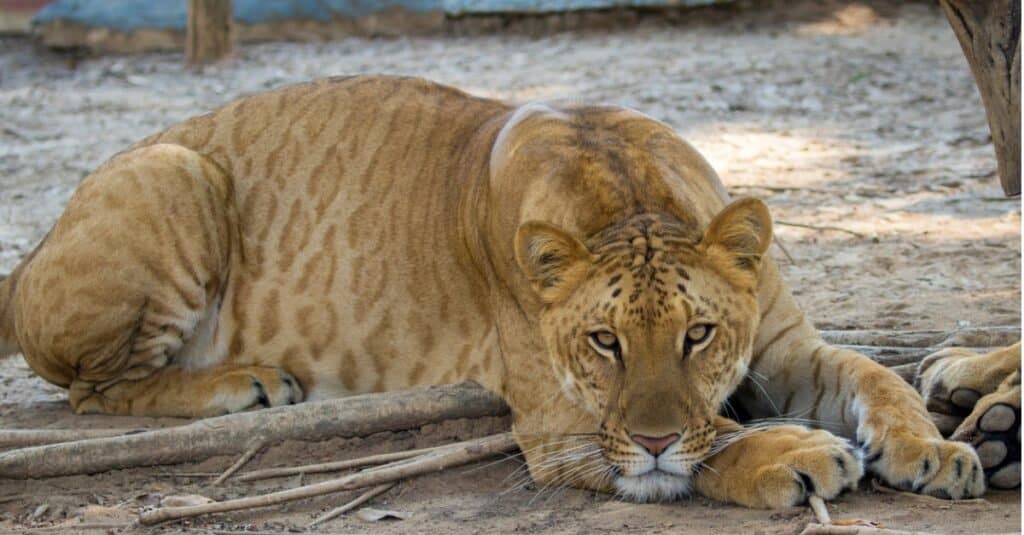
The liger is a hybrid of a tigress and a lion.
©iStock.com/yod67
Hybridization is not a goose-specific occurrence. There are numerous animals around the world and across a wide range of species that have created new and interesting hybrid animals through mating. In some instances, the offspring can mate as they age and produce viable offspring. But, for some, the creation of their species makes them infertile and unable to procreate.
Some of the most common species where hybridization has occurred include:
| Species Of Parent Animals | Offspring Created |
| Tigress and lion | Liger |
| Lioness and tiger | Tigon |
| Polar bear and grizzly bear | Grolar bear or pizzlies |
| Zebra and donkey | Zonkey |
| Zebra and horse | Zorse |
| Beluga whale and narwhal | Narluga |
| Bottlenose dolphin and false killer whale | Wholphins |
| Donkey and horse | Mule |
| Goat and sheep | Geep |
| Coyote and wolf | Coywolves |
These particular species have been known to engage in hybridization in the wild, given the proximity of the animals to one another in their habitats. However, it should be noted that there is a significantly higher chance of hybridization occurring when these animals are kept in captivity, where there is no competition for food sources, and they consistently inhabit the same habitats.
Hybridization generally does not cause any harm. In some instances where one or both of the species participating in the mating is endangered, according to National Geographic, it can be problematic as the gene pool becomes smaller and diluted. However, it is also something that may become more common for several species, including the growler or pizzlies, as the Arctic ice melts and grizzly bears and polar bears have more interaction with one another.