
Spending time near the water in some states requires extra caution. This is because in popular kayaking, fishing, or swimming spots, there are water snakes. While some of these snakes pose no threat to people, others are venomous. However, if the snakes are given space, the likelihood of them striking is small.
Cottonmouth snakes, also known as water moccasins, are muscular snakes that can reach up to six feet in length and strike fear into the hearts of those who frequent bodies of water where the snakes are known to live. Unfortunately, the snakes tend to get a bad reputation based on lore that has been passed down for generations. What cannot be denied, however, is the grace with which the snakes seemingly glide across the water, leaving many to wonder how cottonmouth snakes swim.
Cottonmouth Snakes Are Curious Swimmers
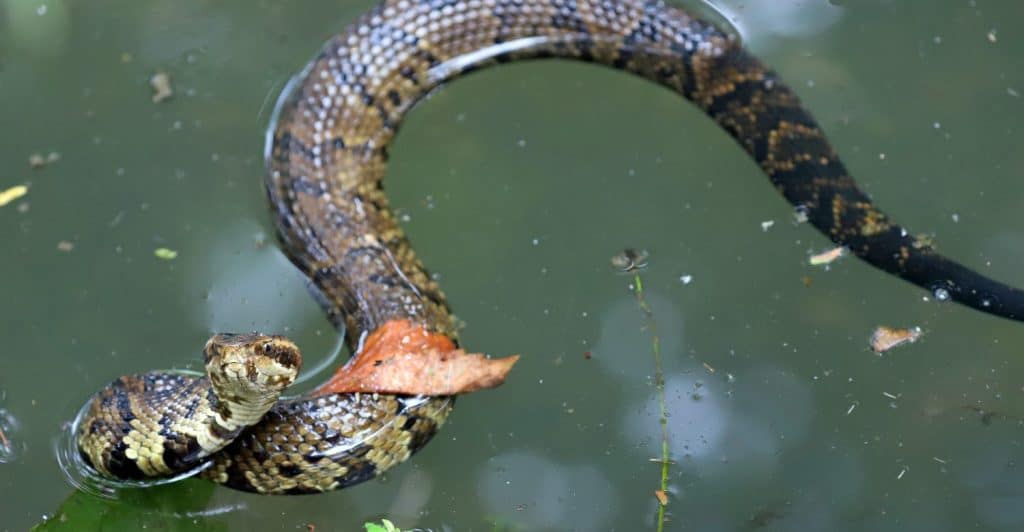
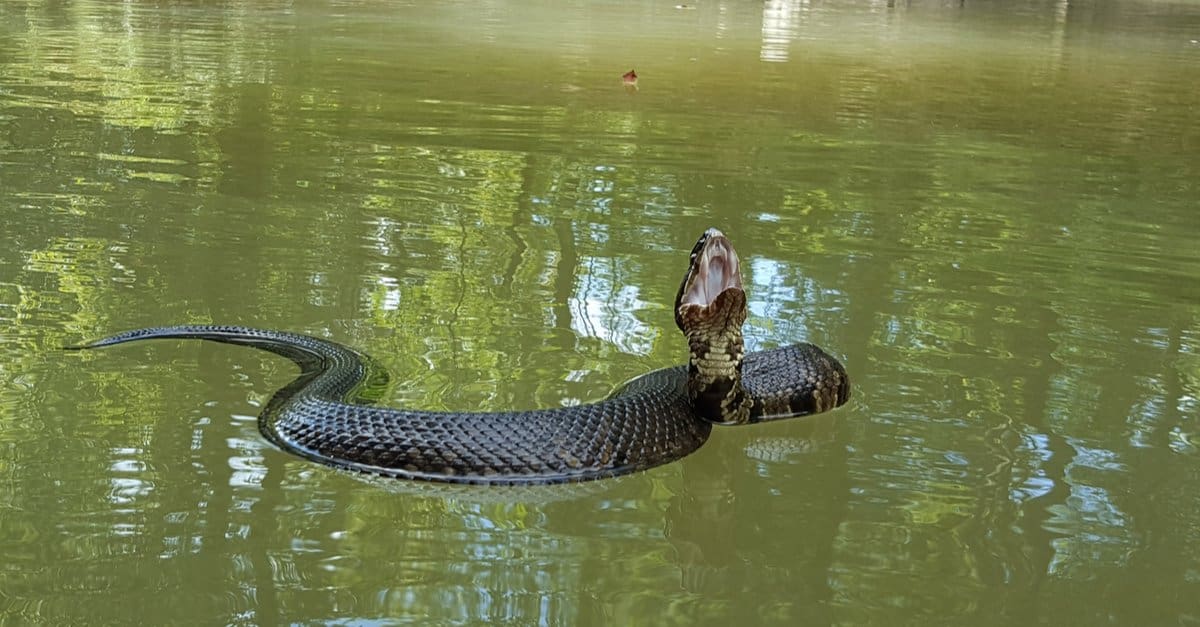
Cottonmouth snakes will approach kayaks in the water, but it is out of curiosity, not a desire to be aggressive and bite.
©KF2017/Shutterstock.com
Cottonmouth snakes are very curious swimmers. It is not uncommon for kayakers to come across venomous snakes and for the snakes to approach. Videos, such as this video on YouTube, show that cottonmouths would prefer to understand what the kayak is, rather than aggressively attack it.
By nature, cottonmouth snakes are shy but curious creatures. This is why, if out on a body of water where cottonmouth snakes are known to frequent, the likelihood of being momentarily approached by one is greater than being attacked by one. In most instances, if kayakers give the cottonmouths distance in the water, the snakes will do the same in return.
Cottonmouths only attack people when they feel threatened. Given that they are easily identifiable in bodies of water, with their ability to stay on the water’s surface rather than keeping only their head above water, those who want to avoid cottonmouths can and should. Not only does this keep those enjoying a day on the water safe, but it also allows the cottonmouth to remain calm and relaxed, so it can focus on finding its next meal.
How Cottonmouths Swim
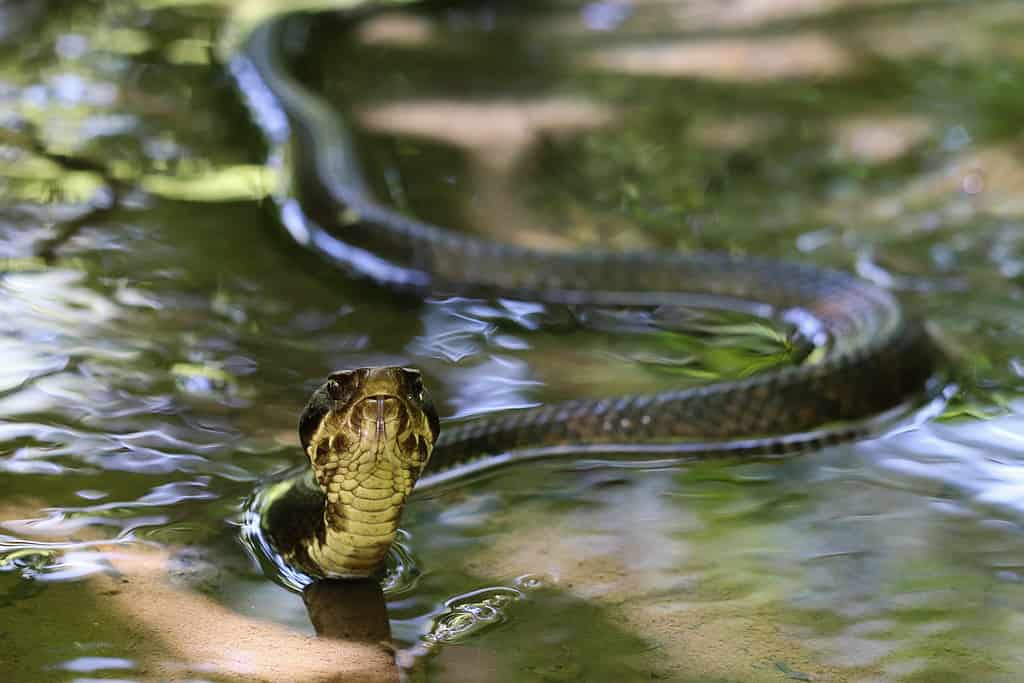
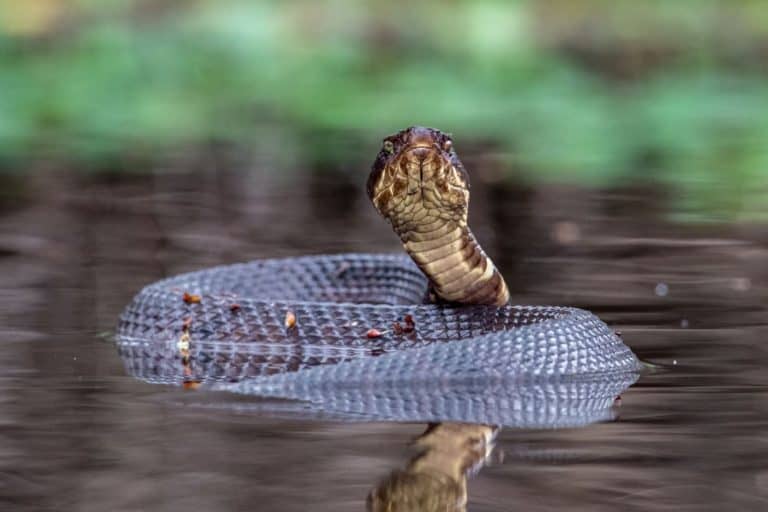
Cottonmouth snakes have a body composition that allows them to be buoyant on the water rather than only being able to keep their head above the surface.
©Rafael R Sandoval/Shutterstock.com
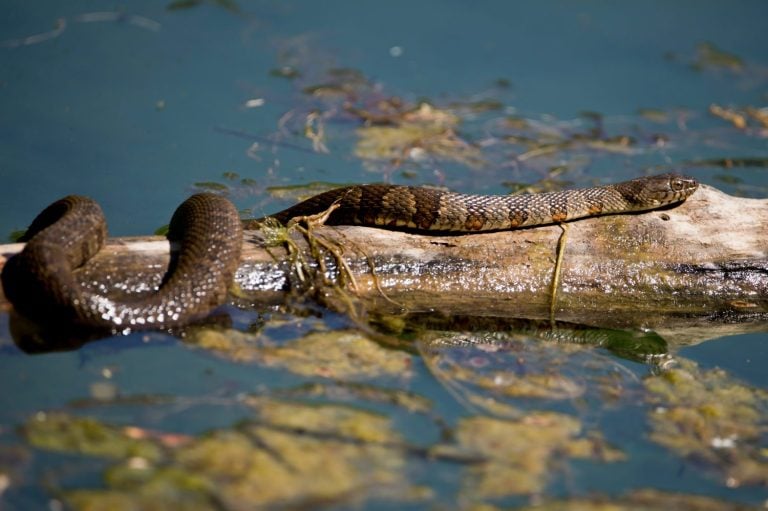
Water snakes are often mistaken for cottonmouths due to their similar markings and the fact that both species are minimally semiaquatic. However, there is a key difference between how the two swim, which those who are eagle-eyed can spot immediately.
Unlike water snakes, which swim with only their heads above the water, cottonmouths are buoyant. Thanks to the distribution of their bodies, the snakes can float on the surface of the water, and navigate along as necessary.
Additionally, water snakes can spend an hour or more underwater at a time. Cottonmouths can only hold their breath for a few minutes at a time. Fortunately, pit vipers have the ability to detect the slightest change in water temperature, allowing them to strike at prey, such as fish, toads, or other similar creatures, below the surface as they pass by.
Where Cottonmouth Snakes Are Found
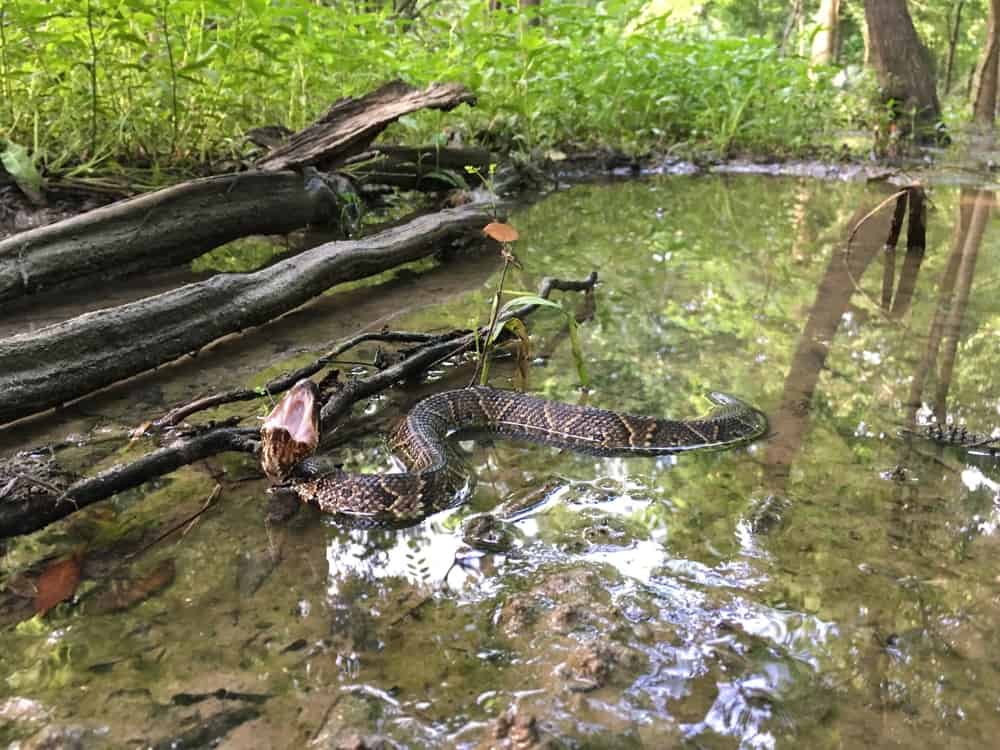
Cottonmouth snakes are found in the southeastern United States.
©Joe Farah/Shutterstock.com
Cottonmouth snakes are found in the southeast United States. The snakes’ territory spans from Texas to Florida, then extends north to Illinois, Indiana, Missouri, and Virginia. But it is not the same species of cottonmouth snake found in every state. Instead, three subspecies of cottonmouth are located in these regions.
| Subspecies Of Cottonmouth | Where Cottonmouth Is Located |
| Eastern Cottonmouth | Florida, Georgia, South Carolina, and Virginia |
| Western Cottonmouth | Indiana, Illinois, Alabama, Oklahoma, and Texas |
| Florida Cottonmouth | Florida and portions of South Georgia |
The coloration of the snakes will be slightly different depending on the subspecies. Where some may be lighter tan in color with identifiable banding, as they age, the scales darken, making the banding hard to distinguish. Some may even have yellow or green tips to their tails, which makes for a lure for bringing prey close enough to strike.
What each of these snakes will have, however, is the signature white mouth that they are named after. If this coloration is observed, it is likely because the person is too close to the snake and it is preparing to strike. This is why, when in the territory where cottonmouths are known to frequent, snakes should be given a wide berth, specifically for those who are unable to identify if the snake is venomous or not.
Types of Aquatic Environments

Cottonmouths can be found in slow-moving bodies of water, such as streams, marshes, ponds, and more.
©Brandon B/Shutterstock.com
Because cottonmouth snakes are semiaquatic animals, they can live both on land and temporarily in the water comfortably. But not all bodies of water are suitable for cottonmouth snakes. Therefore, there are some states that cottonmouths call home that require more attention than others when enjoying entertainment on the water. Bodies of water that cottonmouth snakes are known to frequent in the southeastern United States include:
- Marshes
- Ponds
- Rivers
- Lakes
- Streams
Cottonmouths have even been spotted in rice fields. Therefore, if there is a freshwater source within states that are hotspots for cottonmouths, especially where the water is slow-moving, a cottonmouth will likely make its appearance sooner rather than later.
When Encountering People, Cottonmouths Will More Likely Flee Than Strike
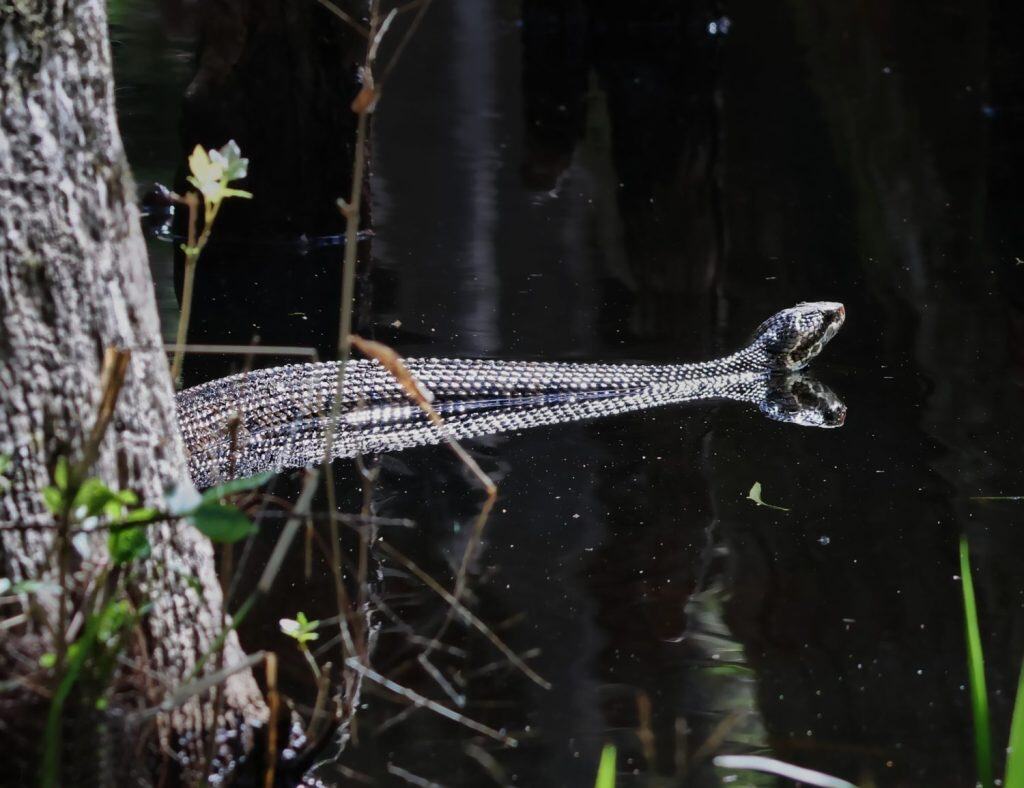
Cottonmouths would rather retreat than attack a person, whom they see as a predator that is much larger than themselves.
©Jean Blom/Shutterstock.com
Cottonmouths have the option of striking both on land and on water. But when it comes to feeling threatened by people, the snakes would rather flee than attack. The truth of the matter is, cottonmouths are venomous snakes. However, the snakes have gotten a bad rap for generations, leading to some misconceptions about the pit viper. This is particularly true of the aggressive behavior of cottonmouth snakes towards people.
Studies have shown that when in the presence of people, cottonmouths prefer to ignore individuals, even if they are only a few feet away, when the snakes are stepped on, or when the snakes are held. In all of these examples, the cottonmouths were most apt to attempt to bite when held, which was just over a third of the time.
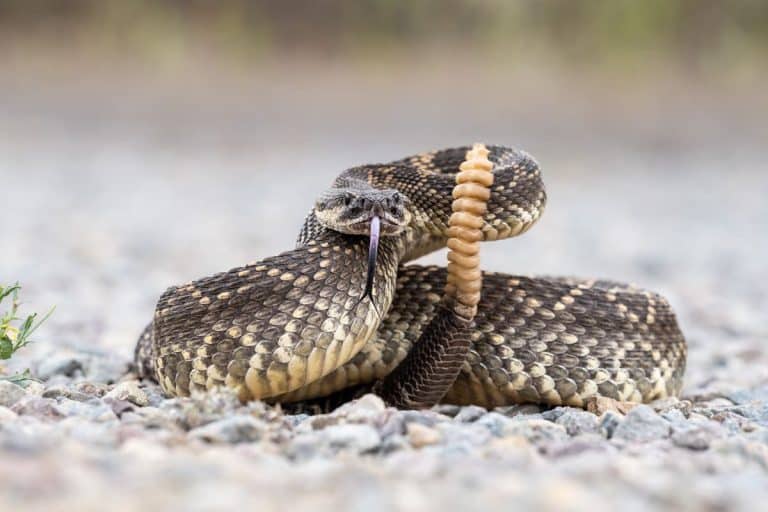
Instead of becoming aggressive, the cottonmouth snakes would open their mouths to reveal the white lining, shake their tails, similar to those of rattlesnakes, or attempt to slither away to the nearest source of cover. In some instances, this was actually in the direction of people, not because the snakes were being aggressive, but because they wanted to find a place to hide. The majority of snake bites from cottonmouths occur when people attempt to handle them. Therefore, when in the presence of one, walk away and leave it be. It will not aggressively follow or try to attack, unlike many tales from the past claim the snake will do.
The Potency of Cottonmouth Venom
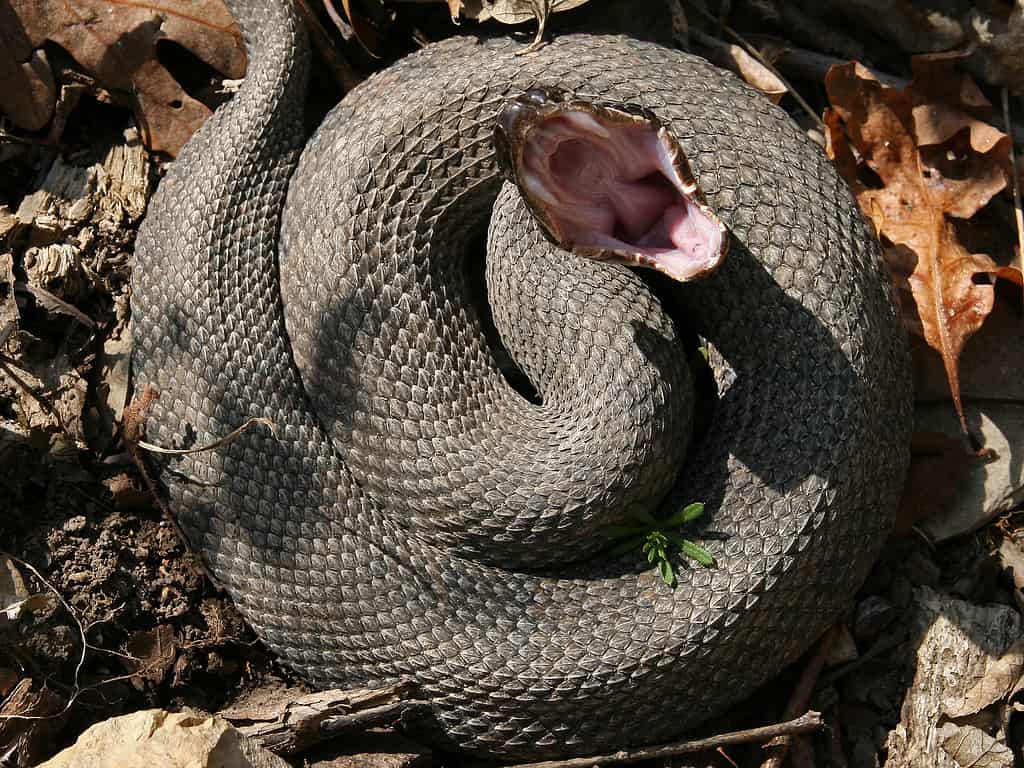
Cottonmouth snakes may appear to be aggressive, but they strike less often and are less venomous than other pit vipers.
©Ryan M. Bolton/Shutterstock.com
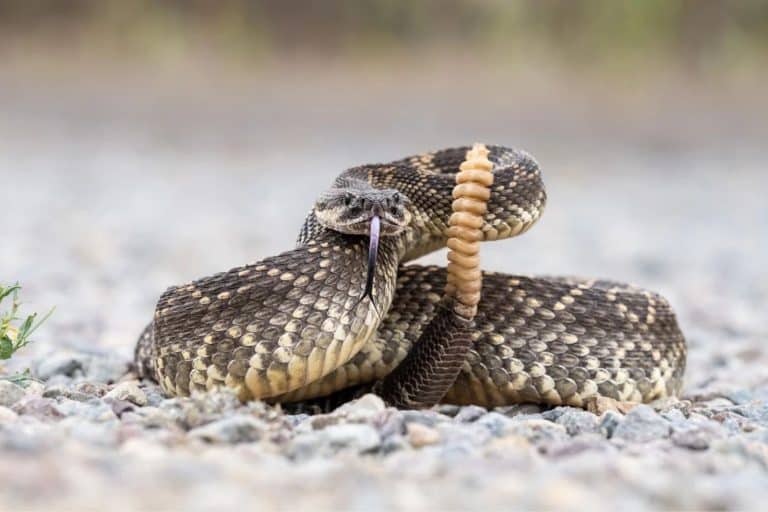
All pit vipers are venomous snakes. However, depending upon the species, some are more venomous than others. Cottonmouth snakes are generally considered less of a threat in terms of envenomation than rattlesnakes. While both snakes should be treated with care if contact is made, rattlesnakes are more apt to inject more venom during a strike than a cottonmouth snake is. Consequently, there is a greater likelihood of death when bitten by a rattlesnake than there is with a cottonmouth.
In total, there are 7,000 to 8,000 people who are bitten by venomous snakes each year. Statistics from 2017 show that there were 420 cases of envenomation by rattlesnakes. Of those cases, there were 38 fatalities. During the same year, there were 252 cases of envenomation by cottonmouths. Of those cases, there were no fatalities.
Though it appears cottonmouths are a better option to be face-to-face with versus a rattlesnake when it comes to survival, all pit vipers, regardless of how potent their venom is, should be handled with care. Therefore, never attempt to get closer, touch, or kill a pit viper. The best course of action is to walk, swim, or paddle away calmly to ensure that no attacks are attempted by a venomous snake.