
This video shows hundreds of thousands of purple martins swarming throughout downtown Nashville, Tennessee, last summer. Each night for several weeks, onlookers gathered in the Tennessee Titans stadium parking lot to watch as this massive flock circled the skies and landed in trees, the sound of which was deafening. What exactly was going on? Why were these birds swarming this southern city? Read on to explore the amazing phenomenon of martin migration.
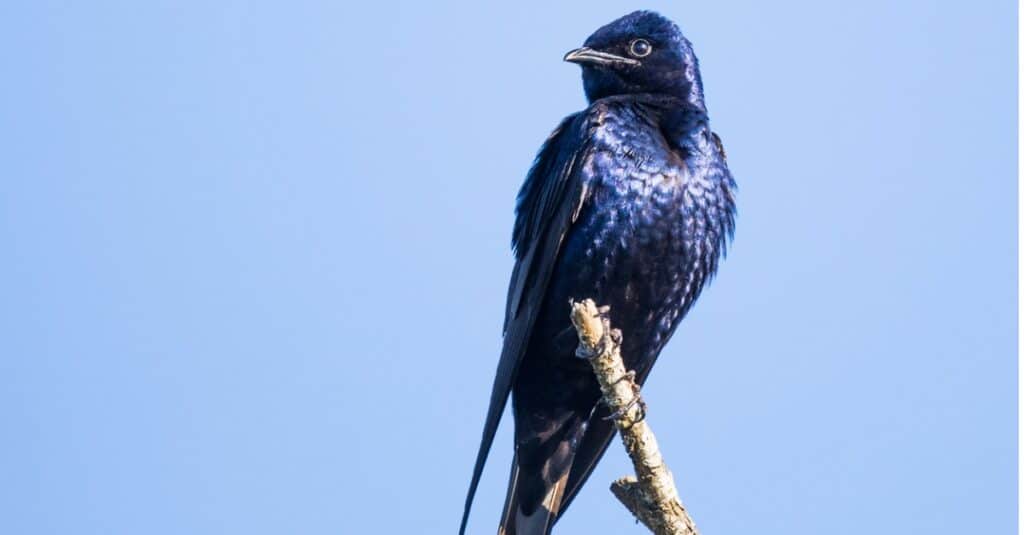
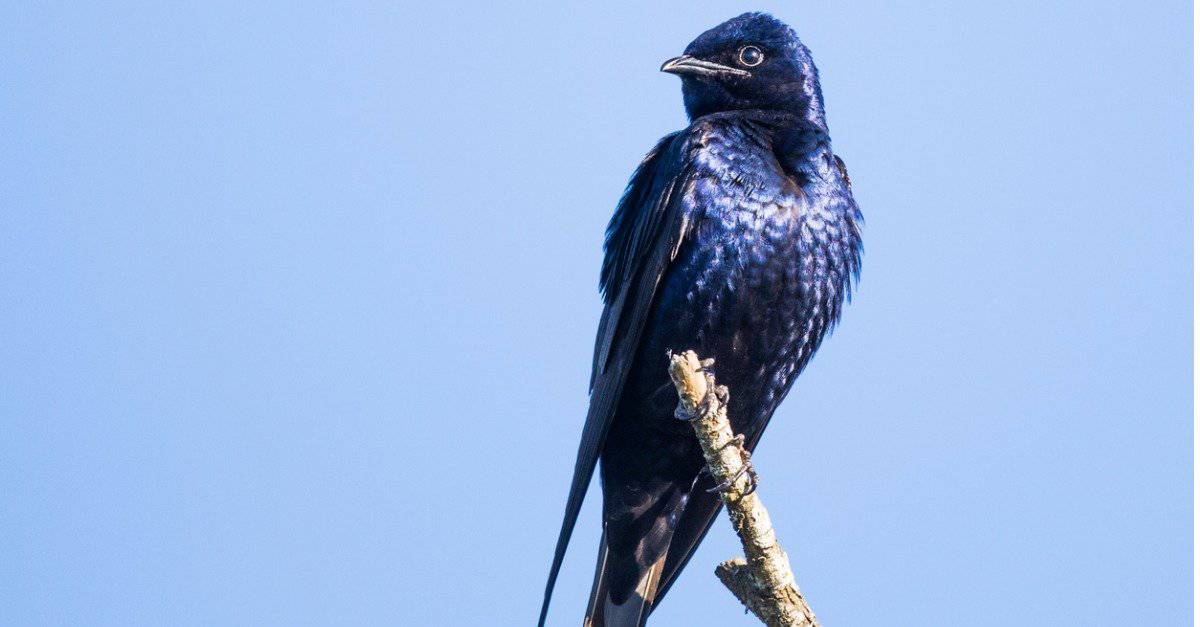
Purple martins are North America’s largest swallows, a family of songbirds adapted to hunting insects in flight.
©iStock.com/Jeff Huth
What Are Purple Martins?
At about eight inches in length, purple martins are North America’s largest swallows, a family of songbirds highly adapted to feeding on insects while flying in the air. Male and female purple martins look dramatically different from one another. They look like they could even be different species of birds! Male purple martins are a deep, shiny bluish-purple color, which gives them their name, with a dark bill, feet, and brown eyes. They can appear almost uniformly black in flight.

Male purple martins are vivid in color, being a deep blueish-purple, although they may appear black in flight.
©Birdiegal/Shutterstock.com
Female and juvenile purple martins are dull in color; females are gray to brown with a white breast, and some have blue coloration on their wings. Juveniles are gray to black with a white belly and a streaked breast.
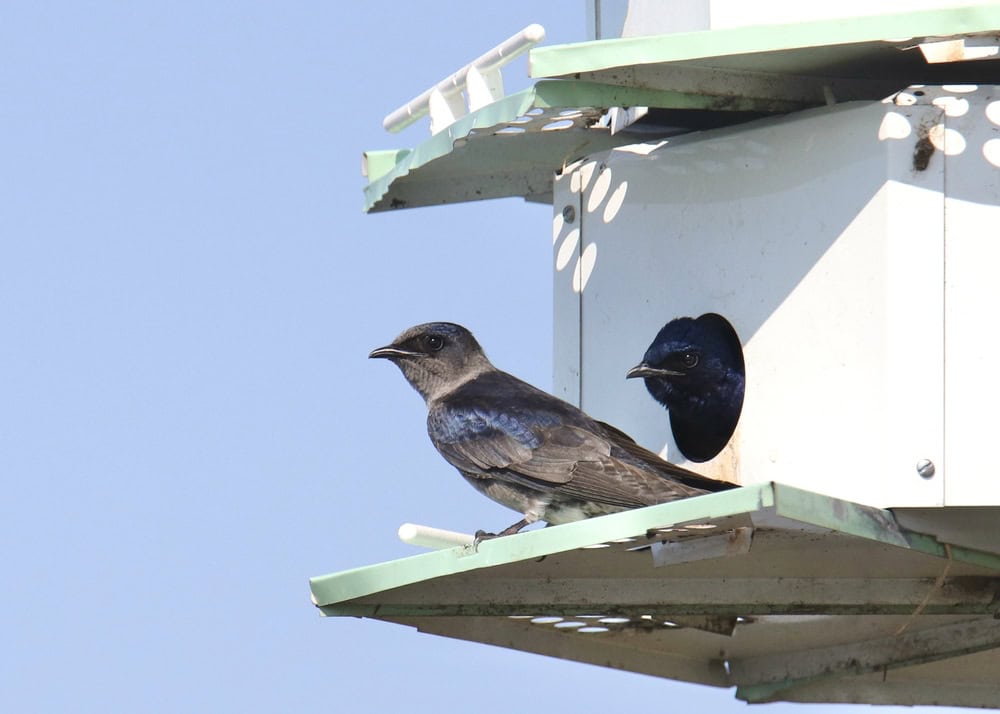
Female and juvenile purple martins are much duller in color compared to males, although some have blue. Here you can see a female outside of a nesting box with a male inside.
©vagabond54/Shutterstock.com
All swallows have a distinct, slender body shape with long, pointed wings that allow them to maneuver easily, glide, and maintain endurance during flight.
Why Do Purple Martins Migrate?
Purple martins breed in North America and migrate thousands of miles to South America in response to the seasonal fluctuations in resources that accompany winter, mainly the availability of insects that make up their diet. Joe Siegrist, President and CEO of the Purple Martin Conservation Association, says, “Aerial insectivores have to move to warmer weather before cold weather arrives in the fall or face starvation.”
Insects cannot tolerate the colder temperatures during winter months; they either die, overwinter in the ground or inside plants, or migrate to warmer areas. Purple martins head to warmer temperatures in South America, where there will be an abundance of insects for them to eat over the winter months.
When chicks leave the nest near the end of the breeding season, purple martins begin to gather in large flocks, sometimes numbering several hundred thousand individuals. This behavior, in which thousands of birds from a wide geographic area gather in one small location, is called migratory roosting. This pre-migration roost forms in early July and lasts through early September. Overall, the roosts may last for 8-12 weeks and are so large that they appear on weather radar.

After nestlings fledge, purple martins begin to roost in large aggregations so that younger individuals can learn from mature ones.
©Jean Faucett/Shutterstock.com
From Texas to Florida, they then begin their journey along the Gulf Coast before continuing on to South America. Some birds fly over Mexico and Central America directly into South America.
When North American winters begin to subside and spring returns, purple martins are among the earliest birds to begin their migration back north, arriving in Florida as early as mid-January, with most returning from late January through March and reaching the northeastern United States by mid- to late April. The spring migration is much quicker than the fall journey south, allowing these martins to be the first birds back to obtain the best nesting cavities and mates.
Why don’t purple martins just stay in the tropics all year? Siegrist says, “One of the theories why birds do this migration is to take advantage of longer days and more concentrated timing of insect abundance that occurs during the growing season of temperate zones.” In other words, making the long journey is worth it in the long run if purple martins can forage more hours during the summer months and eat more insects.
Why Do Purple Martins Roost in Such Large Numbers?
Roosting in large flocks offers several advantages to purple martins before they make their long journey south, including group feeding, socializing, and protection from predators due to safety in numbers. Siegrist explains, “There are more eyes to spot predators, and the large number of martins may make it harder for predators to single out and catch their prey.“

Purple martins form large roosts of up to hundreds of thousands of birds.
©CSNafzger/Shutterstock.com
A large colony is better able to find new food sources, as many individuals explore the environment in search of high densities of insects. They also hunt together in large flocks. Colonies with more mature individuals have experienced birds who can better locate and exploit resources, benefiting the entire flock. “It is thought that young martins learn from other, more experienced martins in the flock where to find food,” Siegrist explains. “As the young birds take off in the morning alongside the older birds, they watch and learn from the behavior of the adults that move purposefully to areas of high insect density.”
Siegrist also notes, “These kinds of roosts are predominantly made up of young martins that only learned to fly weeks earlier.” Therefore, newly fledged individuals use these roosts to strengthen their flying skills in preparation for migration. “They are still learning how to fly well, catch food, and stay safe. So the safety that a flock provides is much needed.“
Purple martins also form large aggregations in South America during the winter and will even flock with other martin species.
Where Do Purple Martins Roost?
Purple martins prefer to roost in several kinds of areas. They may roost in open spaces close to water, such as swamps and wetlands, where there are large populations of insects. Here, they choose reed beds and dry islands with low, thick brush. They also roost in abandoned woodpecker holes or cavities in trees, giant cacti, rocks, and cliffs.
With increased urbanization, purple martins now primarily use manmade structures for roosting sites. Structures such as buildings, bridges, pipes, traffic lights, street lamps, dock pilings, and oil pumps may serve as cavities. People also began providing nest boxes for purple martins, and now, in the eastern United States, these birds live almost exclusively near cities and towns, favoring these modern homes.

Purple martins in the eastern US nest almost exclusively in manmade birdhouses like this one.
©Bbot/Shutterstock.com
Purple martin birdhouses are typically made of wood or aluminum and have 8–12 openings, resembling ‘rooms.’ Alternatively, they may be made from multiple gourds. These houses are usually hung from wires or placed atop poles in open spaces. In 1996, the Purple Martin Conservation Association first identified these birds roosting in urban Nashville and has documented large urban roosts in most years since then, with annual gatherings observed since at least 2003. They have, however, been using the areas around the Cumberland River for centuries.
In South America, purple martins will also roost in cities and towns, often in small parks or the trees within village plazas. In more natural areas, they roost in agricultural fields, savannas, or even within the Amazon rainforest. Purple martins often return to the same nesting sites they used in the previous year.
These kinds of roosts are predominantly made up of young martins that only learned to fly weeks earlier.
Joe Siegrist, President and CEO of the Purple Martin Conservation Association
How Do Purple Martins Choose Where to Roost?
Siegrist states that scientists do not fully understand why purple martins select specific roosting locations, but there are clues about what they seek. He says, “Purple martins choose ‘islands’ of habitat. In the majority of their range, that’s an actual island in a lake or a peninsula of vegetation along a shoreline. But in the southern parts of the US, where wetlands are less common, the ‘islands’ are often groups of trees in a parking lot. Physically, the trees surrounded by a flat area mimic emergent vegetation surrounded by open water. There is inherent safety in having your home surrounded by a clearing, whether water or land.”
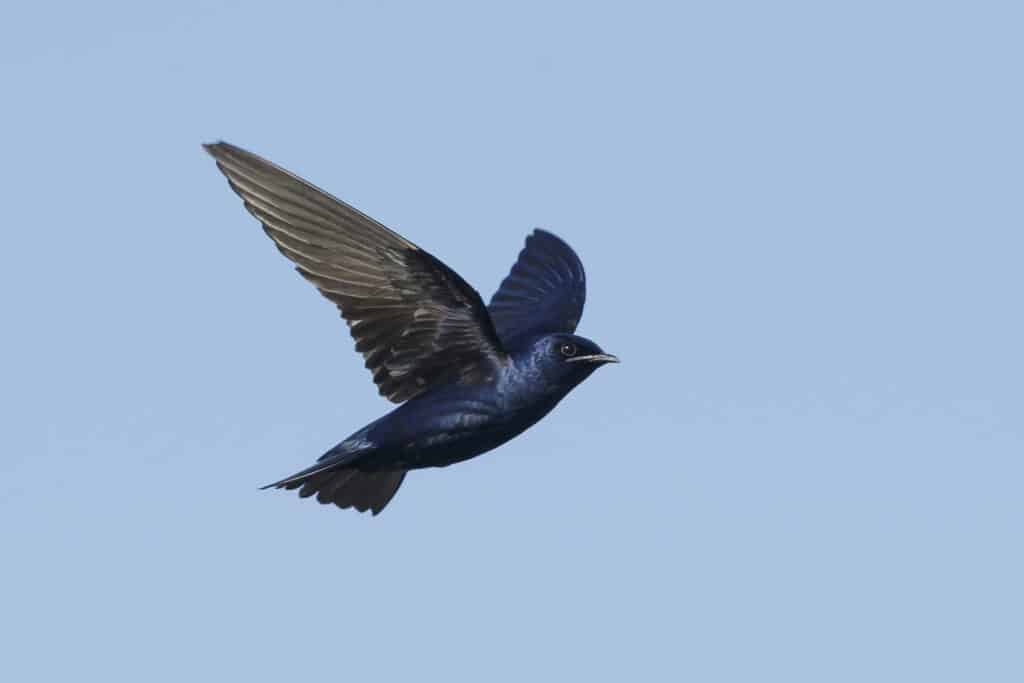
Purple martins hunt, eat, and drink water in flight.
©iStock.com/AGAMI stock
Interesting Facts About Purple Martins:
- Of all of the martins, purple martins hunt insects at the highest altitudes, often over 150 feet from the ground and even up to 500 feet or more.
- Purple martins flare their tails to trap insects and draw them closer
- Consuming small pieces of gravel helps purple martins digest insects’ hard exoskeletons.
- Purple martins get all of their food and water while flying! They hunt insects in the air and fly across the surface of ponds, rivers, or lakes to scoop up water in their lower beak for drinking.
- In the eastern United States, purple martin populations now rely almost exclusively on human-provided nest cavities, unlike their western counterparts, which still use natural cavities.