
Quick Take
- An industrial gas facility's breakwater became one of Peru's largest penguin colonies, and the structural quirk that made it irresistible to the birds is not what you would expect. See the colony's origins →
- El Niño wiped the colony from thousands of penguins down to nearly nothing, and researchers tracking the recovery found a result that changes how they think about the species' future. Track the El Niño recovery →
- Scientists are using these penguins as a living instrument to read the ocean, and what they're detecting points to a threat bigger than the avian flu outbreak that made headlines. Meet the ocean sentinels →
- This isn't the first time a man-made structure meant for something else ended up saving a penguin species. The earlier case began at an Olympic Games.
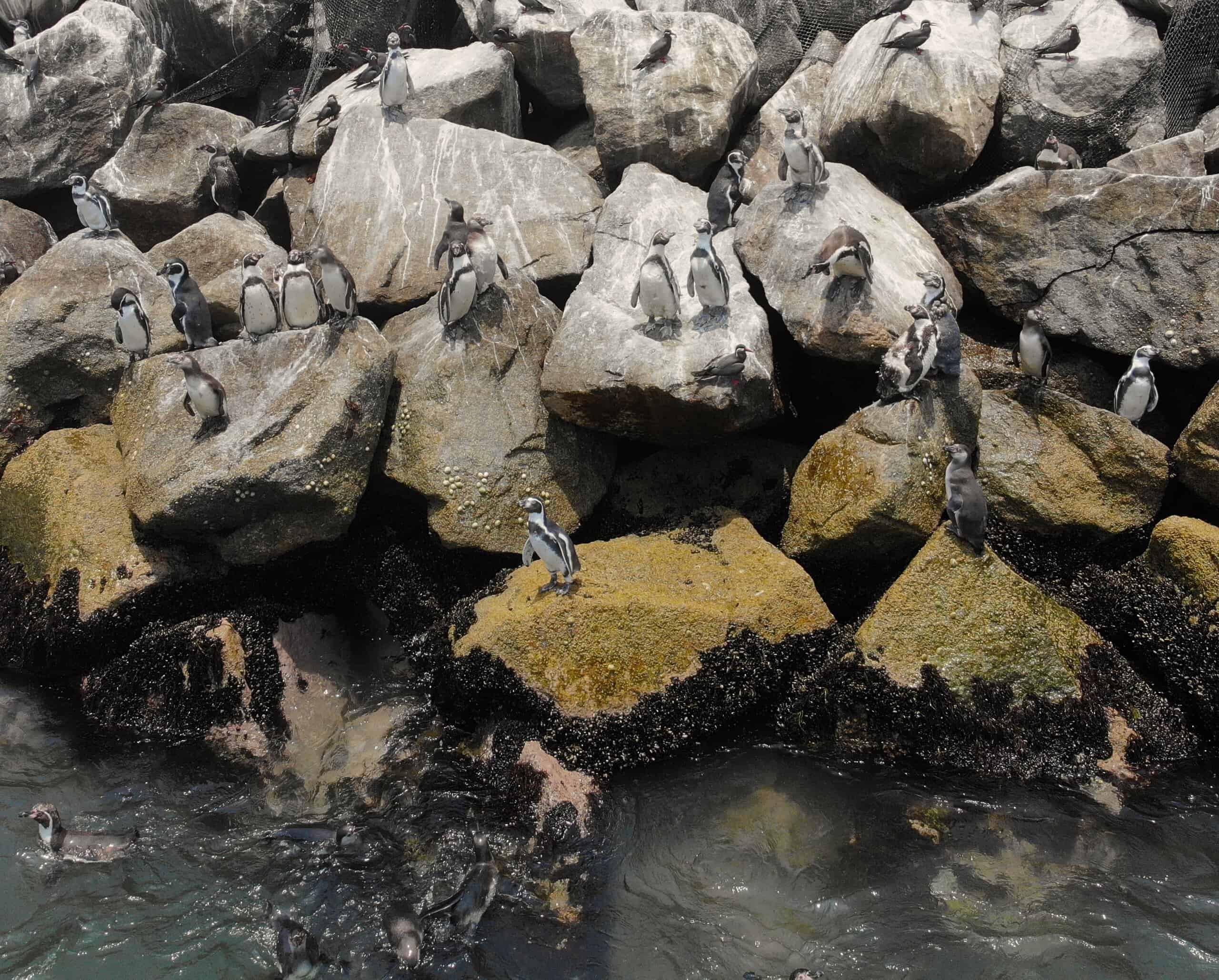
In 2012, researchers at the Smithsonian National Zoo and Conservation Biology Institute in Peru discovered that, within a few years, a colony of Humboldt penguins had turned a man-made breakwater at a natural gas facility into their own refuge.
Years earlier, the artificial reef in Melchorita, located on the coastline near Lima, Peru, became an unexpected refuge for the threatened penguin species. The colony started to form approximately three and a half years after human activity ceased at the large offshore breakwater within a port terminal and was, at one point, the second-largest colony of Humboldt penguins in Peru.
Constructed between 2007 and 2008, the Peru LNG breakwater, nearly half a mile in length and approximately 16 feet above the surface of the ocean, was built to reduce the force of waves and allow ships at the terminal to safely carry out operations.
Researchers, led by Ximena Vélez-Zuazo, Research Associate at the Center for Conservation and Sustainability in Peru for the Smithsonian Conservation Biology Institute, have continued monitoring the area and the colony since 2015—first seasonally, then on a monthly schedule.
The breakwater was built using natural rock and concrete cubes. The coastal, protected side is constructed mostly of rock, which has formed small caves and crevices, creating protective nesting spots for the penguins.
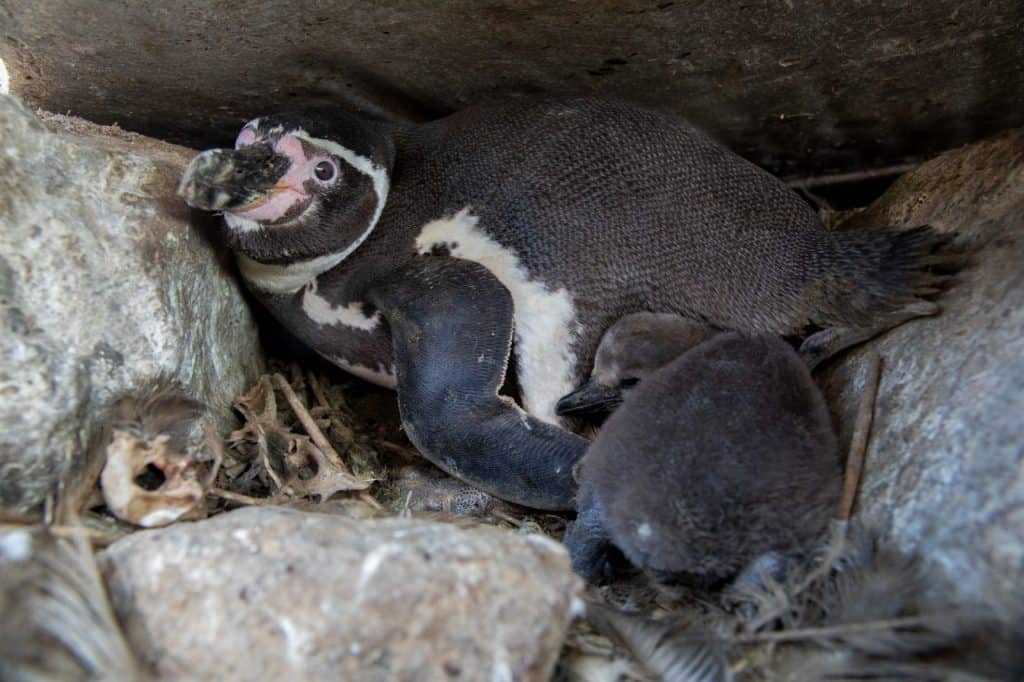
A Humboldt penguin and its chick rest inside a nest cavity at the Peru LNG breakwater in Peru.
©Courtesy of Smithsonian's National Zoo and Conservation Biology Institute – Original / License
Breakwaters provide a safe nesting area for penguins because the cavities in the rocks act as natural barriers against predators and direct human contact. The temperature within the structure is also naturally regulated, providing a cooler, shaded microclimate during the summer and absorbing heat during cold months.
According to Vélez, protection from the waves, the prohibition of fishing (which reduces human disturbance), and abundant food have all played key roles in the establishment and growth of the Humboldt penguin colony. Along with penguins, terns, cormorants, gulls, pelicans, boobies, and on rare occasions, sea lions have also passed through the breakwater.
Rock Penguins
Shortly after discovering the colony, Vélez-Zuazo and her team began studying the colonization of the penguins at Melchorita and observed two penguins swimming near the breakwater in 2008 and 2009.
“The areas were likely used by penguins from nearby colonies to forage,” Vélez-Zuazo says. By 2012, 60 penguins were reported, marking the beginning of the colony’s expansion. “From there it was all the way up,” she adds, “first juveniles and later adults, with numbers increasing every year [from] reproduction.”
In collaboration with Dr. Carlos Zavalaga and researchers at the Universidad Científica del Sur in Peru, Vélez-Zuazo and her team further studied the colony.
“This colony offers us a unique opportunity to make close observations, deploy sensors, and answer questions like: ‘Why did Humboldt penguins choose to colonize this artificial area?’ and ‘What makes this colony different from the others established in natural habitats?’” says Vélez-Zuazo.
They began by counting penguins by life stage—adults, juveniles, and chicks—creating an inventory and georeferencing nests, recording the number of eggs laid by each pair, and collecting other relevant data.
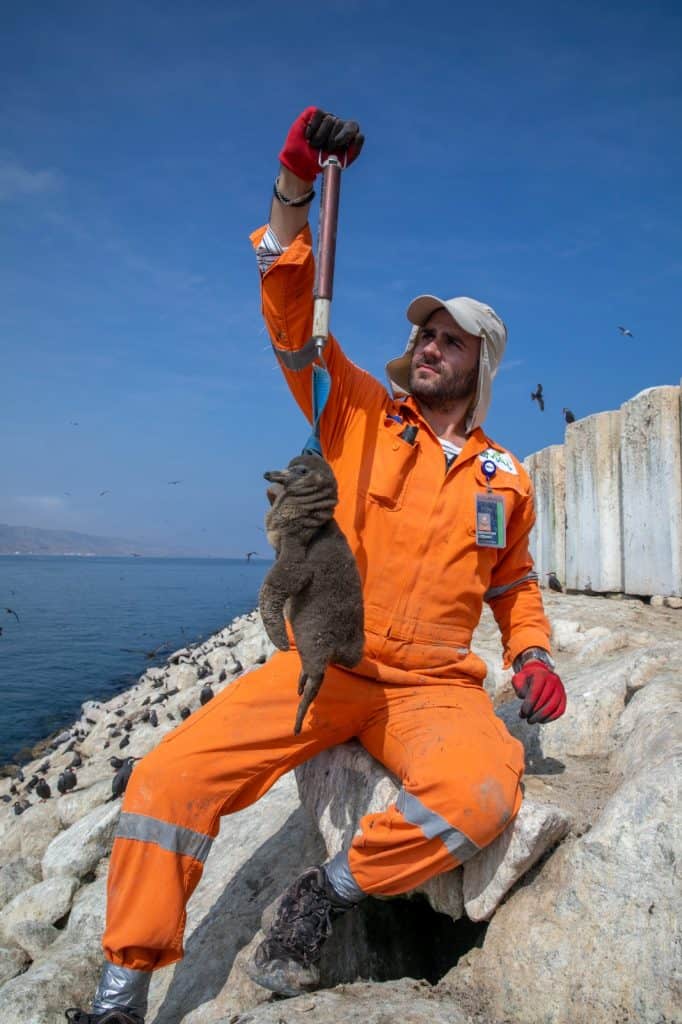
Researcher Sebastian Lozano weighs a Humboldt penguin at the Peru LNG port terminal breakwater in Peru.
©Courtesy of Smithsonian's National Zoo and Conservation Biology Institute – Original / License
Biologging also helps them track the penguins’ migratory routes if they leave the breakwater. “We deploy GPS tags attached to the feathers on the back of the penguin to determine where they go, how far and for how long, and to see their diving profiles,” Vélez-Zuazo says. “These tags also record temperature and depth to complement the movement patterns. We have a comprehensive research plan because we believe penguins are good indicators of ocean conditions, and studying them provides valuable insights into the state of the marine environment.”
Declining Population
Continued research, tracking, and monitoring are critical in the conservation of the species, which has declined in numbers in recent years. Between 2012 and 2021, the number of penguins in the Melchorita breakwater colony increased to approximately 2,091 birds, according to a 2024 report published in Marine Ornithology. However, following severe avian influenza outbreaks and the 2023 El Niño event, the population experienced a dramatic decline, mirroring a two-thirds drop seen across Humboldt penguin colonies in Peru and Chile by 2025.
This colony demonstrates how wildlife can adapt to man-made environments, using artificial structures like breakwaters, bridges, and jetties as refuges. As human development along coastlines increases, breakwaters have become important refuges and nesting habitats for seabirds. The Humboldt penguins in Melchorita are the second recorded colony of penguins to have turned such a structure into a haven.
It is a somber situation we are seeing in the colony. Abandoned nests and all the adults and juveniles are likely swimming south, searching for anchovies and other small pelagic fishes.
Ximena Vélez-Zuazo, Research Associate, Smithsonian National Zoo and Conservation Biology Institute
Decades earlier, little penguins, also known as little blue penguins and fairy penguins, began inhabiting the St Kilda Breakwater in Victoria, Australia—a structure originally built for the 1956 Olympic Games. As of late 2025, the St Kilda breakwater is home to a colony of about 1,400 little penguins.
In 2020, the global Humboldt penguin population was estimated at around 23,800 mature individuals, according to the National Audubon Society. However, since 2022, the population has declined by about two-thirds due to avian influenza outbreaks, El Niño events, bycatch in fishing nets, pollution, and warming ocean temperatures.
The avian flu outbreak between late 2022 and 2023, combined with the 2023 El Niño event, resulted in severe reductions and mass mortality of Humboldt penguins in Peru and Chile. While both factors have had devastating effects, Vélez notes that recurring severe climate events like the El Niño Southern Oscillation (ENSO) continue to pose a major threat to the species.
According to Vélez, such climate events have had a profound effect on the Humboldt penguin population in the area. Additional threats include interactions with fisheries and fishing gear entanglement, predation by invasive species, and disturbance of their natural habitats during guano harvesting. For centuries in Peru, guano, the accumulated waste of coastal seabirds, has been harvested and used as a natural fertilizer.
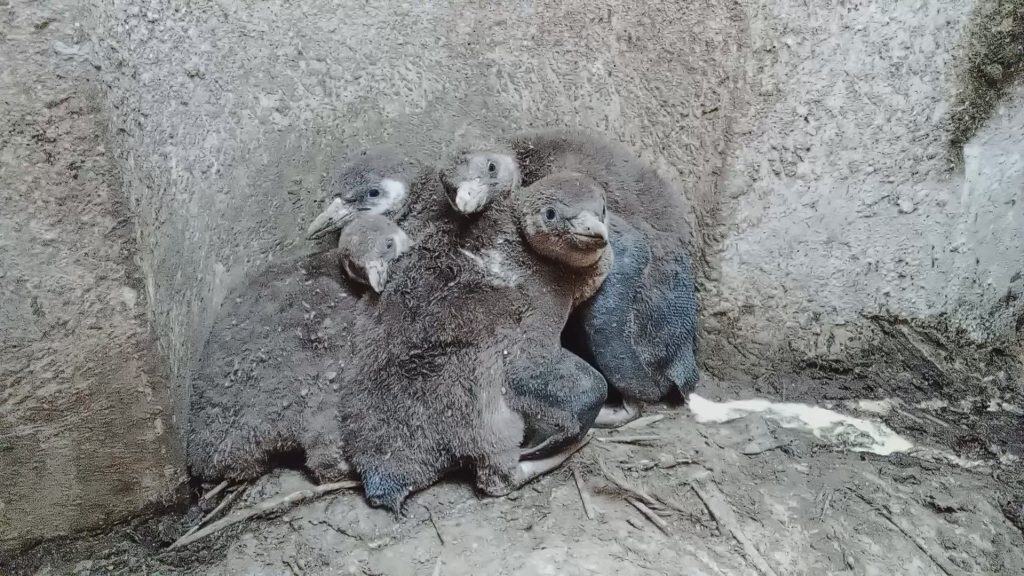
Humboldt penguin chicks huddle together inside a nesting site along the Peru LNG terminal breakwater in Peru.
©Courtesy of Smithsonian's National Zoo and Conservation Biology Institute – Original / License
In 2021, researchers observed a healthy colony of nearly 2,100 penguins around the breakwater, with some beginning to colonize a smaller adjacent breakwater. However, after 2022, the population was devastated by avian influenza and the 2023 El Niño event.
Slow Recovery
After the 2023 El Niño event, only a handful of penguins remained at the colony, as most left in search of food. In late 2024 and 2025, researchers observed a modest recovery, with active reproduction and over 700 penguins reported by late 2025. However, the population remains well below pre-2022 levels, and the ongoing El Niño in 2026 threatens any recent gains.
“It is a somber situation we are seeing in the colony,” says Vélez-Zuazo. “Abandoned nests and all the adults and juveniles are likely swimming south, searching for anchovies and other small pelagic fishes.”
The breakwater in Melchorita has become even more critical following a sharp decline—about two-thirds—in the Humboldt penguin population across Peru and Chile since 2022. “Numbers have worsened in the past few years,” she says. “Some isolated colonies may have experienced slight recoveries, but overall, the trend is strongly negative, so urgent conservation actions are needed to address the main threats.”’
Vélez-Zuazo continues, “We do not have control over climate events, but we can act to mitigate the impact of other threats.”
Severe weather and another ENSO event will only prevent the population from expanding. “Storms in the South Pacific, which bring large swells to the central and southern coasts of Peru, sometimes affect more exposed areas of the colony and can wash away some nests,” says Vélez-Zuazo.
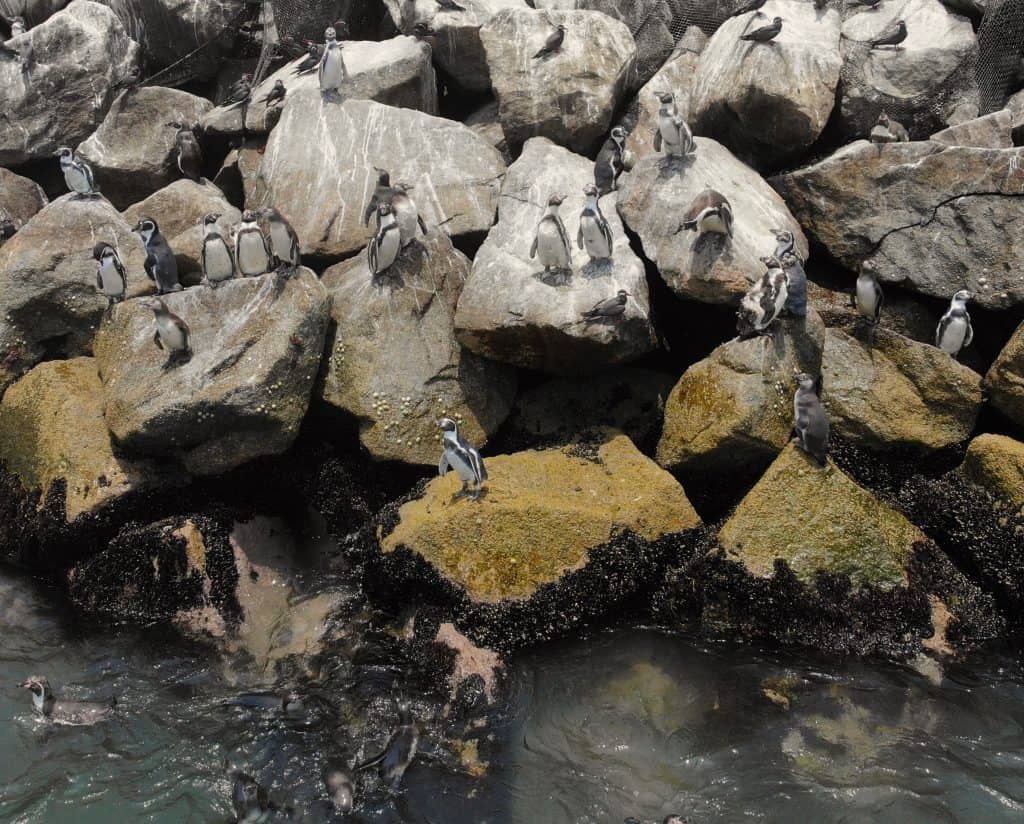
A breeding colony of Humboldt penguins occupying the Peru LNG breakwater.
©Courtesy of Smithsonian National Zoo and Conservation Biology Institute – Original / License
Along with Melchorita, more Humboldt colonies are spread along the coast and some hard-to-access islands in Peru and Chile, including one of the largest Humboldt colonies on the Macabi Islands in northern Peru, approximately 500 miles from Melchorita.
In the past, Santa Rosa Island and Punta San Juan were among the largest colonies of the species, says Vélez-Zuazo, but these numbers also continue to shift.
Despite the drop in numbers, Vélez-Zuazo remains hopeful for the penguins at Melchorita. “Once the ocean conditions return to the usual state, including the stocks of small pelagic fish, we expect the surviving penguins to return home, have enough food resources nearby, and start laying eggs,” says Vélez. “We’ve lost this year’s recruits, and we need them to recover the population. I hope that in five years, climate and ocean conditions will be stable enough to allow penguins enough recovery.”
In a normal year, Humboldt penguin reproduction is successful, provided there are available food sources nearby, which allows the penguins to forage close to home with minimal energy expenditure, says Vélez-Zuazo. The second factor influencing successful nesting and reproduction is the absence of predators and human disturbance around the colony.
Invasive rats, which can attack penguins and eat their chicks and eggs, have also been a problem in some colonies. Along with interactions with fishing gear, these are among the biggest threats to Humboldt penguin populations.
“There is a lot of work to do today,” says Vélez-Zuazo, “to help the population recover and reach the state I want to see this and the rest of the colonies in five years.”