
Quick Take
- Golden tortoise beetles, with their golden color, are found in North America.
- Aspidimorpha sanctaecrucis and Charidotella sexpunctata are two different species of beetle, with the aforementioned often confused for the North American golden tortoise beetle.
- These brilliant beetles are rarely seen due to their size and their tendency to travel solo.
- Golden tortoise beetles undergo a rapid color change when threatened.
Beetles display a wide range of colors, from deep muted tones to those that shift from green to purple or yellow as they reflect sunlight. Whether invading gardens, flying through the air, or walking on the ground, beetles can appear in countless forms.
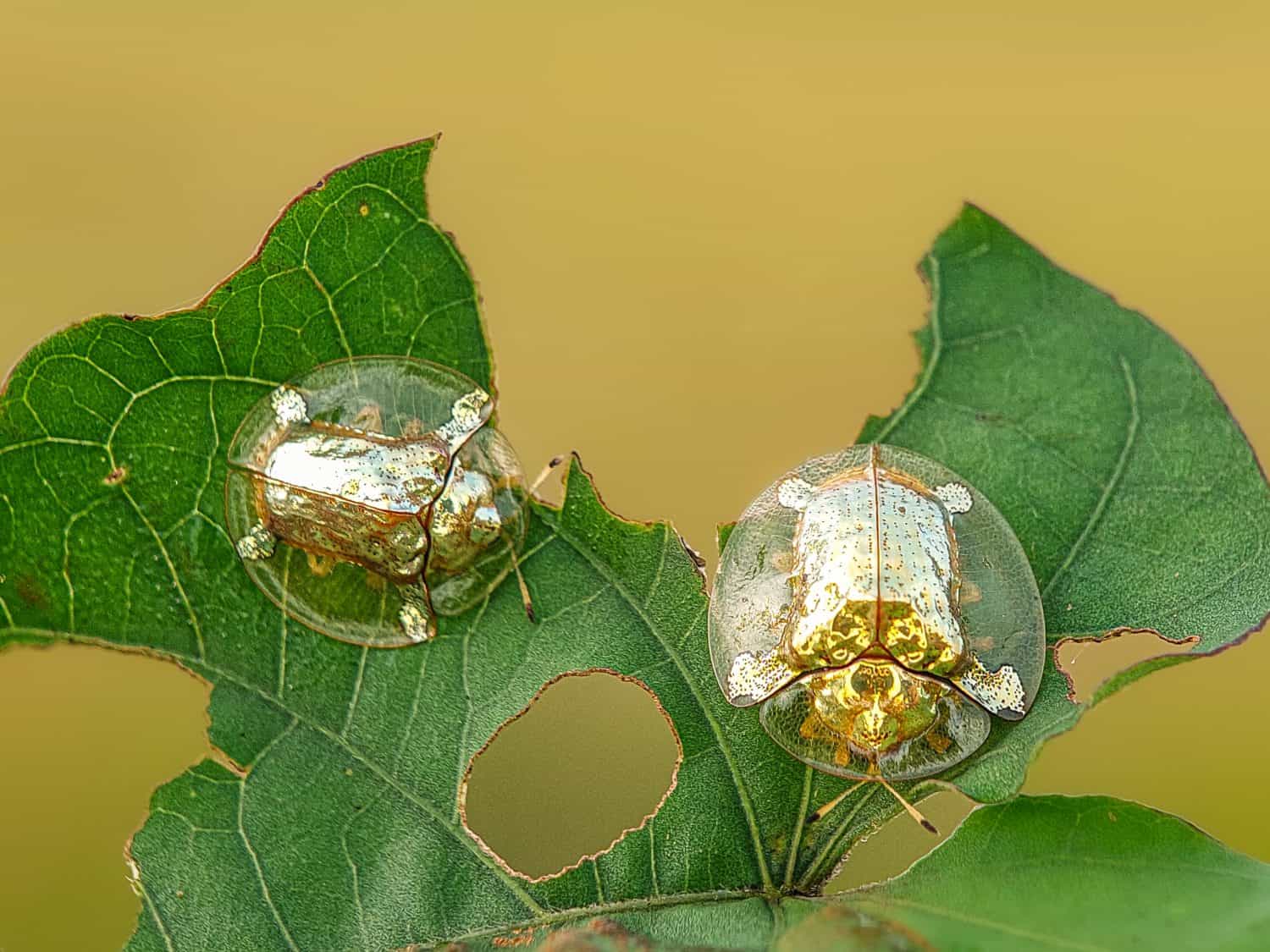
Unbeknownst to some, there is a beetle so dazzling that it looks unreal. This beetle is bright gold and has a translucent covering that lets its brilliance shine through. The beetle is the golden tortoise beetle, found in North America. But with many people claiming never to have seen it, the question arises: how rare is the golden tortoise beetle?
Confusion Over the Golden Tortoise Beetle’s Scientific Name
An Instagram video posted in November 2025 shows a beetle that almost looks like AI. However, upon further investigation, the beetle is not only real but also spectacular, leaving many people wondering why they have never seen one.
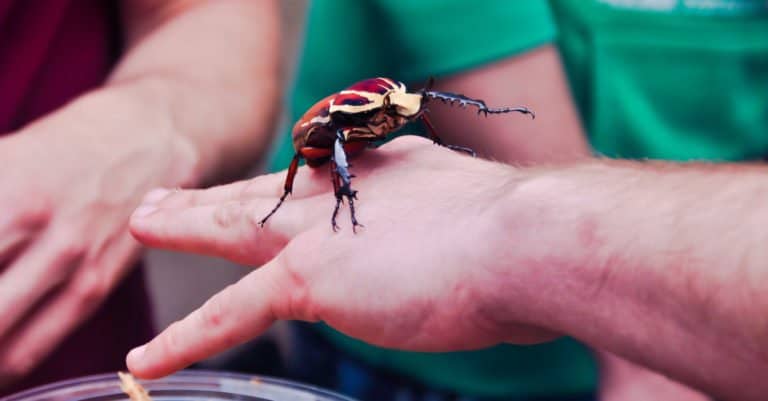
The video shows a golden tortoise beetle walking across a person’s hand before it flies away. This beetle, which is scientifically known as Charidotella sexpunctata, not Aspidimorpha sanctaecrucis, as the video states, is found across North America. While both of these beetles are known as golden tortoise beetles, only Charidotella sexpunctata can be golden. Aspidimorpha sanctaecrucis, on the other hand, are yellow to reddish brown.
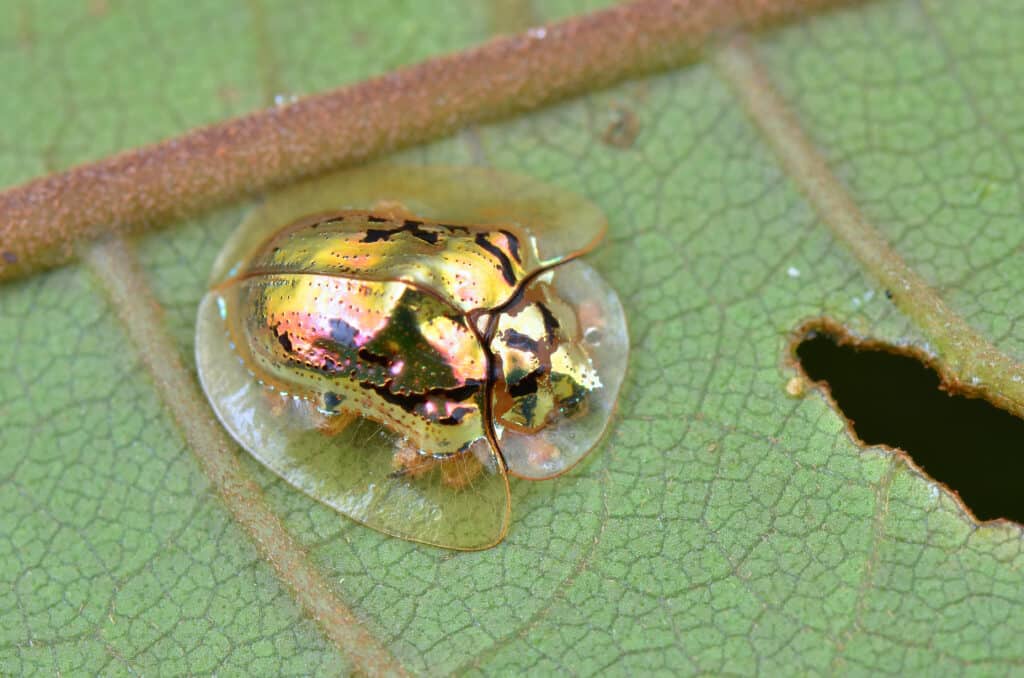
Golden tortoise beetles are found across North America.
©SIMON SHIM/Shutterstock.com
There are also differences between the elytra, or shells, of these beetles. Aspidimorpha sanctaecrucis has a shell that matches its body color, yellow to reddish brown, while Charidotella sexpunctata, as seen in the video, is translucent.
Finally, Charidotella sexpunctata is small, growing to no more than seven millimeters in length, while Aspidimorpha sanctaecrucis can reach over 16 millimeters.
While both are part of the family Chrysomelidae, these two beetles are different species. Since the smaller, golden species lives in North America and the larger species lives in Asia and Africa, it is not difficult to tell them apart.
Golden Tortoise Beetles Are Not Rare
Golden tortoise beetles are not rare. These beetles have a territory that covers the United States, Canada, and Mexico. Why is it, then, that so many claim to have never seen one? This is due to their small size and the fact that they are not an invasive species.
The exact number of golden tortoise beetles is not known. However, given that they are widely distributed across North America, it is believed their population is great. Despite this, golden tortoise beetles are not a common sight for many. This has to do with the beetles being between five and seven millimeters in length and the fact that they tend to travel solo. Because they do not form infestations in gardens, these beetles can be hard to spot unless you are specifically searching for them.
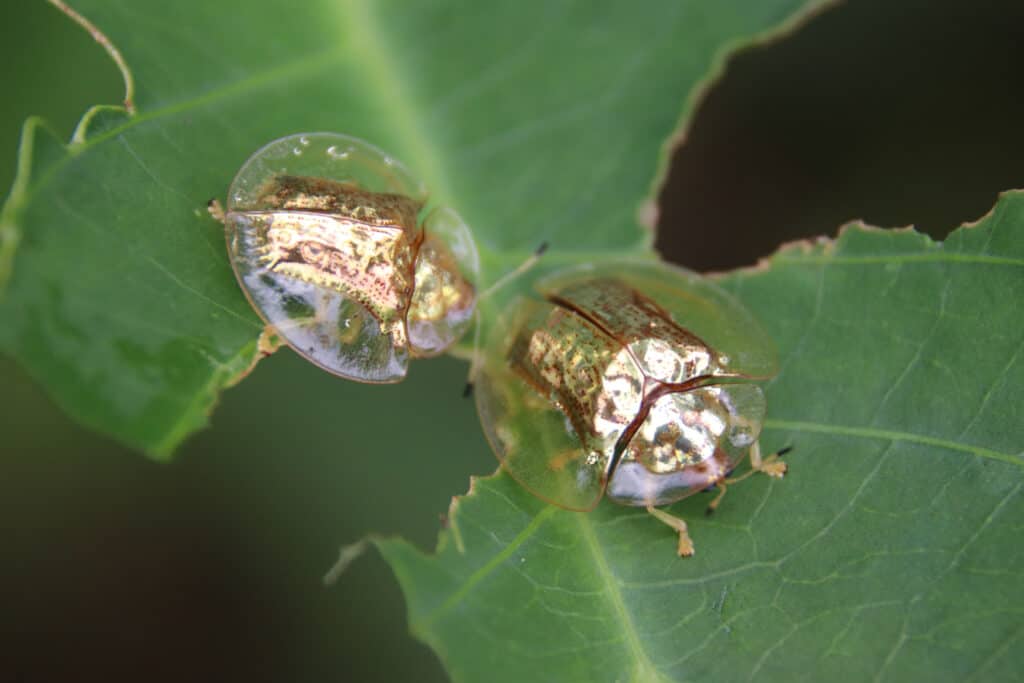
Golden tortoise beetles are widespread throughout Canada, the United States, and Mexico.
©Silmiart/Shutterstock.com
Typically, the larger populations of golden tortoise beetles are found in the following areas:
- Eastern United States
- Iowa
- Texas
- Florida
Therefore, if you are looking for these sparkling beetles, check gardens and crops throughout the aforementioned regions of the U.S. Golden tortoise beetles may be hiding in plain sight.
How Did Golden Tortoise Beetles Get Their Name?
Golden tortoise beetles are very aptly named. These beetles are not only golden, but they also have a protective cover they can hide under when threatened, just as tortoises do. Therefore, there really is no other name for the beetle that would be more fitting.
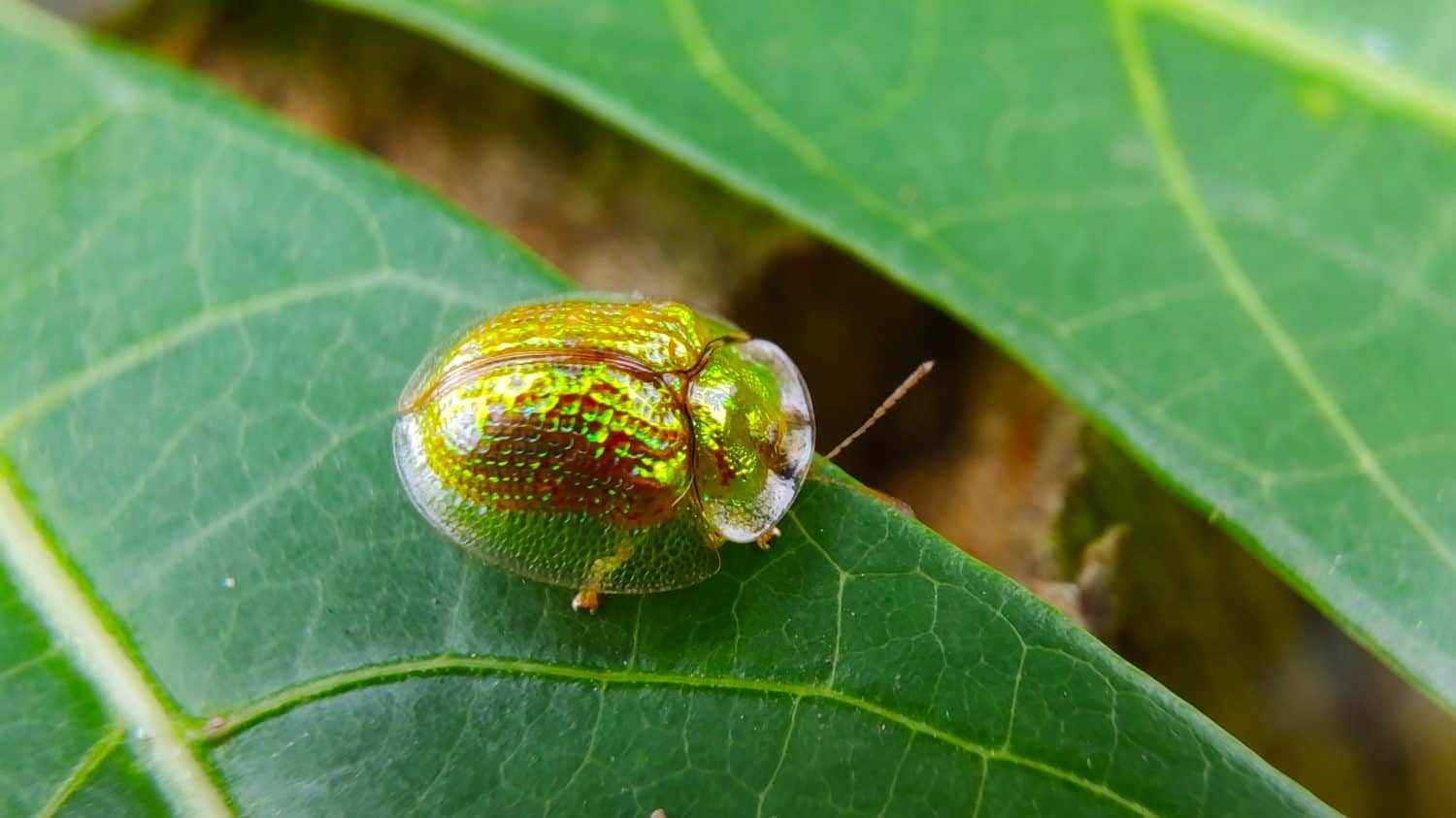
Golden tortoise beetles got their name from their coloration and the fact that they can hide their head and wings under a protective shell.
©KAISARMUDA/Shutterstock.com
The golden tortoise beetles will remain golden as long as they do not feel threatened. As they sparkle in the sun, their coloration can serve as camouflage, helping them blend in with their plant surroundings. If the golden tortoise beetle is spotted, it can tuck its head and wings under its clear elytra, which act as a hard, shell-like covering.
Additionally, the bump on the beetle’s back gives it a tortoise-like appearance. This is why, if a tortoise were to become a beetle, it would likely resemble the golden tortoise beetle.
Golden Tortoise Beetles Can Change Color
Golden tortoise beetles are not strong flyers. Because of this, camouflage is the best strategy for beetles trying to avoid predators. As a result, golden tortoise beetles can change color to better blend into the background, helping them remain hidden.
Typically, golden tortoise beetles range from nearly transparent to a sparkling golden color. This coloration is not due to the beetles actually being gold. Instead, they have structures in their bodies that allow light to bounce off, creating the golden hue.
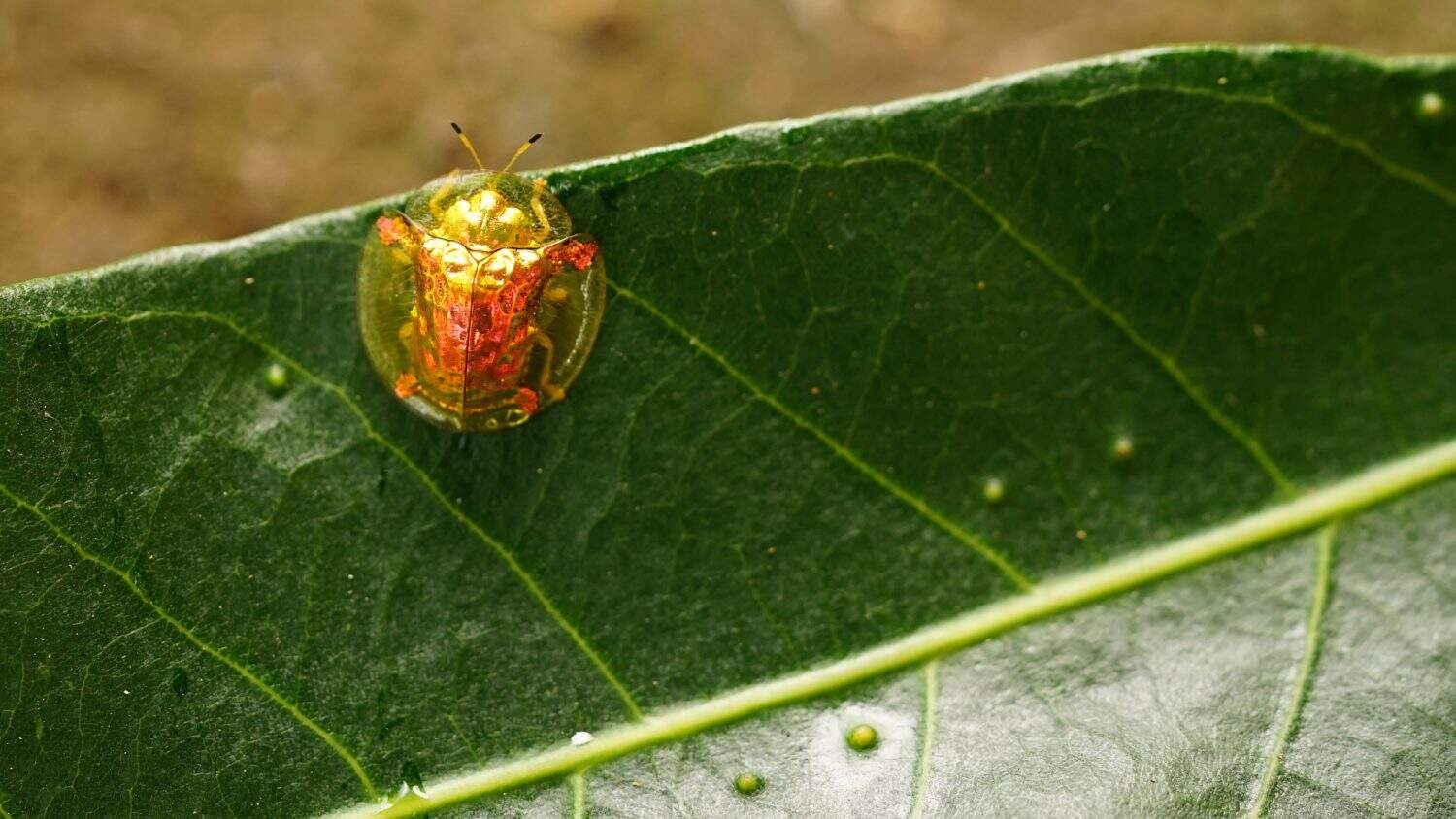
Golden tortoise beetles change colors to survive.
©I Made Rai Yasa/Shutterstock.com
When golden tortoise beetles are threatened, they release a fluid that alters how their body structures reflect light. This takes the body color from gold to a deep ruby color in the blink of an eye. It can also turn some dull brown.
Because golden tortoise beetles can change their coloration so quickly, it helps them both blend into the environment and confuse predators into thinking they are poisonous if eaten. Both techniques help the golden tortoise beetle survive—something it could not do by relying on flight alone.
Golden Tortoise Beetles Generally Do Not Bite
When Mother Nature creates beautifully colored creatures, people may hesitate to get close to them, fearing they could be poisonous. However, in the case of golden tortoise beetles, they are brilliantly colored but are harmless, allowing those who live in regions where the beetles reside to breathe a sigh of relief when they come into contact with them.
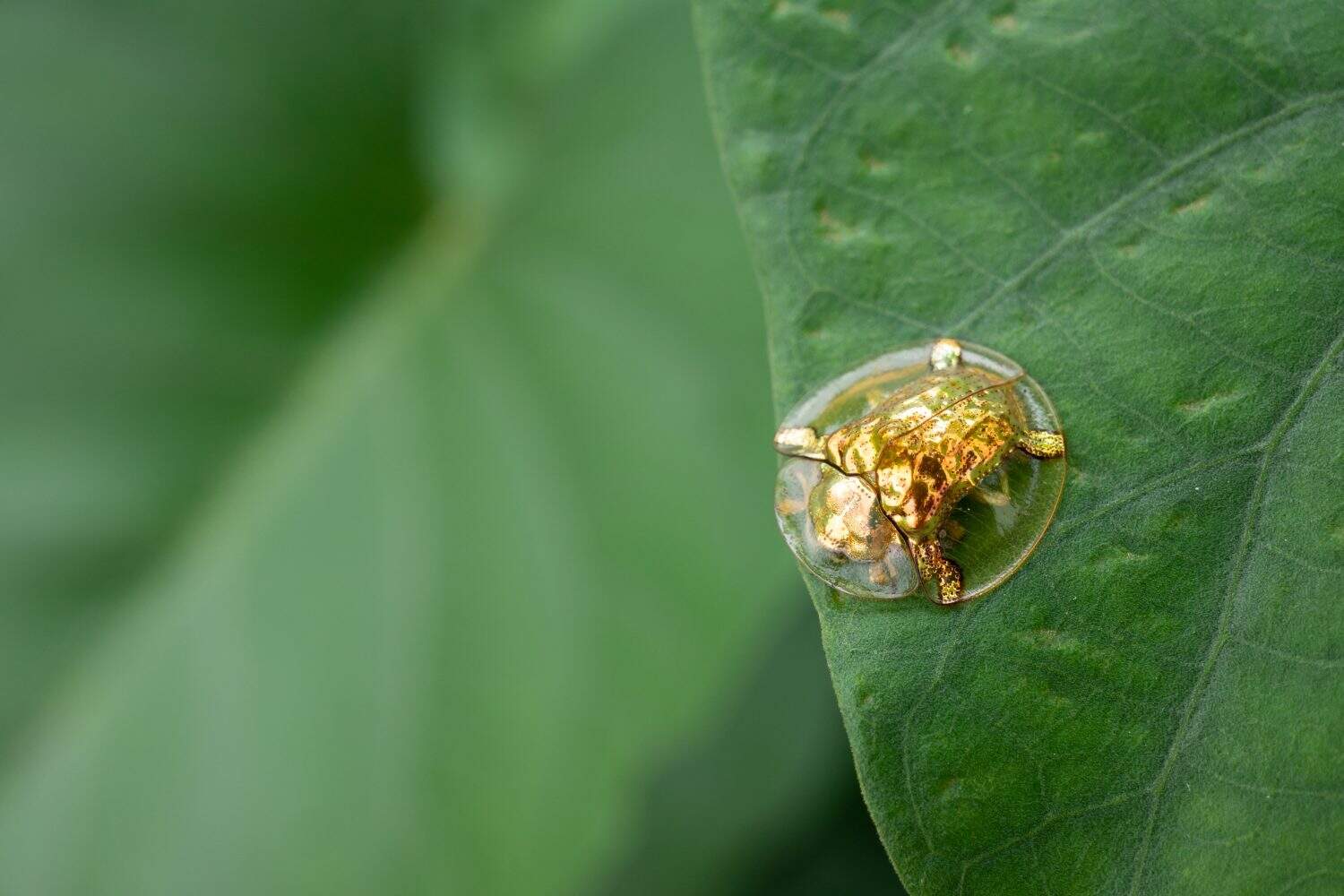
Golden tortoise beetles are docile beetles.
©Tompel/Shutterstock.com
Golden tortoise beetles are considered to be docile. This is why picking them up to examine them can be done without fear. However, it should be noted that, while rare, golden tortoise beetles have bitten when threatened. (A clear indication of one of these beetles feeling uncomfortable is that they will begin to lose their sparkling coloration and turn brown.) The bites are not poisonous or toxic. They can be uncomfortable, though.
Therefore, to ensure that golden tortoise beetles do not feel threatened, observe them without touching. You can still admire their golden hue and delicate wings.
Golden Tortoise Beetles Can Be a Garden Pest
Golden tortoise beetles are beautiful creatures to look at. However, if left to their own devices, they can cause some damage to crops and plants. Depending on the number of beetles found in the garden, some people may choose to remove the larvae and adult beetles.
While golden tortoise beetles will eat the leaves of flowers, fruits, and vegetables, making the plants look less appealing, they typically do not kill the plants. Some of their favorites include:
- Milkweed
- Sweet potato
- Strawberries
- Corn
- Cabbage
- Raspberries
Because of this, most who have them in their garden choose to leave them be. However, if they are causing significant damage to the plants (specifically sweet potatoes), it may be necessary to remove the golden tortoise beetles.
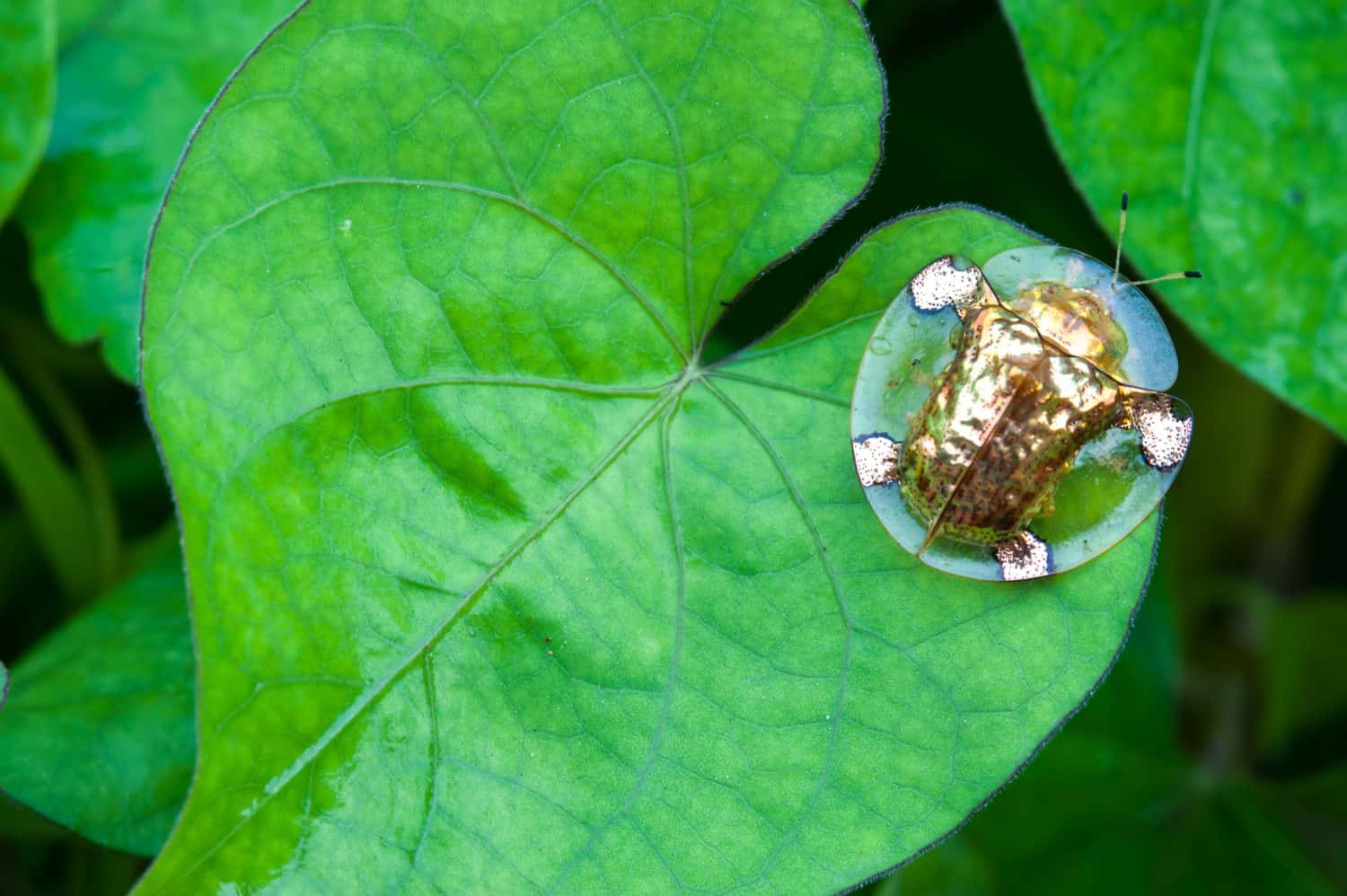
Golden tortoise beetles like to eat the leaves of plants, but generally do not kill the plant by doing so.
©SOMRERK WITTHAYANANT/Shutterstock.com
Gardening experts warn against using pesticides to control golden tortoise beetles because they will render the garden non-organic and kill other beneficial insects, such as ladybugs. Therefore, the recommended way to remove the beetles is by hand when they or their larvae are visible, or by using soapy water.
Additionally, planting deterrent plants such as peppermint or lavender can help keep golden tortoise beetles from nibbling on garden leaves.
In many cases, removing golden tortoise beetles from a garden may not be necessary, as predatory bugs like ladybugs, assassin bugs, and various species of parasitic wasps will help keep the population under control. But if golden tortoise beetles become abundant in the garden, they may need to be removed or relocated so they can feed on wild plants elsewhere.