
Quick Take
- These caterpillars have no ears, yet they detect a human voice with startling precision. The sensory system responsible is nothing like you would expect. Discover the sensory system →
- Your voice doesn't sound like a predator, yet to these caterpillars it registers as exactly that. The reason reveals a specific vulnerability baked into their sensory design. See why voices trigger alarm →
- The synchronized twitch travels through the group in milliseconds, and it does so not because the caterpillars are watching each other but through a communication channel hiding in plain sight. Explore the silk signal network →
- Each caterpillar processes threats through a distributed network of mini-brains, and that unconventional architecture is exactly what makes their collective defense so fast. See how vibration sensing works →
- Their group shudder goes beyond visual intimidation. It creates a physical effect that makes targeting any single caterpillar nearly impossible for a predator. See the group defense effect →
The colorful caterpillars in this Instagram video look like they are performing some cool party trick; clustered together, they jerk their bodies in unison when a human greets them. While this synchronized twitching may look like a social greeting, it is actually a high-tech survival strategy. These social larvae aren’t actually listening to the human voice; instead, they use a sophisticated sensory system to detect the physical vibrations and air movement caused by speech, which they interpret as a potential threat.
Hair Instead of Ears
Morpho telemachus caterpillars do not rely on sight or hearing (in fact, they don’t have ears!). Instead, they use mechanoreception, a sophisticated full-body sensory network that detects movement, vibration, and air displacement.
This system relies on specialized hair-like structures known as setae — the “fuzzy” hairs on the caterpillar’s body — which serve as highly precise sensory tools. Some of these are tactile setae that send instant neural alerts to the caterpillar’s brain the moment they are physically touched. Others, called filiform setae, are vibration detectors and can detect tiny ripples in the air. These sensitive hairs allow the caterpillar to feel the movement of a nearby predator or object long before any actual physical contact occurs.
Beneath the surface, the caterpillar’s internal mechanoreceptor units, known as scolopidia, detect tiny shifts in their body wall caused by vibrations — such as a nearby leaf trembling under a predator’s weight. This gives the caterpillar a critical advantage; it can distinguish between background noise (like a steady breeze) and specific signals of an approaching threat (like a bird landing on a branch).

The rhythmic movement of the caterpillars makes it extremely difficult for a predator to locate gaps in their overlapping hair.
©Instagram / @thenaturewolf – Original
The process happens in an instant. The moment even a tiny disturbance moves a sensory hair or causes a shift in their body wall, neurons send an electrical pulse to local ganglia, which act like “mini-brains” to trigger a defensive flicking movement. The system is incredibly sensitive, but it also learns to ignore harmless movements through habituation, ensuring the caterpillar uses its energy only to react to sudden or irregular disturbances, such as a human voice, as seen in the Instagram video.
Airborne Sounds vs. Substrate Vibrations
Although it can be tempting to say that the caterpillars are simply reacting to noise, that’s only part of the story. They are actually responding to a combination of airborne sound and physical vibration, which are processed through two overlapping systems.
Airborne Sounds as Early Warnings
Filiform setae function like the caterpillar’s “ears,” allowing them to detect the movement of air molecules caused by sound waves. Caterpillars are most sensitive to airborne sounds in the kilohertz range, particularly between 1,000 and 20,000 hertz, though they can also detect lower frequencies. Studies also indicate that caterpillars can be 10 to 100 times more responsive to airborne sound than to the vibrations of the leaf they are standing on. This allows them to “hear” a wasp coming before it even touches the plant.
This makes caterpillars especially sensitive to nearby disturbances — particularly the kind produced by wingbeats or sudden bursts of noise. These alerts warn the caterpillar of potential danger before any physical contact.
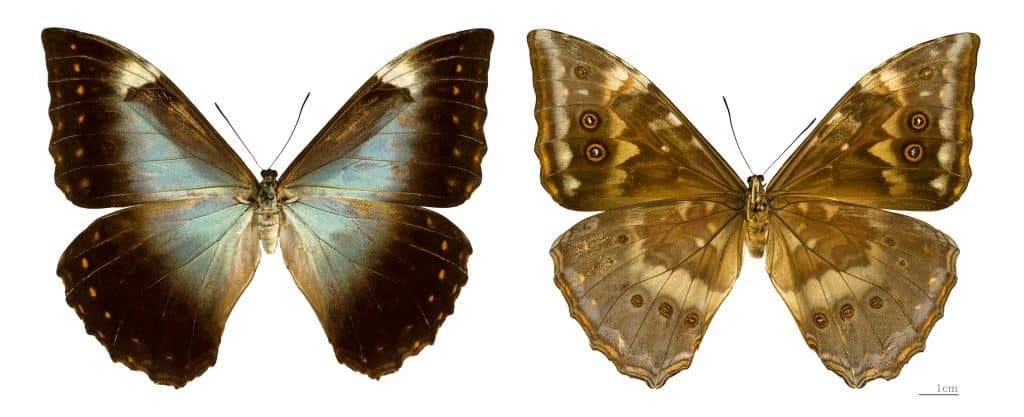
Blue morpho caterpillars are the larval stage of butterflies known for their stunning blue patterns.
©Muséum de Toulouse / CC BY-SA 4.0 / Wikimedia Commons – Original / License
Substrate Vibrations as Tactile Warnings
While sounds alert them to nearby movement, substrate-borne vibrations (those that travel through a leaf, stem, or silk) inform the caterpillars about ground-based threats. These signals, detected by scolopidia, help distinguish between random environmental noise and specific signals, such as a predator moving closer.
When a human speaks near these caterpillars, their voice displaces air, produces sound waves, and potentially vibrates the plant or surface the insects are on. So, the caterpillars aren’t merely responding to the human’s “voice” as a meaningful signal; they’re reacting to the physical disturbances that accompany it.
Synchronized Survival
The most striking aspect of the caterpillars’ behavior isn’t just that they twitch — it’s that their movements are perfectly synchronized. When one caterpillar senses a threat through its setae, it will jerk its body, which sends a vibration through the silk mats they rest on. This triggers a chain reaction through the rest of the group, and within milliseconds, the entire colony twitches and pulses together.
The unified “shudder” the caterpillars produce is a defensive strategy that makes the group appear larger and more threatening. The group’s rhythmic pulsing also creates a vibrational wall of “white noise” that makes it difficult for a predator to locate a specific target. Their synchronized movement makes the caterpillars’ hairs and colors appear to flicker, creating the illusion of a single large, pulsating creature rather than dozens of small, vulnerable ones. The caterpillars’ overlapping hairs further create a moving barrier that’s difficult to penetrate.

Blue morpho caterpillars rely on both airborne sounds and substrate vibrations to detect danger.
©Instagram / @thenaturewolf – Original
It may look like these caterpillars are responding to our voices, but they aren’t actually “listening.” Instead, they feel the vibrations and air movement caused by our speech and mistake us for a predator. What looks like a cool trick is actually a coordinated survival strategy. Using sensitive hairs and the silk they stand on, they detect tiny movements and twitch together to ward off danger. From their ultra-sensitive setae to the vibration-transmitting silk beneath them, these insects are built to detect and respond to danger with remarkable speed and coordination.