
Quick Take
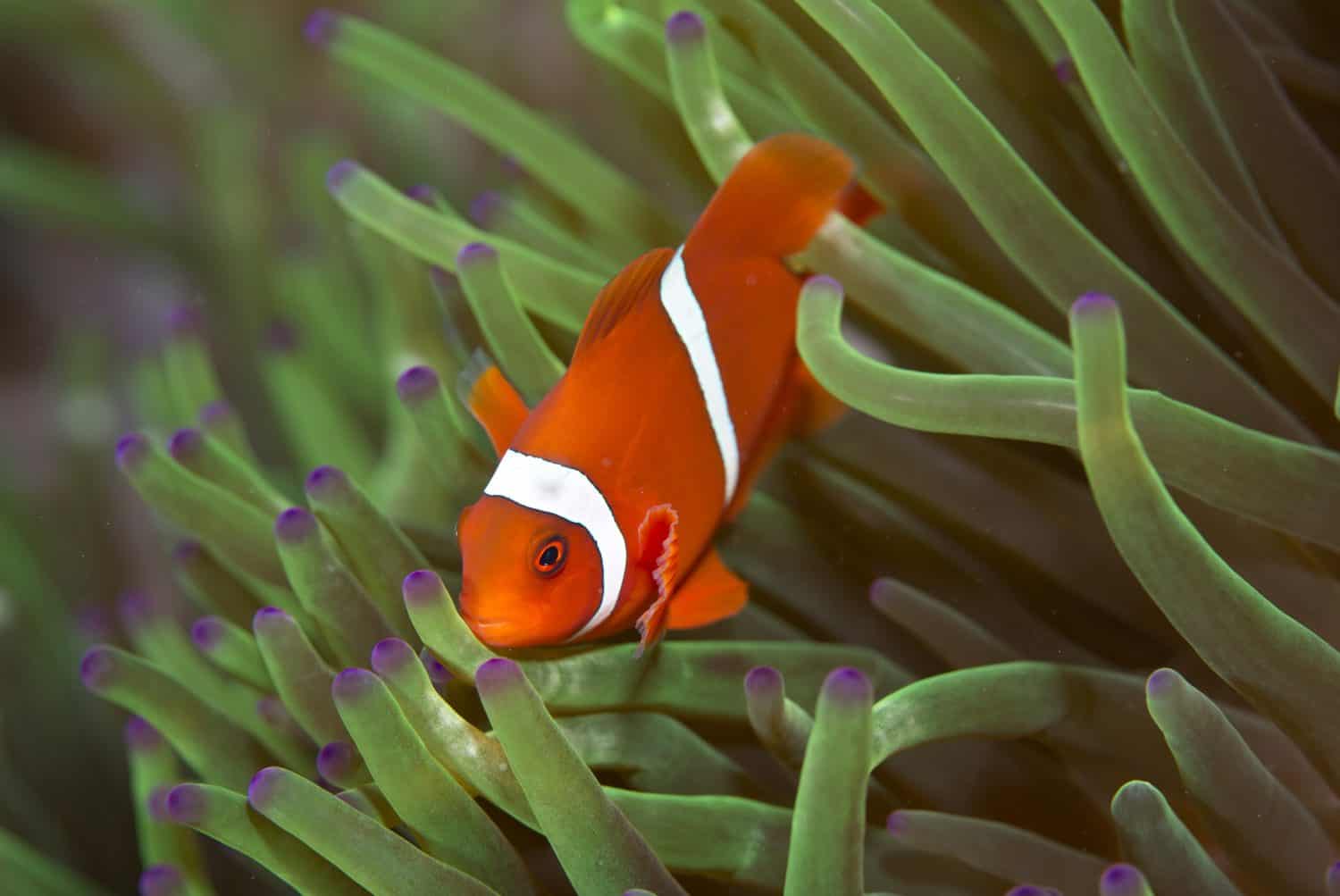
- Juvenile tomato clownfish have bright white stripes on their bodies.
- When juvenile tomato clownfish attempt to find a group to join, they retain the stripes to show they are not a threat.
- After being accepted into the group and knowing where they stand in the hierarchy, the juvenile tomato clownfish’s stripes fade.
With their brilliant white stripes and orange coloration, it is hard to mistake a clownfish for any other species of fish. For some species, the white stripes disappear as they reach adulthood, leaving only one around their face. This leads to the question of why young clownfish lose their stripes.
Social Status Causes Young Clownfish to Lose Their Stripes
Clownfish are known for their bright orange coloration and white iridescent stripes. However, not all clownfish species retain those stripes into adulthood. Instead, species such as the tomato clownfish lose all but one of their stripes. Since this did not seem to be the result of environmental changes, researchers were prompted to ask why it occurs.
According to a new study published in PLOS Biology, tomato clownfish are born with several white stripes. As the younger clownfish swim through the ocean looking for an anemone to call home, all of the stripes are intact.
However, as the clownfish find a harem to join and are accepted, the white stripes fade and eventually disappear. According to Vincent Laudet, a professor at the Okinawa Institute of Science and Technology and one of the study authors, this occurs due to social pressure.
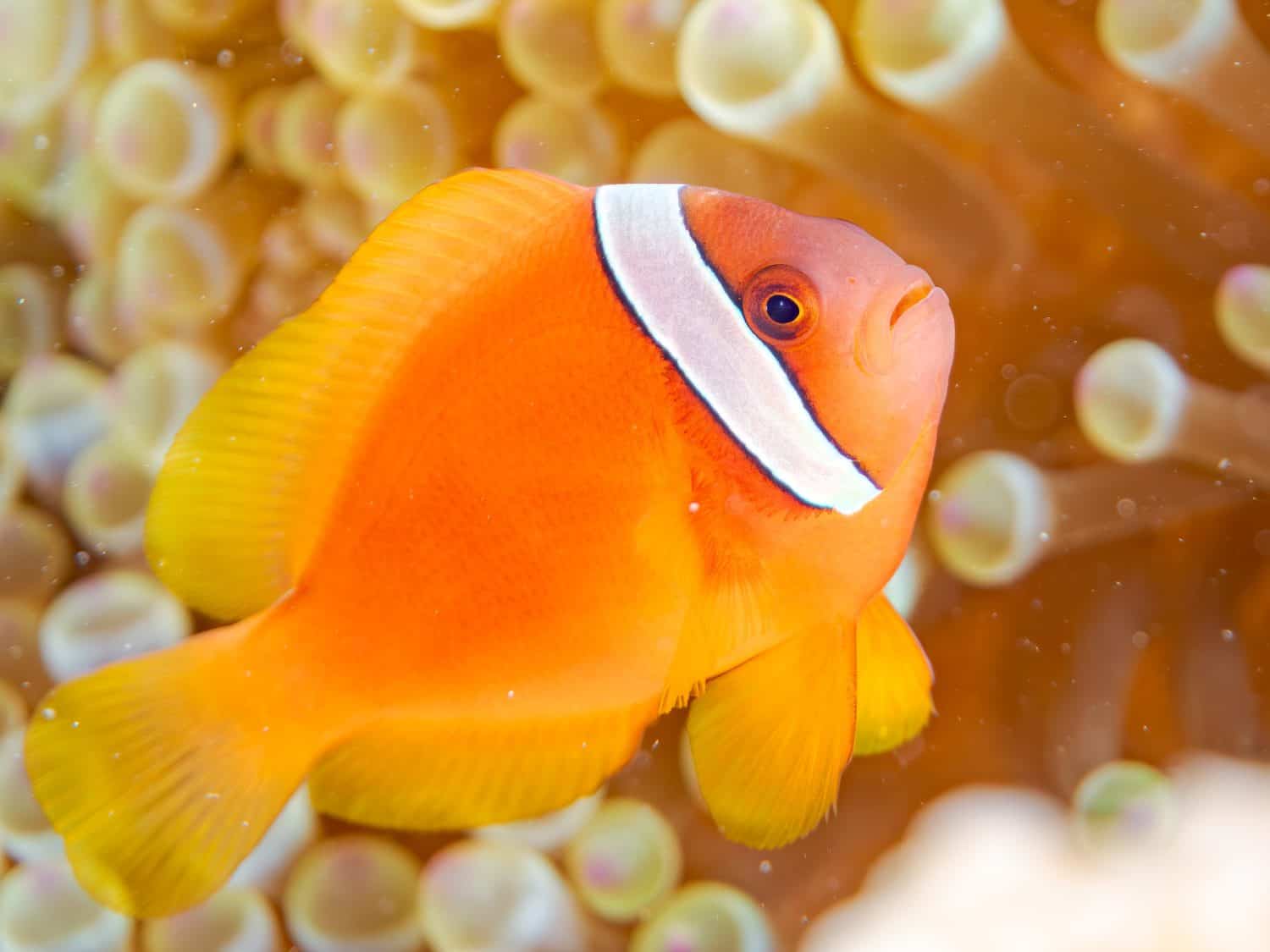
Tomato clownfish lose the stripes on their bodies as they join established harems.
©d3_plus/Shutterstock.com
“Pigmentation traits like these white bars are often treated as simple visual markers, but they in fact carry rich biological meaning,” Laudet stated in a news release. “This study shows how, by combining ecology, evolution, genomics, and developmental biology, we can move beyond describing color patterns to understanding what they actually do.”
To determine whether the loss of stripes was due to social rather than environmental pressure, Laudet and colleagues raised a group of tomato clownfish from the larval stage. When the fish were three weeks old, they were placed in different tanks with different environments.
In one set of tanks, there were no anemones present for the fish to hide in. In another, there were anemones, but they were plastic. In yet another set of tanks, there were real anemones. In the final set, there were both real anemones and adult tomato clownfish.
The results made it clear that the loss of stripes was due to social pressure. The clownfish in the tank with the adult clownfish lost their stripes rapidly. Those who were in the other tanks eventually lost their stripes, but much later than those with the adult clownfish.
The reasoning behind this, according to researchers, is that when juvenile tomato clownfish first attempt to join a harem, their white stripes signify they are not a threat and are at the bottom of the social hierarchy. As they become a part of the group and are recognized by others in the group, the white stripes are lost.
Conversely, retaining stripes longer when adult fish are not present signifies that a clownfish is dominant. This deters other fish who may want to reside in the anemone. In both cases, the clownfish’s goal is to prevent conflict.
How Young Clownfish Lose Their Stripes
When tomato clownfish are born, they have multiple white, reflective stripes on their bodies. However, as they age, the stripes disappear. This is not due to the white stripes changing color. Instead, the light-reflecting cells that make up the white stripes die.
The white coloration on clownfish is produced by specialized pigment cells called iridophores, which reflect light and create their iridescent appearance. According to the study, as the iridophores begin to disappear, they are actually dying.
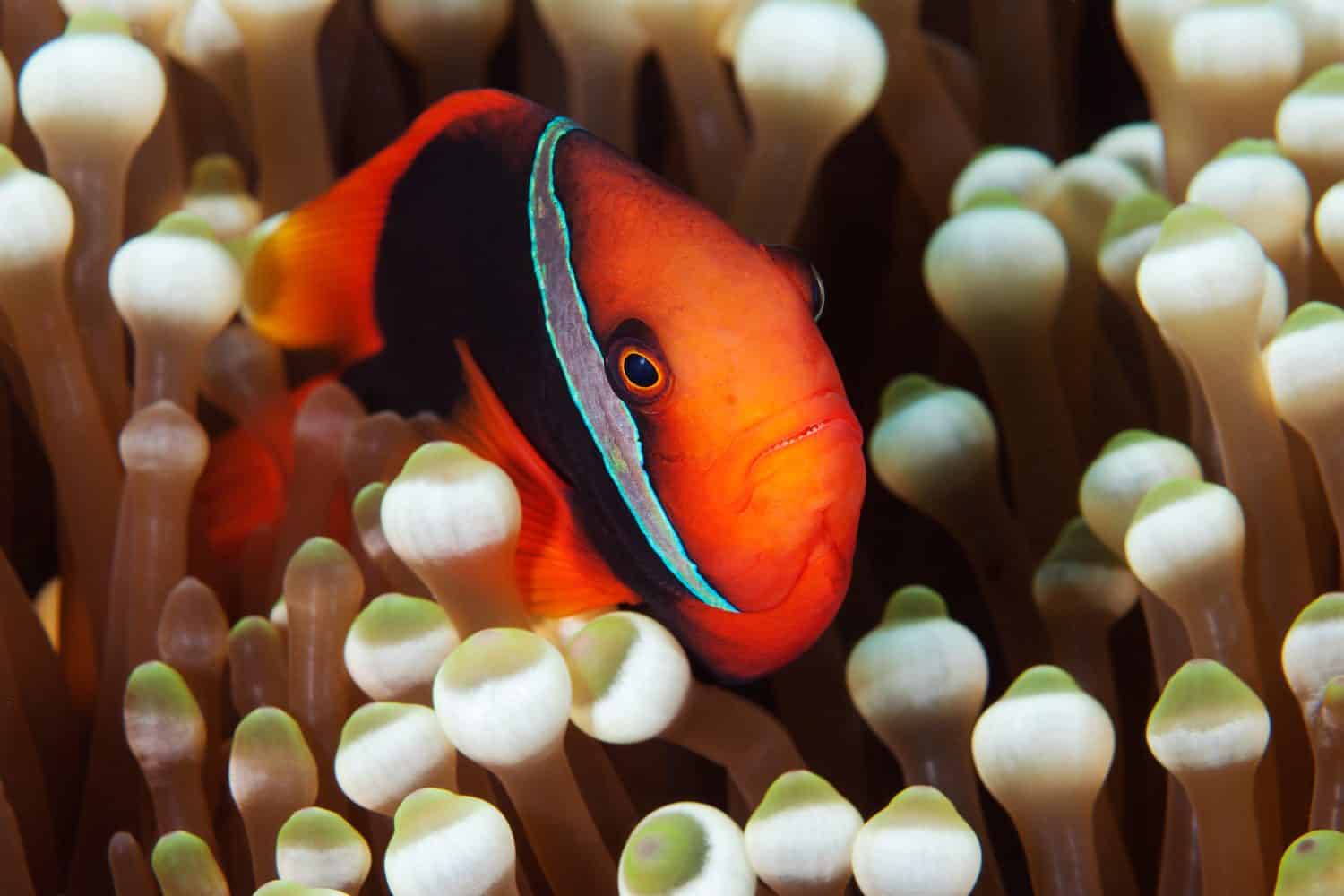
The white stripes on the tomato clownfish eventually disappear.
©Simagart/Shutterstock.com
“The cells shrink, their membranes wrinkle, and their nuclei fragment,” Dr. Laurie Mitchell, first study author, explained in a news release. “These dead cells are not replaced by new iridophores. Instead, the white bar is replaced with their characteristic orange skin.”
Therefore, as the iridophores are lost, orange scales take their place, and the white stripes that many clownfish are known for are never seen again.
When Young Clownfish Lose Their Stripes
As researchers studied the young tomato clownfish, a clear timeline for when the fish lost their stripes did not emerge. It seemed odd to researchers that the fish’s stripes faded at different times.
According to Mitchell, “when [clownfish] first have to interact with others of their own kind to form a functioning social hierarchy or group,” that is when the stripes begin to fade.
“The timing of this loss – it’s highly variable,” Mitchell told NPR.
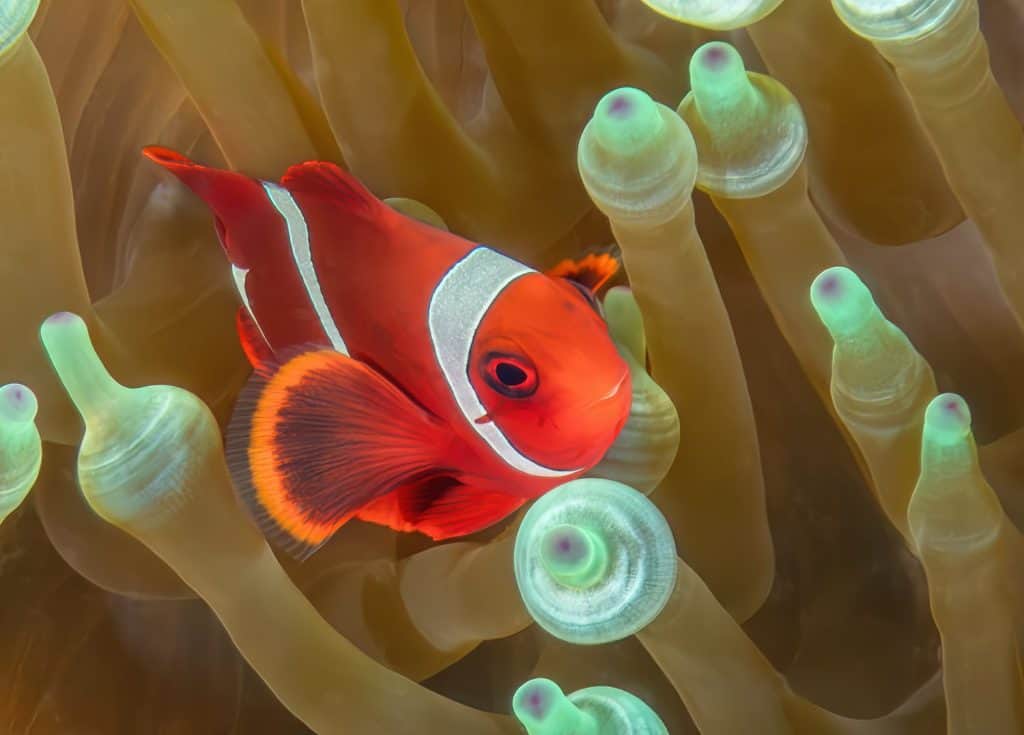
Juvenile tomato clownfish will lose their white stripes between one and 12 months of age.
©Guy Bryant/Shutterstock.com
Stripes were lost between one and 12 months of age. The factors behind this were whether the juvenile clownfish found an occupied anemone to inhabit or an unoccupied one. Those who joined a preexisting group were the ones who lost their stripes the fastest.
According to the study, this signaled that the fish were not a threat to those with higher social status. However, for those clownfish that inhabited a vacant anemone, losing stripes could cause them to be evicted. Therefore, keeping stripes for longer ensured they would be safe in their anemone home.
What Causes Young Clownfish to Lose Their Stripes?
Once researchers recognized that young tomato clownfish lost their white stripes more quickly when they were around adult clownfish, the question that remained was what triggered the stripes to disappear. The answer is hormones.
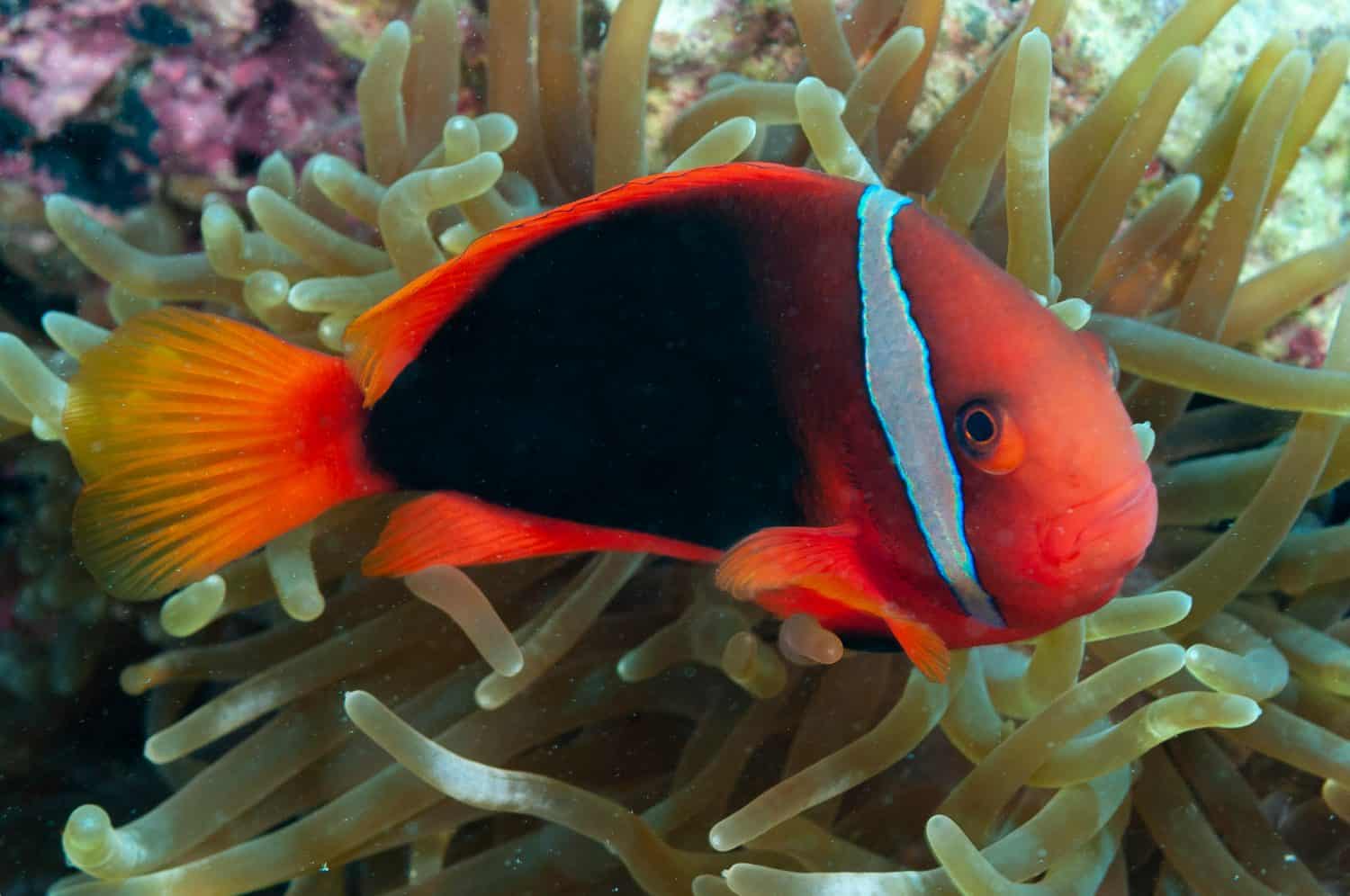
A tomato clownfish’s hormones change, causing them to no longer produce the hormones necessary for the white stripes on their bodies.
©Jesus Cobaleda/Shutterstock.com
According to the study, once juvenile clownfish establish a place in the hierarchy of a harem, the thyroid gland alters the body’s hormone production. These hormones determine which genes are active in the body. Those hormones responsible for the reflective scales on the clownfish’s body stop being produced, except for those around the head, leaving orange scales in their place.
What Does Losing Stripes Say About Clownfish Evolution?
Young tomato clownfish have not always lost their stripes. It was also not a genetic defect that caused the stripes to vanish. Instead, over the course of multiple generations of clownfish, the stripes would fade. This was all connected back to the social hierarchy.
“Our analysis found that bar loss in different species doesn’t date back to one common ancestor. The main link between these species is social — they live in smaller groups,” Mitchell explained to Okinawa Institute of Science and Technology. “We don’t fully understand this association yet, but it could be a protective mechanism.”
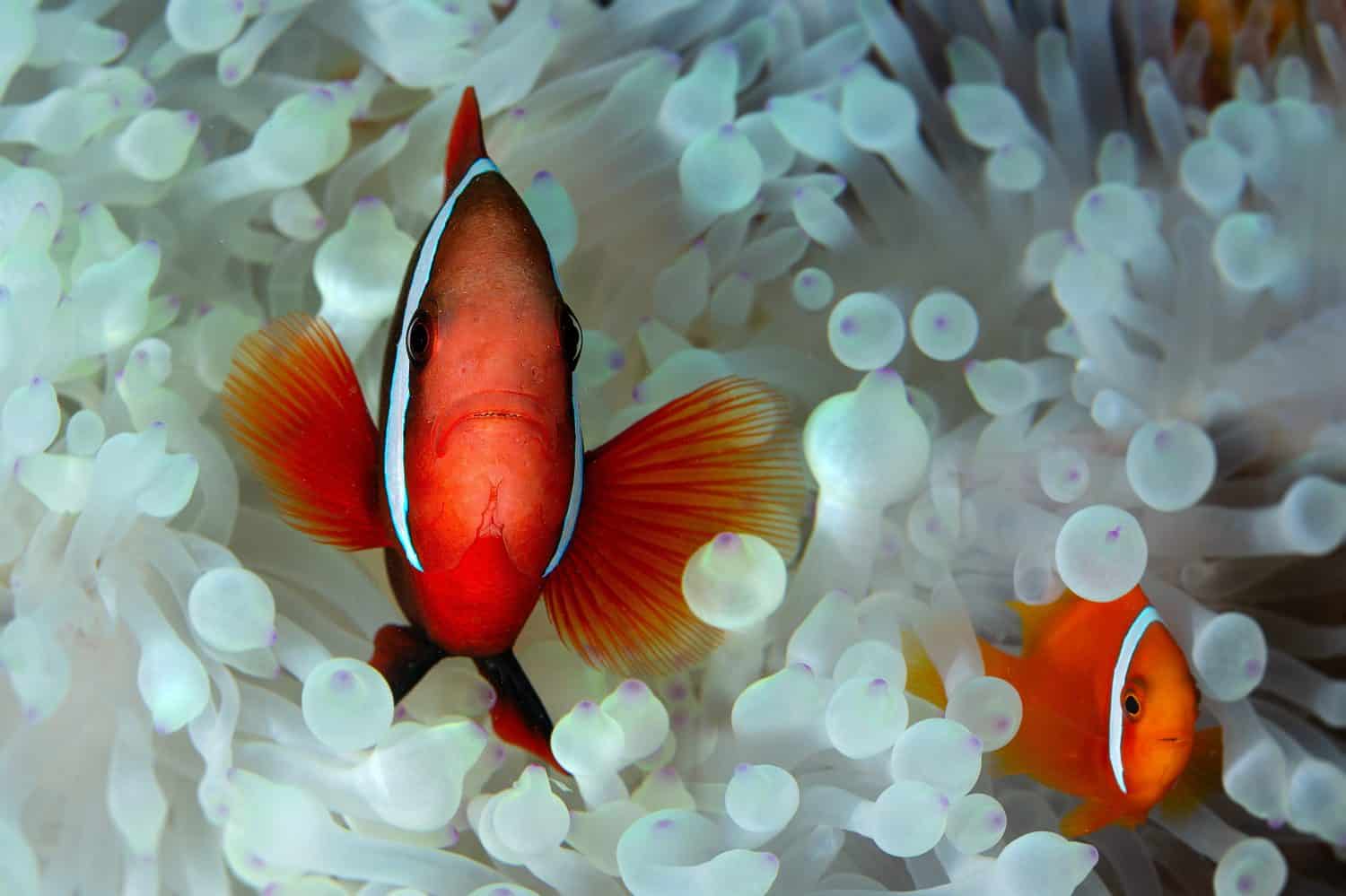
One ancestor did not cause the tomato clownfish’s stripes to fade. Instead, it took generations for this change to occur.
©Oksana Maksymova/Shutterstock.com
Mitchell, who is part of OIST’s Marine Eco-Evo-Devo Unit, continued, saying, “In larger groups, there are smaller size differences between different levels in the social hierarchies, so fights between these fish will be less dangerous. But in small groups, with only big adults and a few little subordinates, one bite could be fatal to the young fish.”
Many questions remain regarding marine biodiversity. By understanding why species like the tomato clownfish lose their stripes, researchers hope to uncover other “environmental factors” that drive evolution. If this happens, according to Mitchell, researchers will be one step “closer to unlocking the mysteries of our diverse reef ecosystems.”