
Quick Take
- Researchers studying ravens and wolves in Yellowstone National Park discovered that ravens are not fully dependent on following wolves to find food.
- In some instances, the ravens do use wolf behavior and vocalization to hone in on fresh kills.
- However, the ravens often use their memory to travel far distances and revisit sites where wolf kills are common, even when no wolves are in sight to follow.
Wolves and ravens have long been closely associated with each other. In Norse mythology, the god Odin sent two ravens, Huginn and Muninn, into the world to act as his spies. To ensure his private eyes always stayed well-fed, he sent his two wolves, Geri and Freki, to accompany the birds on their travels.
For centuries, humans have believed that ravens, notorious scavengers, followed wolves to find their next free meal. The wolves make the kill, and the ravens, following close behind, arrive to feast on any leftover scraps. But a new study released on March 12 in Science calls that myth into question.
Rather than needing the wolves to guide them to the kill, ravens actually remember common hunting grounds and check back often for fresh kills. They don’t depend on wolves to tell them where to go.
How the Researchers Studied the Raven-Wolf Relationship
Researchers from the University of Washington, the Max Planck Institute of Animal Behavior, Senckenberg Biodiversity and Climate Research Centre, the University of Veterinary Medicine Vienna, and Yellowstone National Park spent two-and-a-half years tracking wolves and ravens in Yellowstone National Park. The goal was to test the long-held belief that ravens depended on wolves to guide them to their next meal.
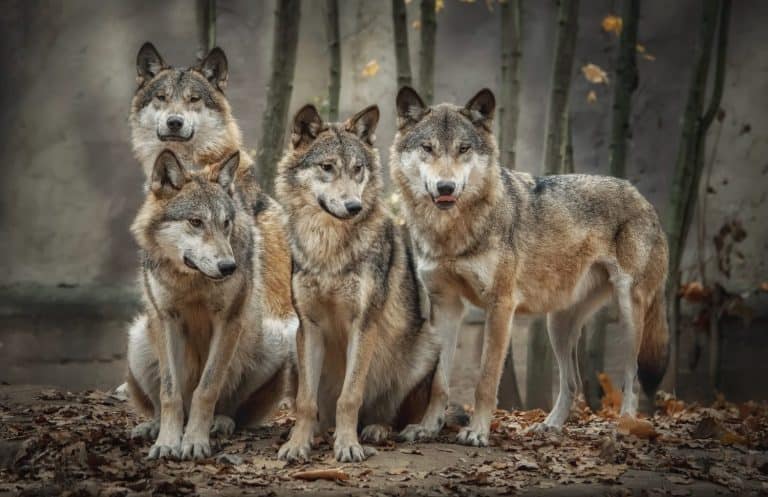
To study the relationship, researchers focused on the travel habits of 20 previously tagged wolves already residing in the park. Those wolves had been reintroduced to Yellowstone in the mid-1990s, after about a 70-year absence.
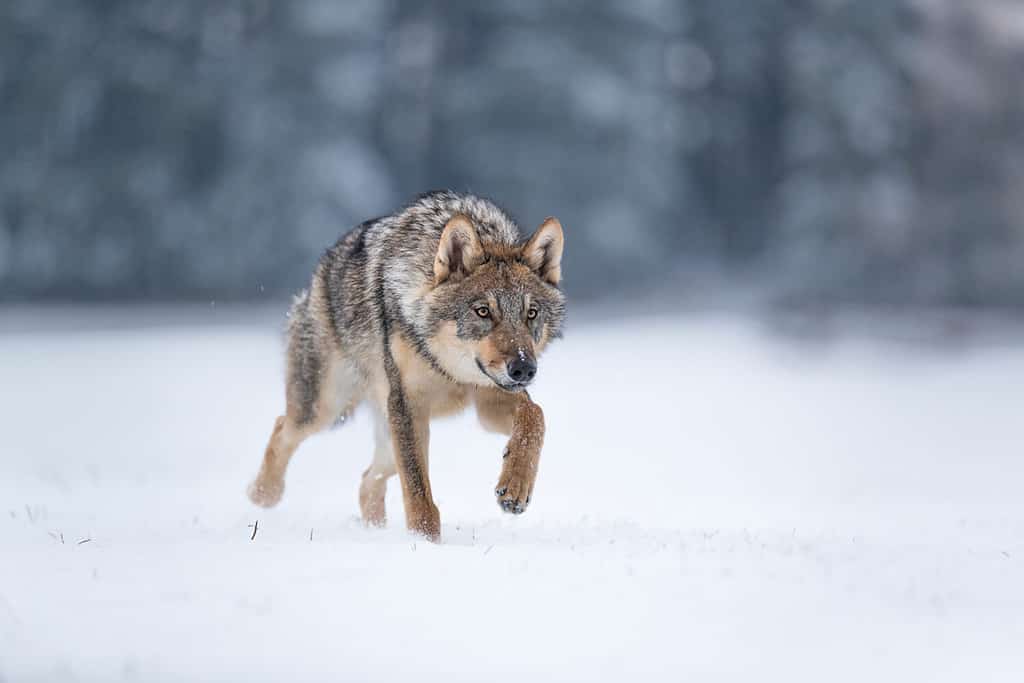
Between 1995 and 1997, 41 wild wolves from Canada and western Montana were released in Yellowstone National Park.
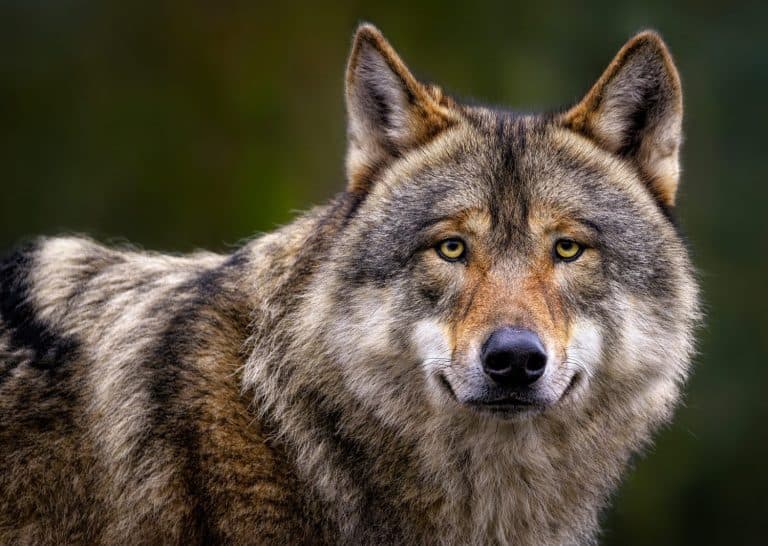
©Vlada Cech/Shutterstock.com
The bird side of the equation was a bit more challenging. Ravens are notoriously smart and skilled at avoiding capture. Researchers had to get creative to trap the birds, then install tiny GPS tracking devices on them.
As Dr. Matthias Loretto, the study’s first author and a scientist at the University of Veterinary Medicine Vienna, said in the press release announcing the study, “Ravens are so observant of the landscape that they don’t step into traps easily.” The team had to disguise traps near campsites with rubbish and fast-food bait, “or else the ravens would suspect that something was off and wouldn’t come near it.”
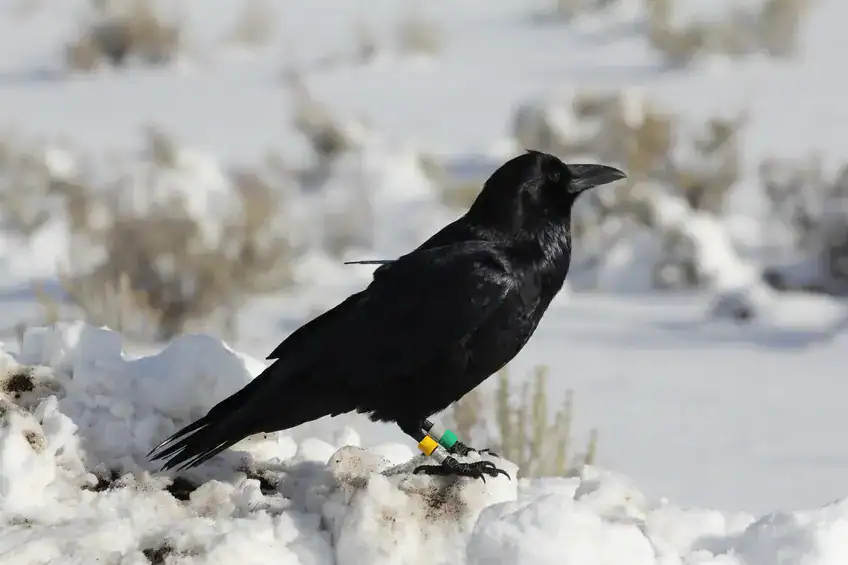
The ravens in the study were fitted with GPS backpacks, seen here with antenna protruding.
©Max Planck Institute of Animal Behavior – Original / License
With the tracking devices in place, the researchers spent two winters recording GPS locations for the ravens at intervals of up to 30 minutes, and for the wolves at intervals of up to one hour. They also tracked data on where and when wolves killed prey. The researchers focused their efforts during the winter season, as that is when ravens most often associate with the wolves.
Research Findings
The researchers’ initial findings surprised them. During the two and a half years of tracking, researchers observed only one clear instance of a raven following a wolf for more than half a mile or for more than one hour. Loretto said in the press release, “At first, we were puzzled. Once we realized that ravens are not following wolves over long distances, we couldn’t explain why the birds still arrive so quickly at wolf kills.”
The team dug deeper into the data for the answer. They discovered that ravens repeatedly visited areas where wolf kills were common. Some of the tracked birds even flew nearly 100 miles in a single day, traveling directly to places where a carcass was likely to appear.
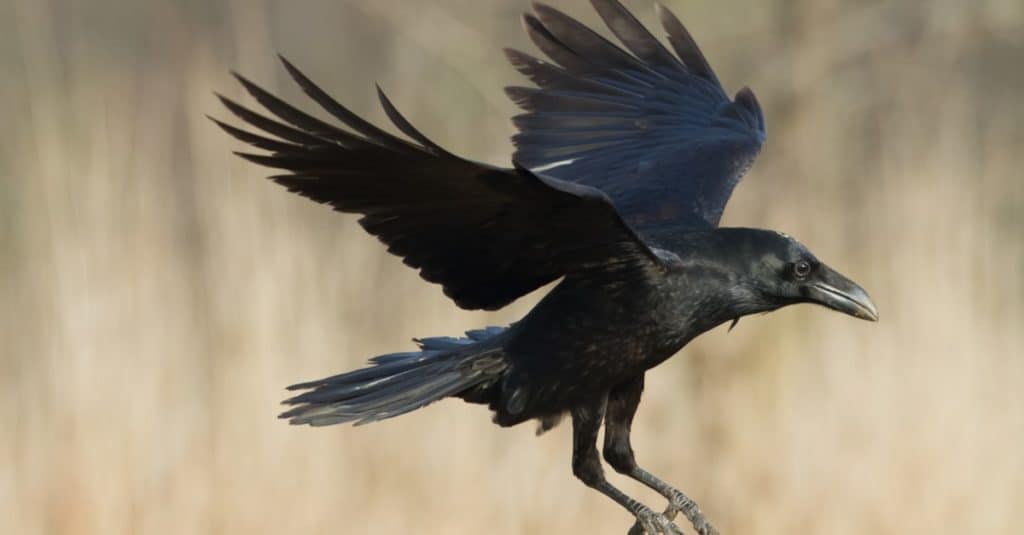
Ravens will fly up to 100 miles in search of wolf kills.
©Marcin Perkowski/Shutterstock.com
Wolves tend to kill near specific areas, like valley floors that are flat and give the wolves a hunting advantage. Much less often, wolf kills are in more remote, difficult terrain. Researchers found that ravens were much more likely to visit locations where wolves frequently made kills, rather than places where kills happened only once. This suggested to researchers that the ravens were learning and remembering the “resource landscape” created by the wolves.
“We already knew that ravens can remember stable food sources, like landfills,” Loretto said in the press release. “What surprised us is that they also seem to learn in which areas wolf kills are more common. A single kill is unpredictable, but over time some parts of the landscape are more productive than others – and ravens appear to use that pattern to their advantage.”
Does This Fully Debunk the Myth That Ravens Follow Wolves?
The researchers are quick to clarify that they aren’t saying ravens don’t ever follow wolves. Loretto noted that ravens do likely use short-range cues, like wolf howling or wolf behavior, to cue the birds into a fresh kill nearby.
It is the ravens’ behavior on a broader scale that defied expectations. The researchers note that ravens rely on memory first and environmental cues second. The ravens use spatial memory and navigation to decide where to search in the first place, even when it is nearly one hundred miles away.
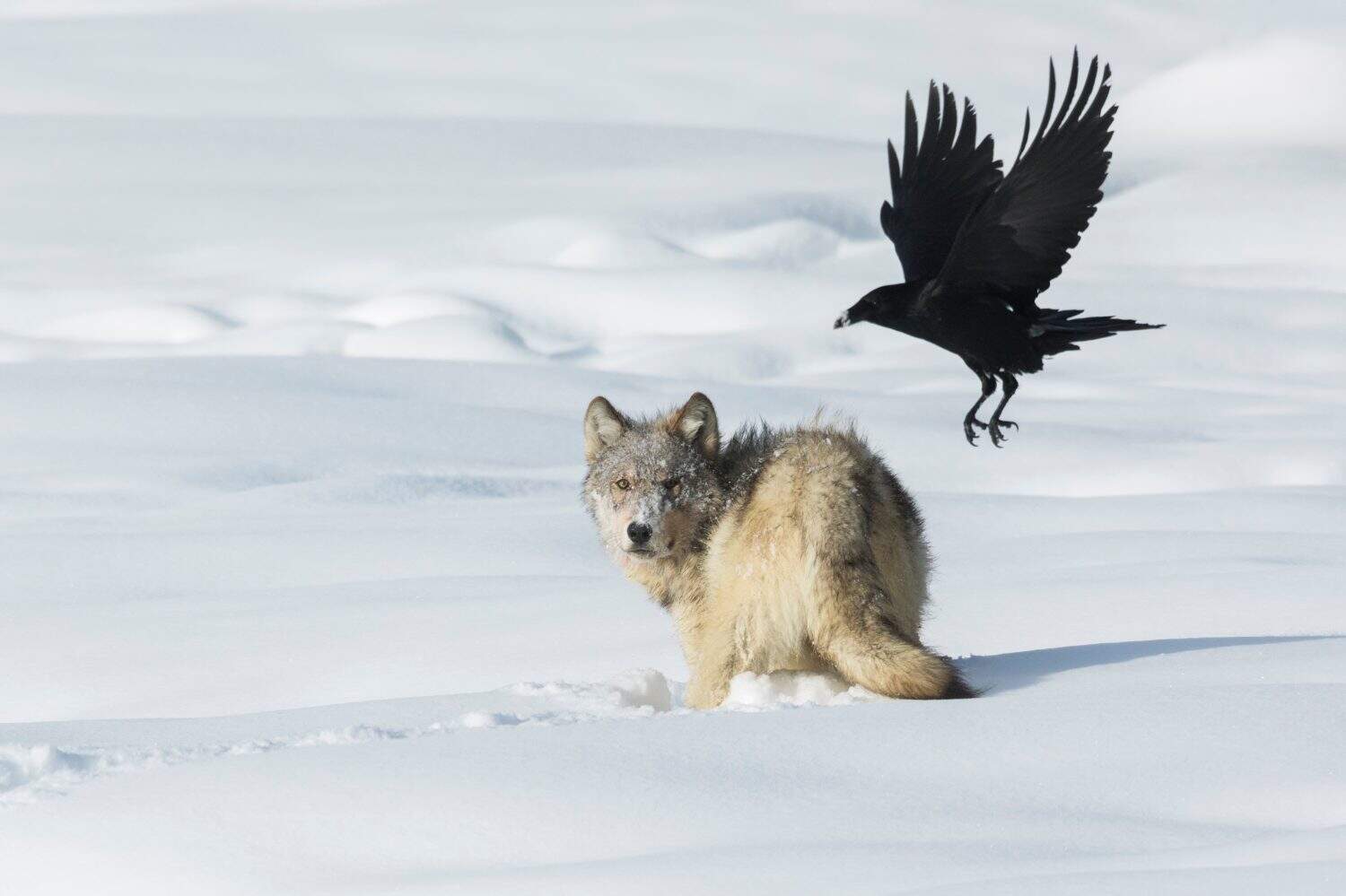
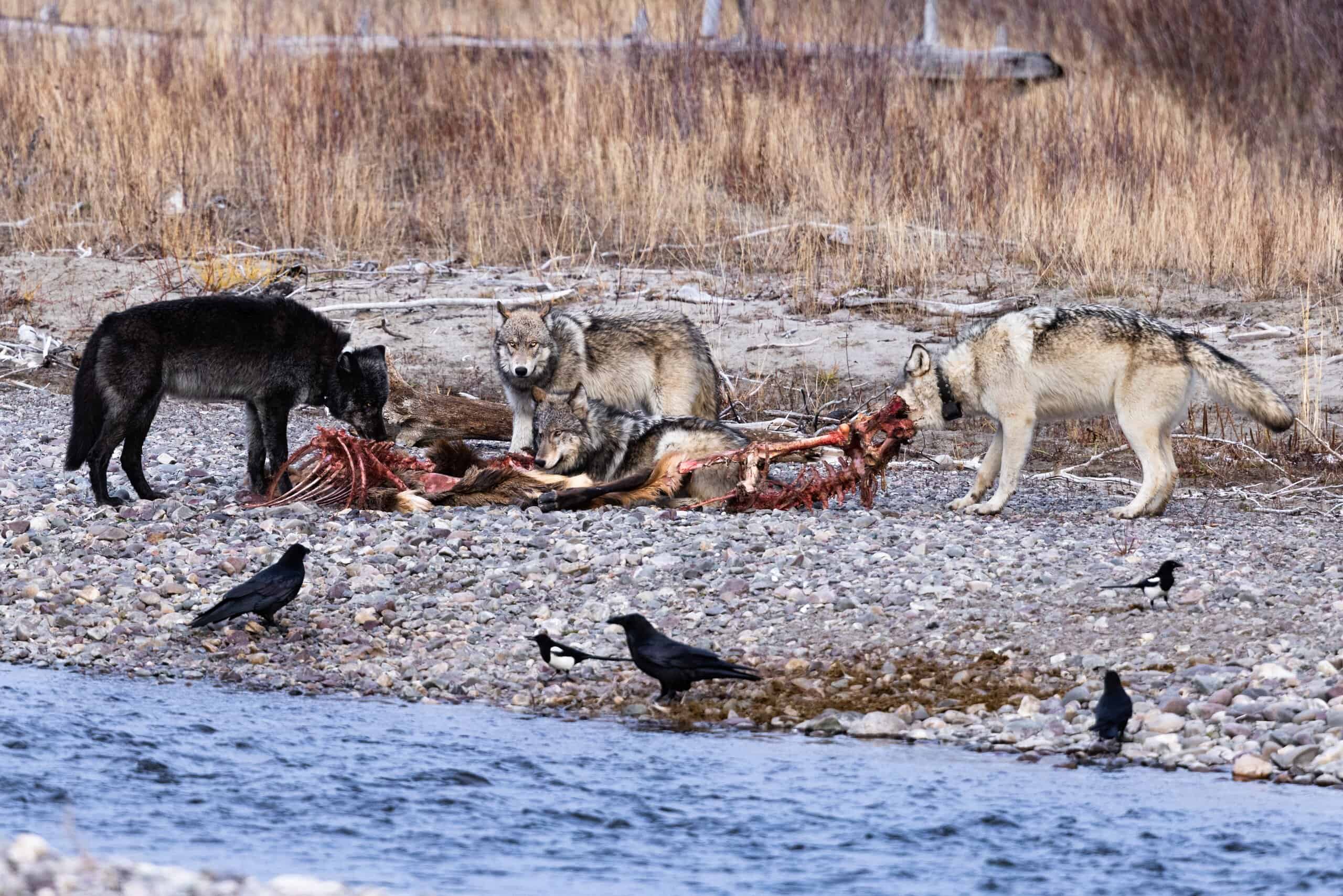
Ravens do follow wolves, but also use memory to revisit places where wolf kills are likely.
©Danita Delimont/Shutterstock.com
The study’s senior author, John M. Marzluff, professor emeritus of environmental and forest sciences at the University of Washington, added in the press release, “What our study clearly shows is that ravens are flexible in where they decide to feed. They don’t stay tied to a particular wolf pack. With their sharp senses and memory of past feeding locations, they can choose among many foraging opportunities far and wide. This changes how we think about how scavengers find food—and suggests we may have underestimated some species for a long time.”