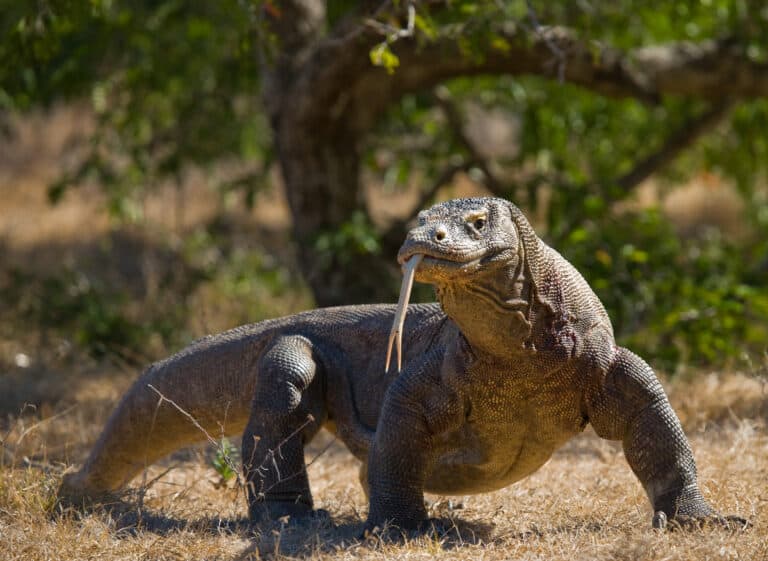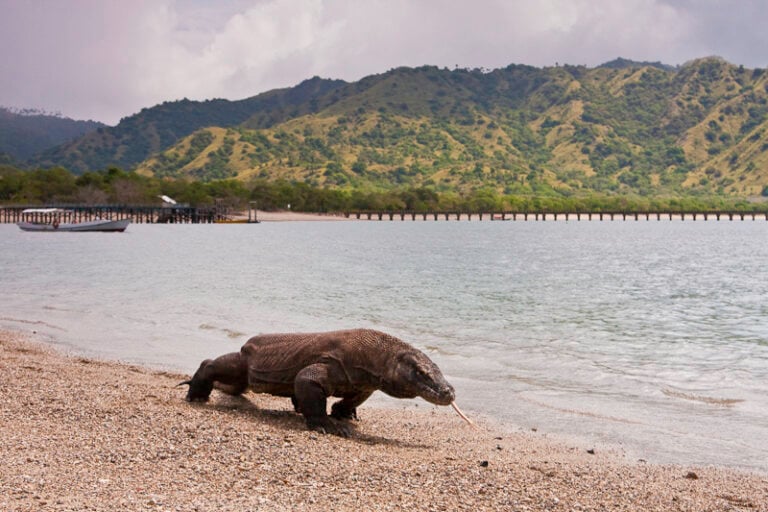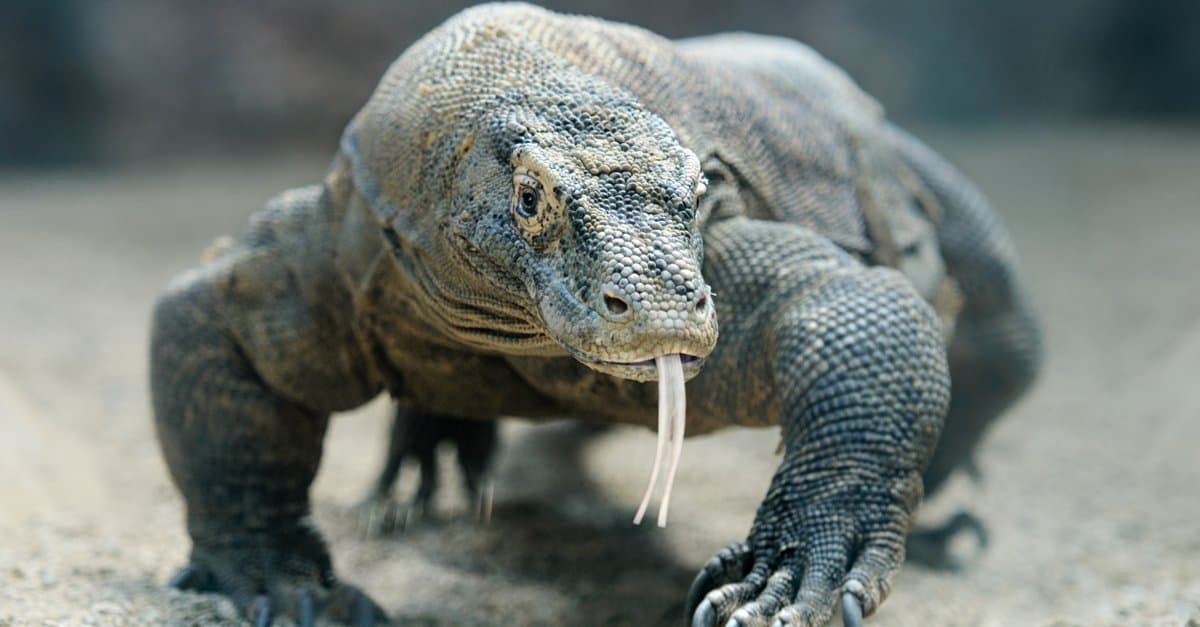

The Komodo dragon is the world’s largest lizard and one of its fiercest predators. Their name suits them well, as Komodo dragons are true carnivores that prey on all sorts of animals in the wild. With their muscular bodies and serrated teeth in a mouth once believed to contain bacteria-killing saliva, Komodo dragons can take down prey many times larger than themselves, such as deer, pigs, and water buffalo. The Komodo is not known to feed on humans, but fatal encounters have been reported. Nevertheless, while they are not inherently aggressive, Komodo dragons have earned themselves a reputation for being one of the most aggressive, dangerous, and venomous apex predators on the planet.
But how much of that reputation is fact and what is fiction? As with so many things, knowledge is the best way to separate the wheat from the chaff. In this article, we’ll learn whether the Komodo dragon is venomous and how dangerous a threat it really presents to humans.
Are Komodo Dragons Venomous?
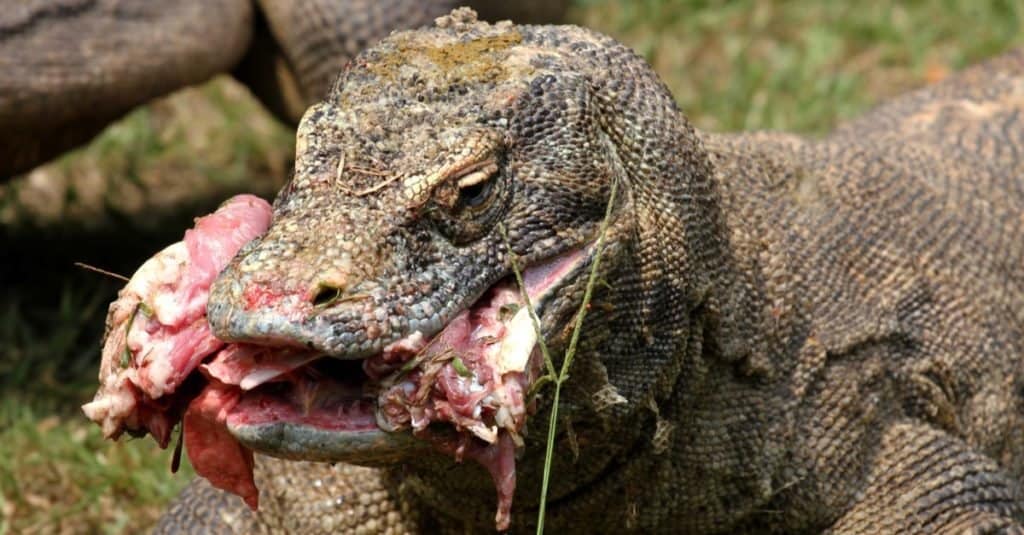
The Komodo dragon seems terrifying because of, among other things, its 60 sharp, serrated teeth. Like other lizard species, the Komodo dragon has a fairly weak bite force compared to other animals and even humans. According to this study, which examined the role played by Komodos’ mass, total body length, head length, and maximum head width, “All [Komodo dragons] produced a wide range of forces, but heavier [Komodos] produced greater maximum forces with the highest at 148.56 N[ewtons].” This is significantly weaker than that of an Australian saltwater crocodile of the same size—a creature that, as an adult, can generate a bite force of 16,460 Newtons (on average, these crocodiles bite with a force of around 9,000 Newtons). One study reported that the bite force of humans is between 148-354 Newtons, depending on the sex and age of the participant and where in the mouth the bite force is being measured.
Technically, the Komodo dragon’s bite—if solely based on bite force—should not be enough to create colossal damage or impact on their prey. So, what makes a Komodo dragon’s bite lethal? A couple of things. First, their 60 teeth are serrated and very sharp, designed to tear into flesh. Komodos use a customized bite-and-pull strategy when they bite their prey. They do this using their powerful neck muscles that aid them in taking a bite.
Second, Komodo dragons exert a venom through their teeth that prevents their prey’s blood from clotting, quickening the block loss process; induces shock, which lowers its blood pressure; and causes hyperalgesic cramping, further immobilizing the prey. The combination is lethal. According to this study, researchers determined the composition of the Komodo dragon’s venom. The below table shows each toxin identified in the Komodo’s venom and what that toxin does to the body of another animal.nown to :
| Toxin Type | Previously Characterized Bioactivities |
|---|---|
| AVIT | Potent constriction of intestinal smooth muscle, resulting in painful cramping, and induction of hyperalgesia. |
| CRISP | Basal toxic activity of paralysis of peripheral smooth muscle and induction of hypothermia via blockage of L-type Ca2+– and BKCa K+-channels. Derived activities include blockage of cyclic nucleotide gated calcium channels. |
| Kallikrein | Basal toxic activity of increasing vascular permeability and production of hypotension in addition to stimulation of inflammation. Derivations affect the blood through the cleavage of fibrinogen. |
| Natriuretic | Basal activity potent induction of hypotension leading to loss of consciousness. Derived activities include cardiovascular effects independent of the GC-A receptor and antiplatelet activities evolved for emergent domains upstream of the natriuretic peptide domain. |
| PLA2 (T-III) | Anticoagulation via platelet inhibition. |
The short answer to whether Komodo dragons are venomous is yes.
Are Komodo Dragons Dangerous to Humans?
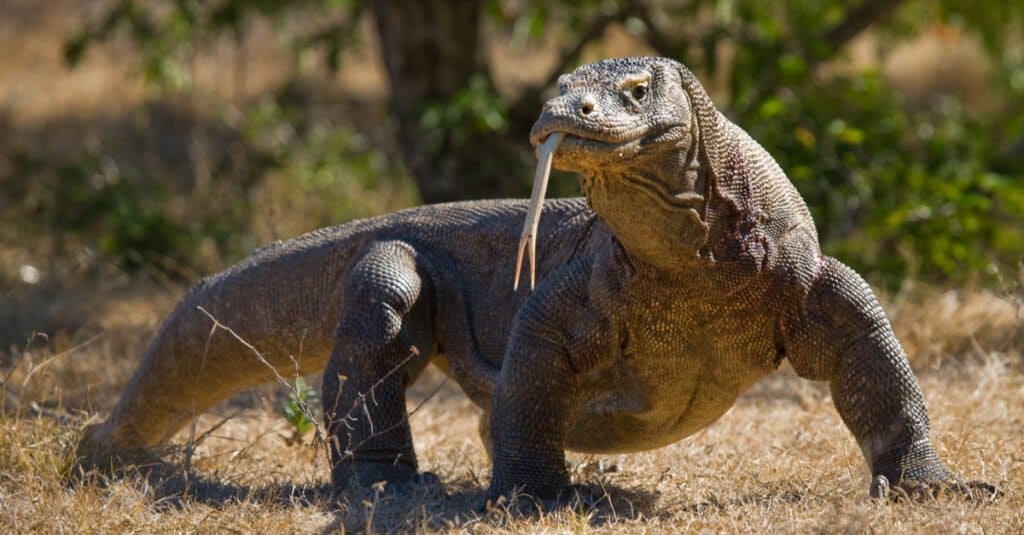
A Komodo dragon’s bite can be very dangerous to humans.
©GUDKOV ANDREY/Shutterstock.com
There are a few recorded human fatalities at the mouths of Komodos. In fact, the Komodo dragon has been a fearsome reptile in Indonesia. Yet, experts claim that Komodo attacks are rare. From 1974 to 2012, both in captivity and the wild, the Komodo National Park reported 24 encounters, five of which were fatal. One of those attacks, the first deadly one in 33 years, includes the death of an 8-year-old boy on Komodo Island in 2007. The creature mauled the boy as he went to go to the bathroom behind a bush. The boy succumbed to his injuries. In 2009, a 31-year-old man gathering sugar apples on Komodo Island fell from a tree. He fell on two Komodo dragons, which ravaged him. The victim was reported to have bites on his hands, legs, neck, and all over his body. The man died shortly after the attack. Some other reports of Komodo attacks have left individuals gravely injured.
Any animal—big or small—could be dangerous to humans. In that sense, Komodo dragons are no exception. But are they dangerous to humans just because? Not really, but no one would reasonably recommend getting a Komodo dragon for a pet.