Rabbits are hugely popular pets in the US with 1,534,000 households owning a bunny. They are fascinating little creatures who are descended from wild rabbits. Having first evolved in Asia millions of years ago, they were first domesticated during the 1500s. Now that they share our lives we want to learn more about how our pets perceive the world, especially what they can see. So, let’s take a look at how rabbit eyesight works. Most importantly, can rabbits see in the dark?
How Do Animals See in the Dark?
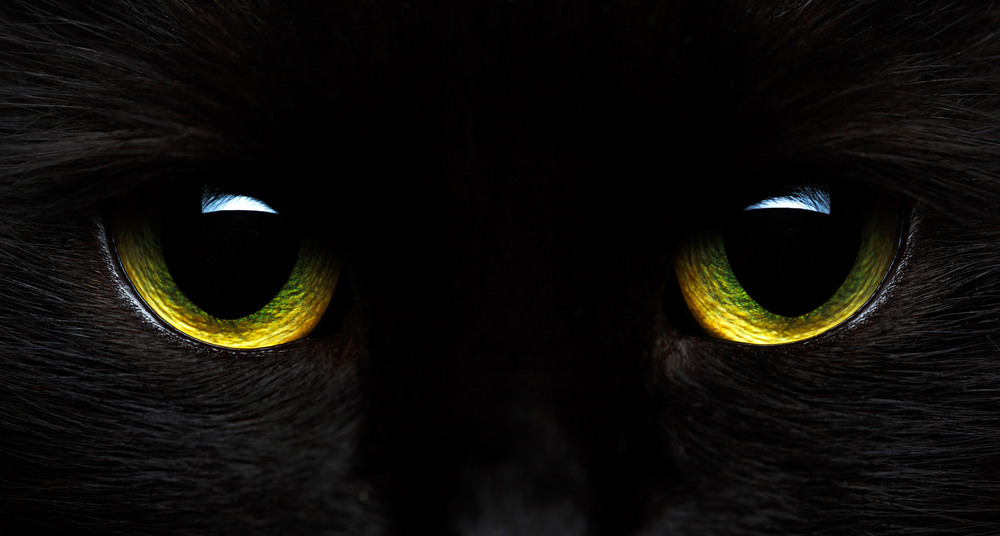
Cat’s eyes shine at night because they have a tapetum.
©Vladyslav Starozhylov/Shutterstock.com
Some animals, including cats, can see well in the dark. Often, these are creatures that hunt and feed at night or are most active when light levels are low. They need to be able to see in order to find food. All vertebrates have a basic eye structure. An opening (the pupil) can get bigger or smaller to control how much light can enter the eye. Then, a lens focuses the light onto a layer of light-sensitive cells called the retina at the back of the eye. This sends signals to the brain via nerves.
Animals that can see in the dark have larger eyes and pupils that cover the whole front of the eye to let in as much light as possible. Their eyes may be a different shape, and they may have very large lenses. Some have a mirror-like layer behind the retina, making the most of the light. This is called a tapetum.
Vertebrates have two types of photoreceptor cells in their retinas. The first are cones, which give a clear picture with high resolution, and the others are rods, which allow animals to see in poor light. Animals that can see in poor light have a lot of rods.
What Can Rabbits See?
Rabbits are prey animals, so their eyesight must allow them to detect predators from any direction. Also, they are diurnal (active during the day), so night vision is not essential for them. That said, they are most active at dawn and dusk, so good vision in low light is useful. Thanks to the position of their eyes, they can see nearly 360 degrees around them. They are also farsighted so that they can see things in the distance. The downside is that they have a small blind spot right in front of their face.
Like other vertebrates, rabbits have both cones and rods. They have limited color vision and use other senses, including their hearing, to detect what is happening around them.
Can Rabbits See in the Dark?

Rabbits can see better than us in the dark, but not as much as nocturnal animals.
©oyvindpe/Shutterstock.com
Rabbits can see better in the dark than humans, but not as well as nocturnal animals. They do not have the mirror-like layer behind the retina (tapetum) seen in nocturnal animals, but they do have large pupils and large lenses. Also, they have a high ratio of rod-to-cone cells in their retina, meaning they can see in low-light conditions, but what they see is grainy and unclear.
What the Experts Say
Experts from the University of Minnesota Health Sciences Center, University of Michigan Medical School, and Tufts–New England Medical Center, in a paper published in 2013, explain, “The anatomy of the rabbit eye reflects its niche as a diurnal herbivore. The rabbit has both photopic and scotopic vision without the benefit of a tapetum.”
Also, Dana M. Krempels, Ph.D. explains in Houserabbit Adoption, Rescue and Education, “Although a rabbit can see better than a human in low light conditions, his low light image has a much poorer resolution (clarity) than the daytime images formed by your cone-rich, primate retina.”