
Dog lovers have claimed for years that owning a dog (or a few) is life-changing. Sure, there’s hair everywhere and you need to clean up after them, but there’s an intrinsic calm they provide on even your worst days that just makes life better.
Instead of leaving it up to opinion, scientists have tested the effect of dogs on people with heightened cortisol levels. These studies had one major finding in common:
Yes, pets really do lower stress.
Keep reading to learn more about the studies examined and how exactly dogs and other domesticated animals can lower your stress level.
Which Studies Discuss Pets Lowering Stress Levels?

Over the last five years, dozens of studies tested their unique hypotheses on dog’s effects on human emotions.
©Nina Buday/Shutterstock.com
Three studies in particular have shown significant findings in lowering stress levels. They are the Animal Visitation Program study, the oxytocin study, and the military veterans study.
The Animal Visitation Program Study examined how seeing versus interacting with dogs in a university setting would affect the cortisol levels of stressed-out students. Scientists partnered with an undefined research university in the Pacific Northwest U.S. over three semesters. They tested the cortisol levels of different groups who pet, observed, watched a slideshow, and waited to see the shelter dogs and cats on campus as part of a “de-stress for final exams” event.
Conversely, the oxytocin study sought to answer, through an exploratory study, how behavioral patterns are associated with oxytocin and cortisol levels in dog owners and their pets. The sample size, 10 female dog owners and their male Labrador dogs, participated in 60-minute interactions — with their blood taken at varying intervals.
Finally, the military veterans study took 65 individuals who were military veterans or ex-first responders with PTSD who have service dogs and measured their subjective and physiological parameters. Overall, the researchers sought to find differences in cortisol levels, signs of PTSD symptoms, and the quality of both sleep and well-being.
What Are Stress Levels?

Stress sets in during high-pressure life situations.
©fongbeerredhot/Shutterstock.com
Before understanding the findings of the studies, we must first understand stress. We need to know what it is, where it comes from, and how it affects our bodies and minds.
“Stress” is a feeling you get in high-pressure situations that releases cortisol. Three biological types of stress exist: acute stress, chronic stress, and traumatic stress.
Cortisol, a steroid hormone, comes from your adrenal glands. It’s a vital hormone to many of your body’s functions. One of cortisol’s main functions is to regulate your body’s response to stress. Other functions of cortisol include controlling your body’s use of macronutrients, regulating blood pressure and blood sugar, and suppressing inflammation.
What Are the Studies’ Findings?

Studies found that dogs have a positive effect on humans across the board.
©iStock.com/Viorel Kurnosov
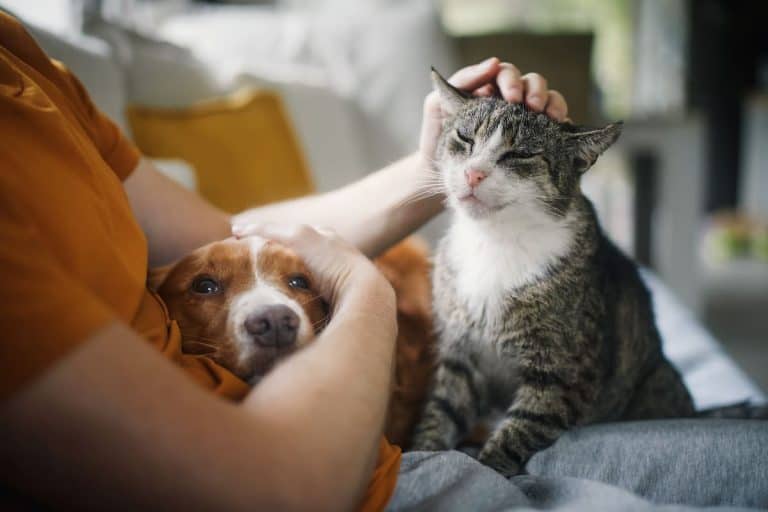
The Animal Visitation Program Study found that petting a dog was the most stress-relieving part of the animal program on college campuses. When compared to the other groups, a clear difference in momentary stress relief presented itself.
Overall, the oxytocin study found that its hypothesis was correct. As quoted in the abstract of the study, “Oxytocin and cortisol levels, both in dogs and in their owners, are associated with the way the owners interact with their dogs and also with behaviors caused by the interaction.”
This means that both the love hormone and the stress hormone are at play in interactions between dogs and their humans. If it’s scientifically proven to be at play, it’s logical to assume that positive interactions between the human and dog result in less stressed behavior. You don’t need to draw assumptions, though, as a resident expert inferred the study’s main findings and distilled them in layman’s terms.
Anne-Marie Sharpe, a pet expert with years of experience and the head writer at Breed Advisor, told A-Z Animals, “This study shows that owners of dogs had significantly reduced cortisol levels and increased levels of oxytocin. Oxytocin is known as a ‘love hormone’, creating strong bonds and making you feel happy and positive.”
The military veterans study found that “that veterans and first aid responders with PTSD who had a service dog showed significantly less PTSD-related symptoms, better sleep quality, and better wellbeing experience than those with a companion dog.” Additionally, those with a service dog tended to walk more than individuals without PTSD. The study did not obtain conclusive results on the difference in cortisol levels between the tested groups.
What the Findings Mean
These three studies recount a few of the most recent and unique experiments to discover how dogs affect cortisol levels. Over the last 20 years, researchers have spent more time and resources understanding the effects of dogs on humans in search of practical medical applications.
John Dolores, a Clinical Psychologist, PhD, JD, FACHE for Bespoke Treatment, shared an interesting perspective with A-Z Animals on pets’ influence on our lives.
“It’s worth noting that the historical mood-boosting effects of pets on humans contribute to the positive association between domesticated animals and our overall mood,” he said. “Media representation, interactions with other pet owners, and our personal experiences with pets collectively foster our perception of pets. If they’re mostly positive, we feel less stressed around them — even when we’re only watching videos. Conversely, a number of negative experiences or understanding of pets can make others feel more stressed around them.”
Why Pets Lower Stress Levels

The comforting effect of a dog depends on individual humans.
©iStock.com/Vacharapong Wongsalab
Besides the scientific reasons mentioned above, Dr. Kathryn Rosalie Dench, a veterinary surgeon and dog behavior advisor with Gentle Dog Trainers, says that the effects of a dog are far-reaching — but depend on individuals.
“Despite consistent results across studies, the personalized nature of pet-based stress relief must be acknowledged,” she conceded. “To different people, pets have varying degrees of calming effects. Although some may disagree, there is a broad agreement that pets positively affect the emotional wellness and reduce stress levels of their owners.”
What are some of these general positive effects? They include:
- Reduced cortisol levels.
- Boosted mood.
- Lower blood pressure. Studies reveal that petting dogs and cats can be especially beneficial for those dealing with hypertension.
- Decreased heart rate.
- Stress reduction in various settings.
Applications for Dog De-Stressing
Service and emotional support animals already exist — but the use of dogs to make humans less stressed doesn’t stop there.
“One of the most common and heartbreaking parts of aging is a tragic sense of loneliness. Even if seniors are not alone, they’re at a point in their life where many of their friends and family have passed on,” said Daniel Caughill, the co-founder of Dog Tale.
“One of the best tools for combatting senior loneliness is caring for a pet. A dog or cat will faithfully stay by their owner’s side for life, with all the affection they can give. On top of that, caring for a pet on a daily basis gives seniors a sense of purpose. The owner will have a dependance to feed, entertain, and walk on a daily basis, and this sense of purpose, companionship, and daily exercise can go a long way in preventing loneliness, anxiety, and stress.”
Dogs also have incredibly high emotional empathy and teach responsibility. Both of these traits afford young children a helpful teacher for life. Dogs keep them active, teach what it means to care for another being, and how to show empathy. They can also help kids grapple with loss, understand their own feelings better, and provide a dedicated protector.
Yes, Petting Dogs Is a Healthy Habit
Science doesn’t lie — study after study proves that being around dogs can lower cortisol levels, thereby lowering levels of stress. As found in the Animal Visitation Program study, petting dogs provided more relief than simply observing dogs.
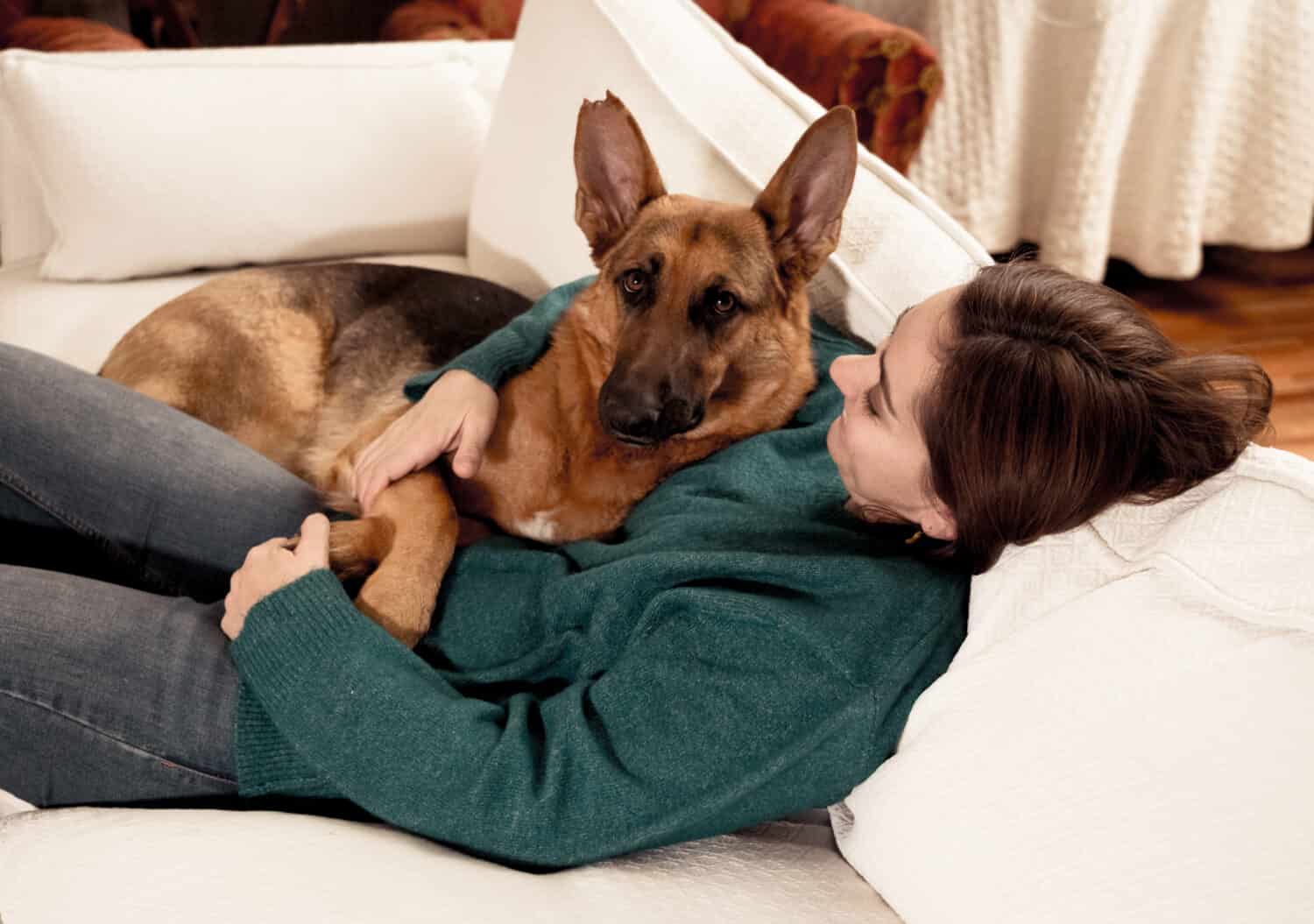
So the next time you feel stressed, try giving your dog a hug or a pet. You’ll lower your stress and show them some much-deserved love.