
Quick Take
- When researchers pitted birdsong against traffic noise, the stress difference was stark, and the real surprise was which factor drove the results more. See the stress findings →
- Listening to birdsong on headphones helps, though where you listen changes everything. Explore the study setup →
- Up to 60% of college students report mental health struggles, and a cheap, accessible habit might be part of the answer. See the mental health data →
- You don't need a remote wilderness for the effect to work, and the study's location will likely surprise you. Discover the urban implications →
There is a growing body of research linking nature to positive mental health. A new study has further advanced the field by linking birdsong and time spent in forests to positive mental health outcomes. This research suggests that it’s time we valued landscape restoration and our avian friends, especially in urban areas.
Nature and the Mental Health Crisis
It’s no secret that there is a growing mental health crisis globally, particularly among young people. It is especially worrying on college campuses, where up to 60 percent of young people report mental health challenges. Could nature have the answer? There is an increasing wealth of research suggesting that nature-related activities can support and restore mental health.
During the COVID-19 pandemic, scientists recorded that nature-based interventions proved effective in preventing mental health declines. They have been linked to positive outcomes such as stress reduction, reduced depression, and improved mood. This raises the possibility that nature-based activities could be a promising way to support college students facing psychological challenges.
The Rise in Bird Popularity
Bird watching is a rapidly growing form of nature-based activity. In the UK, the Royal Society for the Protection of Birds (RSPB) has about as many members as the major political parties. In the US, nearly 100 million Americans birdwatched in 2022.

Bird watching is a popular activity.
©PeopleImages.com – Yuri A/Shutterstock.com
Technology such as the Merlin bird identification application has broadened the appeal to young people. More and more people are participating in conservation-focused citizen science initiatives connected to birds. Birdwatching is a highly accessible nature-based activity that requires little in the way of equipment or physical ability. It can be done in both rural and urban environments. Furthermore, it can foster interest in and support for wildlife conservation.
Why Are Birds Beneficial to Mental Health?
There is scientific evidence that birdwatching supports mental health. In Europe, increased bird diversity has been linked to increased life satisfaction. Birdwatchers in both Europe and China have reported better mental health. Studies have linked higher bird abundance with lower anxiety, stress, and depression.
Similarly, exposure to birdsong is linked to health benefits. In laboratory studies, it has been associated with lower self-reported stress, anxiety, and paranoia. Bird sounds also promote perceptions of restorativeness. At the same time, walks in nature also promote positive emotions and lower physiological stress.
Studying Nature, Birdsong, and Mental Health
Researchers wanted to establish the relationship between birdsong, the physical landscape, and mental health. Does where you listen to the birdsong make a difference?
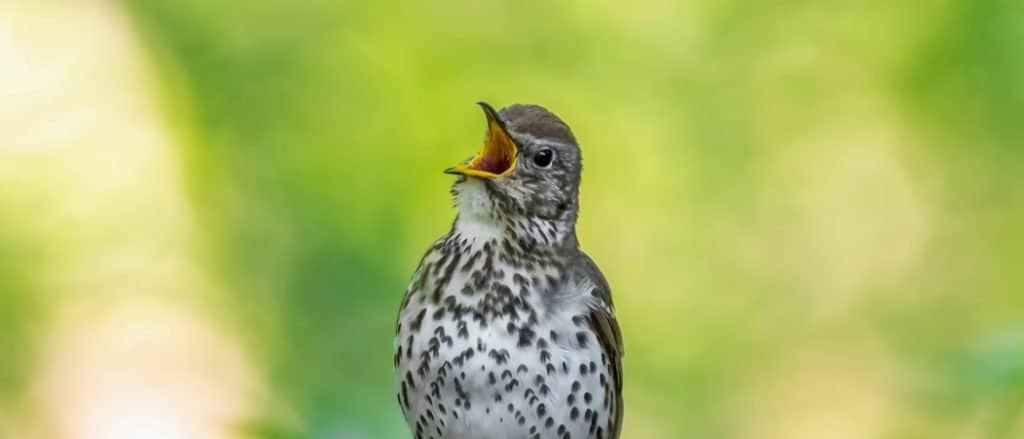
Listening to birdsong is beneficial for wellbeing.
©dentorson/Shutterstock.com
So, in this new study, they used two soundtracks and two landscapes. The first landscape was a restored forest with over 70 percent canopy cover. The second was a ‘grey space’ location outside the Talley Student Union building on the campus of North Carolina State University.
A total of 106 volunteer students were randomly assigned to one of the locations. Once there, they were played either a birdsong or a traffic soundtrack (10 minutes each) on noise-cancelling headphones. At the end of the soundtrack, participants completed a survey about their mental well-being. Then, they listened to the other soundtrack before completing another survey. Each participant then walked to their second assigned location and repeated the process in the designated order.
The Link Between Birdsong and Positive Mental Health
Participants who were in the forest and listened to birdsong reported an average stress score of 3.2 on an 11-point scale. This was much lower than the 6.4 for those on the plaza hearing traffic. The combination of birdsong and forests also produced the highest positive emotion and the strongest sense of restoration. The worst was the plaza-traffic combination.
For mental restoration, the physical setting mattered more than the soundtrack. However, for stress and for positive and negative emotions, both sound and setting were equally important. Overall, this provides evidence of what scientists call a causal and additive relationship between exposure to birdsong soundscapes, restored forest, and multiple measures of psychological well-being. Essentially, this means that listening to birdsong is beneficial, but listening to it in a forest is even better!
Why This is Important
Importantly, you don’t need to be in a large, remote forest for this effect to occur. The benefit was observed even in a small, recently restored forest within an urban environment. Also, exposure to forests and birdsong may reduce the psychological harm caused by grey spaces and traffic noise.
Although the findings of this preliminary study need to be confirmed with future research, it shows that forest restoration has important benefits for human well-being. This may be particularly true around college campuses. Additionally, the easily accessible activity of listening to birdsong on headphones may offer a way for young people to improve their mental health. It is crucial that we work to protect and restore both our forest landscapes and our avian populations.