
“Jumanji,” “The NeverEnding Story,” and “The Legend of Tarzan” are just a few of the movies featuring famous quicksand scenes. Pretty much everyone has a terrifying image of what quicksand is like. However, the truth is that there are many things you can do to safely escape quicksand, especially if you know what you’re doing.
Quicksand is a non-Newtonian fluid, which means it doesn’t adhere to the same rules as other liquids. One moment it’s mushy, and the next it’s compacted sand. When you understand how quicksand behaves, you can use this knowledge to free yourself, one limb at a time.
In this article, we’ll be taking a deep dive into how to get out of quicksand, in the safest way possible. We’ll look at the top 5 steps to take, the do’s and don’ts of surviving, as well as the science behind this natural phenomenon. It’s time to become a survival expert, follow along to learn the right way to escape quicksand.
- Contrary to movies, you won’t be completely engulfed; your body’s buoyancy prevents full submersion, likely to sink about halfway.
- Quicksand’s behavior depends on viscosity – stable like clay when undisturbed, transforms into a liquid with shake or stress, surprising victims.
- Forms from water-saturated sand particles become a mushy mixture over time, and can’t support weight.
- Risks beyond sinking: weather exposure, hypothermia, predators, dehydration.
- Sand’s pressure causes “crush syndrome,” releasing harmful substances into the bloodstream.
How Can You Get Out of Quicksand?
If you ever find yourself stuck in quicksand, here’s what you should do to get out:
1. Stay Calm: Take a deep breath and don’t panic. Don’t move around too quickly.
2. Drop Heavy Stuff: If you have anything heavy with you, let it go. This will help you become lighter.
3. Hold On: Try to grab onto something steady that’s nearby, like a rock or a tree branch.
4. Move Your Legs: Move your legs slowly by making circles in the sand. This can help you wiggle out.
5. Pull Yourself Out: When your legs are free, start pulling your body up and out of the quicksand.
If there’s nothing to grab onto, don’t worry. You can still get out:
- Sometimes you can crawl or walk after your legs are free.
- Other times, you can flatten your body and pretend to swim to the edge.
- Wiggle your arms and legs to loosen the sand around you, and then move towards safety.
What if You Fall Into Quicksand?
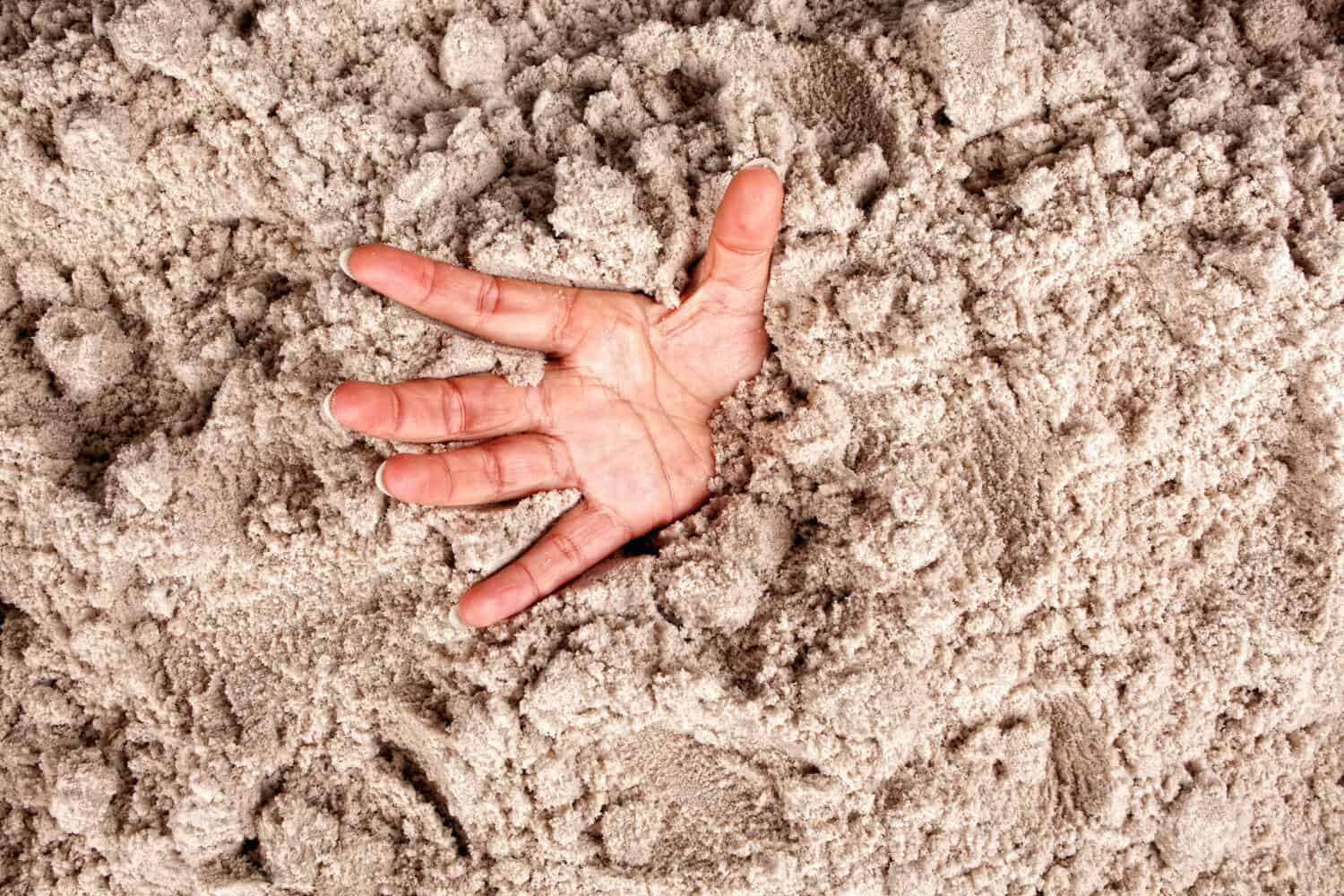
If your arms fall into the quicksand, move them in circular motions to make the sand movable.
©Anneka/Shutterstock.com
What if you fall in? After falling in one, or both of your arms might be trapped. Or maybe you’re flat on your back; now what? Use the same idea of small movements to invite water and movement around your limbs. Small purposeful movements, in a circular motion, will help free your body. It’ll be like working your way through concrete, but at least you’ll be moving instead of staying stuck. As you free your limbs, bring them to the surface of the quicksand, and continue working your way horizontally toward the edge.
The Truth About Quicksand
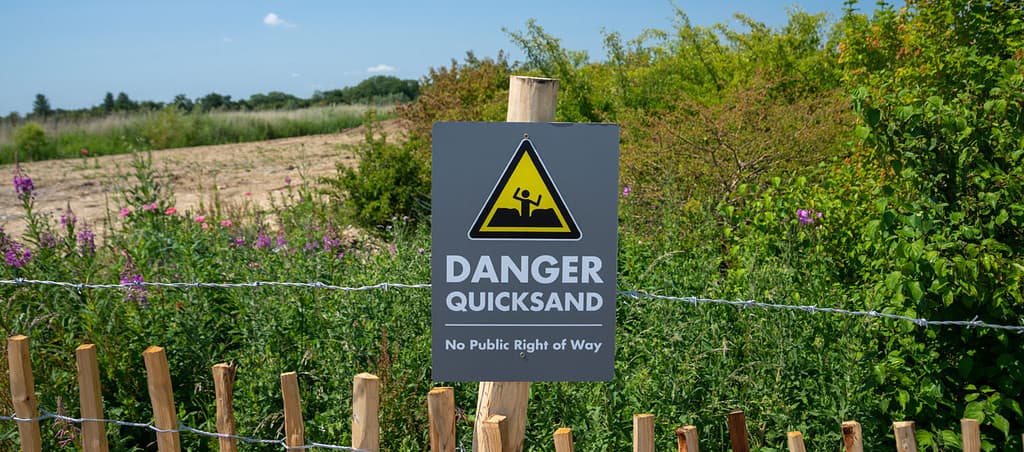
Quicksand isn’t a big pool of liquid sand that completely swallows people, but it’s still dangerous.
©John Corry/Shutterstock.com
A lot of people think quicksand is a perilous pool of sand that swallows people whole. However, real-life quicksand is far less dramatic and doesn’t have that type of depth or force. In reality, the main danger of quicksand isn’t necessarily sinking entirely. The challenge lies in getting ensnared and struggling to move.
Quicksand looks a lot like regular sand. That’s because it’s just sand saturated with water, reducing friction between sand particles. It’s a mushy mixture of sand and water unable to support weight. The term “quicksand” refers to its shifting properties in a semi-liquid state. Quicksand forms when soil liquefaction transforms solid ground into a viscous liquid during events like earthquakes. When pressure is applied, the sand becomes unstable, transitioning from a liquid to a more solid state. This unpredictability is what makes it so troublesome.
Why Doesn’t Quicksand Completely Suck You Under?
You’re lighter than the quicksand, so it’s more likely to be sucked halfway down than completely pulled under. But even if your head is above ground, you’ll still be in a dangerous situation. Remember how quicksand changes how thick or liquid it is? Well after liquefying, and pulling you in, it kind of hardens. Even though you won’t be sinking any further down, you’ll be trapped in highly compacted sand. The force required to extract an object from quicksand is substantial.
Viscosity
Imagine you have two liquids, like water and maple syrup. Viscosity is like a measurement that helps us understand how easy or difficult it is for these liquids to flow. Water can easily flow out of a bottle because it has low viscosity—it’s not very thick. On the other hand, maple syrup has a high viscosity, which means it’s thick and doesn’t flow as smoothly as water. Maple syrup resists moving when you try to pour it.
When at rest, quicksand gradually becomes more viscous or stable over time, resembling the behavior of clays. However, under the right conditions, a dramatic transformation occurs. Even a small stress or vibration change drastically reduces viscosity, turning it from solid to liquid. This is what makes quicksand such a deadly phenomenon.
How Quicksand Kills People

Quicksand leaves you vulnerable to the weather, which can turn deadly fast.
©Ed Connor/Shutterstock.com
If quicksand doesn’t drown people, what makes it deadly? Being stuck in quicksand means you’re vulnerable to the weather, hypothermia, incoming tides, predators, and dehydration. Plus, the thick sand can cause injuries like crush syndrome.
Crush Syndrome
The quicksand’s strong sucking force can squish the muscles and tissues in the body really hard. This can lead to a problem where the muscles break down, releasing myoglobin into the blood. Myoglobin, normally found in muscles, can become problematic when it overwhelms the kidneys. This can trigger a condition called rhabdomyolysis.
Quicksand Is Rarely in the Desert

In a lot of movies, quicksand is in the desert, but it’s more likely to happen near flowing water.
©Shengyong Li/Shutterstock.com
What places have quicksand? There are quite a few. For starters, let’s talk about where you’re least likely to encounter it; the desert. Quicksand is rarely in the desert because it needs underground flowing water to form. That’s why it’s more likely to occur near swamps, coastal areas, and river banks. The flowing water agitates sand particles and reduces friction between them, causing them to separate. It’s a phenomenon that can happen all over the world, but it’s more concentrated in certain areas like the marshy coasts of Florida and canyons in southern Utah.
Do’s and Don’ts for Surviving Quicksand
Let’s go over some of the top do’s and don’ts for encountering quicksand. You’ll know you’re dealing with quicksand by the way it behaves. Unlike solid sand, quicksand ripples and wobbles as you step on it. The more you push down, the weirder the surface behaves. And if there’s enough pressure and movement, it starts sucking things in.
Do Stay Calm
Remember, it might feel strange, but the more you panic, the thicker and stickier the quicksand becomes. So, take a breath and stay composed. Deep breaths are calming and also make you float better. The good news is your body is lighter than quicksand, so you naturally float. This makes it less likely to sink all the way.
There are a couple of things you can do to stay calm. For some, it helps if they focus on their breath, working to take steady inhales and exhales. For others, singing a familiar tune in their head helps them focus on getting out. Finally, sometimes counting down from 100 as you work to free yourself can help distract your mind from panicking.
Do Lighten Your Load
If you’re in quicksand with a heavy backpack or anything heavy, the first step is to let it go. Heavy items will only make it harder for you to stay afloat and escape. If you’re wearing shoes, think about removing them, but only if it’s easy. Remember, keep your movements thoughtful and controlled.
Don’t Let Anyone Yank on You
Avoid asking a friend to yank you out of the quicksand. Although it’s tempting to seek help, having someone pull you forcefully can worsen things. Sudden movements may disrupt the balance and increase the suction effect, causing you to sink further or sustain injuries. Your friend can still help you get out. If there’s nothing nearby for them to give you to hold onto, they can offer their hand. Just be careful to not pull them in too.
Do Move Legs in Slow Circular Motion
Now, let’s talk about the movements that can help you escape. Your goal is to free your legs. You’ll do this by making the dense sand around them more watery. Start by moving your legs in a slow, circular motion. This will create a space between your legs and the quicksand by pushing the sand away. This gradual liberation allows water to flow downward, dilating the quicksand and creating space for you to move upward.
Don’t Use All Your Energy on Pulling
Is someone offering you a hand to escape? Don’t pull on their hand. Instead, slowly shift your weight onto your friend’s outstretched arm. There is a difference between pulling and holding onto.
While they provide support, focus on freeing your limbs. Inch by inch, move your limbs in the direction you want to escape. Focus on freeing each limb slowly rather than applying excessive force. This gradual approach prevents creating additional suction or destabilizing the quicksand.
Do Hold Onto Something
Can you reach for something close, like a rock? Or maybe a friend is with you and can offer your a rope or stick. Holding onto a stable object is always better than holding someone’s hand. Rocks, ropes, trees, sticks, grab whatever is available with a firm grip. This will help you move better on the quicksand’s surface, making you steadier.
Remember, don’t just try to pull yourself out —focus on freeing your legs and creating space. Even if you’re holding a rope, your main goal is to move your legs. These tools will make escaping safer and easier.
Don’t Take Large Steps
After you free your first leg, you may want to try lunging forward but avoid this urge. Don’t take large steps in quicksand. Forceful steps might feel instinctual, but they can sink your standing foot deeper. You can also tear a ligament if you try to move with too much force.
After you’ve freed your first leg, you can start working to free the other leg. Make slow purposeful movements. Once both legs are free, you can begin working your way toward the edge.
Do Get Out Safely
After freeing your limbs, how do you get out of the quicksand? Sometimes, when the quicksand becomes thicker and more solid, you can simply walk out. In one video, a tour guide demonstrates how she escapes quicksand. After freeing both of her legs, she calmly walks on top of the watery sand to safety. Other times, you might have to summon all your strength and crawl your way out.