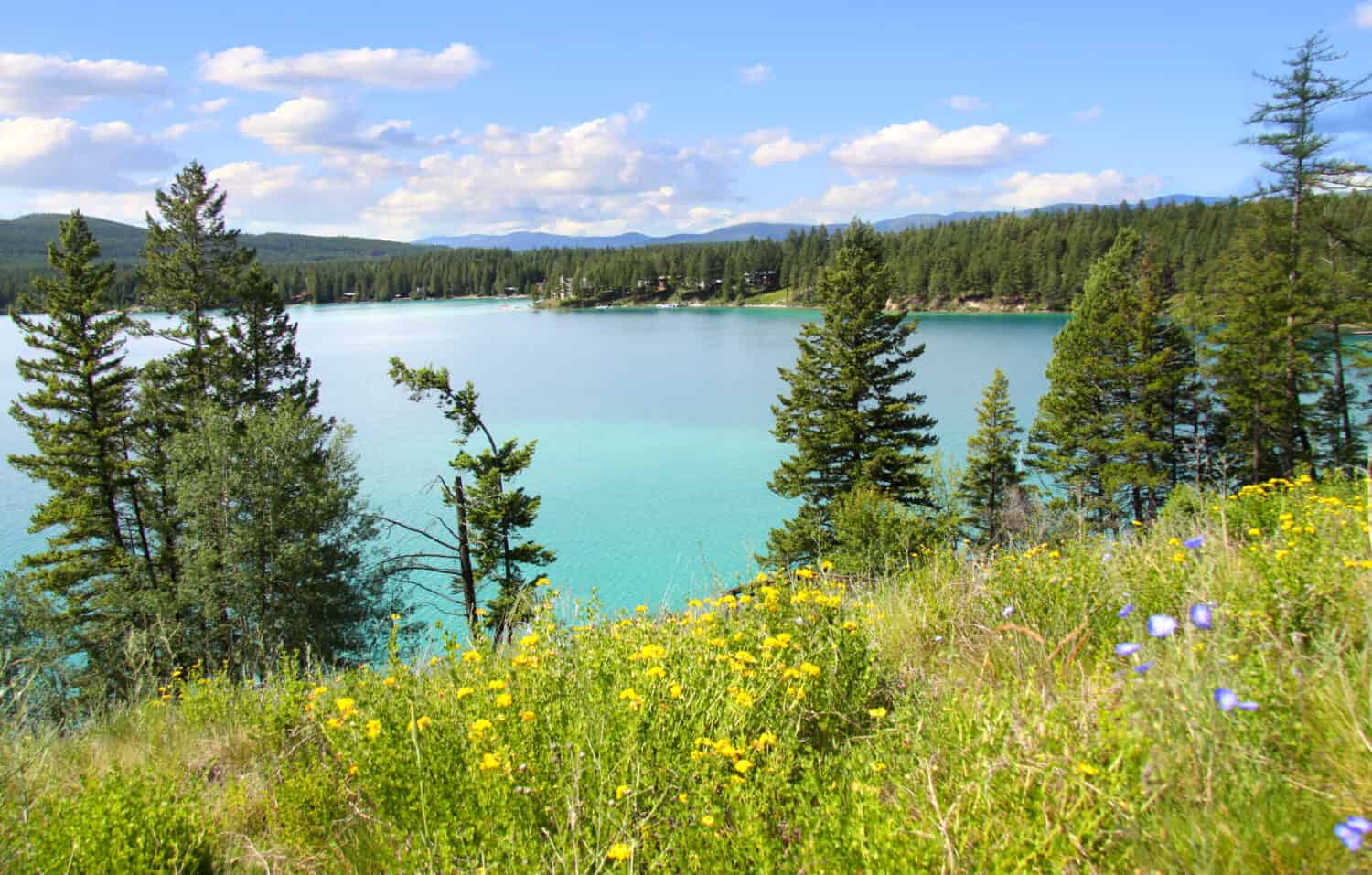

Montana is known for its stunning landscapes, diverse wildlife, and natural minerals. Together these features have helped the state earn the nickname “Treasure State.” Although there are 180 tree species in the state’s urban public forests, we only had room to include some of the most interesting native species. In this article, we will explore the 15 most iconic trees native to Montana.
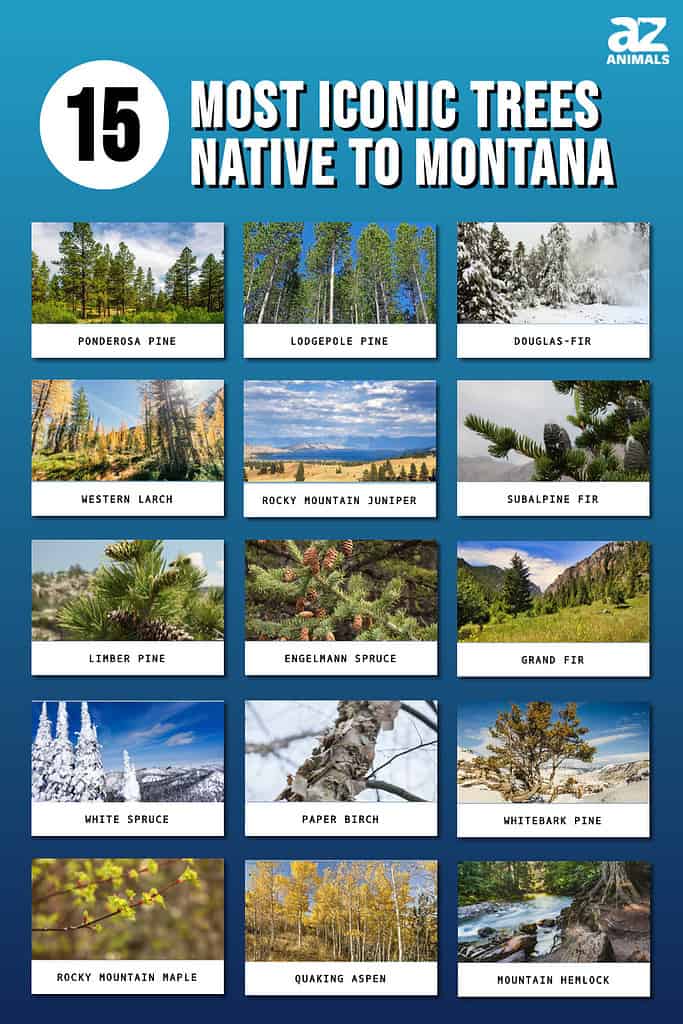
What Is the State Tree of Montana?
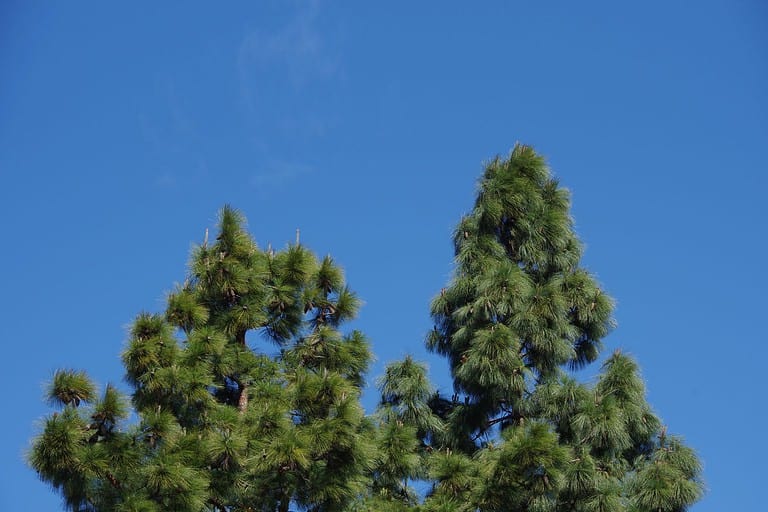
One of the most iconic trees native to Montana is the ponderosa pine, which was adopted as the Montana state tree in 1949. In fact, schoolchildren were asked to vote for the state tree in 1908 and chose the ponderosa pine over other options, including the American larch, Douglas fir, and cottonwood. However, it wasn’t officially named the state tree until 1949.
1. Ponderosa Pine
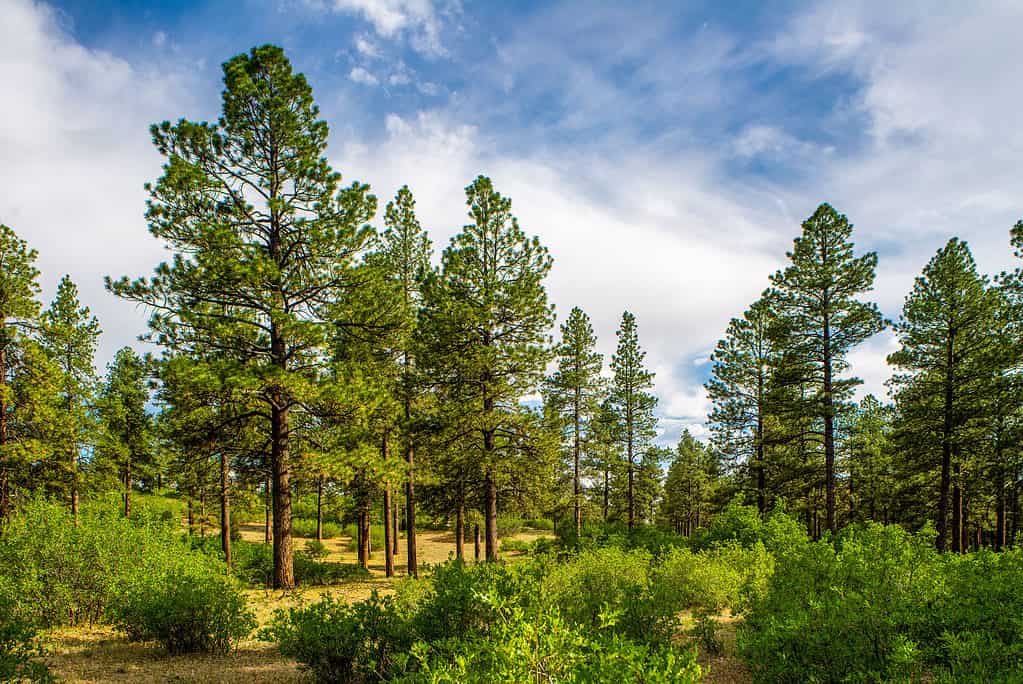
The ponderosa pine is the Montana state tree.
©Dominic Gentilcore PhD/Shutterstock.com
The ponderosa pine (Pinus ponderosa) is one of the most iconic trees native to Montana. It’s a large coniferous pine tree in the mountainous regions of North America. It’s also the most widely distributed pine species in North America. The ponderosa pine is a hardy evergreen that reaches a height of about 80 feet but can reach heights up to 200 feet. They drop oval or egg-shaped cones that are 3-6 inches long and 2-4 inches in diameter with spines that make them prickly.
The best way to tell it apart from other pine species is its bark. Mature to over-mature trees have yellow to orange-red bark, while young trees are black or brown. This species has thick bark and buds protected by bright green needles 4-8 inches long. These features have helped it adapt to fires and drought. However, it’s intolerant to shade.
2. Lodgepole Pine
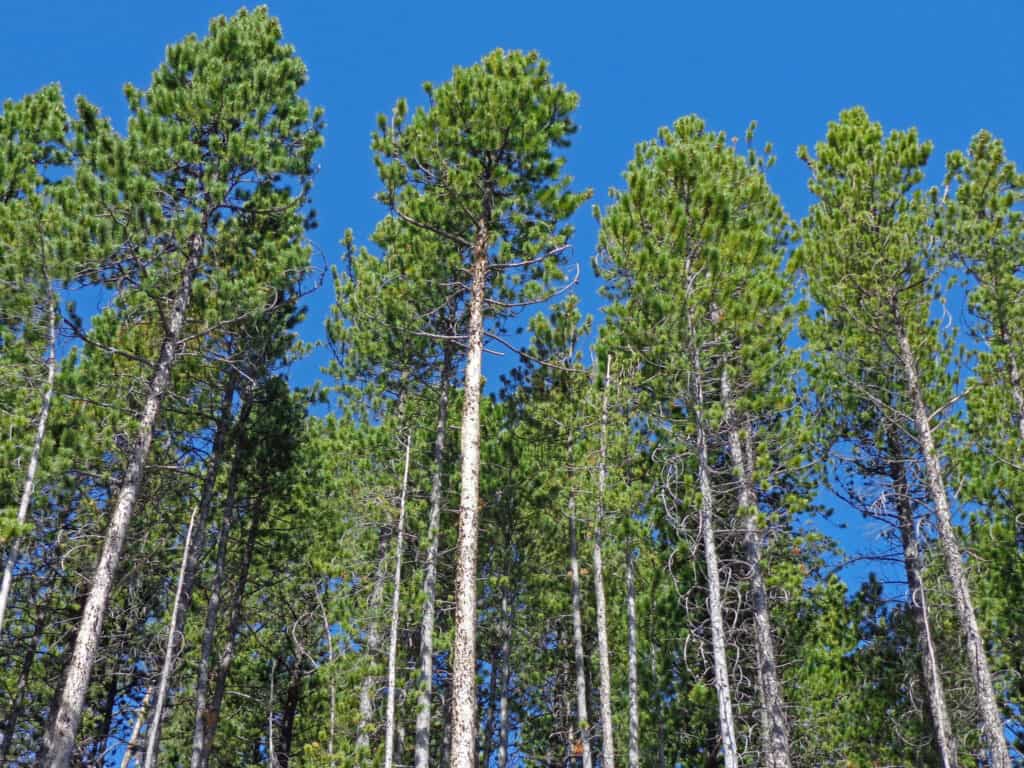
The lodgepole pine is one of the most common pine trees in North America.
©Sara Kendall/Shutterstock.com
The lodgepole pine (Pinus contorta) is a species of evergreen conifer native to western North America and the western portion of Montana. It’s a straight, slender tree with orange-brown to gray scaled bark that grows up to 70-80 feet. The needles grow in bunches of two, commonly twisted in the shape of a dark green spiral. However, seed cones of this pine vary in shape. They are either short and cylindrical or oval, but they are all 1-1.5 inches long without stalks with sharp scales at the tip. However, some subspecies don’t have pointy tips on top.
The lodgepole pine is adaptable, meaning it can grow in various environments. It’s also the first species to regrow after wildfires. Another unique feature of this pine species is the protective seal surrounding its cones that require heat to release the seeds. The added layer of protection around the seeds allows them to survive near or on the tree until the surrounding environment produces ideal growing conditions.
3. Douglas-fir
The Douglas-fir is not really a fir tree.
©Paul B. Moore/Shutterstock.com
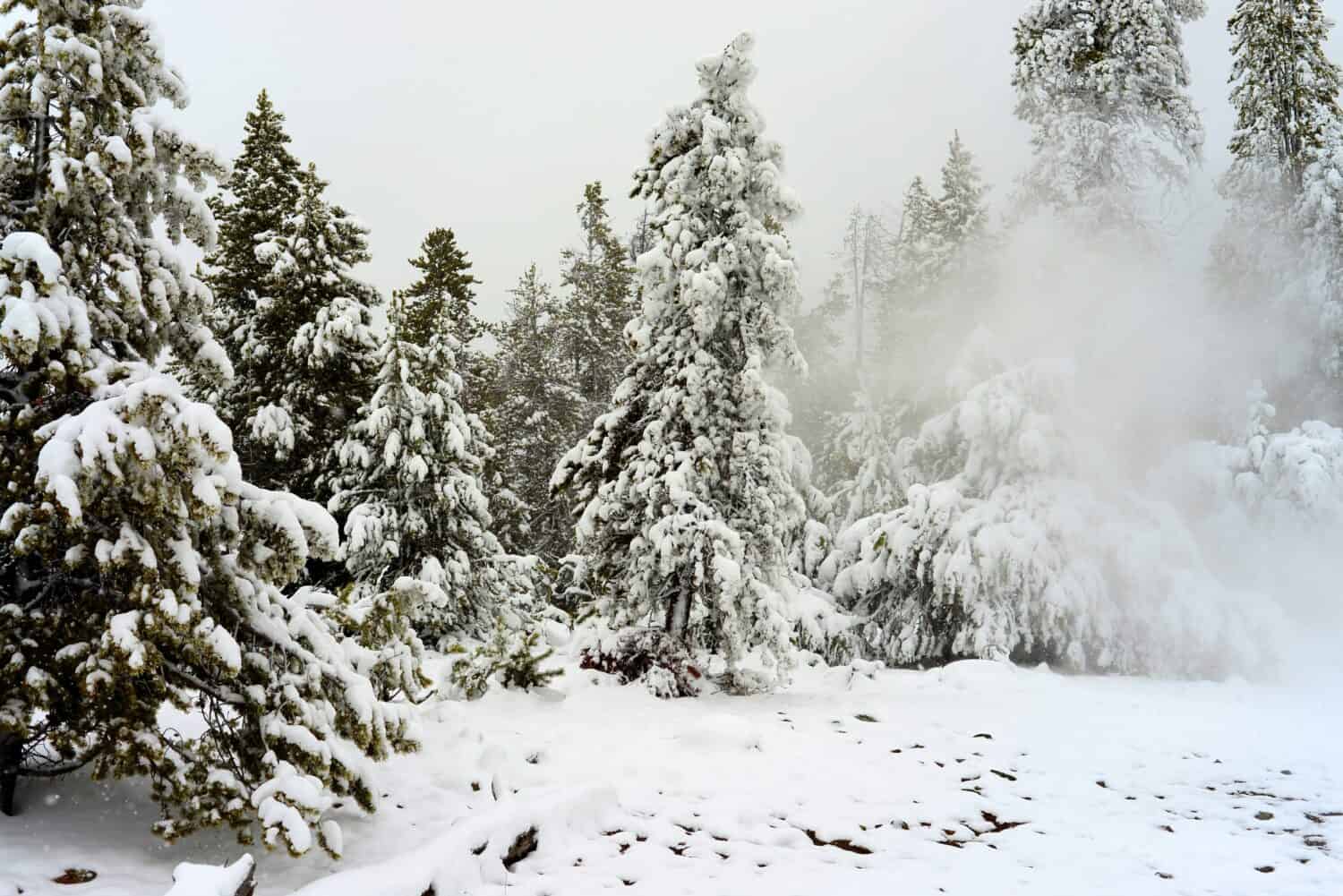
The Douglas-fir (Pseudotsuga menziesii) is not actually a true fir. The cones fall off the branches whole. These trees are found in over two-thirds of the state and is the most abundant forest fir type. These evergreens are native to the mountainous interior regions around 6,500-9,000 foot altitudes. The large tree reaches heights of 80-150 feet with over a 3-foot diameter. The bark of young trees is smooth and gray, whereas the bark of mature trees is dark and scaly.
Their shape resembles a pyramid with tiered branches and spirally arranged, shiny needles. The needles are also 1 inch long and flat, coming in shades of blue-green or gray-green and grow in all directions. The cones that sit at the end of the branches are tan and about 3-4 inches long with unique 3-pronged bracts growing out between their scales.
4. Western Larch
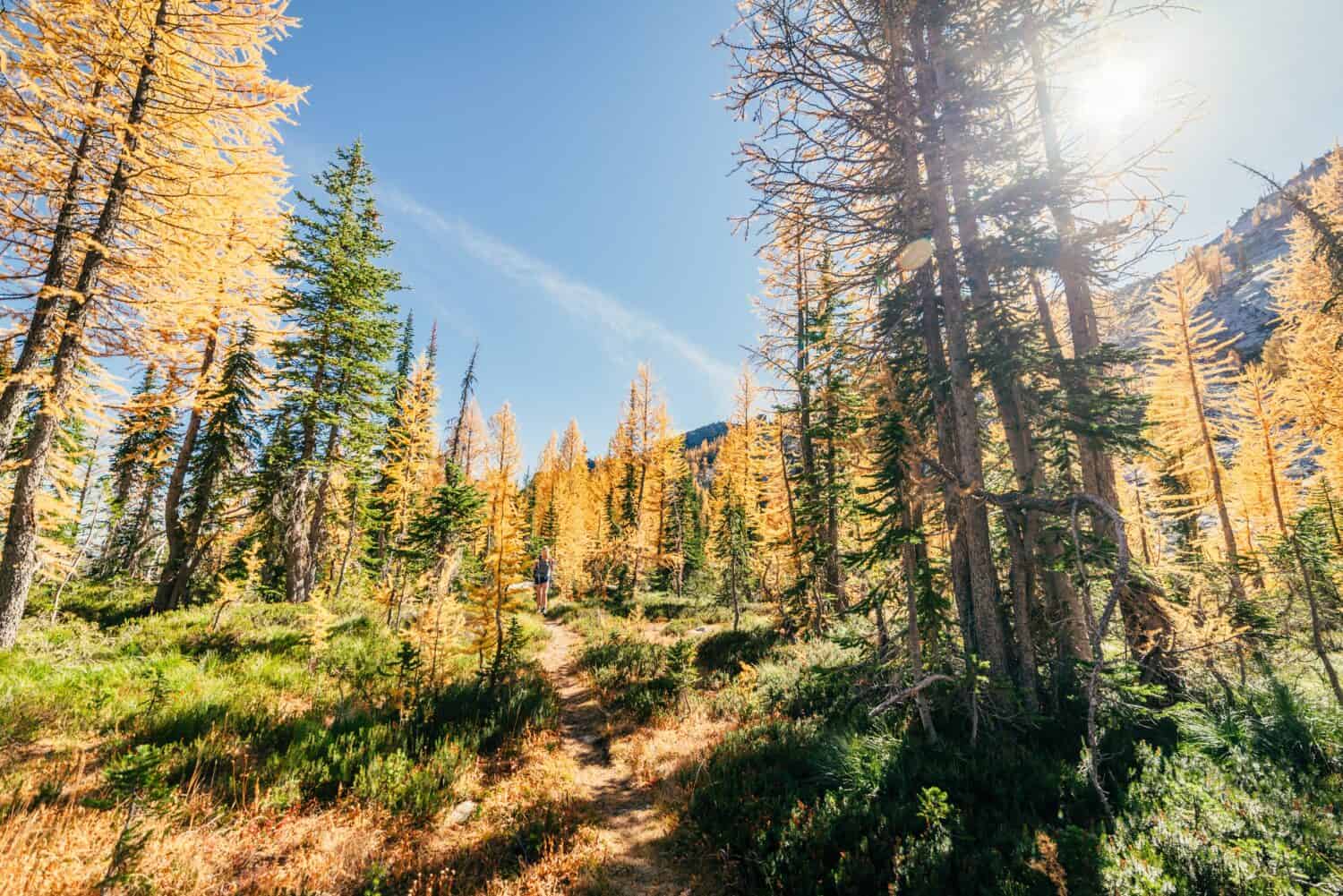
The tallest western larch is a 63-foot tree named Gus.
©MontanaMountainPhotos/Shutterstock.com
The western larch (Larix occidentalis) is one of the most iconic trees native to Montana and grows only in the northwestern corner of Montana. These areas include the wet forest on cool slopes or the valleys of the low subalpine. They are deciduous conifers that lose all their needles in the fall. They are also an outlier in the Conifer family because the needles turn a bright gold before dropping to the ground. The western larch is the largest in the Larix genus, growing up to 150 feet tall and living over 700 years. In fact, the world’s largest larch tree finds its home near the western shore of Seeley Lake, Montana. This 163-foot tree is locally revered and affectionately named Gus.
Another unique feature of the western larch is its three-sided needles and cones connected to their branches by short stalks. The bark of mature trees is thick, deeply furrowed, and covered in cinnamon-colored plates. They depend on other tree species, including the Douglas-fir and lodgepole pine, which they grow alongside in the cool slopes and valleys they are native to.
5. Rocky Mountain Juniper
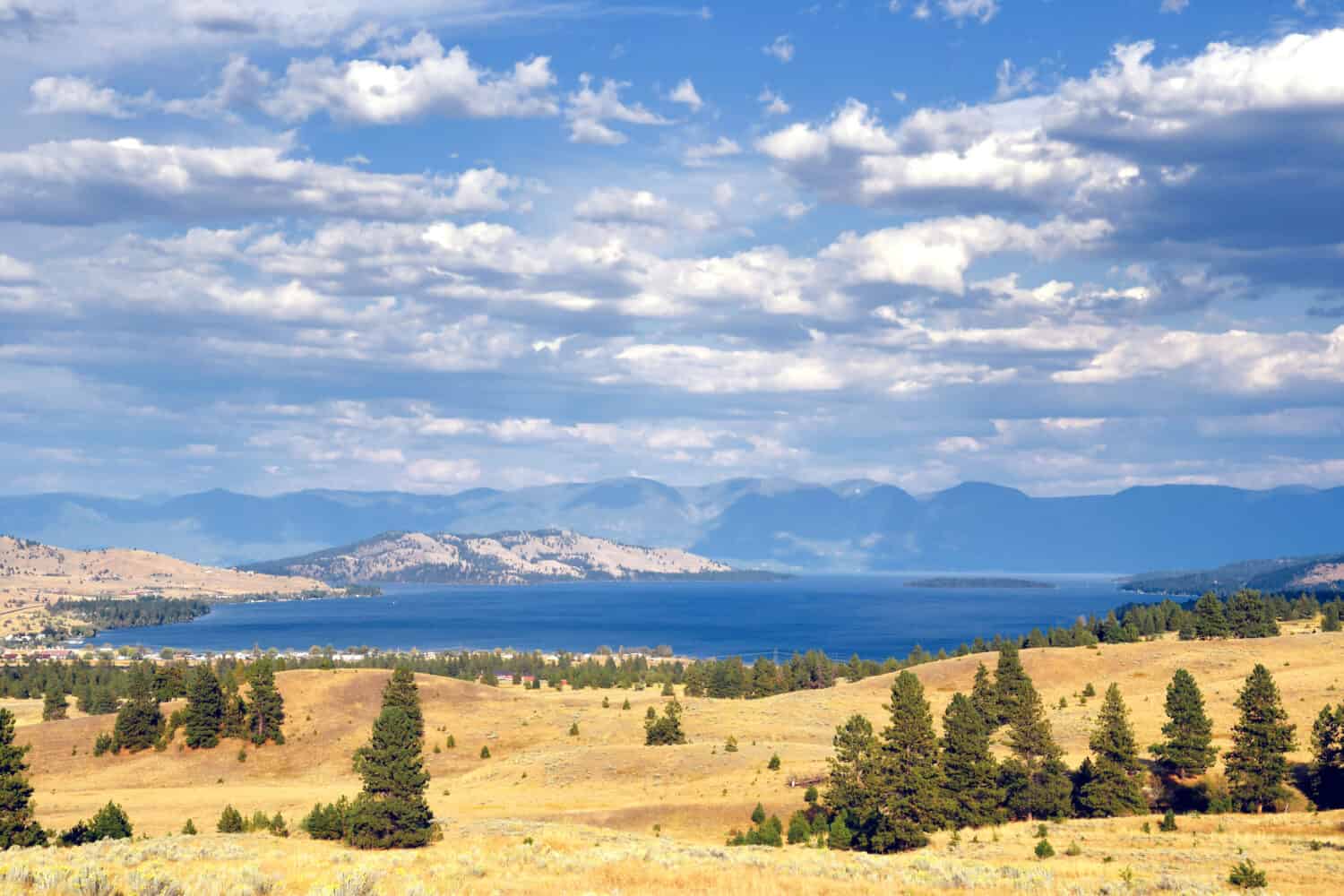
The Rocky Mountain juniper is a small tree that grows in dry soils.
©Karin Hildebrand Lau/Shutterstock.com
The Rocky Mountain juniper (Juniperus scopulorum) grows in the eastern foothills of the rocky mountains in dry soils throughout most of Montana. They are small trees reaching only 30-50 feet tall with a spread between 3-15 feet. Their shape resembles a column or round evergreen, supported by several main stems. The bark is a red-brown or gray color and has a shedding texture.
Young trees have pointed, white-coated needles, whereas mature trees have scale-like foliage that varies in color from dark blue to light green needles. They also produce dark, berry-like cones that are covered in a white bloom and ripen in their second year. Some of the native wildlife love them. Their aromatic wood is also a popular choice for handmade chests.
6. Subalpine Fir
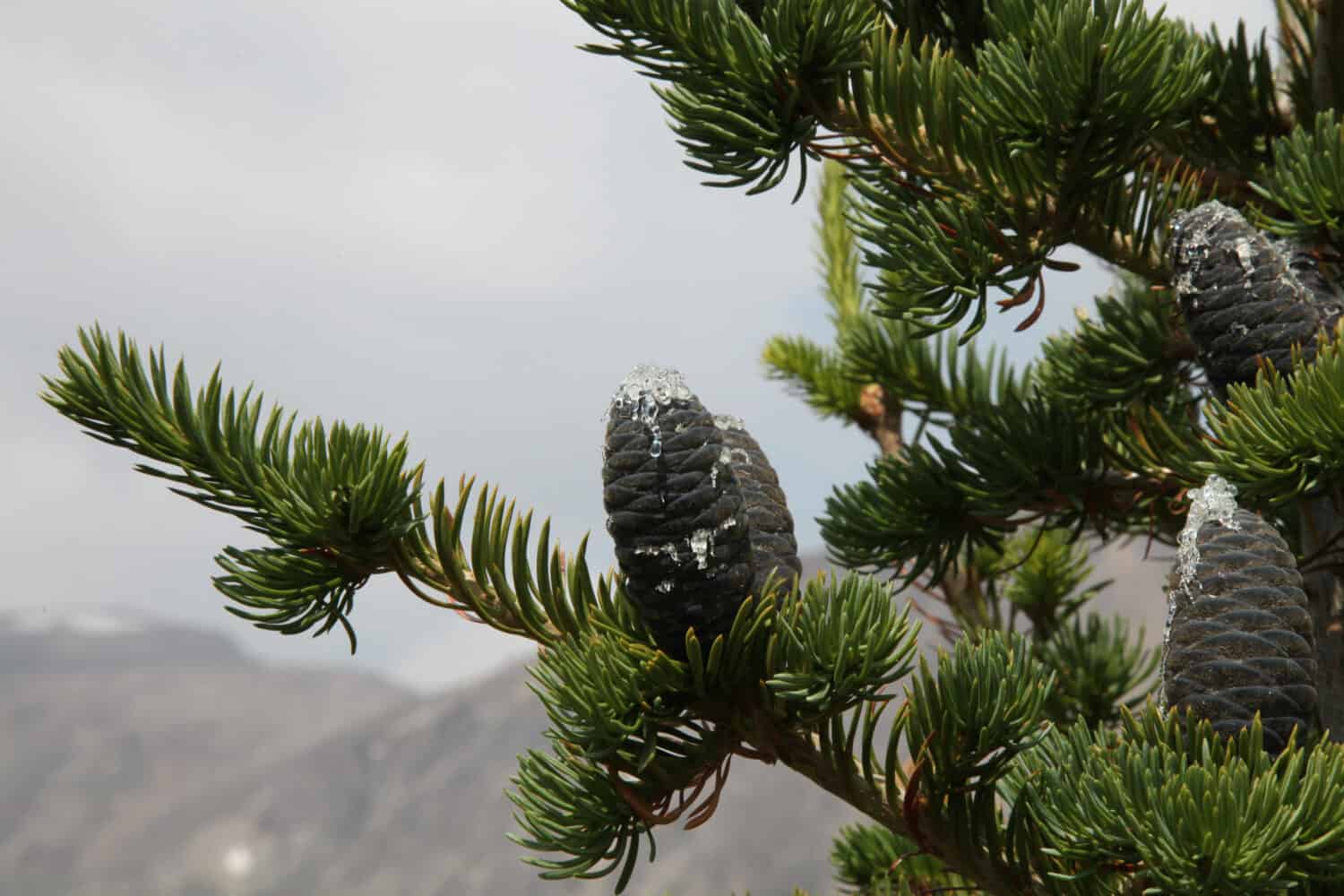
Subalpine firs have a shelf-life appearance.
©Nikki Yancey/Shutterstock.com
The subalpine fir (Abies lasiocarpa) grows in elevations of 7,000-11,500 feet and have adapted to living most of the year under heavy snow. They are often mistakenly called “alpine fir” since they grow in areas above the timberline. However, they are scattered throughout the western portion of Montana, spilling into central and southern regions. They live in moist areas at the edges of alpine meadows and stream beds. These trees can reach 150 feet but typically only reach 60-100 feet.
The subalpine fir has dark purple cones that stand upright on their tops. The trees are slender and spire-like, with short, dense, and rigid branches that extend to give them a shelf-life appearance. However, the needles are soft, flat, flexible, and curved upward, similar to the needles of the white fir. Subalpine firs have a smooth, light gray bark with resin blisters.
7. Limber Pine
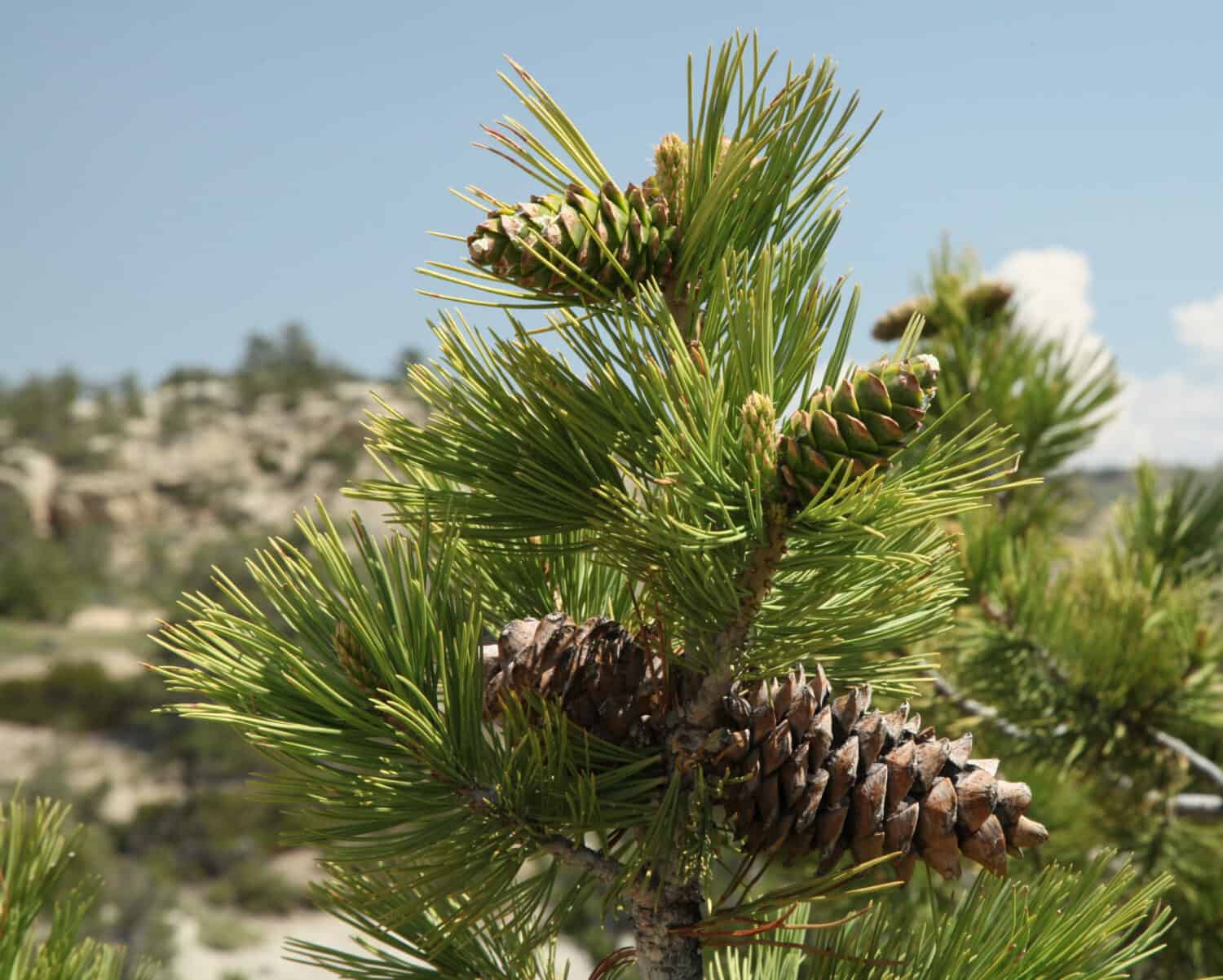
The limber pine has long flexible branches and soft needles.
©163942596/Shutterstock.com
The limber pine (Pinus flexilis) grows throughout much of Montana, excluding the northwestern and eastern regions of the state. Limber pine trees only grow 50 feet in height with a spread of 30 feet. They are a loose and delicate evergreen because of their long and flexible branches and soft needles. They are also adaptable and durable, making them the ideal species for a windbreak. The limber pine often blends into the landscape and grows for a long time, often taking over 100 years to reach maturity, making it one of the most iconic trees native to Montana.
8. Engelmann Spruce
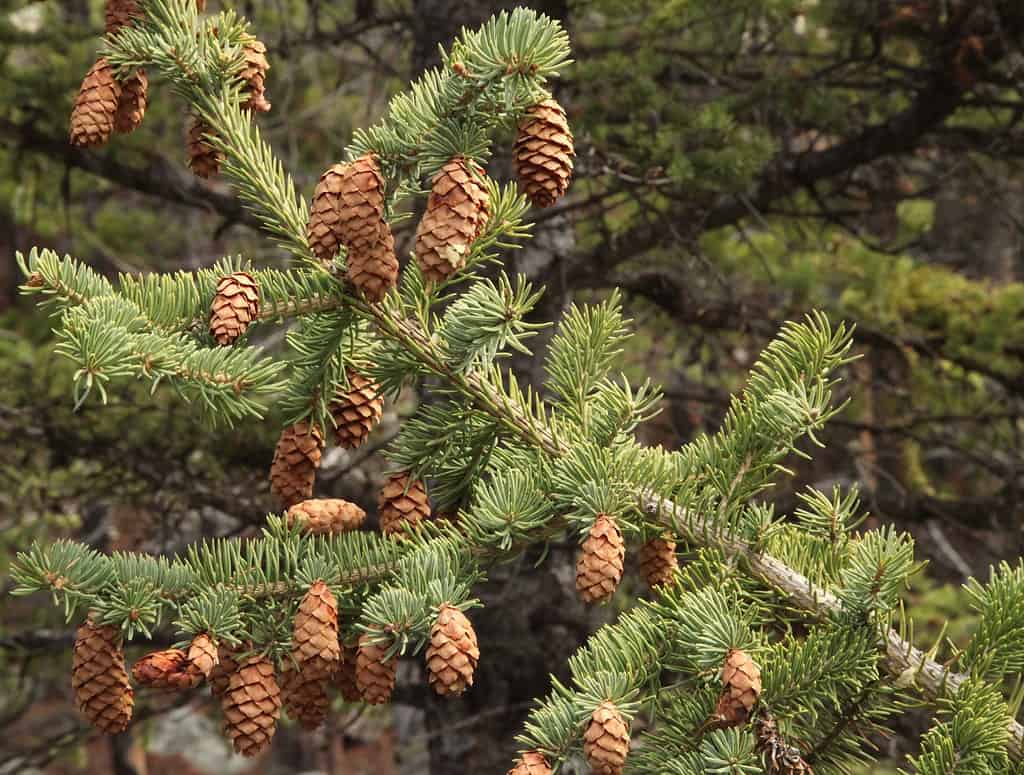
Englemann spruce cones are 3-4 inches long with a papery scale.
©Nikki Yancey/Shutterstock.com
The Engelmann spruce (Picea engelmannii) is native to Montana. It’s found in the state’s western half in cool mountain canyons and along streams and lakes at high elevations. They are uncommon trees to see in the forest and are intolerant, requiring the shade of other trees to regenerate. This native spruce grows to stand over 160 feet tall with narrow, spire-like crowns. The bark is gray or red-brown with blue-green needles less than an inch long and stiff in texture. Moreover, the cones are 3-4 inches long with a papery scale. The best way to identify a spruce is by its prickly needles.
9. Grand Fir
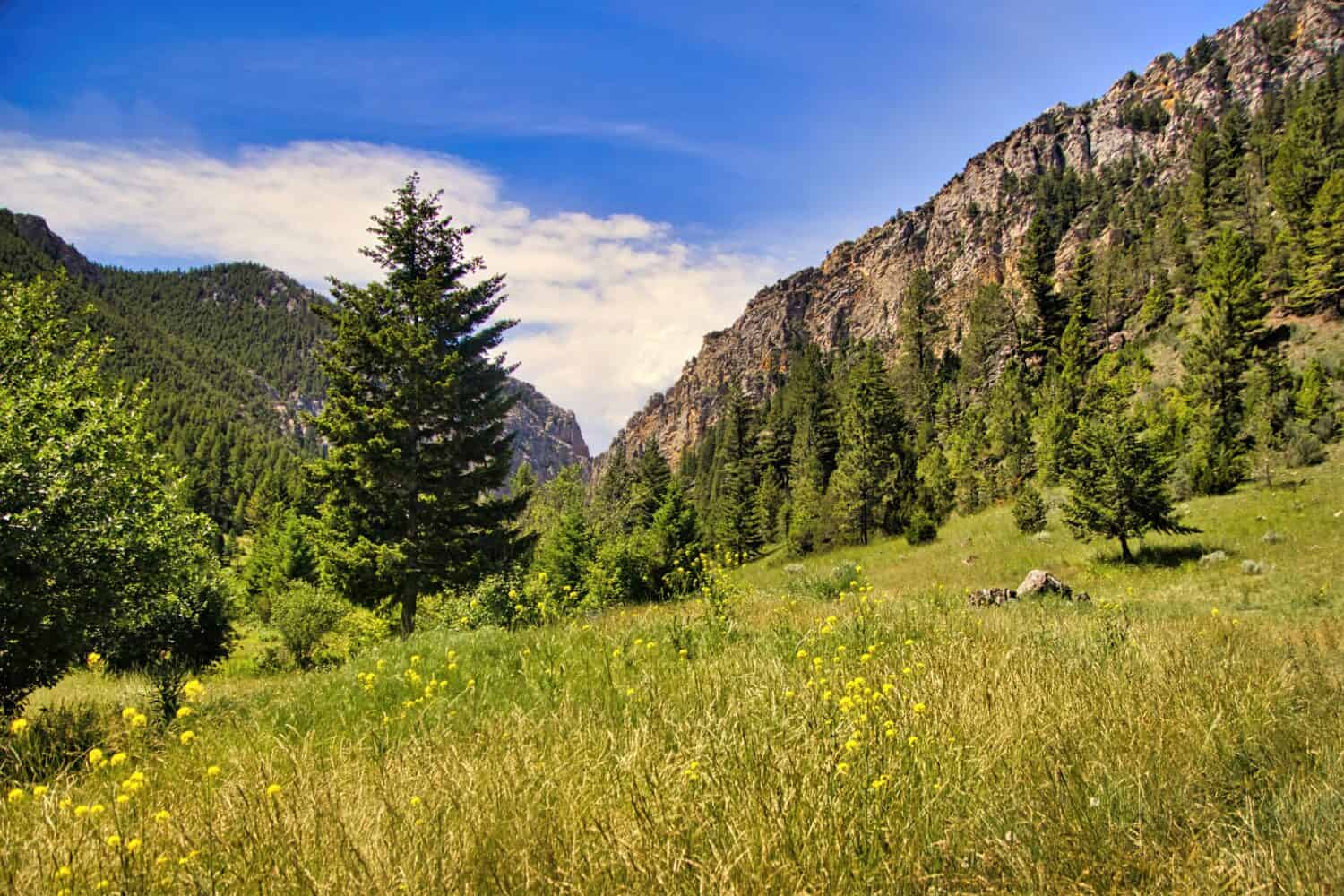
The tallest grand firs grow up to 260 feet.
©Dave Jonasen/Shutterstock.com
The grand fir (Abies grandis) stays in the northwestern corner of Montana near the Rocky Mountains and is sometimes called the lowland fir in other states because it’s found in low elevations. The tallest grand firs are over 260 feet but typically grow to be 135-180 feet tall. Compared to other trees, they grow quickly unless they are in the shade and only live up to 300 years. They are not particularly tolerant trees but grow in moist river valleys or dry forests.
The grand fir is easily recognized when they are young because of their smooth gray or red bark and twigs with small leaf scars from fallen needles. However, mature branches are commonly covered in resin blisters, and the bark is brown. Their cones are also produced upright at the top of the trees. But when cones mature, they shed their scales while still attached to the tree, making it a rarity to see an intact fir cone on the ground.
10. White Spruce
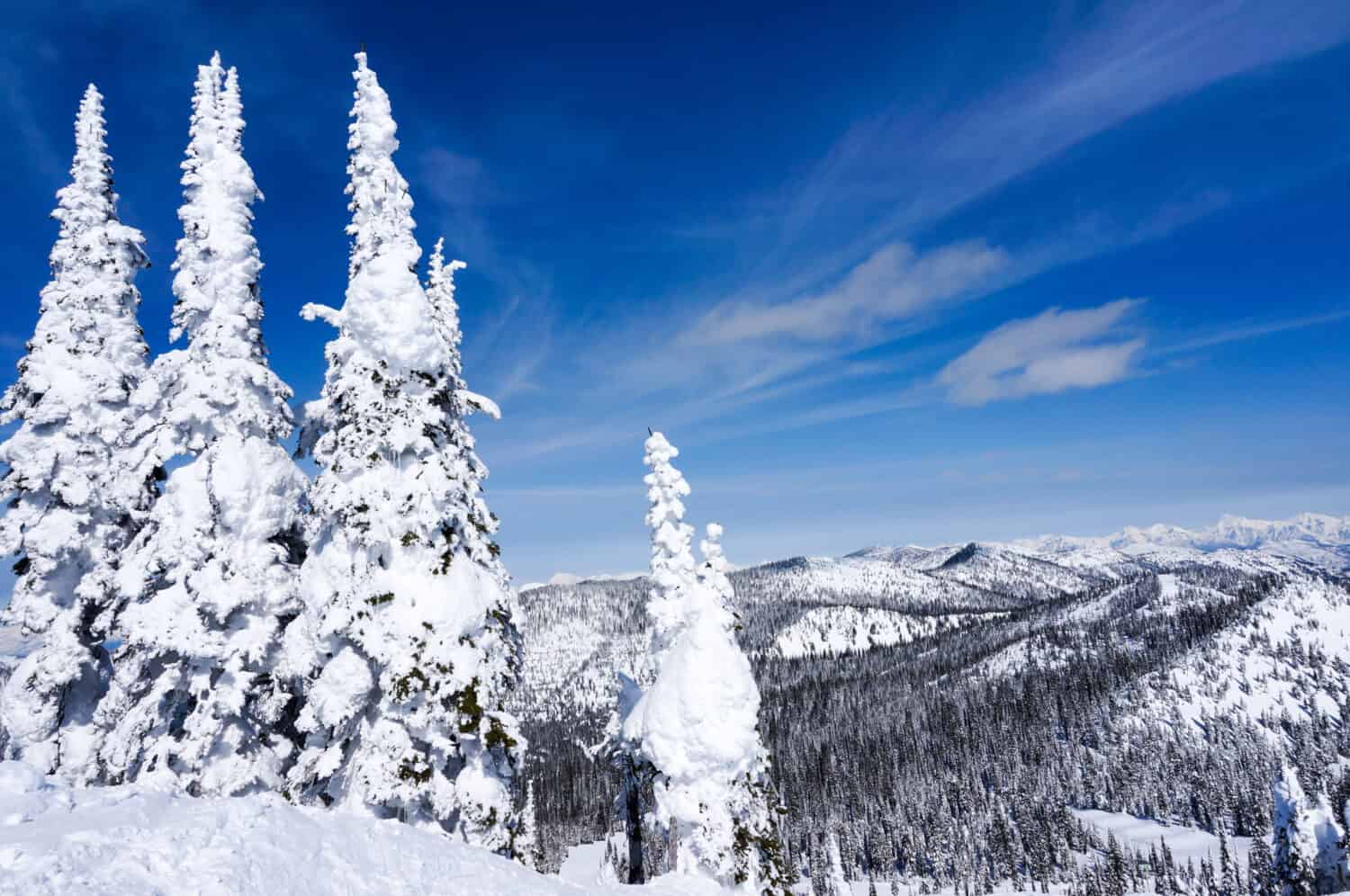
The white spruce grows in the Glacier Park area of Montana.
©Ronnie Chua/Shutterstock.com
The white spruce (Picea glauca) grows naturally in the Glacier Park area of Montana. Moreover, their ideal location is in well-drained with moist loam soils in protected areas. They grow to be 50 feet tall and 20 feet wide. These trees are also fast-growing and densely foliated with a conical form. The needles they produce are a beautiful blue-green that creates a stark contrast against their small, brown cones. Depending on age, these cones are green, red, or brown and grow to be 1-2 inches.
11. Paper Birch
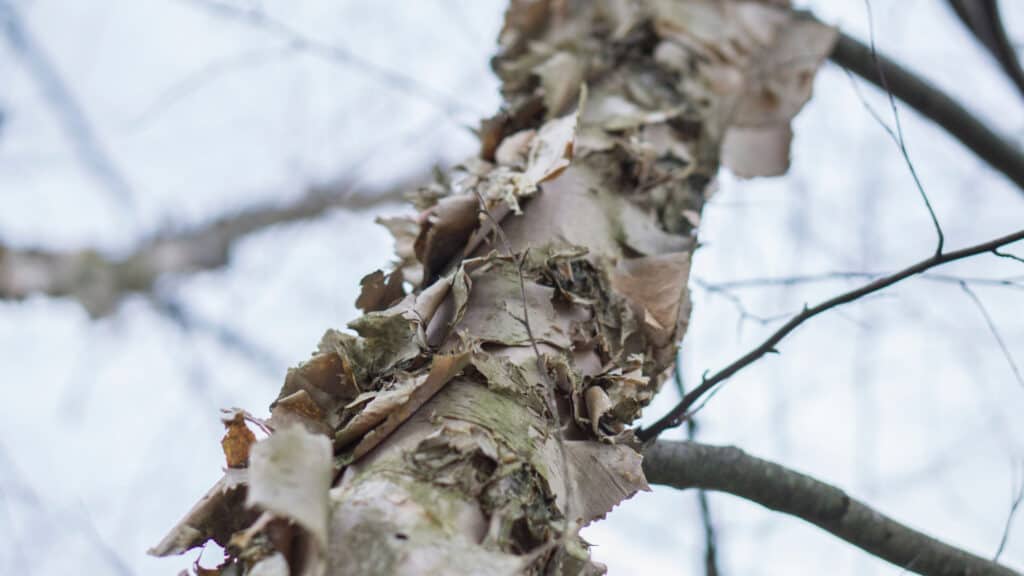
While they don’t live very long, paper birches are beautiful.
©thematthewhyatt/Shutterstock.com
The paper birch (Betula papyrifera) is a deciduous tree with an oval-shaped form, focused in the northwestern corner of Montana but scattered in the central north and southeast. It appears almost unremarkable in the landscape because its texture and color blend in with the trees around it. However, in the fall, the leaves turn into beautiful gold. Then in winter, the snow-white, horizontally peeling bark it’s known for stands out. They grow to be around 60 feet tall with a spread of 35 feet and can withstand frigid temperatures. Similar to the maple trees, paper birch trees are sometimes tapped for their sap. Their unique texture and appearance make them one of the most iconic trees native to Montana.
12. Whitebark Pine
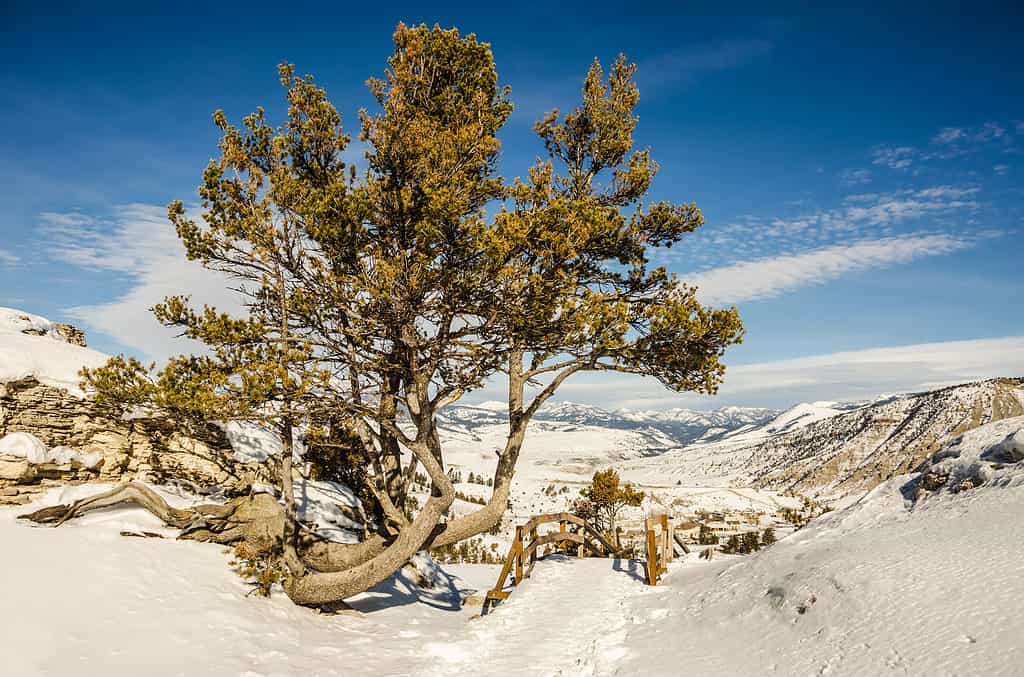
The whitebark pine grows in Mammoth Hot Springs in Yellowstone National Park.
©Sue Smith/Shutterstock.com
The whitebark pine (Pinus albicaulis) is one of the oldest tree species in western North America, in almost all major mountain ranges in western and central Montana. They are most known for their ability to thrive in some of the most extreme mountain conditions and are considered a keystone species. They grow on ridges below the treeline between 4,300-12,100 feet elevations.
The whitebark pine is a slow-growing, long-living tree that can live up to 1,000 years. This tree species grows between 40-60 feet tall and up to 5 feet in diameter. However, they also grow shrubs in higher, windier elevations. The bark is scaly and gray with needles between 1.5-3 inches long in clumps of 5 at the end of the branches. The whitebark pine is also monoecious, which means male and female cones grow on the same tree. The female cones are purple or dark brown growing 2-3 inches long on the ends of the upper branches.
13. Rocky Mountain Maple
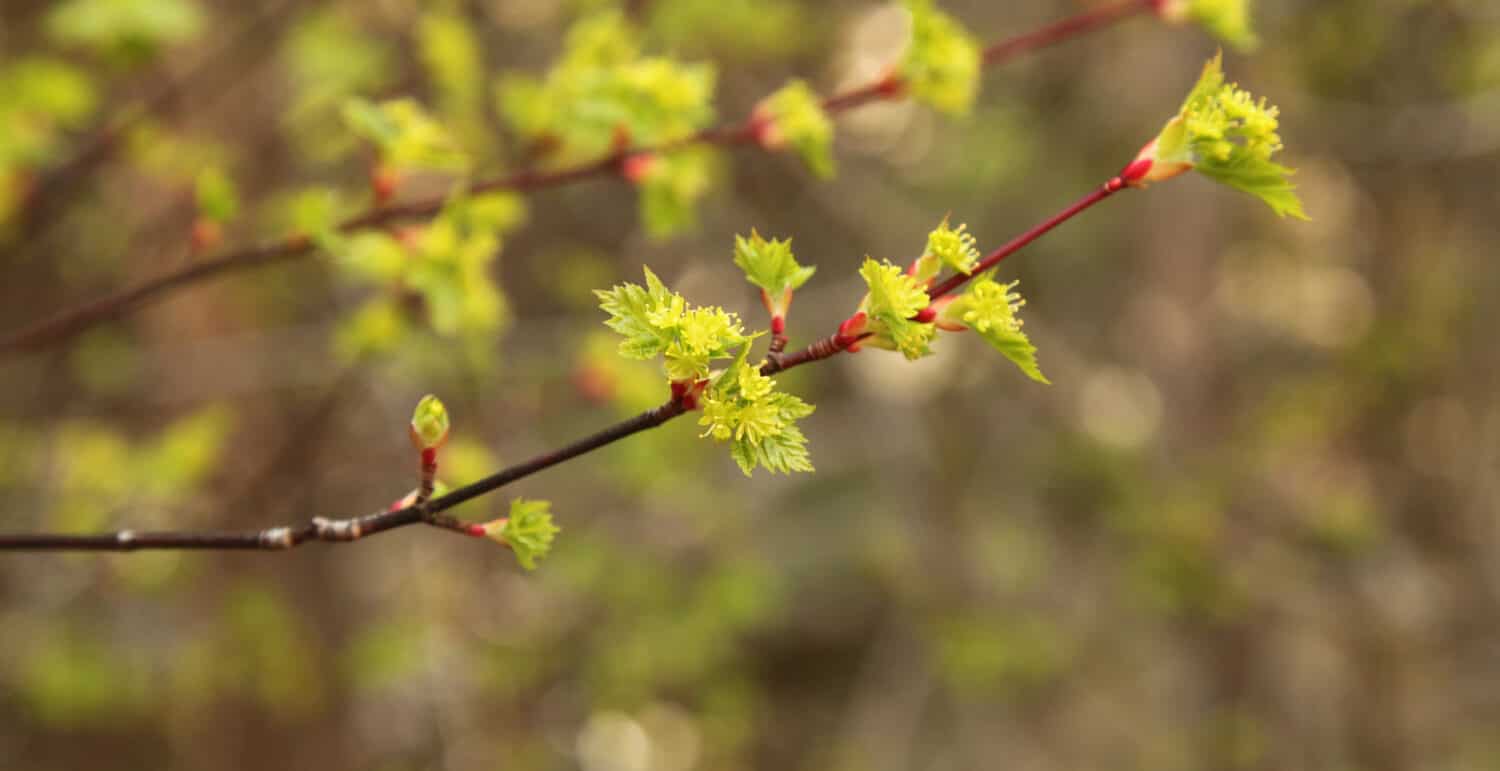
The Rocky Mountain maple is green but turns red in fall.
©Nikki Yancey/Shutterstock.com
The Rocky Mountain maple (Acer glabrum), sometimes called the Douglas maple, is an open deciduous tree that spreads upright. The tree grows up to 20 feet tall with a 15-foot spread throughout western and central Montana. This native woodland tree requires partial shade and adequate moisture to thrive in the wild. Similar to the paper birch, it blends in with the landscape. However, the leaves go from a bright green to a stunning brick red in the fall.
14. Quaking Aspen
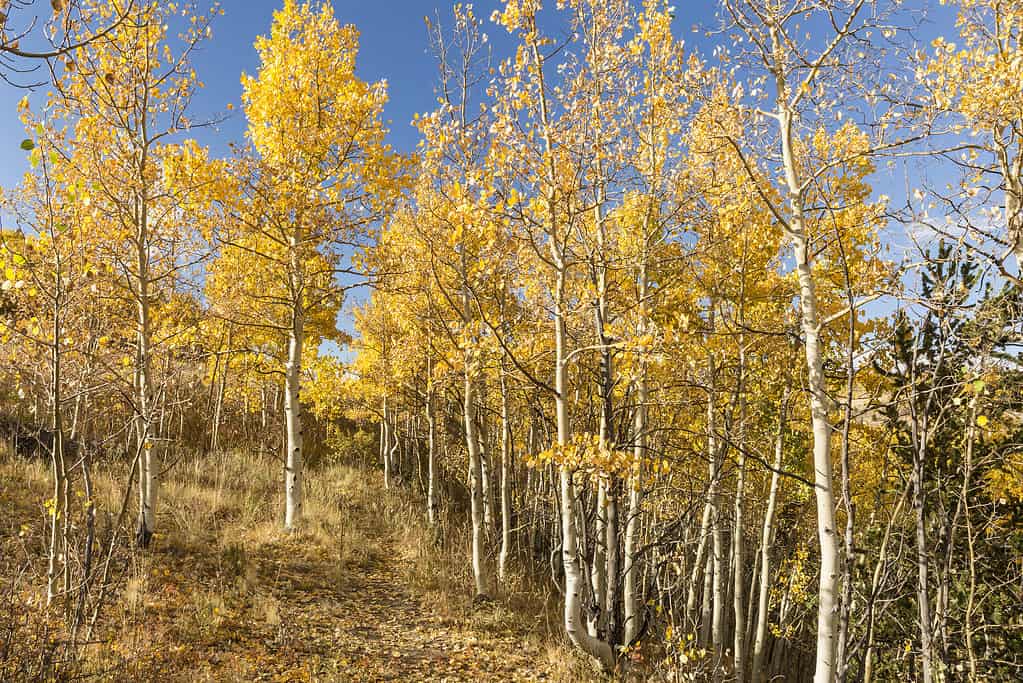
Golden quaking aspen trees turn gold in the fall.
©Colin D. Young/Shutterstock.com
The quaking aspen (Populus tremuloides) is aptly named for how the slightest breeze causes the delicate tree leaves to “quake.” It’s one of the few deciduous trees in the Helena National Forest and one of the most widely distributed native species in Montana. They grow in dispersed open-canopy forests and parks across the state. They also turn gold in fall, making them one of the most iconic trees native to Montana.
Aspens are easy to spot because of their narrow trunks covered in smooth green-white bark containing chlorophyll. As they grow up to 40-50 feet with a spread of 20-30 feet, they create a shade canopy. However, they are easily damaged by pests and fire. When an aspen tree dies, a hormonal imbalance within the tree causes new sprouts. This process preserves the trees, which is vital since aspens are a favorite of big game and domestic wildlife in the winter. Unfortunately, aspen trees are in decline, with an estimated 64% of Montana’s aspen groves lost.
15. Mountain Hemlock
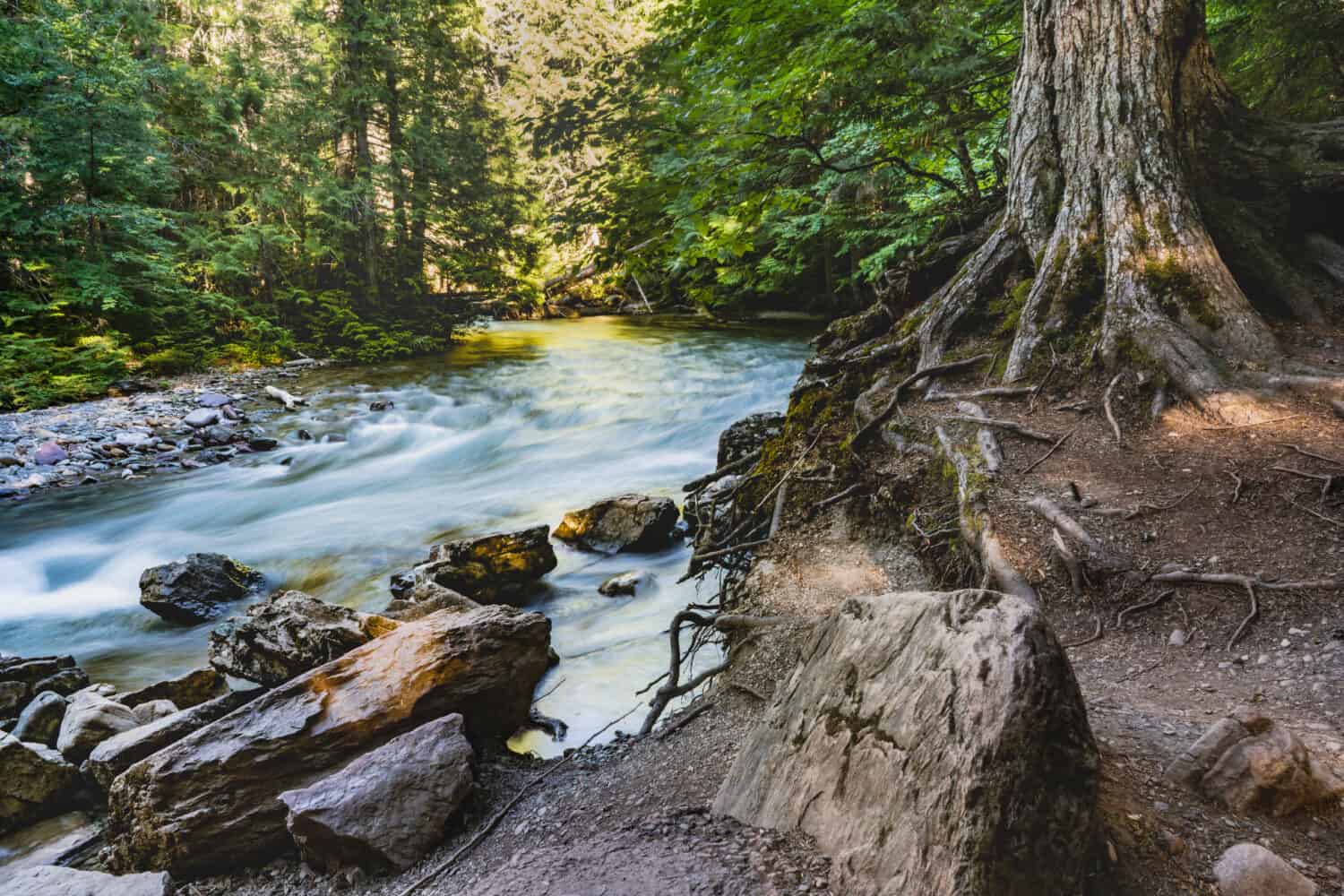
The mountain hemlock grows in Glacier National Park.
©Urban Images/Shutterstock.com
Mountain hemlock (Tsuga mertensiana) grows in the mountains of Montana in the timberline and subalpine parkland in a small area of Western Montana. They are sometimes referred to as “hemlock spruces” to make a distinction between the poisonous hemlock. They grow very slowly due to the long winters, therefore only reaching heights of 10 feet. However, they can grow over 100 feet in the lowlands and live for over 500 years. Needles on the tree are equal in length and arranged radially around the twigs with large cones measuring 1-5 inches. This beautiful green tree is named after German botanist Franz Karl Mertens.
Summary of the 15 Most Iconic Trees Native to Montana
| Number | Tree | Scientific Name | Height |
|---|---|---|---|
| 1 | Ponderosa Pine | Pinus ponderosa | Up to 200 feet |
| 2 | Lodgepole Pine | Pinus contorta | Up to 70-80 feet |
| 3 | Douglas-fir | Pseudotsuga menziesii | 80-150 feet |
| 4 | Western Larch | Larix occidentalis | Up to 150 feet |
| 5 | Rocky Mountain Juniper | Juniperus scopulorum | 30-50 feet |
| 6 | Subalpine Fir | Abies lasiocarpa | Up to 150 feet |
| 7 | Limber Pine | Pinus flexilis | Up to 50 feet |
| 8 | Engelmann Spruce | Picea engelmannii | Up to 160 feet |
| 9 | Grand Fir | Abies grandis | 135-180 feet |
| 10 | White Spruce | Picea glauca | Up to 50 feet |
| 11 | Paper Birch | Betula papyrifera | Up to 60 feet |
| 12 | Whitebark Pine | Pinus albicaulis | 40-60 feet |
| 13 | Rocky Mountain Maple | Acer glabrum | Up to 20 feet |
| 14 | Quaking Aspen | Populus tremuloides | 40-50 feet |
| 15 | Mountain Hemlock | Tsuga mertensiana | Up to 10 feet |