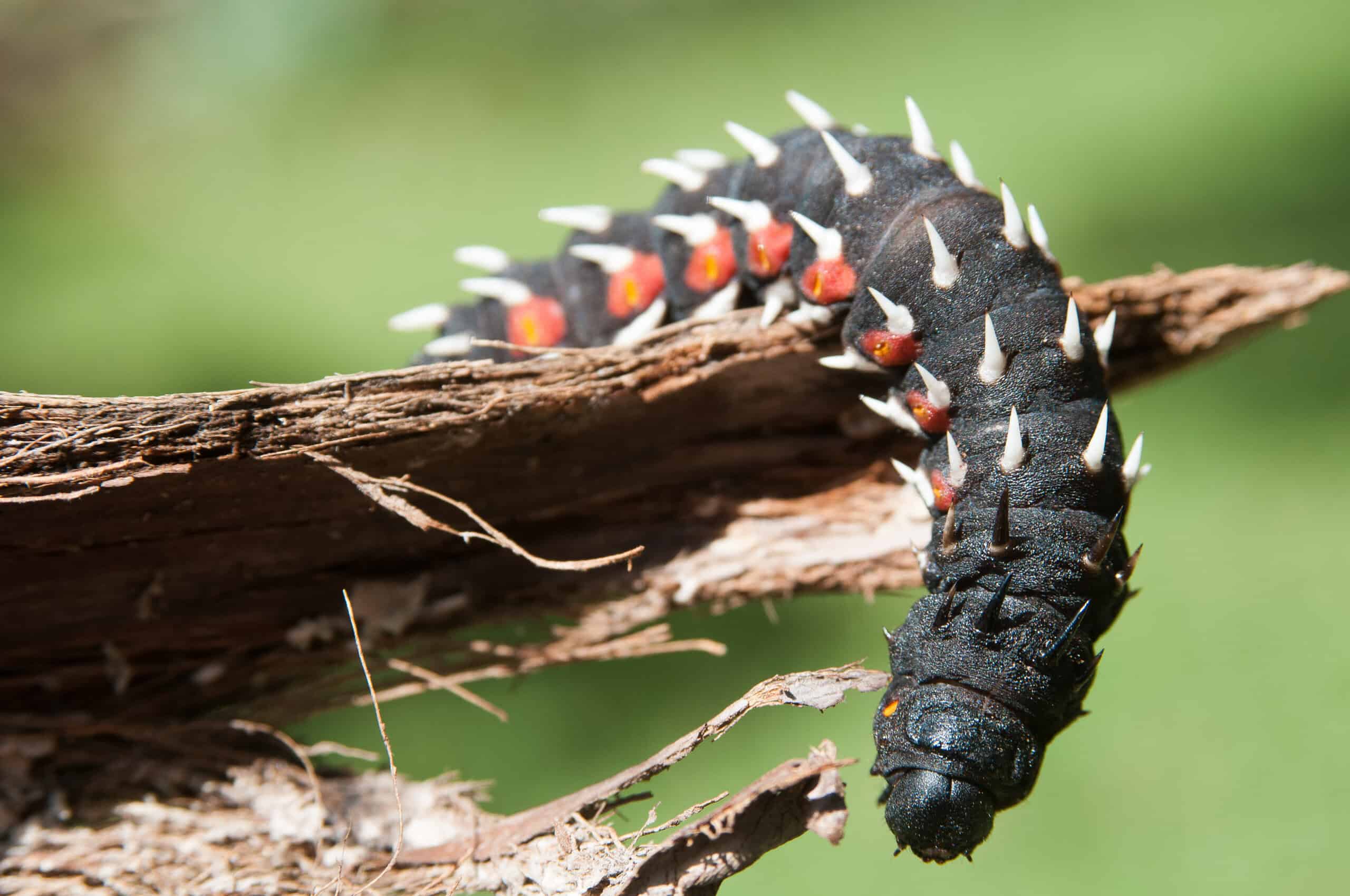

Have you ever seen such massive, oddly-patterned caterpillars as the ones in this Instagram video? Posted by Ivan Carter, a Zimbabwean conservationist, professional guide, and photographer, the video shows cabbage tree emperor moths in their larval stage as caterpillars. In the video, they look almost as large as snakes, wrapping around Carter’s hands as thick, black critters.
These caterpillars are large and velvety-black, with white or yellow “spines” and red markings down their bodies. Despite their intimidating appearance—which is meant to deter predators—they are completely harmless to humans. Once they mature, the caterpillars turn into cabbage tree emperor moths (Bunaea alcinoe), which live only for about a week to reproduce.
Interested in learning more about these unique insects? Keep reading to understand their size, appearance, behaviors, and life stages.
What Are Cabbage Tree Emperor Caterpillars?

Cabbage tree emperor caterpillars have spikes along their bodies, but they’re completely harmless.
©Marco Polo's Rhino/Shutterstock.com
Cabbage tree emperor caterpillars are the larval stage of cabbage tree emperor moths, which are found in tropical Africa. These caterpillars spend most of their time feeding on native plants, but they are also an important food source for humans.
According to David Price, Associate Certified Entomologist and Vice President of Strategic Growth at Mosquito Joe, a Neighborly company, “They are saturniid caterpillars, part of the Saturniidae family, part of the world’s largest moths.”
These critters are part of the silkmoth species found in Africa. In fact, the cabbage tree emperor moth is one of the largest African moths and is native to sub-Saharan Africa. They feed on leaves of broad-leaved trees, most notably in cabbage trees—hence their name. However, only the caterpillars eat, as the moths themselves exist for short periods, merely to reproduce.
“As moths, they are typically black or dark brown with bright yellow or orange tubercles (spikes) along their bodies,” says Price. “They also have sprinklings of fine white hairs. The colors signal to predators that they are distasteful.”
The caterpillar’s spines are also harmless and only serve as a deterrent against predators like birds, spiders, and certain insects. However, despite how off-putting they might appear as a food source, these caterpillars are actually edible and quite nutritious—even for humans. In fact, these insects are actually considered an important food source in parts of tropical Africa. They’re rich in protein and nutrients, and many enjoy them roasted, sun-dried, or cooked into soups or stews.
How Big Do Cabbage Tree Emperors Get?
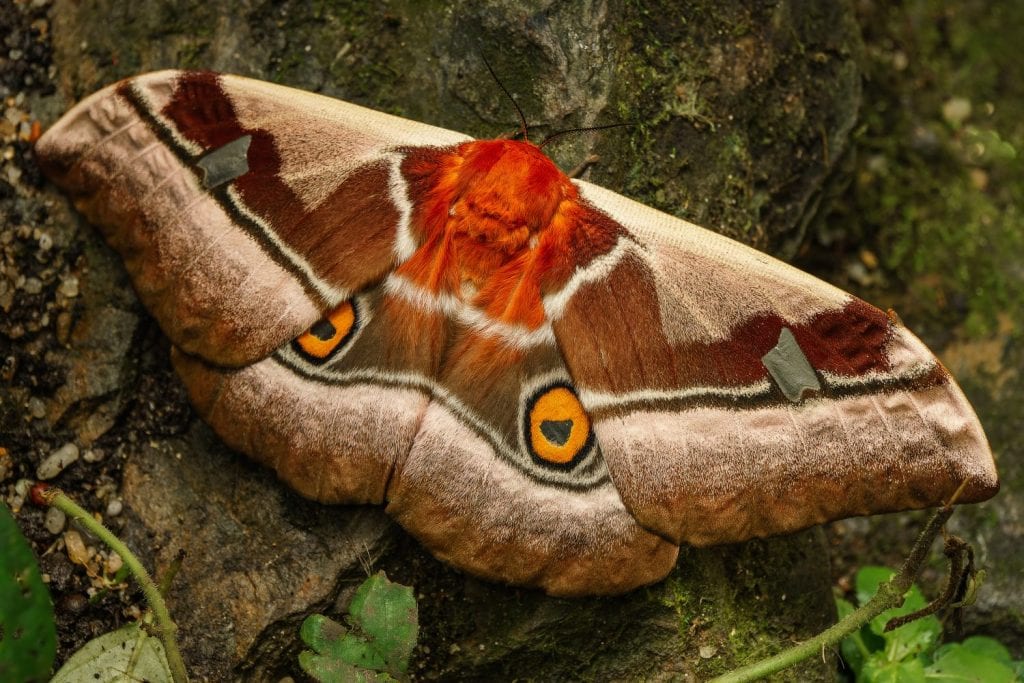
Cabbage tree emperor moths have large wingspans that can reach up to eight inches.
©Honza123/Shutterstock.com
Both the cabbage tree emperor caterpillars and moths grow to massive lengths, which can make them appear intimidating. In fact, according to Price, the mature caterpillars can reach up to five inches. As shown in the video, these caterpillars nearly cover Carter’s entire hand, wrapping around it like snakes. They are also extremely thick insects.
Once they mature into moths, their wingspans reach up to eight inches, with females typically having larger wingspans than males. Their bodies are also thick, similar to the caterpillars’. However, the moths don’t live for long once they mature into adults.
The pupal stage can last several weeks to months, depending on the temperature and season.
David Price, Associate Certified Entomologist and Vice President of Strategic Growth at Mosquito Joe
How Long Do They Take to Become Moths?

It can take months to years for the cabbage tree emperor moth to reach its adult stage, especially depending on its environment.
©Dominyk Lever/Shutterstock.com
Typically, it takes a few months for cabbage tree emperor moths to reach their adult stage. This process includes a 10- to 12-day egg stage, followed by the larval (caterpillar) and pupal (cocoon) stages. These insects remain as caterpillars for a few weeks before they undergo their transformation.
“The pupal stage can last several weeks to months, depending on the temperature and season,” Price explains. “In some cases, it can take up to six months before emerging as an adult moth.”
The length of the pupal stage largely depends on environmental conditions. During this time, the caterpillar chooses a safe spot to pupate within its cocoon. Sometimes, the cocoon is hidden underground, among leaves, or on the host plant.
During this phase, the insect undergoes metamorphosis, developing wings, legs, antennae, and other features of an adult moth. Sometimes, the pupa remains dormant until it has the right environmental conditions to emerge from its cocoon. As Price mentions, this can last for several months and sometimes even years, in rare cases.
The environmental factors that influence the pupal stage length include temperature, humidity, and even nutrition levels before cocooning. Once the cabbage tree emperor moth reaches its adult state, it only lives for about one week.
“Adults do not feed,” Price says. “Their primary goal is reproduction. They live about 10 days after emerging.”