
Quick Take
- A ghostly white shark sounds like a case of albinism, but scientists say that diagnosis is completely wrong and the real condition is far rarer. See the drone discovery →
- Out of more than 229,000 tracked sharks, only a shockingly small number have ever been documented with this condition, and there is a grim reason to explain why. Explore the rarity data →
- The drone footage may not show a newly discovered shark at all. A fisherman's chance encounter years earlier could change everything we know about this individual. Meet the tagged shark →
- Piebaldism, albinism, and leucism all look similar, yet confusing them matters more than most people realize. Understand the differences →
Those who swim in the waters off the coast of Florida know that shark sightings are common. Thanks to warm waters and abundant prey, up to 18 different species may be lurking in the water from time to time.
What is uncommon is to see a shark without pigmentation. Yet this is what happened recently when a rare white lemon shark was spotted swimming in Tampa Bay. What caused its unusual skin coloration? Read on to find out.
Continue reading
How a Glimpse of a White Lemon Shark Was Captured
It is not uncommon for lemon sharks to be spotted off the coast of Tampa Bay. While many live in the region year-round, people often see them in spring, summer, and fall, when the waters serve as a nursery for juvenile sharks.
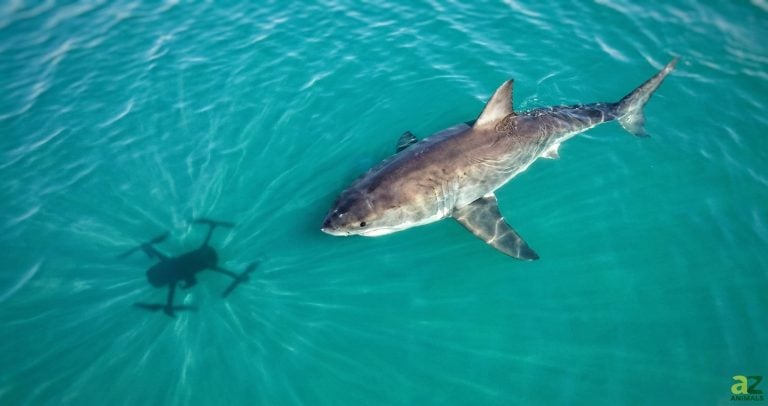
It is rare to see a nearly all-white lemon shark swimming through the shallows. But one lucky drone operator observed just that recently, in what has been described as a “one in 100 million” occurrence.

A lemon shark, similar to this shark, was recently seen off the coast of Tampa Bay, lacking its usual yellowish skin coloration.
©aaroncraftphotography/Shutterstock.com
On August 22, 2026, drone photographer Jacob Merrifield took his drone out over Tampa Bay around 7:30 A.M. to photograph marine wildlife. Much to his surprise, Merrifield explained in a September 6, 2026, interview with Islander that there was a white creature swimming through the shallows of the shoreline. Wanting to identify the animal, Merrifield brought the drone in for a closer look.
What Merrifield observed was a white lemon shark. The only coloration present was a dark line extending from the shark’s head down its tail.
Merrifield believed the shark had albinism. But according to Dr. Robert Hueter, a senior scientist emeritus at Mote Marine Laboratory, to whom Merrifield emailed his findings, the shark did not have albinism. Instead, Hueter called the discovery a “very rare find.”
What Condition Causes the Lemon Shark to Have White Splotches?
With the missing pigmentation from the shark’s skin, many believe that it is suffering from albinism. However, that is not the case. The lemon shark has a skin mutation that is something entirely different.
The lemon shark seen in the drone footage has a condition called piebaldism. Piebaldism causes a skin splotch pattern. Only certain areas of the skin are missing pigmentation. This occurs when the KIT gene fails to distribute pigmented cells throughout the body during embryonic development.

The lemon shark, similar to this one, had splotchy skin due to piebaldism.
©nicolasvoisin44/Shutterstock.com
In contrast, albinism is a total absence of melanin in the body. Without melanin, the entire body is affected. The skin is white, and the eyes may be pink. There is no coloration whatsoever. This condition results from a variety of gene mutations. As a result, there are multiple forms of albinism.
Another gene mutation that is often confused with albinism is leucism. Animals afflicted with leucism may appear to have albinism. This is because, as with albinism, the skin, feathers, and other features will be white. The difference is that leucism does not affect the eyes. Therefore, their eyes will be brown or black, like those of others in their species. Piebaldism is considered a form of leucism.
Why So Few Cases of Piebaldism Have Been Identified in Sharks
Shark tagging and observation have been a part of the scientific community since the 1960s. Although shark tagging and observation are more extensive and complex today, the National Oceanic and Atmospheric Administration (NOAA) has maintained extensive records of sharks living and swimming in U.S. waters.
Over decades of record-keeping, a 2025 study found only 27 sharks with piebaldism. Of those 27, researchers have identified 17 shark species across 11 families. In a database of over 229,000 sharks, this is a small number.

Piebaldism, as seen in this hammerhead shark, has only been identified in 27 individual sharks.
©JOHANLETANG/Shutterstock.com
The reason that so few sharks have piebaldism, according to the study, has to do with the following:
- Piebaldism is a rare, genetic mutation
- The majority of sharks with the condition do not survive the embryonic stage due to the condition causing severe developmental issues
- Given that not all species of sharks have been noted to have piebaldism, it may be that not all species are affected
- Piebaldism may make camouflage difficult, leaving those affected to be targeted by predators
It is unknown whether more sharks with piebaldism remain undiscovered. This rarity makes the observed cases especially remarkable to researchers, as these sharks have overcome significant odds to survive into adulthood.
This Particular Lemon Shark Was Possibly Tagged in the Past
In 2024, a fisherman named Jack Appleton caught a lemon shark. However, when the shark was brought alongside the boat, it became clear that it was no ordinary lemon shark. The lemon shark had piebaldism.
According to Islander, Hueter’s email to Merrifield mentioned the lemon shark captured in 2024. Hueter believes the lemon shark Merrifield captured footage of could have been the same shark pulled to the docks for tagging in 2024.
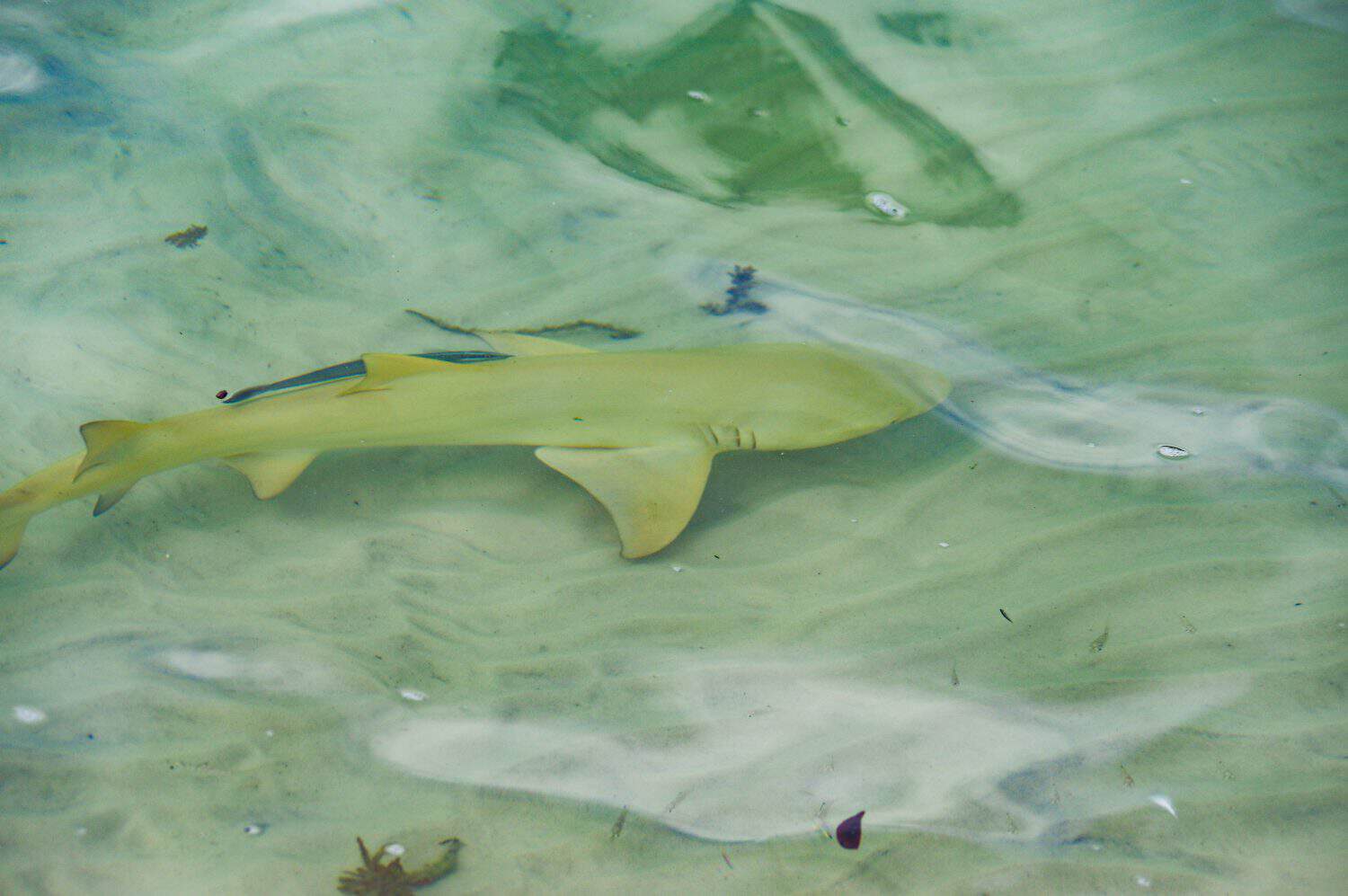
The lemon shark observed recently, similar to this one, is believed to be the same individual tagged in the past few years.
©AndreasM8/Shutterstock.com
Interestingly, when Appleton briefly brought the lemon shark out of the water to tag it, he discovered the shark was already tagged. This means that the shark was already known in the scientific community. As a result, Appleton noted the tag number and measured the shark. This information was then sent to NOAA.
NOAA uses information on tagged sharks to track them for conservation and sustainability. By knowing where sharks are located, researchers can see the effects of climate change through shifts in ocean temperature, observe shark migration patterns, identify species caught via bycatch, and more.
The lemon shark with piebaldism observed just a few weeks ago may not be a newly identified individual with the condition. However, it may be one of the best-studied, given the amount of contact it has had with the scientific community to date.
Is Piebaldism Seen in Other Aquatic Animals?
Piebaldism is a rare condition. Sharks are more likely to be identified as having piebaldism than other marine animals because they are more visible and the condition is relatively easy to spot. As a result, sharks are among the best-known marine animals with piebaldism.

Bottlenose dolphins have been noted to have piebaldism.
©Monica Lozano Subiranas/Shutterstock.com
Although several shark species have been identified as having piebaldism, they are not the only aquatic animals with the condition. Other aquatic creatures can also be affected. Those animals include:
Researchers are even investigating whether white stripes or mottling on shells result from piebaldism.
The footage Merrifield captured was truly “one in 100 million.” It will be interesting to see whether this particular lemon shark can continue to be observed. If so, researchers may learn a great deal about how piebaldism affects sharks and its impact on their survival.