
Quick Take
- The "dogs see in black and white" belief is one of the most persistent myths in pet ownership, but the reality is far more specific and stranger than that. See what dogs actually see →
- Dogs are actually superior to humans in at least three measurable ways when it comes to vision, and most owners have no idea. Explore dogs' visual advantages →
- Your dog's eyes are built for a very different time of day than yours, a fact whose evolutionary origins go back further than dogs themselves. Trace the evolutionary origins →
- The color of a toy you buy your dog might matter less or more than you think, depending on what you're trying to achieve. Check which toy colors matter →
Don’t you wish you could see the world through your dog’s eyes? Unfortunately, the closest we can get is knowing the science behind how they see. Although dogs see things differently than humans, their vision is more efficient in certain environmental conditions. Find out if dogs can see red and whether that even matters.
What Colors Can Dogs See?
Scientists used to believe that dogs could only see in black and white, but this is untrue. Like some humans, dogs have red-green color blindness. This means that red and green look like grey or brownish shades. They also don’t see purple, orange, or pink in the same way we do, since these colors have red in them. Without red, purple looks blue-violet, orange looks more yellowish-brown, and pink looks like a pale yellowish-white.

A dog’s view of a red apple, with actual appearance on the left, and what dogs see on the right.
©Bocskai Istvan/Shutterstock.com
Dogs see colors primarily in shades of blue and yellow. Although they do not see purple as we do, they can see the color purple well because it appears violet. It tends to be easier for them to distinguish red from yellow than orange from green, because both orange and green appear yellowish to their eyes.
Dog Vision
Humans and dogs both have the same two types of photoreceptors in their eyes. Rods help us see in low light, and cones help us see in color. Humans are trichromatic, meaning we have three types of cones. This gives us a color spectrum of approximately 10 million colors. Dogs are dichromatic, with two types of cones, so they can only see shades of blue, yellow, grey, and brown.
Dogs have one cone for every 20 rods in their eyes, while humans have one cone for every nine rods. This allows dogs to see better at night and better detect motion in low light conditions. Dogs also have a reflective layer called the tapetum lucidum that bounces light back through the retina for better night vision. Additionally, dogs’ pupils dilate further than humans’, allowing in more light.
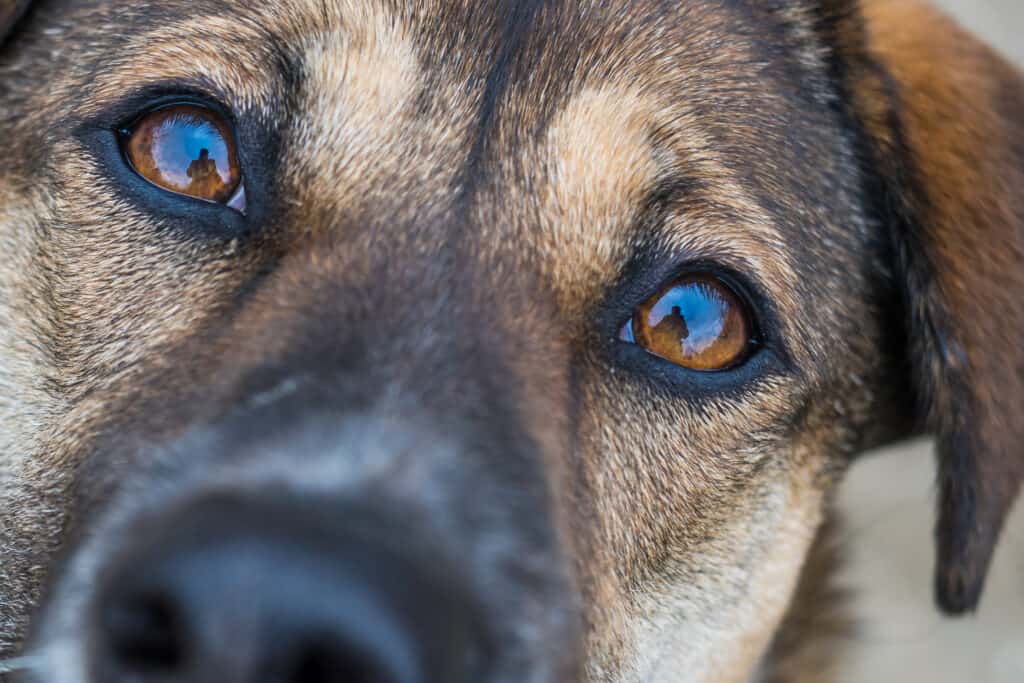
Dogs have a higher ratio and concentration of rods, allowing them to see better in low light than humans.
©iStock.com/Corey O'Hara
Their visual acuity is only 20/75, so dogs have blurry distance vision. In other words, a dog must be 20 feet away from an object to see it as clearly as a human sees it from 75 feet away. However, dogs have a wider field of view than humans at up to 240° to our 180°. This allows dogs to scan the horizon for movement. Humans have better depth perception than dogs because our eyes are set closer together, but eyes set further apart give dogs greater peripheral vision.
Why Do Dogs and Humans See So Differently?
Dogs have evolved to see differently than humans for good reason. Although we are both predatory species, we evolved to be awake at different times of day. Humans are diurnal, meaning we’re awake during the day and sleep at night. Wolves, dogs’ ancestors, are crepuscular. This means they’re most active at dawn and dusk.
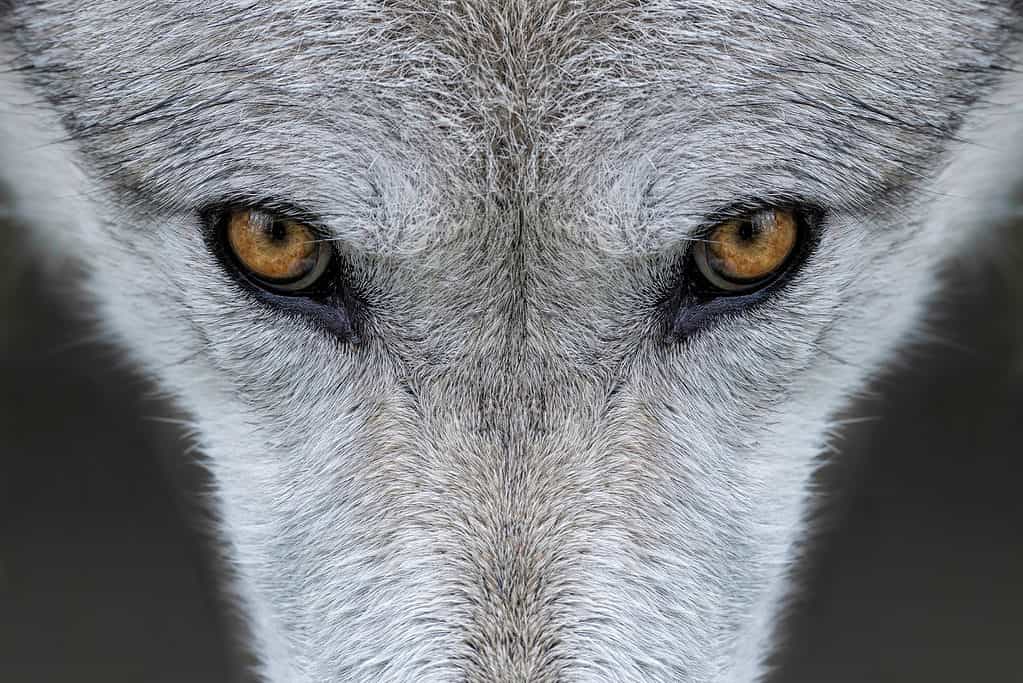
Wolves eyes, and thus, dogs’ eyes, evolved so they could see better in the dark.
©iStock.com/gnagel
So, humans need to see detail and color, but night vision isn’t as necessary for us. Canines need to see and detect movement in low-light conditions because they hunt in the early morning and evening. Daytime vision isn’t as important to them, because they tend to be less active or even sleeping when it’s light out.