
Quick Take
- A salamander you've likely seen has been hiding something that only appears in the dark.
- Scientists can't yet name the molecule behind the effect, and it may be entirely new.
- The glow may be a message, a warning, or both. Who is it meant for?
- Scorpions aren't the only glowing oddballs, and some members of this club will surprise you.
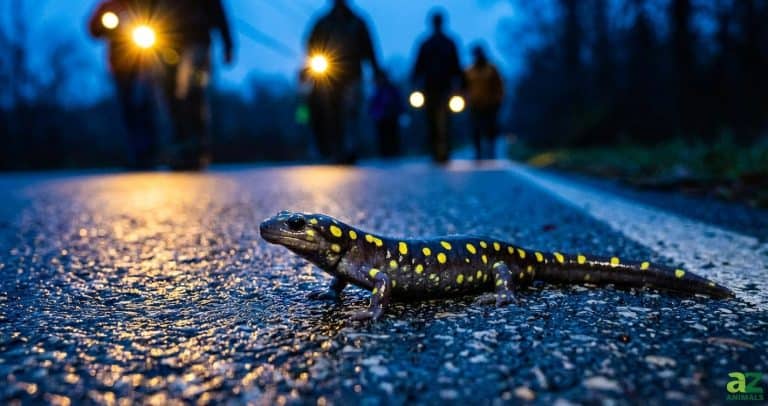
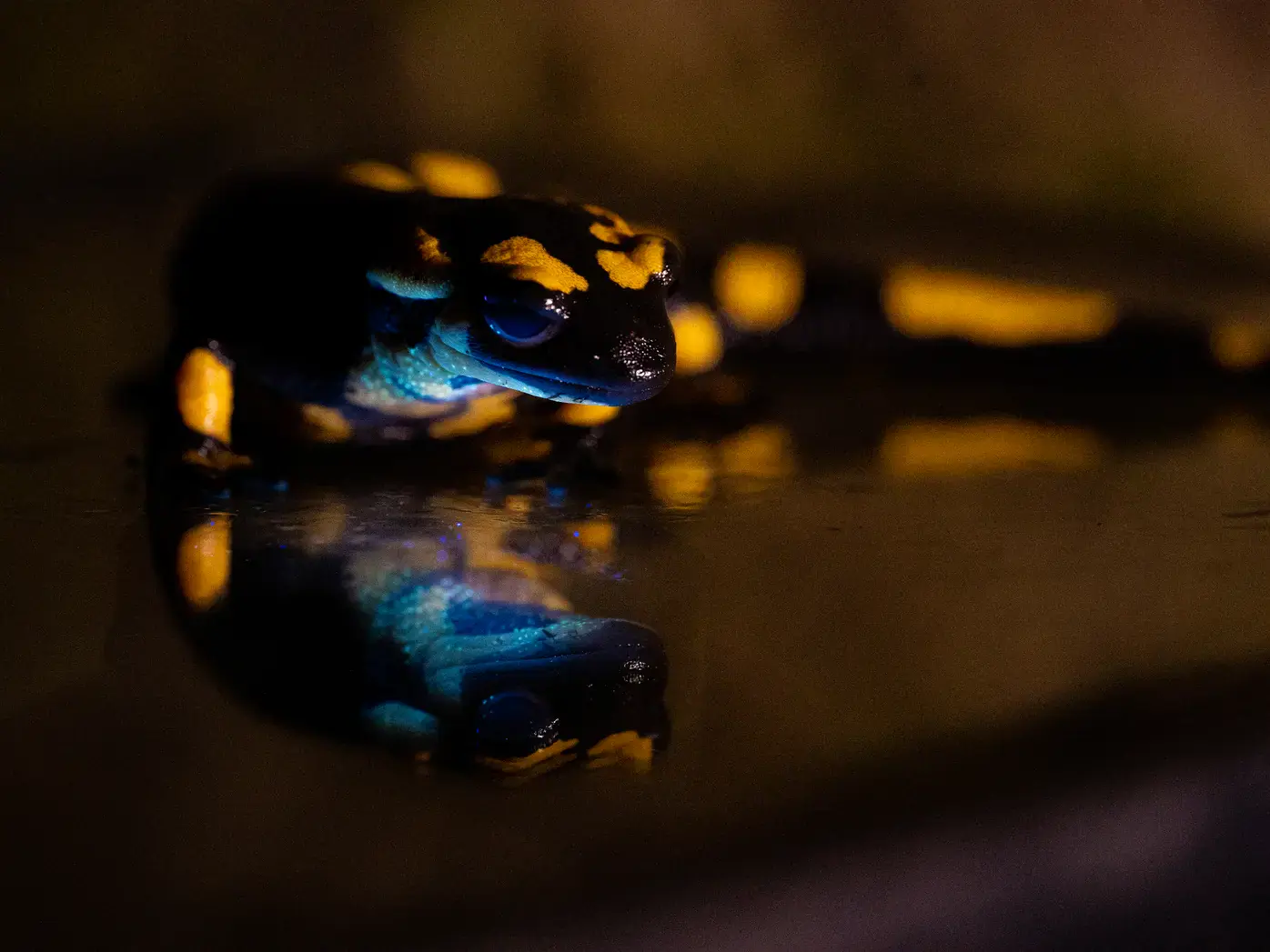
Black and yellow fire salamanders are a common sight across Europe. But what nobody knew until recently was that, under UV light, these ubiquitous amphibians’ sides and bellies glow with bright green and turquoise blue colors.
An international research team, led by scientists from the Museum of Natural Sciences in Barcelona, the Institute of Evolutionary Biology (IBE), a joint center of the Spanish National Research Council (CSIC) and Pompeu Fabra University (UPF), and the Max Planck Institute for Chemical Ecology in Jena, Germany, made the surprising discovery. They published their findings in a new study in the journal Royal Society Open Science.
“It is fascinating that such a well-studied species still harbors unknown phenomena like this. It reminds us that even the most familiar organisms can hide secrets that are only revealed when they are observed with new tools,” says Bernat Burriel, a researcher at the Museum of Natural Sciences in Barcelona and first author of the work, in a press release announcing the study.
What Makes the Salamander Glow?
The scientists discovered that the chemicals responsible for the glow under UV light are concentrated in the yellow areas on the salamander’s sides and belly. The glow comes from toxic secretions the salamander emits through its skin glands. The fluorescent glow lasts for more than 24 hours after the secretions are released.
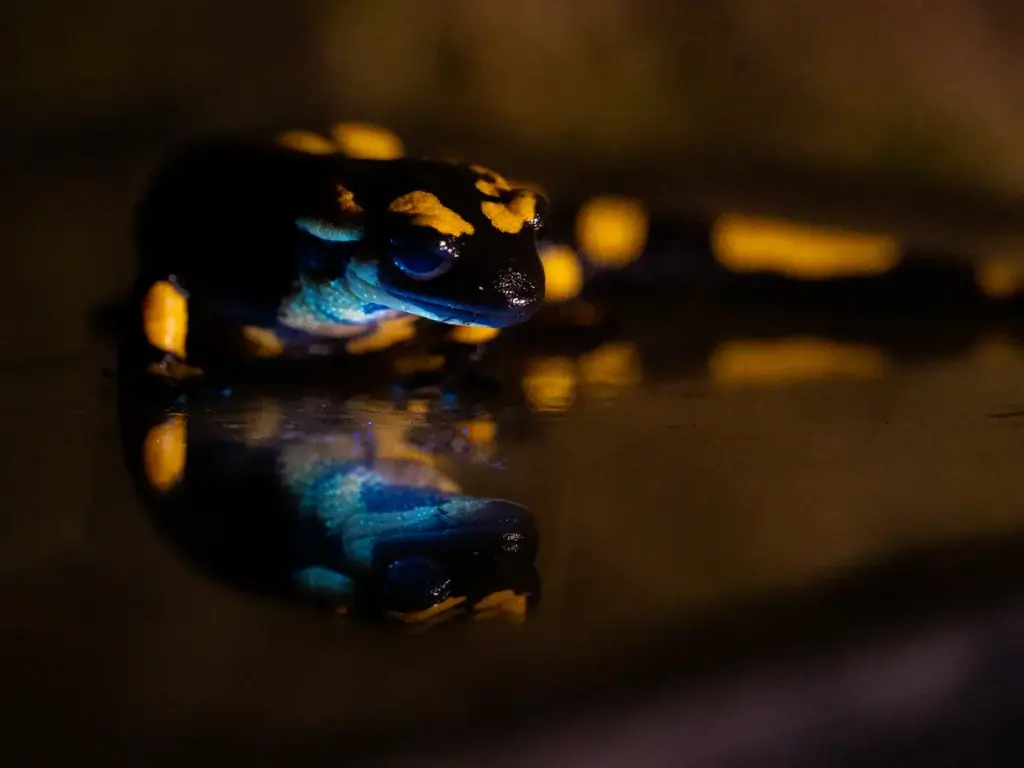
When exposed to UV light, fire salamanders emit a blue and green glow.
©Bernat Burriel-Carranza, Museu de Ciències Naturals de Barcelona, Spain – Original / License
When those secretions are exposed to ultraviolet light – a light source imperceptible to the human eye, the salamanders glow. When the UV light strikes the salamander’s skin, the chemicals present in the secretions transform the light into something the human eye can see. In this case, it is a colorful glow of greens and blues.
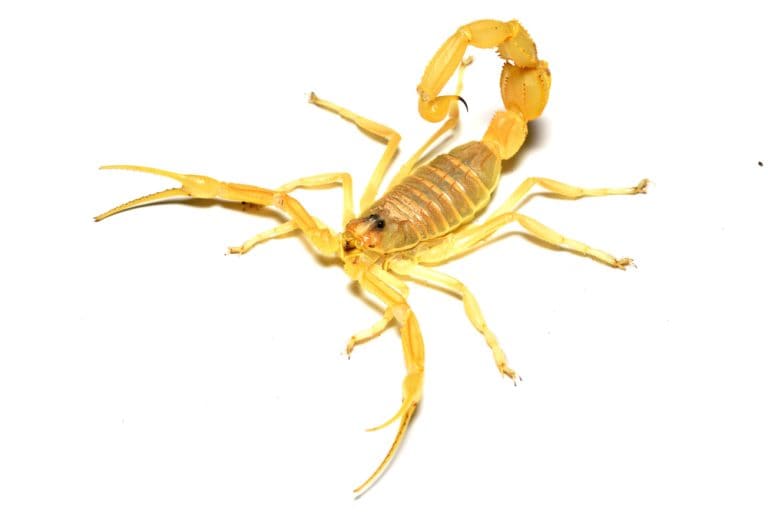
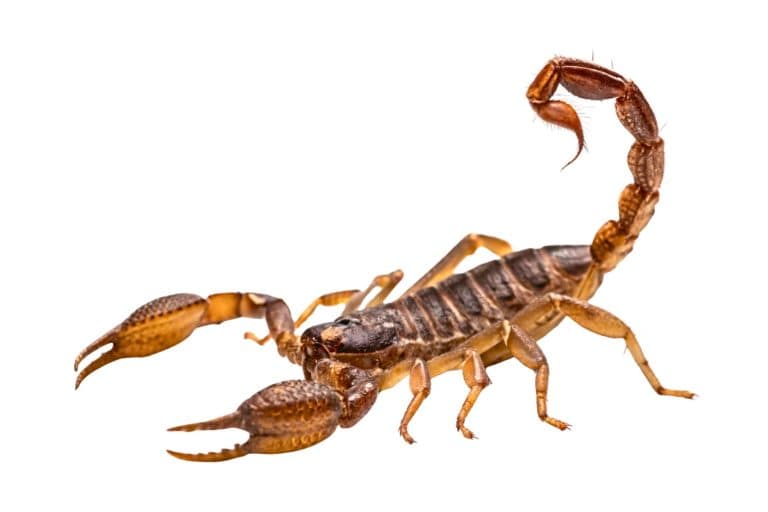
This process is called biofluorescence and requires an external light source to trigger the process. It’s the same thing that makes scorpions glow under UV light. The process is different from bioluminescence, a phenomenon you see in other species, like fireflies. Bioluminescent species generate their own light via chemical reactions.
For a long time, scientists believed that biofluorescence was limited to scorpions and some marine life. Discovering the same effect in fire salamanders was unexpected.
What’s the Purpose of Biofluorescence?
Researchers think the ability to glow in UV light could have several ecological functions. One possibility is that the glow is used to communicate with others of the species and to influence mating partners. Alternatively, the glow could be a way to deter predators.
“Fluorescence meets several criteria that suggest a communicative function. It could help salamanders detect each other in nocturnal or particularly dense environments, or act as an additional defense signal,” Martin Kaltenpoth, the director of the Department of Insect Symbiosis at the Max Planck Institute for Chemical Ecology and co-author of the study, said in the press release.
The fact that the chemicals are also part of the salamander’s toxic secretions leads scientists to believe the biofluorescence is a way to ward off predators. The process of using visual cues for protection is called “aposematic signaling strategy.” While scientists have long studied salamander chemical secretions, finding the fluorescent properties was new.
“The presence of this fluorescent compound was surprising because salamander skin secretions have been studied chemically for decades, and we were unaware of any published reports on fluorescence,” Andrés Brunetti, a researcher at the Max Planck Institute for Chemical Ecology and co-first author of the study said in the press release.
But the research team still doesn’t know which compound is responsible for the fluorescence. They believe it is a molecule not previously known in this species.
“We still don’t know what the compound responsible for this fluorescence is, but everything indicates that it is a molecule unknown until now in this species. Identifying it will be key to understanding its origin and function,” Salvador Carranza, researcher at the IBE (CSIC-UPF) and also co-author of the study said in the press release.
The research team is still analyzing the compounds.
What Other Animals Glow in UV Light?
Fire salamanders are part of a growing group of animals that scientists now know glow in UV light. Though scorpions are the most widely known, plenty of other animals glow too.

Scorpions are another species that has biofluorescence.
©iStock.com/alekseystemmer
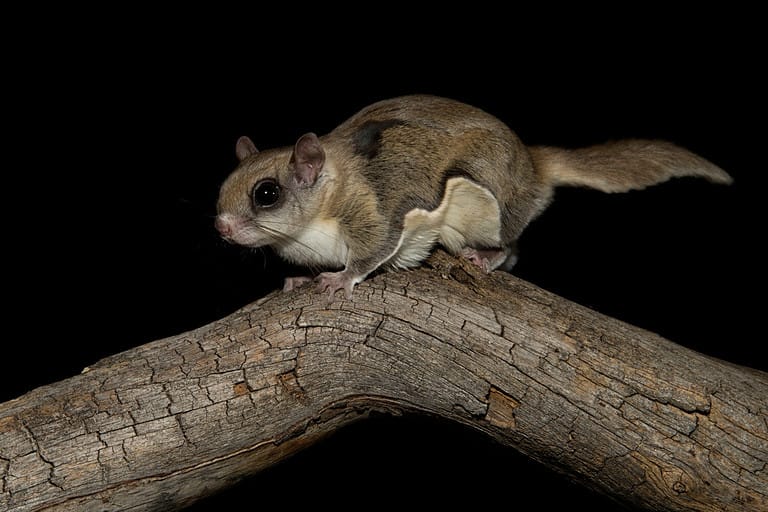
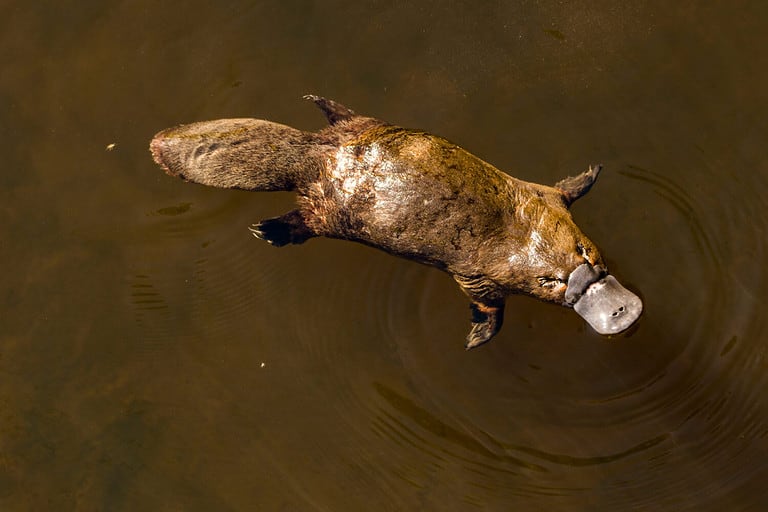
Flying squirrels glow pink when exposed to UV light. The brown fur of the platypus glows blue-green under UV light, as demonstrated when researchers examined museum specimens of the animal. Puffin beaks, tree frog skin, and millipede shells also glow under UV light.
Why Do These Findings Matter?
Fire salamanders are listed as vulnerable on the IUCN’s Red List, threatened by fragmentation and destruction of their habitats. The salamanders typically live in humid forests, streams, and mountain areas.
This research helps scientists better understand the species, which can help conservation efforts. Understanding how the vulnerable species communicates and behaves can guide protection efforts.
More generally, the surprising discovery highlights the importance of studying animals from fresh perspectives. When a new approach is taken, unexpected discoveries can be made.