The cat palm is a plant that has been used in landscaping and as an indoor houseplant since the Victorian era. It’s a really stunning species with large, delicate leaves and a manageable overall size. It may not be the most popular palm houseplant anymore, but it is still worthy of any tropical plant collection. It’s also a fantastic species of palm to grow indoors with relative ease.
In this guide, we’ll take a look at some basic information about the cat palm and how to successfully keep one alive and thriving indoors.
What is the Cat Palm?
The cat palm, also known as the cascade palm or the cataract palm, is classified as Chamaedorea cataractarum and is a member of the Arecaceae family. A smaller palm tree, this species is native to Central America and the southern region of Mexico.
The cat palm has pinnate leaves and thin, green, cane-like leaf stalks that can reach heights of four feet indoors and seven feet outdoors. This palm produces new plants asexually from the base of older plants as well as sexually from seeds. Both male and female flower stalks are found in the same group of plants. Male stalks wilt after producing pollen. The stems develop a vivid orange hue as the seeds mature if female blooms are pollinated. It is a small, pretty, clumping palm with no trunk that reaches heights and widths of approximately seven feet and eight feet, and has glossy, emerald-green leaves with long, skinny leaflets.
With enough time, the cat palm will ultimately grow into a sizable, thick cluster. On rare occasions, it can be grown as a hedge for landscaping purposes. Its flexible, long, thin leaflets and trunkless habit are adaptations that enable the least amount of resistance to flowing water, which prevents it from being uprooted and carried away during floods. As the roots expand, they crawl across the soil, strengthening the plants’ hold against the pressures of flowing water. This plant’s immature hanging fruit is ovoid, glossy, and dark green. When fully grown, it has a diameter of roughly a half inch.
In tropical and subtropical areas and temperatures, the cat palm is planted as a garden plant. Bright light is necessary for cat palms as indoor houseplants. This species can survive outdoors in USDA hardiness zones nine through 11.

Outdoor cat palms (pictured) are not cold-hardy and only survive in USDA hardiness zones nine through 10.
©Danita Delimont/Shutterstock.com
How to Care for Cat Palm Trees
Let’s first discuss where to grow cat palms before we discuss how to care for them. To keep cat palm plants flourishing, it’s critical to pick the ideal site. Cat palms can only be planted outside year-round in USDA hardiness zones nine through 11 since they are not cold-resistant. Even though they can withstand lows of 25 degrees F, the foliage starts to suffer at temperatures below 50 degrees F.
Cat palms prefer a partially to completely shaded garden area outside in a warm enough environment. Moreover, they thrive in pots with excellent drainage. They are usually kept indoors throughout the winter and moved outside during the warmer weather.
Depending on the density you choose, you can space these palms as close as three feet apart to create a privacy screen or hedge outdoors. Cat palms thrive in huge pots because of their sluggish pace of development; just make sure they receive consistent watering. Because of their limited salt tolerance, too much chlorine from pool water might harm the leaves, so if you put one in a pool cage, keep it away from the water’s edge.
Water is important to cat palms, which require constant moisture to thrive. Give them a thorough drink after allowing the top two inches of soil to dry up, then let the extra water drain out. To help you find the ideal water quantity for your plant, you can invest in a moisture meter. Cat palms can also be susceptible to the chlorine and minerals in tap water, as well as to cold shock. Use filtered tap water, tepid distilled water, or collected rainwater for optimal results.
Your cat palm will flourish in an area with at least 50% humidity because it is native to humid, tropical settings. As most indoor living spaces tend to be a little bit dry, you’ll probably need to increase your home’s humidity for your cat palm. A digital hygrometer can be used to measure humidity levels. To provide additional moisture, if necessary, run a small humidifier near your cat palm, place the pot on a tray of pebbles, or spray their leaves often.
The green fronds of the cat palm can potentially suffer damage from direct sunshine. They don’t mind a little bit of early or evening sun, but they prefer a spot outside that has some shade. They’ll thrive inside in a bright area with lots of indirect light. Rotate them regularly to maintain the exposure evenly, or add a grow lamp to supplement it with extra light.
Cat palms like temperatures between 65 and 80 degrees F for optimum growth. They can withstand temperatures as low as 25 degrees F, but when temperatures go below 50 degrees F, the foliage suffers and starts to wither. It’s preferable to move it inside in chilly locations in the fall before nighttime lows of 60 degrees F occur. They will require more shade and more regular irrigation in hot weather in order to survive the heat.
A sandy, permeable soil mixture with high drainage and moisture retention is the optimum soil for this species. You can use a probe meter to determine the pH range that is ideal, which is anywhere between 6.0 to 7.7. The easiest way to provide a good soil mix for these plants is to use a ready-made, fast-draining mix. As an alternative, you can mix two parts of regular potting soil with one part each of pine bark and perlite.
A crucial aspect of your cat palm’s care is regular feeding, which is a terrific method to encourage healthy new growth. Throughout the spring and summer, give them a monthly dosage of a balanced liquid plant fertilizer or any type of liquid compost. Likewise, once or twice every season, you can use a slow-release granule fertilizer. Stop fertilizing completely in the fall and winter. Fertilizing during the plant’s dormant period can throw off the pH balance of its soil and cause damage.
Pruning your cat palm is not really necessary unless you want to remove yellow or otherwise dying and damaged leaves. As fresh growth emerges in the spring, the bottom leaves will tend to wither with advancing age. Using clean pruners, you can remove dead leaves once they have fully turned yellow or brown.
How to Propagate Cat Palm Plants
Cat palms can be propagated most successfully by cutting off offshoots or suckers from the plant’s root system. Just removing the suckers from the parent plant is all that is required. Often, these offshoots have their own roots, making cat palm propagation ridiculously easy. You’ll never have to buy one again! Cat palms do best when propagated in the springtime when it is actively growing.
To start, take your cat palm out of its container. The sucker with the longest or thickest roots should be used. Cut the sucker from the main plant using a pair of sanitized and sharp scissors. Place the new palm plant in a container after filling it halfway with a specific palm soil mix, which can be found at your local garden center. The remaining area inside the pot should be filled with potting mix. Water the soil well.
Put the propagated cat palm in a bright, sunny location, but away from direct sunlight, and cover it with a plastic bag to enhance humidity. As the soil starts to dry up, water the plant. Remove the plastic cover after a few weeks and continue to look after the cat palm as you would a mature plant.
Common Issues to Watch Out For
Cat palms that are in good health rarely have insect problems, but mealybugs, scale, and spider mites can occasionally harm them. Treating these pests with a neem oil solution or insecticidal soap is the most effective organic control approach.
Another problem that could arise at some time in the life of your cat palm is yellowing leaves. Your cat palm can have yellow leaves for a variety of reasons, including overwatering, weather changes, aging, or nutritional deficiency. Cat palms require constant hydration, but if left in wet or poorly drained soil, they risk developing root rot. Both heat above 80 degrees F and cold below 50 degrees F can be harmful, as can a deficiency of nutrients in its soil. If the bottom leaves start to yellow but the remainder of the plant appears healthy, there is no need to be concerned. Yellowing is a normal component of aging. Just cut them off with clean scissors.
Browning tips are another highly prevalent issue for cat palms. Brown patches or tips can be caused by sunburn, insects, mineral buildup from tap water, or the application of synthetic fertilizers. Keep cat palms out of direct sunlight, especially during the warmest part of the day, and treat any pests you spot soon away. To remove the buildup if you’ve been watering with tap water or using chemical fertilizer, flush the pot for five to 10 minutes with distilled water or rainwater.
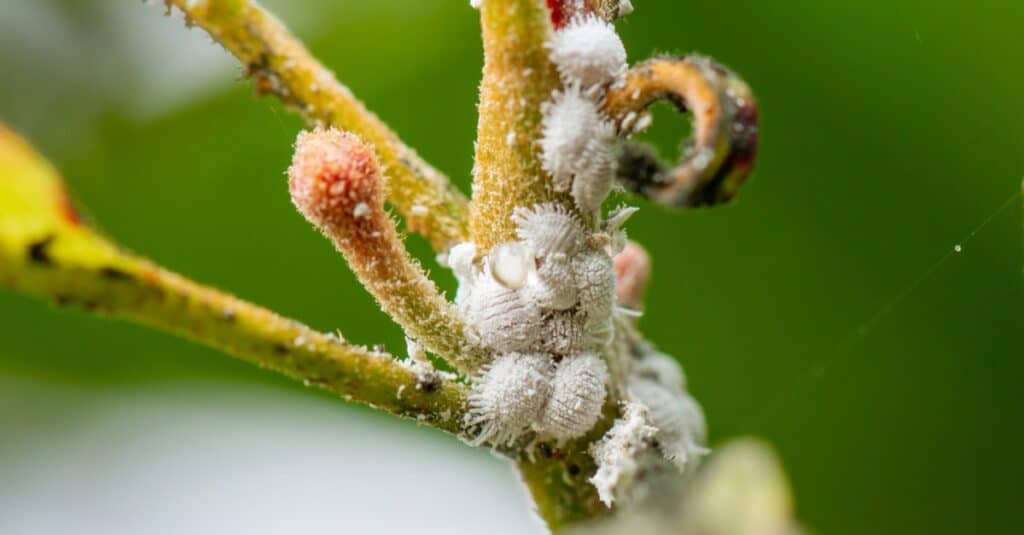
Mealybugs (pictured), scale, and spider mites are the most common cat palm pests to look out for.
©phomphan/Shutterstock.com
Are Cat Palms Toxic?
Because the closely-related Chamaedorea elegant is described as being non-toxic to cats and dogs, the general belief is that the cat palm is harmless for cats and dogs. In any event, you should make an effort to keep pets away from indoor plants. Any plant that has been consumed can result in stomach pains for your pet and, of course, missing chunks out of your plant.
Are Cat Palms Hard to Grow?
One of the easiest indoor plants to grow for beginner gardeners is the cat palm. A cat palm can be grown with just some extra misting with a water bottle, average indoor ambient temperature, and bright indirect sunlight. As the soil on this low-maintenance houseplant starts to dry up, water it. It’s basically as easy as that!
The cat palm is an easy palm to care for indoors. If you can manage to find this somewhat elusive species at your local garden center, it only requires a little bit of attention to survive. What’s not to love about the incredible little cat palm?