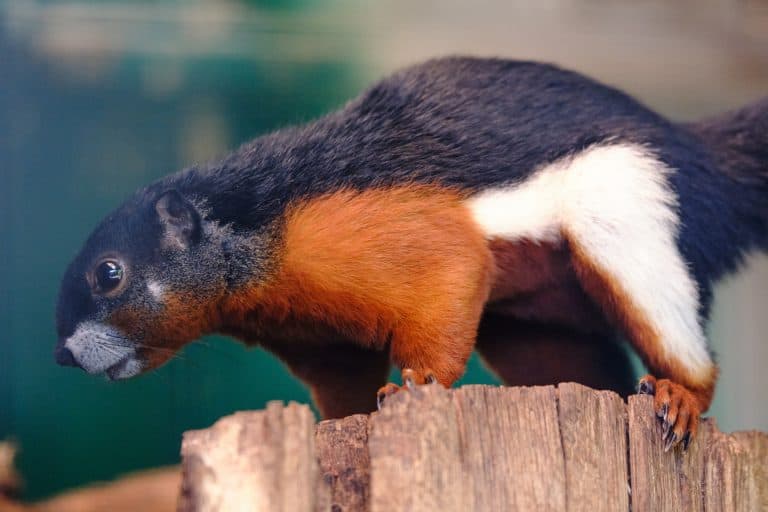
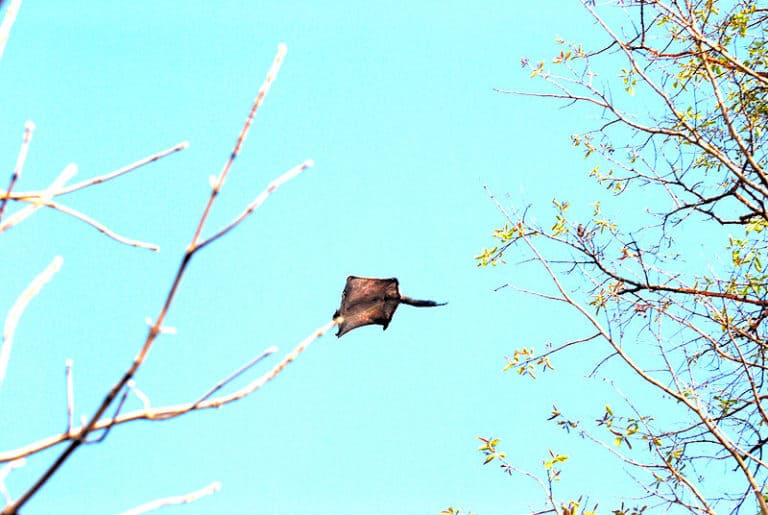

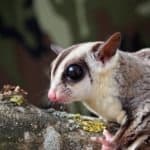
A flying squirrel has the power to glide 300 feet through the air.
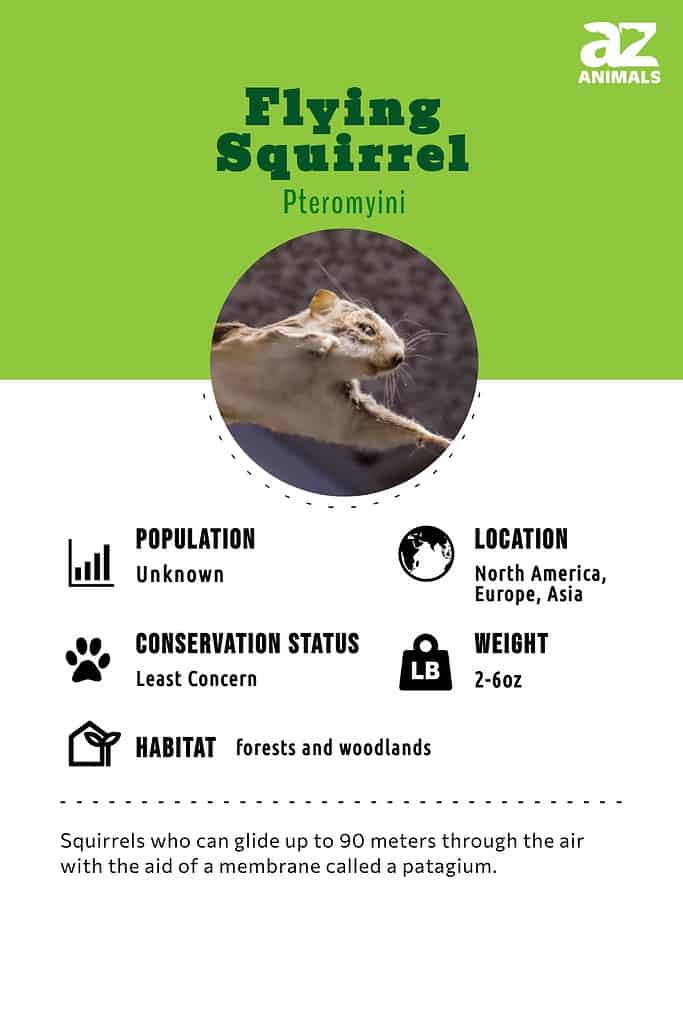
Despite its name, a flying squirrel doesn’t fly the same way a bird or a bat flies. Instead, flying squirrels are animals that glide or drift, through the air. These omnivores eat insects, mushrooms, flowers, and, of course, nuts. Flying squirrels are nocturnal animals and search for food at night. They can change direction by 180 degrees when gliding through the air.
5 Incredible Flying Squirrel Facts!
• These squirrels can gather and store up to 15,000 nuts in one season.
• The 50+ types of flying squirrels are in a group known to scientists as Pteromyini.
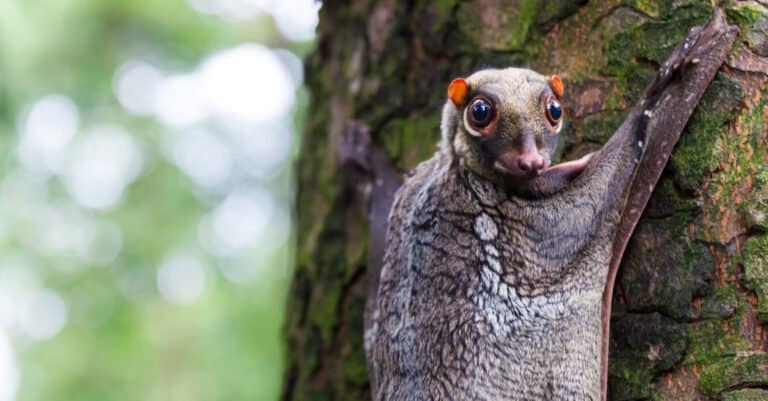
• The extremely large eyes of these small rodents allow light to pour in so they can see at night.
• These squirrels live in Europe, Asia, North America, Mexico, and Central America.
• The official conservation status of these squirrels is Least Concern.
Scientific Name
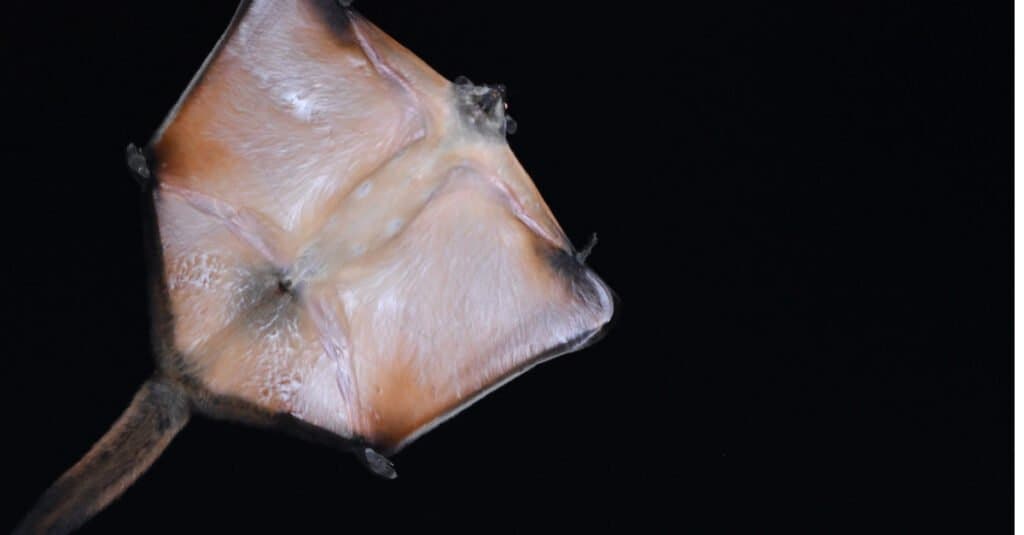
Flying squirrels share the suffix Ptero in their scientific name with the popular dinosaur Pterodactyl.
©Saichol Campan/Shutterstock.com
The scientific name for a flying squirrel is Pteromyini. ‘Ptero’ is a Greek word meaning wing and ‘myini’ means small. It belongs to the Sciuridae family and the Mammalia class.
The southern flying squirrel, the northern flying squirrel, Humboldt’s flying squirrel, and the Japanese dwarf flying squirrel are just four of the over 50 species of this animal in the pteromyini tribe.
Evolution
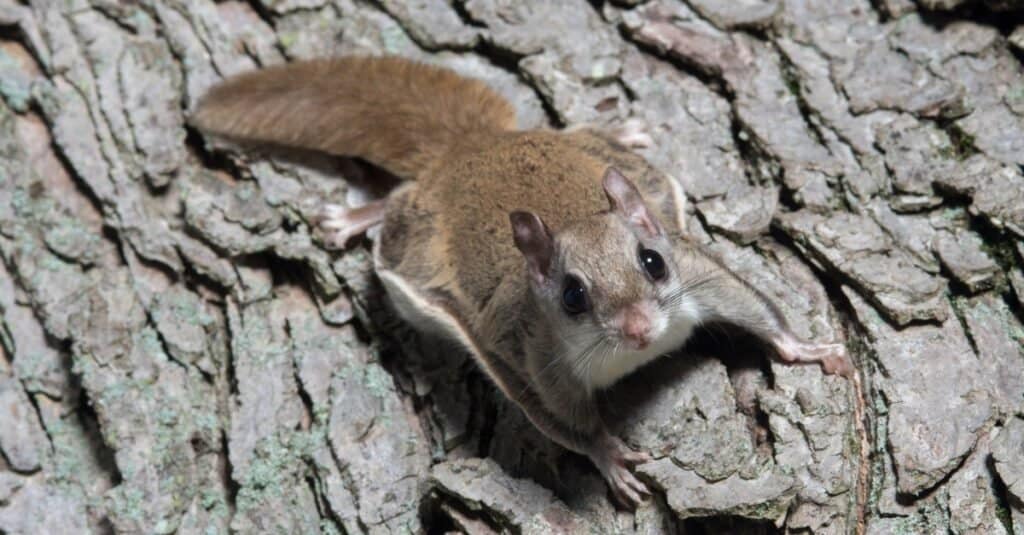
The oldest flying squirrel fossil ever found was 11.6 Million years old!
©iStock.com/EEI_Tony
Biologists believe that flying squirrels first began to diverge from the family tree of regular squirrels and develop their signature aeronautics sometime 23-36 Million years ago. Their genes have remained vastly unchanged in the time since they first appeared on the evolutionary scene, as their special gliding membrane has proven to be an incredibly successful trait for escaping predators and securing prey with ease. Flying squirrels are also notable to biologists for being the most genetically diverse group of flying mammals alive today, with 50+ different species currently soaring through the forests of the Northern Hemisphere.
Appearance and Behavior
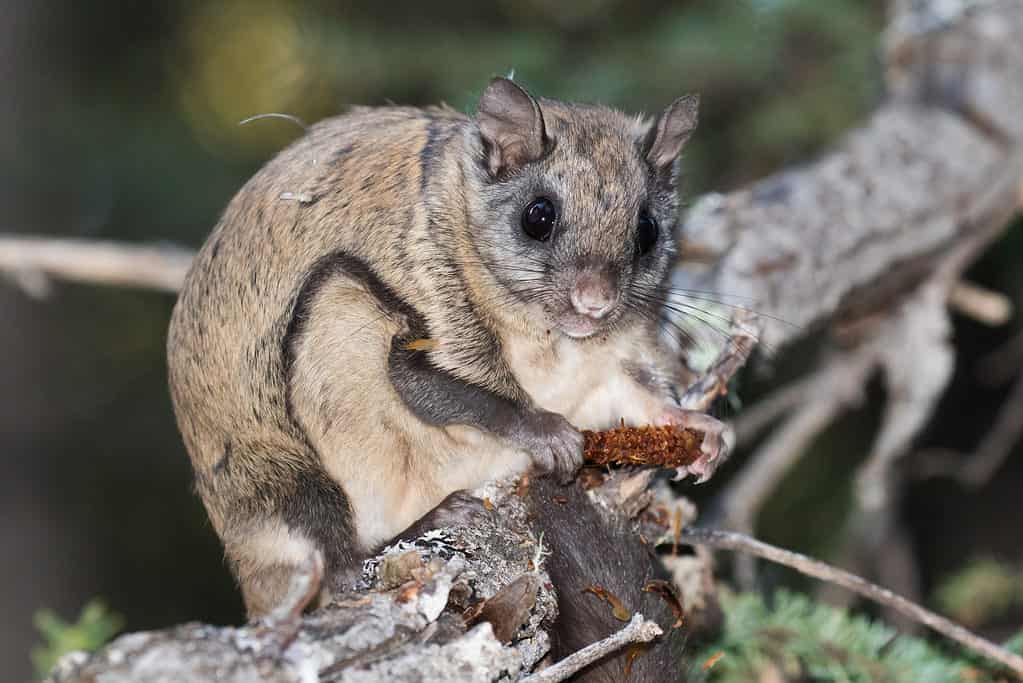
All flying squirrels have a membrane that acts like a parachute to help them glide.
©Jukka Jantunen/Shutterstock.com
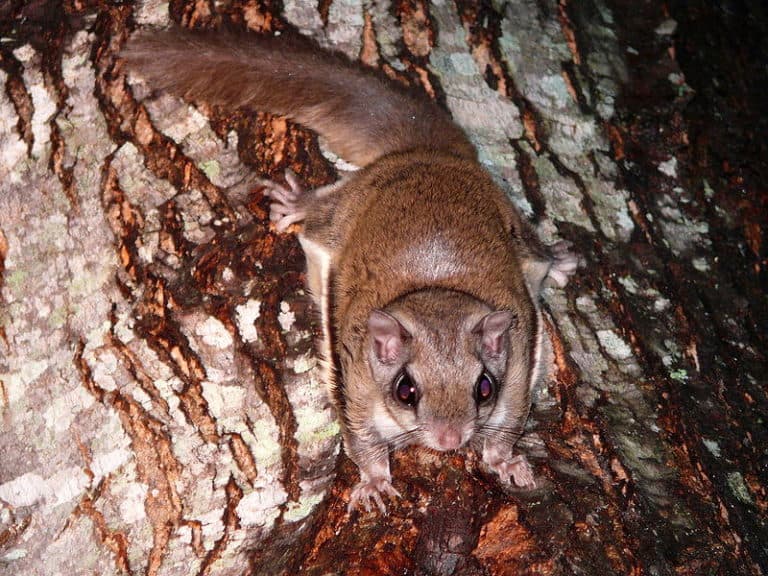
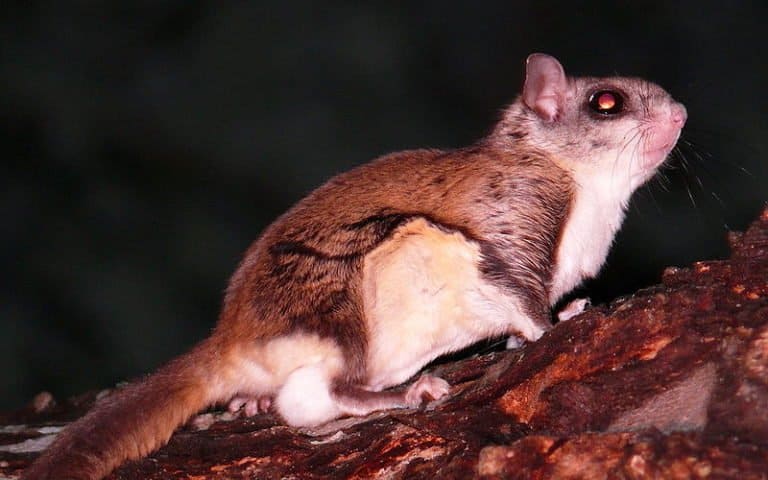
These squirrels have a light coat of brown fur on their back and white fur on their stomach. Some types of squirrels have small differences in fur color. For instance, the southern flying squirrel has all-white fur on its stomach while a northern flying squirrel has belly fur that’s white at the tip and darker near the skin. The most notable feature of all of these squirrels is a pair of large, dark eyes. Their eyes let a lot of light in which helps these animals to see their surroundings as they hunt at night.
These squirrels have a flat tail, four small feet, and long whiskers. Their whiskers help them to avoid running into objects while hunting at night. Like their cousin, the ground squirrel, they have sharp teeth they use to cut into black walnuts and other types of nuts.
Adult squirrels have a body measuring 9 to 14 inches long with a tail of about four inches. They weigh from two to eight ounces. For reference, a 14-inch-long squirrel is almost as long as a bowling pin. Furthermore, a squirrel that weighs eight ounces is as big as an adult hamster.
The largest species is the Red and White Giant flying squirrel. It has a 23-inch long body with a tail measuring about 24 inches. Also, this squirrel weighs around 10 pounds. Alternatively, the Japanese dwarf flying squirrel is one of the smallest types of these squirrels. It grows to be just seven inches long including its tail and weighs around five ounces.
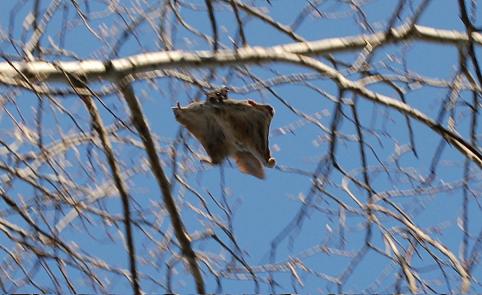
These squirrels have a membrane or fold of skin called a patagium. This membrane spreads out on both sides of the squirrel’s body allowing it to glide between tree branches. If you look up at a flying squirrel moving from tree to tree, the membrane takes the shape of a square.
Though these squirrels can glide a distance of 300 feet, the average gliding distance is 65 feet. To get a better mental picture, when a flying squirrel glides 300 feet, it is traveling about as far as the Statue of Liberty is tall (not including the base it is on)! A squirrel that glides 65 feet is traveling a distance equal to the length of three adult giraffes.
These squirrels spend most of their time in trees as a way to stay safe from predators. When they do walk on the ground level, they are clumsy and will hide from a predator as opposed to trying to run away.
Adult and young squirrels live in nests with about eight other squirrels. These small squirrels are not aggressive and are rarely seen mostly because they are active late at night.
Habitat
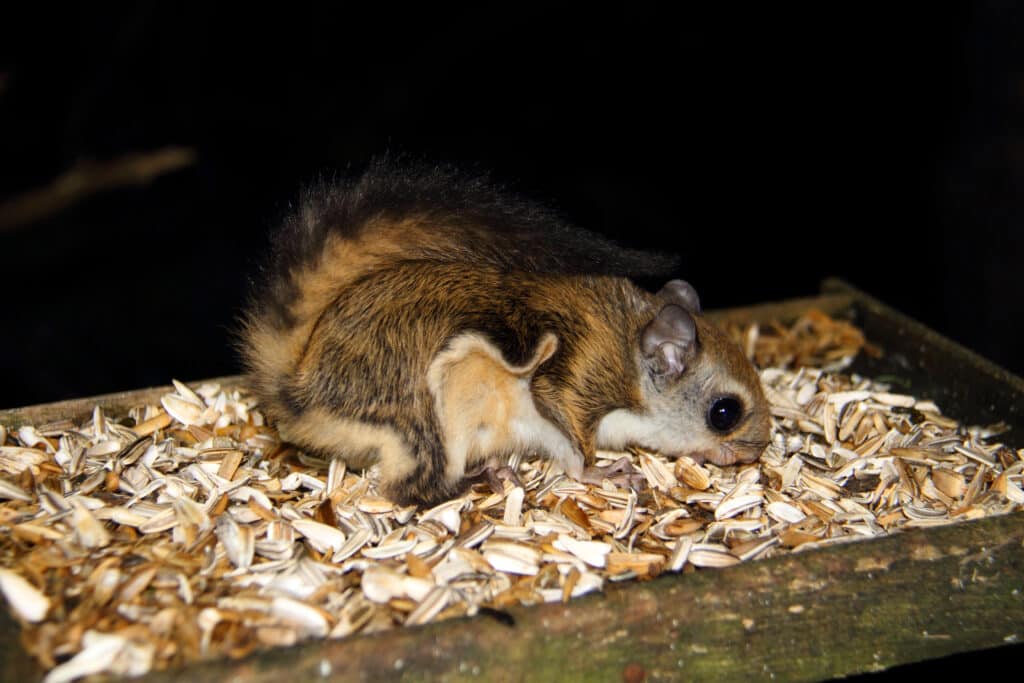
Flying squirrels are found in North America, Asia, and Europe.
©feathercollector/Shutterstock.com
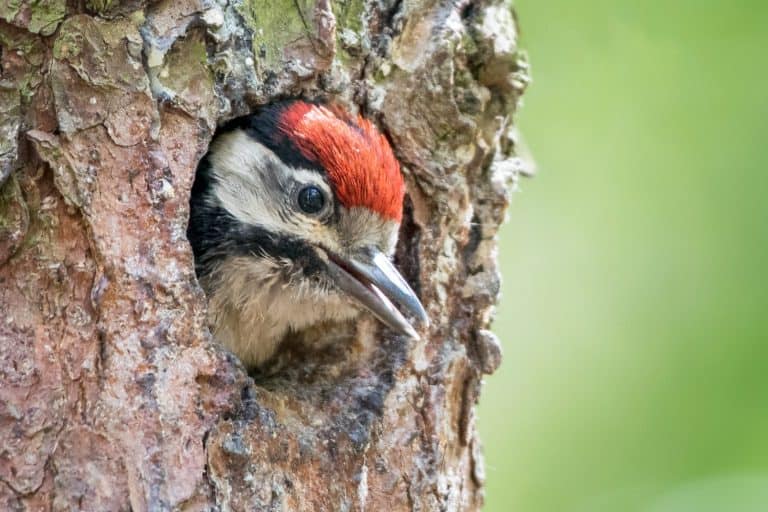
These squirrels live in Europe, Asia, North America, Mexico, and Central America. They live in deciduous and coniferous forests high up in the trees. A group of these squirrels may live in a nest that’s been left behind by a large bird or in a woodpecker’s hole in a tree. These squirrels stay in trees most of the time because they are more vulnerable to predators when they go to ground level.
These squirrels communicate with one another by letting out high-pitched chirping sounds as they glide through the trees. These chirps can be used to warn other flying squirrels of danger or to recognize members of a group. This is a quality they share with ground squirrels, which have a complicated system of chirps and barks they use to communicate with one another.
Northern, Southern, and all other species of flying squirrels like to stay warm! So, if the weather gets really cold in the wintertime, they survive by huddling with other squirrels inside a tree or in a nest to keep warm. Just imagine eight little Japanese dwarf flying squirrels huddled in a tree together!
Diet
Flying Squirrels are omnivorous.
©FWS – Public Domain
What do these squirrels eat? These animals are omnivores and eat insects, flowers, bird eggs, nuts, fungi, and fruit. They have a varied diet and will eat whatever food source is most plentiful within their habitat.
A flying squirrel eats about 10 grams of food per day. This amount of food weighs a little less than a AAA battery you may put in an alarm clock.
For a full analysis of what flying squirrels eat, make sure to read our guide ‘What Do Flying Squirrels Eat? 13 Foods for this Cute Rodent.’
Predators and Threats
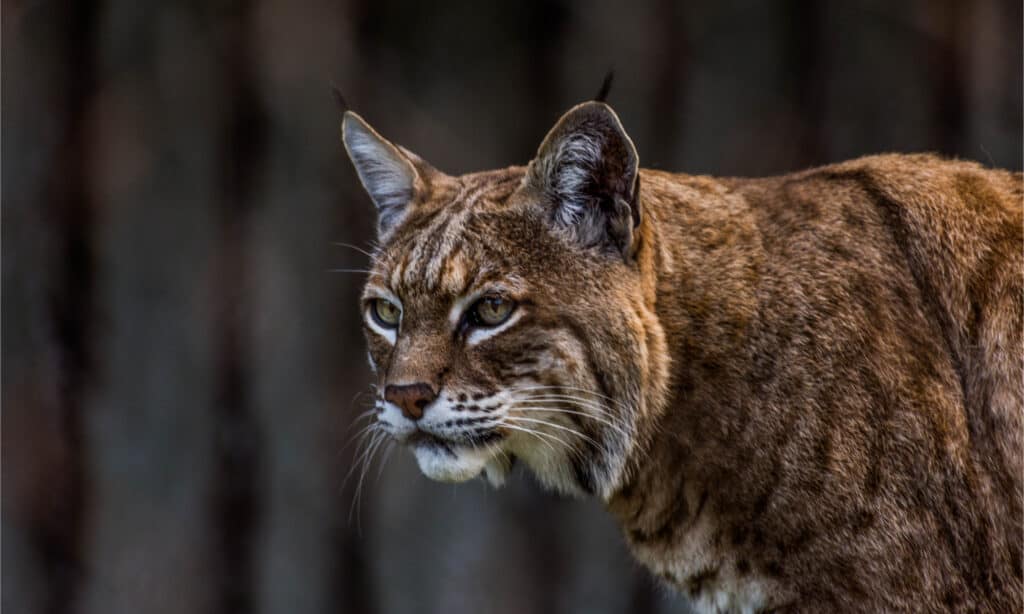
Bobcats have been known to eat flying squirrels when they’re able to catch them.
©Victor Arita/Shutterstock.com
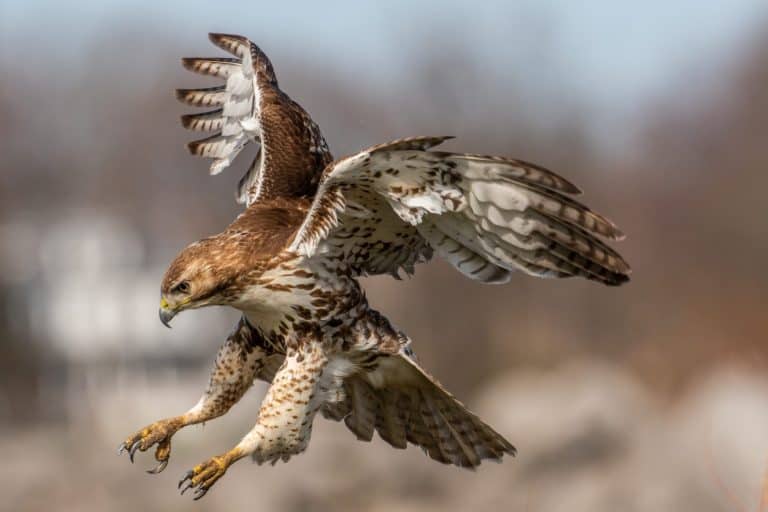
It probably won’t surprise you to know that these squirrels have many predators. Some of them include snakes, owls, hawks, weasels, raccoons, bobcats, and sometimes even domesticated cats.
Most of this animal’s predators live in or can climb into trees. This makes flying squirrels vulnerable to them. Plus, many of these animals are nocturnal so they are active at the same time. When looking for food, a raccoon may climb a tree to access a nest of these squirrels. Or, an owl may swoop down to capture a flying squirrel that has just taken off to glide toward another tree branch.
Humans are another threat to these squirrels because these animals are sometimes captured to sell as pets. Flying squirrels also face loss of their habitat whenever parts of a forest are cleared, and trees cut down.
These animals have a conservation status of the least concern. Though their habitat is threatened, there are some things people do to help flying squirrels. For example, when the Cherohala highway was built in North Carolina, it was discovered that the highway was too wide for the northern flying squirrels to glide over. So, pieces of PVC pipe were attached to the top of poles on both sides of this highway. A squirrel gliding over this highway is able to safely grab onto the PVC pipe when they reach the other side. They sometimes even disappear inside the PVC pipe for protection against predators in the area!
Reproduction, Babies, and Lifespan
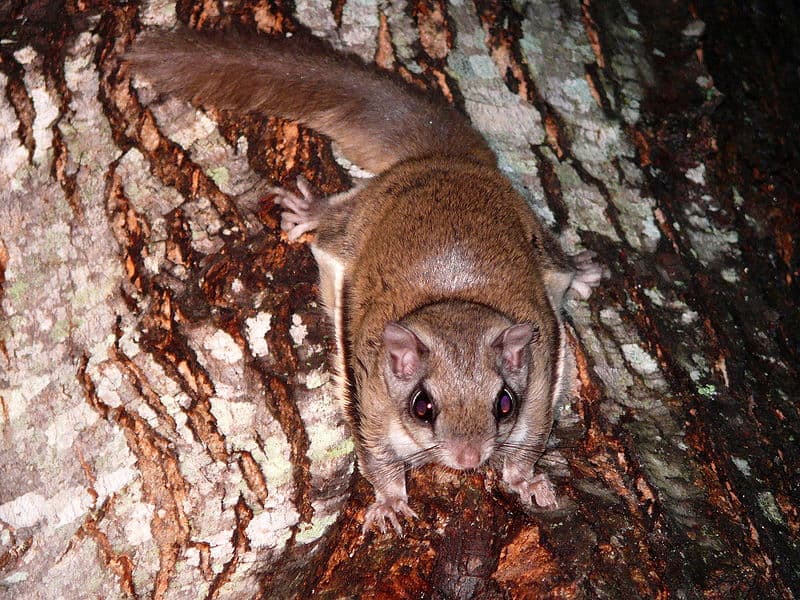
Flying squirrels are extremely vulnerable after they are first born and must be protected by their mother.
©Ken Thomas / Public Domain
During mating season, male squirrels chase females through the trees in a playful way. These squirrels breed twice a year. Breeding season happens from January through April and again from June through August. A male and female stay together for that breeding season and may not meet again. The gestation period, or pregnancy, lasts for 40 days.
A female squirrel gives live birth and can have up to six babies in a litter. However, most females only have two to three babies in one litter. A baby squirrel is about 2 ½ inches long from its nose to the tip of its tail. This is about as long as an adult human’s thumb.
Baby squirrels are called kits and are nursed by their mother in the nest for the first 65 days of life. They are born without fur and their eyes and ears are closed. This makes them very vulnerable to larger animals who might find the nest. So, the mother stays with them except when she’s out hunting food for herself. When they’re about three or four days old, the kits’ ears open. At 25 days old, their eyes open. The kits stay with their mother in the nest until they are four months old. At that time, they are able to find their own food and can survive on their own.
In the wild, these squirrels live to be five or six years old. In a zoo or wildlife park, this squirrel can live to be 10 years old. These animals will live longer in a zoo or wildlife park because they are protected from other animals, fed nourishing foods on a regular basis, and kept healthy by caregivers.
In 2018, the oldest fossil of a flying squirrel was discovered in Catalonia Spain by paleontologists. The fossil is believed to be 11.63 million years old!
Population
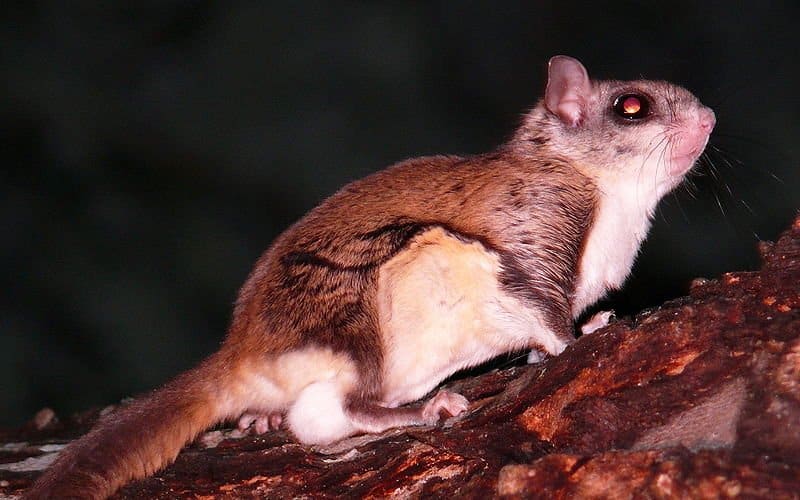
Flying squirrel population sizes are largely unknown, though they are believed to be mostly stable.
©Ken Thomas – Public Domain
When it comes to population, some types of flying squirrels are categorized as decreasing, stable or their population trends are unknown. For instance, the Sipora flying squirrel in Indonesia is decreasing while the population of the Indochinese flying squirrel in China is stable.
Sometimes scientists have challenges gathering the data they need to determine the population of a particular species of the flying squirrel because some types of flying squirrels live in forests and wooded areas that are hard for humans to get to. Also, a group of flying squirrels may remain hidden making it difficult for scientists to get an accurate count. One example is the Red-cheeked flying squirrel. There’s not enough data to determine its population.
Types of Flying Squirrels
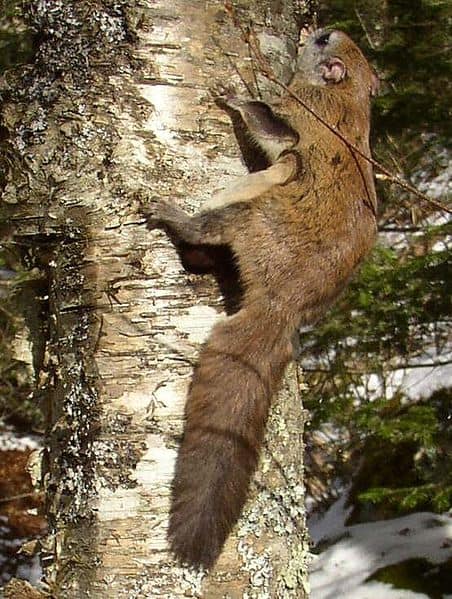
There are more than 50 different species of flying squirrels.
©Bob Cherry – Public Domain
| Kashmir Flying Squirrel | Eoglaucomys fimbriatus |
| Afghan Flying Squirrel | Eoglaucomys fimbriatus baberi |
| Southern Flying Squirrel | Glaucomys volans |
| Northern Flying Squirrel | Glaucomys sabrinus |
| Humboldt’s Flying Squirrel | Glaucomys oregonensis |
| Particolored Flying Squirrel | Hylopetes alboniger |
| Bartel’s Flying Squirrel | Hylopetes bartelsi |
| Arrow Flying Squirrel | Hylopetes sagitta |
| Palawan Flying Squirrel | Hylopetes nigripes |
| Indochinese Flying Squirrel | Hylopetes phayrei |
| Jentink’s Flying Squirrel | Hylopetes platyurus |
| Sipora Flying Squirrel | Hylopetes sipora |
| Red-cheeked Flying Squirrel | Hylopetes spadiceus |
| Sumatran Flying Squirrel | Hylopetes winstoni |
| Javanese Flying Squirrel | Iomys horsfieldii |
| Mentawi Flying Squirrel | Iomys sipora |
| Lesser Pygmy Flying Squirrel | Petaurillus emiliae |
| Hose’s Pygmy Flying Squirrel | Petaurillus hosei |
| Selangor Pygmy Flying Squirrel | Petaurillus kinlochii |
| Basilan Flying Squirrel | Petinomys crinitus |
| Travancore Flying Squirrel | Petinomys fuscocapillus |
| Whiskered Flying Squirrel | Petinomys genibarbis |
| Hagen’s Flying Squirrel | Petinomys hageni |
| Siberut Flying Squirrel | Petinomys lugens |
| Mindanao Flying Squirrel | Petinomys mindanensis |
| Temminck’s Flying Squirrel | Petinomys setosus |
| Vordermann’s Flying Squirrel | Petinomys vordermanni |
| Himalayan Large-eared Flying Squirrel | Priapomys leonardi |
| Groove-toothed Flying Squirrel | Aeretes melanopterus |
| Black Flying Squirrel | Aeromys tephromelas |
| Thomas’s Flying Squirrel | Aeromys thomasi |
| Hairy-footed Flying Squirrel | Belomys pearsonii |
| Namdapha Flying Squirrel | Biswamoyopterus biswasi |
| Laotian Giant Flying Squirrel | Biswamoyopterus laoensis |
| Mount Gaoligong Flying Squirrel | Biswamoyopterus gaoligongensis |
| Western Woolly Flying Squirrel | Eupetaurus cinereus |
| Yunnan Woolly Flying Squirrel | Eupetaurus nivamons |
| Tibetan Woolly Flying Squirrel | Eupetaurus tibetensis |
| Red and White Giant Flying Squirrel | Petaurista alborufus |
| Spotted Giant Flying Squirrel | Petaurista elegans |
| Hodgson’s Giant Flying Squirrel | Petaurista magnificus |
| Bhutan Giant Flying Squirrel | Petaurista nobilis |
| Indian Giant Flying Squirrel | Petaurista philippensis |
| Chinese Giant Flying Squirrel | Petaurista xanthotis |
| Japanese Giant Flying Squirrel | Petaurista leucogenys |
| Red Giant Flying Squirrel | Petaurista petaurista |
| Mechuka Giant Flying Squirrel | Petaurista mechukaensis |
| Mishmi Giant Flying Squirrel | Petaurista mishmiensis |
| Mebo Giant Flying Squirrel | Petaurista siangensis |
| Siberian Flying Squirrel | Pteromys volans |
| Japanese Dwarf Flying Squirrel | Pteromys momonga |
| Smoky Flying Squirrel | Pteromyscus pulverulentus |
| Complex-toothed Flying Squirrel | Trogopterus xanthipes |
Flying Squirrel Pictures
View all of our Flying Squirrel pictures in the gallery.

Ken Thomas / Public Domain
How to say Flying Squirrel in ...
Sources
- David Burnie, Dorling Kindersley (2011) Animal, The Definitive Visual Guide To The World's Wildlife / Accessed October 22, 2009
- Tom Jackson, Lorenz Books (2007) The World Encyclopedia Of Animals / Accessed October 22, 2009
- David Burnie, Kingfisher (2011) The Kingfisher Animal Encyclopedia / Accessed October 22, 2009
- Richard Mackay, University of California Press (2009) The Atlas Of Endangered Species / Accessed October 22, 2009
- David Burnie, Dorling Kindersley (2008) Illustrated Encyclopedia Of Animals / Accessed October 22, 2009
- Dorling Kindersley (2006) Dorling Kindersley Encyclopedia Of Animals / Accessed October 22, 2009
- David W. Macdonald, Oxford University Press (2010) The Encyclopedia Of Mammals / Accessed October 22, 2009