M
Species Profile

Moth

Lepidoptera

More than night flyers
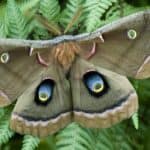
Fir0002 / Creative Commons

Moth Distribution

Click a location to explore more animals from that region

Loading map...
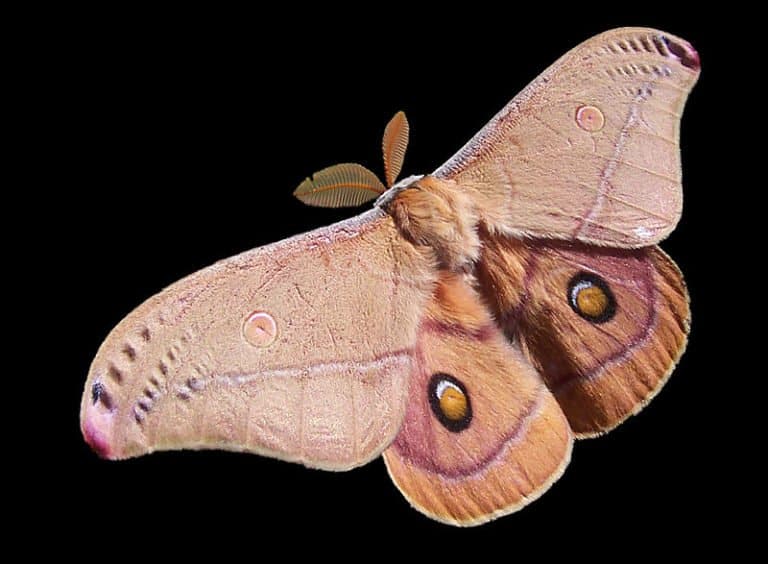
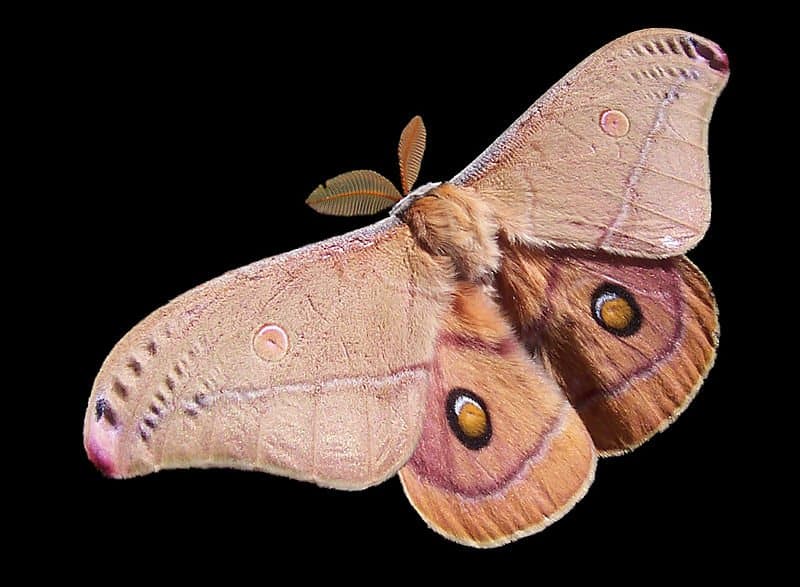
Moth on black background

At a Glance

Order Overview This page covers the Moth order as a group. Stats below are general traits shared across the order.
Diet Herbivore
Activity Nocturnal+
Lifespan 0.3 years
Weight 0.02 lbs
Status Not Evaluated
Did You Know?

"Moths" aren't a single lineage: they span many Lepidoptera families (e.g., Noctuidae, Geometridae, Erebidae, Sphingidae, Saturniidae, Tineidae) with very different lifestyles.

Scientific Classification

Order Overview "Moth" is not a single species but represents an entire order containing multiple species.

Moths are a broad, informal grouping of lepidopteran insects (order Lepidoptera). They share scaly wings, complete metamorphosis (egg–larva–pupa–adult), and typically have feathery or filamentous antennae. Many are nocturnal, though many species are day-flying. Moths include an enormous diversity of families (e.g., Saturniidae, Sphingidae, Noctuidae, Geometridae, Erebidae, Tineidae).

Kingdom
Animalia
Phylum
Arthropoda
Class
Insecta
Order
Lepidoptera

Distinguishing Features

  • Two pairs of wings covered in microscopic scales (a defining trait of Lepidoptera)
  • Complete metamorphosis with caterpillar larvae and a pupal stage (often in a cocoon)
  • Adults commonly have stout bodies and are frequently (but not always) nocturnal
  • Antennae often filamentous or feathery (especially in males of many species)
  • Larvae typically specialized herbivores with host-plant associations

Physical Measurements

Males and females differ in size

Weight
0 lbs (0 lbs – 0 lbs)
Top Speed
31 mph
flying

Appearance

Skin Type Chitinous exoskeleton covered in scales; wings and body often densely scaled and fuzzy, with membranous wings beneath scales; larvae are soft-bodied caterpillars with a tougher head capsule.
Distinctive Features
  • Measurements (order-wide range): adult wingspan ~3-300 mm; adult body length ~2-120 mm; caterpillars commonly ~2-150 mm depending on species.
  • Lifespan (range across species): full life cycle often ~3-8 weeks, but can extend to ~1-3 years with diapause; adult stage commonly ~3-30 days, sometimes months in overwintering adults.
  • Scaly wings and scale-covered bodies; scales create matte camouflage, metallic shine, or structural iridescence.
  • Antennae diverse: threadlike to strongly feathered; many rely on pheromone detection, especially males.
  • Mouthparts vary: many have a coiled proboscis for nectar; some adults have reduced mouthparts and do not feed.
  • Resting postures vary widely: wings flat, tent-like, wrapped, or roofed over the body; many maximize camouflage on substrates.
  • Larvae occupy many niches: leaf-chewers, borers, miners, rollers, case-bearers; some feed on detritus, fungi, stored products, wool/keratin, or aquatic plants.
  • Ecology/behavior: many are nocturnal, but substantial diversity includes day-flying and crepuscular species; attraction to artificial light is common but highly variable.
  • Key roles: major prey base for bats, birds, and invertebrates; many adults pollinate nocturnal and diurnal flowers; larvae shape plant communities.
  • Sensory defenses common: hearing organs in many lineages for bat ultrasound, startle displays (eyespot hindwings), chemical defenses, and mimicry of wasps or toxic insects.
  • Human relevance spans silk production (multiple lineages), agricultural/forestry pests, conservation importance, and documented impacts from light pollution and habitat change.

Sexual Dimorphism

Sexual dimorphism is widespread but variable: males often have larger, more plumose antennae for pheromone tracking, while females may be larger-bodied for egg production. In some groups, females are reduced-winged or wingless; in others, sexes look nearly identical.

  • Often more plumose/bipectinate antennae for pheromone detection
  • Frequently slimmer abdomen; sometimes more agile or longer-flying
  • In some groups, brighter or more contrasting pattern elements used in courtship
  • Specialized scent scales or hair-pencils in certain lineages
  • Often larger abdomen for egg capacity; sometimes overall larger body size
  • In some lineages, reduced wings or flightlessness; males remain fully winged
  • Sometimes duller or more cryptic coloration during egg-laying periods
  • Ovipositor adaptations and abdominal shape differences linked to egg placement

Did You Know?

"Moths" aren't a single lineage: they span many Lepidoptera families (e.g., Noctuidae, Geometridae, Erebidae, Sphingidae, Saturniidae, Tineidae) with very different lifestyles.

Size range is extreme: the smallest micro-moths have wingspans of only a few millimeters, while the largest (e.g., white witch moth) can reach about 30 cm wingspan.

Many adults never eat: several giant silk moths (Saturniidae) emerge with reduced mouthparts and live mainly to mate and lay eggs.

Some males can detect a female's pheromones from kilometers away using plume-like antennae packed with scent receptors.

Not all moths fly at night-many are day-fliers (including "clearwing" moths that mimic bees/wasps).

Moths are major nighttime pollinators; some plants strongly rely on nocturnal moth visitation, including long-tubed flowers serviced by hawk moths.

Light pollution can disrupt moth navigation, feeding, and reproduction, changing pollination and food-web dynamics.

Unique Adaptations

  • Scaly wings: dense, colored scales provide camouflage, warning colors, thermoregulation, and easy "scale-shedding" to escape spider webs.
  • Cocoon vs. naked pupa: many moths spin silk cocoons (variable across families), while others pupate in soil or leaf litter with minimal silk-reflecting huge life-history diversity.
  • Silk production: many larvae spin silk for shelters or cocoons; domesticated silkworms (a moth) were selectively bred for high-yield, continuous silk filament.
  • Camouflage and mimicry: widespread leaf/bark mimicry, "dead-leaf" wing patterns, and clearwing mimicry of bees/wasps; some species display sudden bright hindwings to startle predators.
  • Chemical defenses: some caterpillars sequester plant toxins; others synthesize defensive compounds, while certain adults advertise unpalatability with bold patterns.
  • Tympanal hearing (in many groups): specialized organs detect bat ultrasound, enabling rapid evasive maneuvers.
  • Extremes in mouthparts: from long-tongued hawk moths adapted to deep flowers to groups with reduced or absent adult feeding structures.

Interesting Behaviors

  • Nocturnal, crepuscular, and diurnal activity: many species fly at night, but numerous lineages are active at dawn, dusk, or full daylight.
  • Pollination networks: adults commonly visit flowers for nectar (and can move pollen at night when bees are inactive), though some groups feed on sap, rotting fruit, or not at all.
  • Pheromone-guided mate finding: females of many species release species-specific pheromone blends; males orient upwind in "zig-zag" flight to the scent plume.
  • Anti-bat tactics (varies by family): some moths hear ultrasound and perform evasive dives; certain tiger moths can produce ultrasonic clicks that may jam or confuse bat echolocation.
  • Seasonal strategies: many species overwinter as eggs, larvae, pupae, or even adults depending on climate; diapause timing can be tightly tuned to local seasons.
  • Mass movements and migrations: some moths migrate long distances or erupt in population booms (e.g., various armyworm/cutworm moths), affecting ecosystems and agriculture.
  • Larval feeding diversity: caterpillars include leaf-chewers, miners, stem/wood borers, lichen feeders, detritivores, and keratin feeders (e.g., clothes moths).

Cultural Significance

Moths link to humans: silk (sericulture) changed economies and trade; some moths are crop and forest pests, others help control pests and pollinate. They appear in art, are harmed by artificial night lights, and some, like the bogong moth, were eaten.

Myths & Legends

Chinese tradition credits Leizu (Lady Xiling), a legendary consort of the Yellow Emperor, with discovering how to reel silk from silkworm cocoons-foundational to sericulture lore.

In parts of Europe, the death's-head hawkmoth (Acherontia) became an omen-laden figure in folklore because of its skull-like marking and squeaking sound, often linked with ill fortune or death.

A widespread folk belief in multiple cultures holds that moths drawn to lamps at night can be wandering spirits or souls of the dead visiting the living (told in varying local forms).

Australian Aboriginal histories record large ceremonial gatherings tied to the annual migrations of bogong moths into the Alps, remembered through story, song, and shared feasting traditions.

The "Mothman" of Point Pleasant, West Virginia (1960s), is a modern American legend describing a large winged figure associated with ominous sightings before a bridge disaster.

Conservation Status

NE Not Evaluated

Has not yet been evaluated against the criteria.

Population Unknown

You might be looking for:

Luna moth

16%

Actias luna

Large North American saturniid moth with pale green wings and long tails; adults do not feed.

View Profile

Atlas moth

14%

Attacus atlas

One of the largest moths by wing area; native to South and Southeast Asia.

View Profile

Death's-head hawkmoth

12%

Acherontia atropos

Large sphingid moth known for a skull-like marking on the thorax; Eurasia and Africa.

Domestic silkmoth

12%

Bombyx mori

Fully domesticated moth used in silk production; derived from wild relatives in Asia.

Clothes moths (webbing clothes moth)

12%

Tineola bisselliella

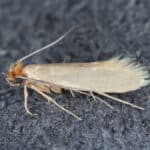
Small tineid moth whose larvae can damage wool and other animal fibers in homes.

Gypsy moth / spongy moth

10%

Lymantria dispar

Defoliating erebid moth with major forestry impacts; common in pest-management contexts.

View Profile

Peppered moth

10%

Biston betularia

Geometrid moth famous in evolutionary biology for industrial melanism studies.

View Profile

Life Cycle

Birth 100 caterpillars
Lifespan 0 years

Lifespan

In the Wild
0.04–5 years
In Captivity
0.04–6 years

Reproduction

Mating System Promiscuity
Social Structure Solitary
Breeding Pattern Transient
Fertilization Internal Fertilization
Birth Type Internal_fertilization

Across moth lineages, adults typically form no lasting pair bonds; mating is brief and pheromone-mediated. Many males mate multiple times, while females vary from single-mating to polyandry. Eggs are laid without parental care; aggregation swarms occur in some taxa.

Behavior & Ecology

Social Congregation Group: 1
Activity Nocturnal, Crepuscular, Diurnal, Cathemeral
Diet Herbivore Varies strongly by life stage: larvae most commonly feed on specific host-plant tissues; adults commonly favor floral nectar where feeding occurs.
Seasonal Migratory, Hibernates 1,864 mi

Temperament

Highly diverse order; adults are usually non-aggressive, evasive, and disturbance-avoiding.
Adult sociality is typically low; most contact is brief and reproduction-focused.
Larval behavior varies from solitary to strongly gregarious, sometimes defensive as a group.
Predation pressure shapes behavior: crypsis common; some species are aposematic and bold.
Resource-driven aggregation is common (lights, pheromone plumes, nectar, sap, minerals), but not cohesive groups.

Communication

Ultrasound clicks in some groups (e.g., many tiger moths) for defense or interference.
Audible or near-audible wing/abdominal sounds in some species during courtship or disturbance.
Sex pheromones are primary long-distance signals; some species attract mates from kilometers downwind.
Chemical cues also guide host finding, oviposition, and aggregation around resources.
Visual signaling varies widely: wing patterns, flash colors, UV cues; important in day-flying species.
Tactile communication during courtship (antennal contact) and mating alignment is widespread.
Substrate-borne vibrations may occur during courtship in some lineages, but many are chemically driven.

Habitat

Biomes:
Tropical Rainforest Tropical Dry Forest Savanna Desert Hot Desert Cold Mediterranean Temperate Grassland Temperate Forest Temperate Rainforest Boreal Forest (Taiga) Tundra Alpine Freshwater Wetland +8
Terrain:
Mountainous Hilly Plateau Plains Valley Coastal Island Riverine Volcanic Karst Rocky Sandy Muddy +7
Elevation: Up to 18044 ft 8 in

Ecological Role

Highly diverse consumers and pollinators: larvae are major herbivores (and occasional detrital/fungal feeders) shaping plant communities; adults often function as important nocturnal pollinators, while both life stages are key prey supporting food webs.

nocturnal and crepuscular pollination (including of night-blooming plants) energy transfer in food webs (major prey for birds, bats, reptiles, amphibians, spiders, and predatory insects) regulation of plant growth and community composition via herbivory nutrient cycling through frass deposition and decomposition of plant material supporting parasitoid communities (as common hosts), indirectly influencing ecosystem population dynamics

Diet Details

Main Prey:
Soft-bodied insects Insect eggs and small larvae Small arthropods
Other Foods:
Host plant tissues Nectar Pollen Fruit Tree sap, honeydew, and plant exudates Seeds, grains and stored plant products Lichens, algae, and fungi +1

Human Interaction

Domestication Status

Wild

Lepidoptera (moths) are mostly wild. A few are domesticated or semi-domesticated, best known is the silkworm Bombyx mori used in sericulture for about 5,000 years; other silk moths are regionally managed. Many species are pests or live near people, while others are pollinators, used in research, or protected.

Danger Level

Low
  • Skin irritation/dermatitis from contact with urticating hairs or spines of some caterpillars (severity varies widely by species; reactions can be significant in sensitized individuals)
  • Allergic reactions to scales/hairs or frass during heavy indoor infestations or occupational exposure (rarely severe)
  • Indirect harm via crop/forest damage and associated economic/food-security impacts (not a direct physical threat)
  • Occasional eye/respiratory irritation when handling large numbers without protection

As a Pet

Suitable as Pet

Legality: Usually legal to keep common local moths (Lepidoptera), especially eggs, caterpillars, and pupae for teaching. Rules vary; protected species, moved/imported insects, crop or tree pests, and releases are often restricted. Check local laws.

Care Level: Moderate

Purchase Cost: Up to $150
Lifetime Cost: $10 - $500

Economic Value

Uses:
Textiles and biomaterials (silk/sericulture; regional wild-silk industries) Agriculture and forestry (major pests; integrated pest management; biological control programs) Pollination and ecosystem services (including nocturnal pollination networks) Household economics (stored-product and textile damage by certain lineages) Science, education, and biotechnology (model organisms; genetics, development, ecology, pheromone research) Biodiversity, conservation, and ecotourism (moth-watching, light-trapping surveys)
Products:
  • Silk (domesticated and some managed wild-silk systems)
  • Pheromone lures and monitoring tools for pest management
  • Biological-control inputs (e.g., parasitoid-based programs; microbial insecticides used against lepidopteran larvae)
  • Educational rearing kits/supplies (eggs/larvae/pupae for classrooms and hobbyists)

Relationships

Predators 9

Ecological Equivalents 5

Animals that fill a similar ecological role in their ecosystem

Butterflies
Butterflies Papilionoidea Often share nectar-feeding and pollination roles, and have host-plant-specialized caterpillars. They differ mainly in typical diel activity (many butterflies are day-flying, many moths are night-flying), though there are many exceptions in both groups.
Caddisflies Trichoptera Adults resemble small moths and occupy similar roles as flying insects in food webs; both are holometabolous and closely related evolutionarily, though caddisfly larvae are primarily aquatic.
Nocturnal beetles Coleoptera In many ecosystems, nocturnal beetles and moths overlap as nighttime flower visitors and as prey for bats, birds, and spiders.
Sawfly larvae Symphyta Sawfly larvae fill caterpillar-like leaf-chewing niches on many of the same plants and share many of the same predators and parasitoids, such as birds and wasps.
Hoverflies Syrphidae Adults overlap strongly with moths as pollinators, especially in open habitats. Both are important prey for aerial predators and often visit the same flowers at different times of day.

Types of Moth

15

Explore 15 recognized types of moth

Tobacco hornworm / Carolina sphinx moth Manduca sexta
Luna moth
Luna moth Actias luna
Domestic silkmoth Bombyx mori
Atlas moth
Atlas moth Attacus atlas
Hercules moth
Hercules moth Coscinocera hercules
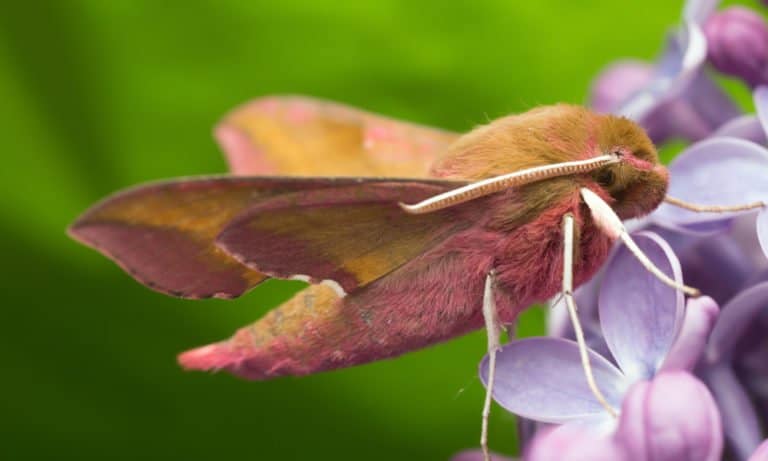
Elephant hawk-moth Deilephila elpenor
Deaths-head hawkmoth Acherontia atropos
Gypsy moth (spongy moth) Lymantria dispar
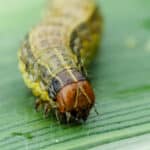
Fall armyworm
Fall armyworm Spodoptera frugiperda
Cotton bollworm / corn earworm Helicoverpa armigera
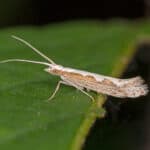
Diamondback moth
Diamondback moth Plutella xylostella
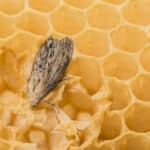
Greater wax moth
Greater wax moth Galleria mellonella
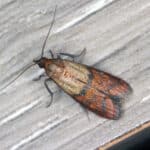
Indianmeal moth
Indianmeal moth Plodia interpunctella
Webbing clothes moth Tineola bisselliella
Old world swallowtail Papilio machaon

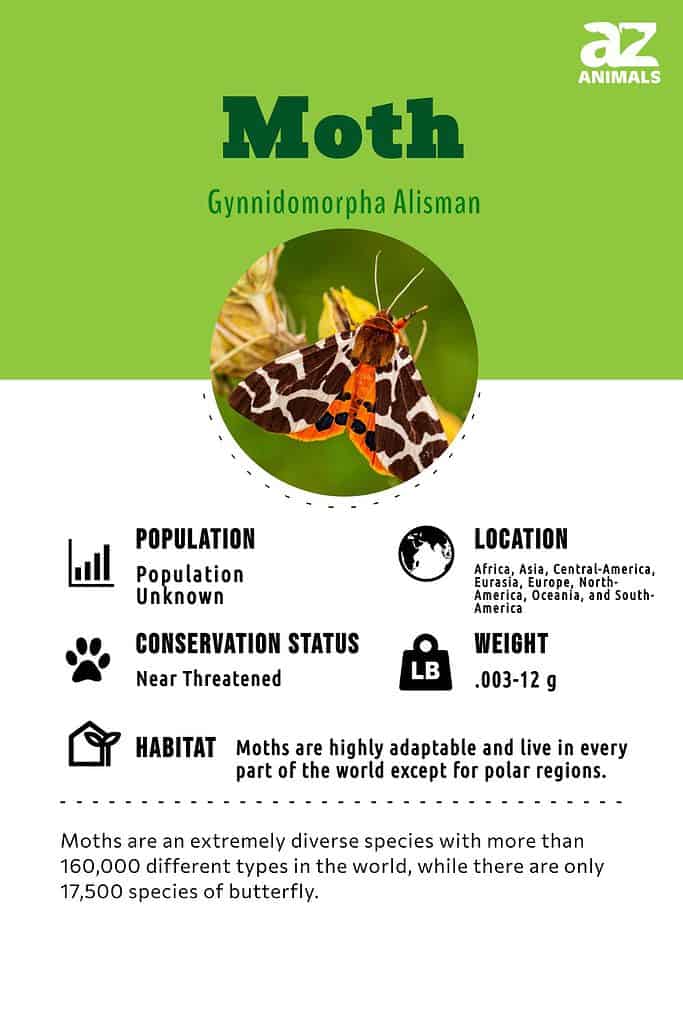
Moths are an extremely diverse species with more than 160,000 different types in the world, while there are only 17,500 species of butterfly.

Most types of moths are nocturnal (active at night). During the day, they hide under the leaves of trees or find a way to get into a dark attic or basement of a home.

Fully-grown moths survive on a liquid diet of tree sap, flower nectar, and even juice from a piece of rotting fruit. These insects only live an average of 40 days.

5 Interesting Moth Facts
regal moth on bark

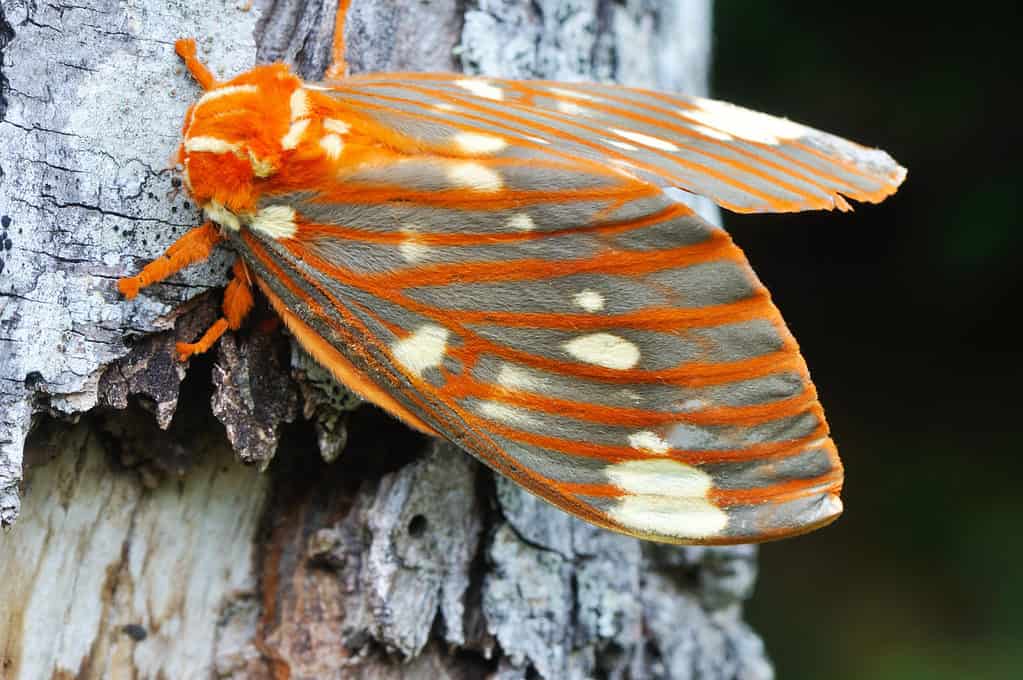
While the regal moth may not be the largest, it still maintains nearly 6 inches of wingspan!

• Some moths measure less than an inch while other species have a wingspan of 11 inches.

• These insects move pollen from flower to flower just like butterflies.

• Males have an excellent sense of smell.

• A Luna moth doesn’t have a mouth and can’t eat, so it only lives about a week.

• When they see an electric light it gets confused, loses direction, and fly into the glow.

You can check out more interesting facts about moths.

Evolution and Origins

Which came first, the moth or the butterfly? Moths evolved way before butterflies did. Moth fossils have been found that may be close to 200 million years old.

Moths and butterflies are thought to have co-evolved with flowering plants, mainly because modern species, both as adults and larvae, feed on flowering plants.

Additionally, eggs from light moths morph into light moths and dark moth eggs turned to dark adults. The dark color was caused by a mutation in the DNA of one single moth.

Scientific Name
Garden Tiger Moth

Gynnidomorpha alisman is the scientific name for these insects.

Gynnidomorpha alisman is the scientific name for these insects. Moths belong to the Insecta class and are in the Saturniidae family. Both moths and butterflies belong to the order Lepidoptera. This comes from Greek words meaning scale (lepis) and wing (pteron).

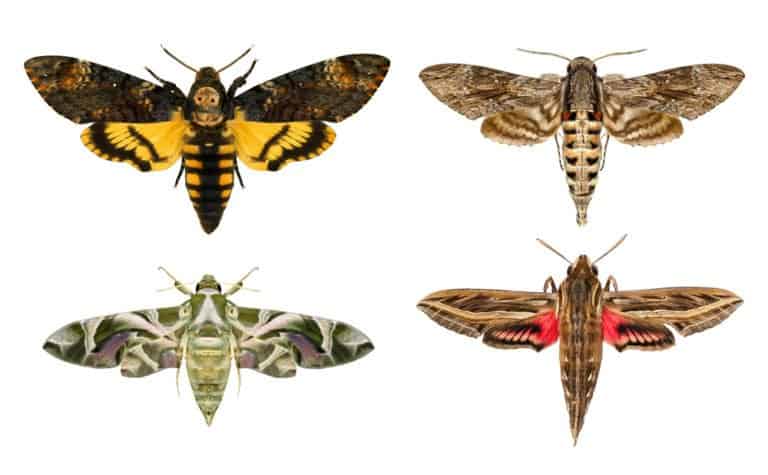
There are thousands of subspecies of moth. Some examples include the gypsy -, Luna -, Isabella tiger -, Bella -, cecropia -, hummingbird -, hawk -, Atlas -, and puss moth.

Common Types of Moths

  • Gypsy Moth – Gypsy moths have cream-colored to brownish-grey bodies with dark brown zigzag markings on their wings. They are considered one of the most destructive pests in the world due to their consumption of over 500 different species of trees, shrubs, and plants.
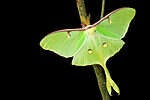
  • Luna Moth – The Luna moth has a white body with lime green-colored wings. These moths are often preyed upon by bats and as a defense mechanism, they spin their elongated tails around which is believed to confuse the bat’s echolocation.
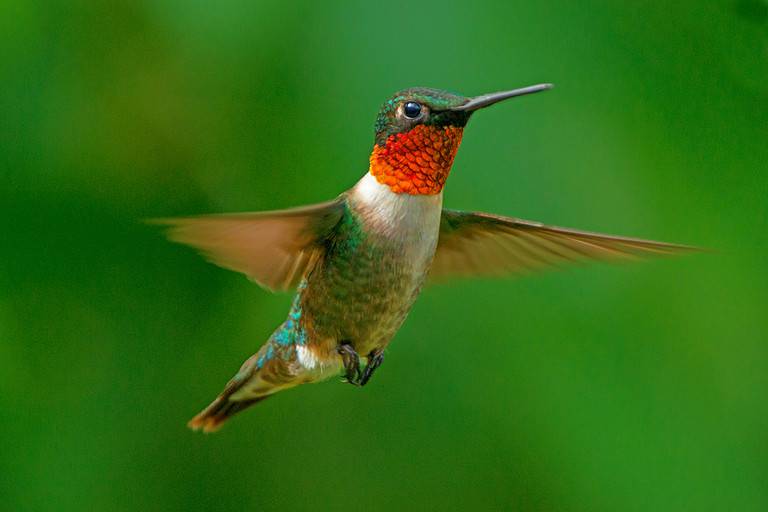
  • Hummingbird Moth – Hummingbird moths have bodies like bumblebees and are often mistaken for actual hummingbirds. This moth has a wingbeat of up to 70 beats per second and can travel up to speeds of 12 miles per hour.
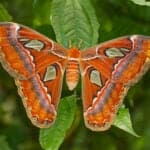
  • Atlas Moth – Atlas moths are one of the largest lepidopterans, with wingspans reaching more than 9 inches long. They have small bodies and reddish-brown wings with black, white, pink, and purple patterns.
  • Puss Moth – The puss moth is a fluffy-looking moth with whitish-grey bodies with black bands and yellowish-grey wings. When attacked, these moths will fight back, squirting formic acid from whips attached to their wings.

Additionally, here is a full list of moth types:

Appearance and Behavior

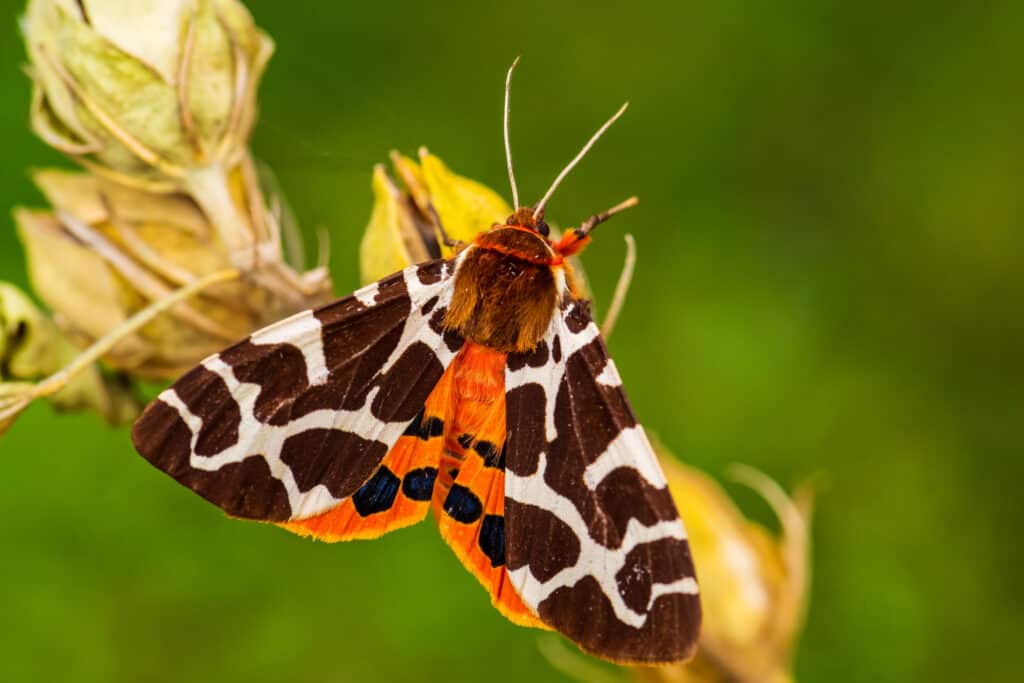
Garden Tiger Moth

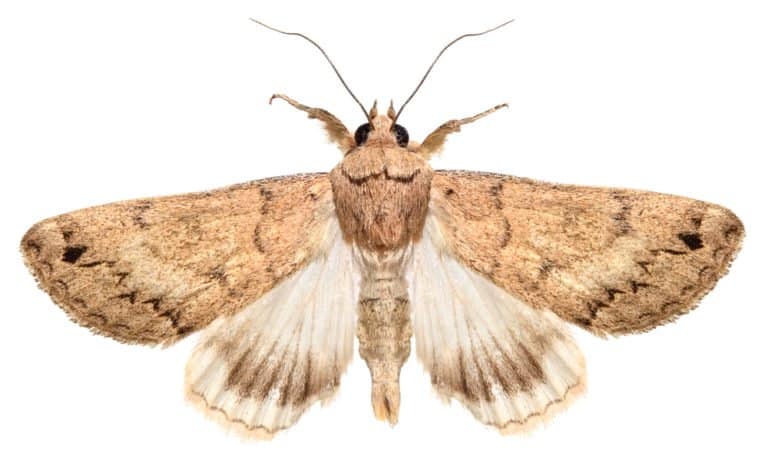
A moth’s body is covered in scales, that look like small hairs. Giving them the appearance of being furry.

A moth’s body is covered in scales, that look like small hairs. It has two antennae that look almost like small feathers attached to its head. They have one large wing and one smaller wing on both sides of their body. They have six legs and two tiny dark eyes designed to see things at night.

The size of the moth depends on what type of moth it is. A Cecropia moth is the largest species of moth in North America. It has a wingspan of five to six inches and weighs around two or three grams. A Cecropia moth with its wings spread out would be equal to half the length of a wooden ruler you may use in school. Its weight would be equal to a small cotton ball.

Some of these insects, like the Luna moth, have a wingspan of two to four inches whereas a really tiny one, such as the pigmy moth, has a wingspan of just four millimeters. Put three tiny grains of sand from the beach together and you have the length of a Pigmy moth!

An Atlas moth is one of the largest moths in the world with a wingspan of a little over nine inches. A line of 16 nickels is about equal in size to the wingspan of an Atlas moth. This moth is about the same size as the world’s largest butterfly, Queen Alexandra’s birdwing. This butterfly lives in Papua New Guinea and has a wingspan of almost ten inches.

The color of the moth also varies depending on its species. For instance, the body of a puss moth is white. It has gray spots on its head and gray swirling designs on its wings. This moth earned its name because its scales are furry making it look like a cat. Alternatively, a male Gypsy moth has dark brown scales, while a female’s scales are white and black.

The colorful designs on this insect’s body aren’t just for show. A moth’s colorful design can help it to hide from predators. The color of an angle shades moth allows it to look exactly like a brown leaf hanging from a tree. A brown Gypsy moth can easily blend in with the dark bark of a tree.

Sometimes a moth’s appearance can scare a predator away. For example, a Lunar Hornet moth’s appearance is remarkably similar to a hornet’s. Many predators see it and mistake it for an insect that can sting! Not surprisingly, they keep their distance. In addition, a hummingbird moth (like the name says) looks a lot like a hummingbird. So, many predators are fooled into believing it’s a bird and not a moth.

These are solitary, shy insects. They have many predators, so they like to remain hidden whenever possible.

Habitat
Moth on black background

Moths live everywhere on Earth except for the polar regions.

Moths are highly adaptable and live in every part of the world except for polar regions. There are more than 11,000 species of them in the United States and 160,000 species worldwide.

They need a warm climate to survive, so moths migrate south when it grows cold in the wintertime. A moth living in the midwestern part of the United States during the summertime migrates to Mexico before the weather turns cold. Sometimes the insects will make their way into homes to get shelter during the cold winter months.

Some moths fly a very long distance during migration. As an example, a hummingbird hawk-moth leaves North Africa when the weather turns cold and makes its way to the southern coast of the United Kingdom.

Moths adapt to their environment in several ways. They have eyes that reflect the light so they can see best at night. Most of them spend the daytime in the woods or hiding in the vegetation. Their color and wing design help them blend into their surroundings (trees, leaves, bushes) when they are most vulnerable to predators during the daytime hours.

Diet
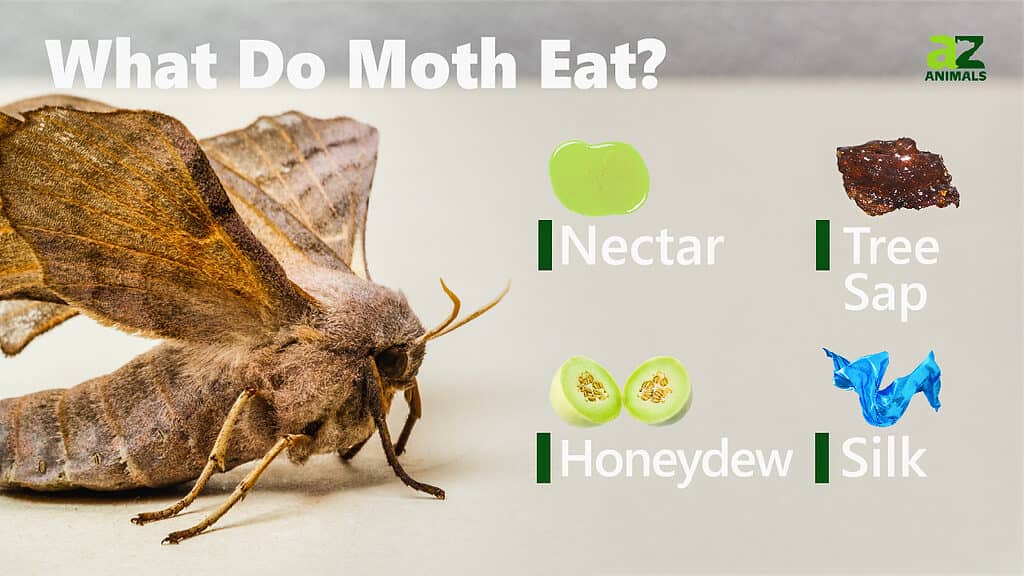
Moths eat tree sap, nectar, honeydew, and silk

The insect in caterpillar form are herbivores that eat the leaves of plants and sometimes fruit. A caterpillar may eat one large leaf per day. A fully-grown moth drinks flower nectar or sap for nourishment. Nectar is the food source of butterflies as well.

Did you know that some of these insects don’t eat at all? They don’t eat because they don’t have a mouth! One example is the luna moth. This insect doesn’t eat, so its lifespan is about one week. During that week, the insect mates to keep the species alive.

Moth caterpillars instinctively know which plants to eat. However, a caterpillar may eat plants in a garden that have been sprayed with pest control poison. When this happens, the caterpillar becomes sick and dies.

Predators and Threats
Are Bats Mammals

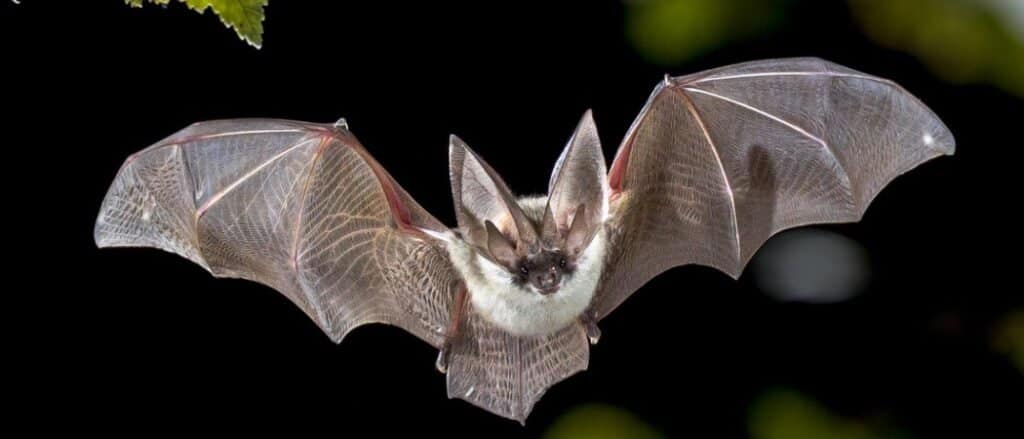
Bats are one of the main predators of these insects.

Bats are one of the main predators of these insects because both animals are active at night. A bat uses echolocation (reflected sound) to find them and swoop down to grab them.

Moths also become caught in spider webs and are eaten by spiders. If the insect flies near the ground, it could also be eaten by a toad. Other predators include lizards and birds. Sometimes they can be killed by a pet dog or cat.

These insects are attracted to porch lights, streetlights, and other lights that come on around houses and buildings at night. Sometimes they fly into the lights, so many times they fall to the ground and are picked up by a predator.

Also, when they invade the closets or wardrobes in a home, the people living there may call a pest control company or use other poisons to kill them.

The official conservation status of moths according to the International Union for the Conservation of Nature (IUCN) is threatened, although some species are more at risk than others.

Reproduction, Babies, and Lifespan
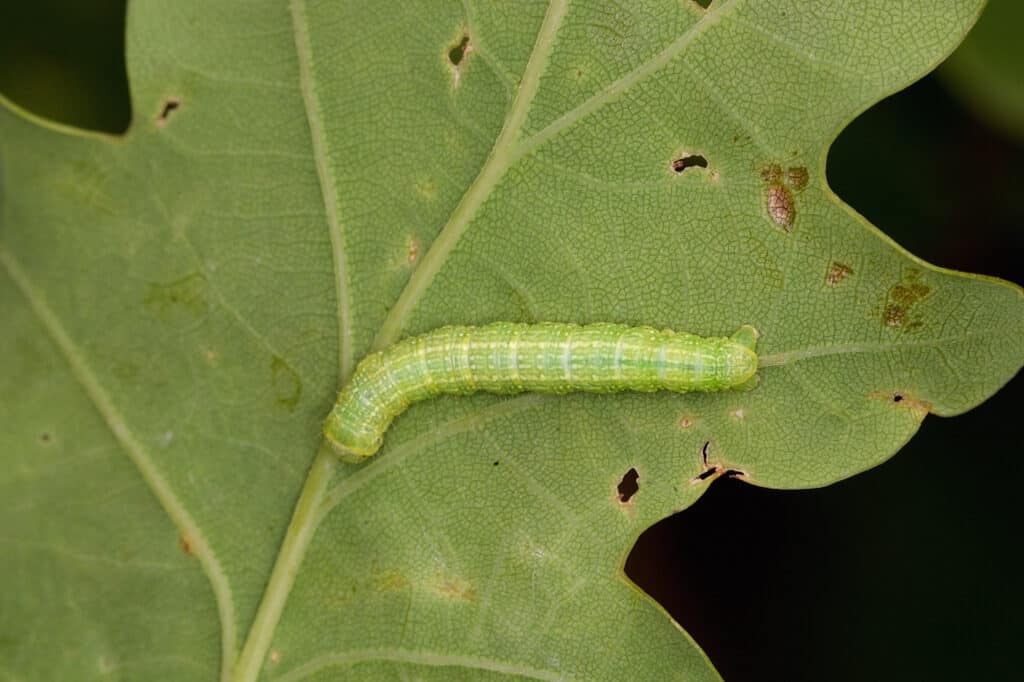
Winter Moth caterpillar

Moth females lays eggs on a plant that she knows her babies can eat once the eggs hatch.

A female releases a particular chemical scent when she is ready to mate. Males in the area pick up this scent and go to find her. After mating with a male, the female lays eggs on a plant that she knows her babies can eat once the eggs hatch into caterpillars.

The mother leaves her eggs and doesn’t return. Most eggs hatch in about 10 days. The number of eggs laid by this insect depends on her species. Some species lay 250 eggs while others lay only 50.

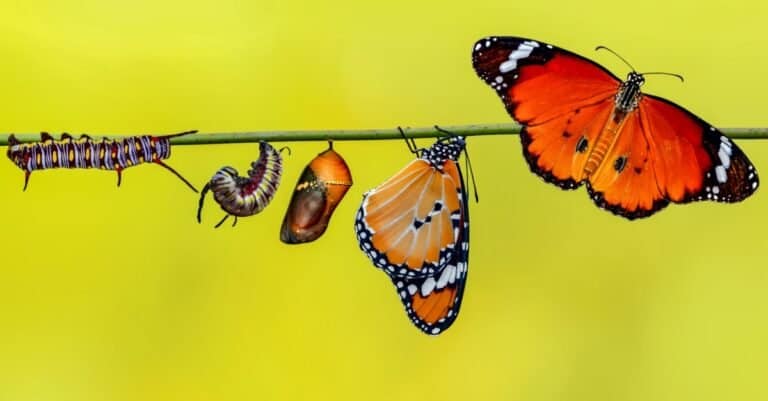
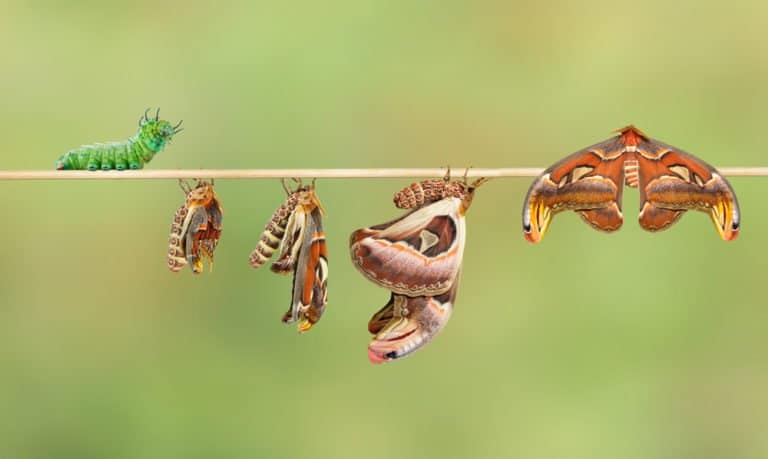
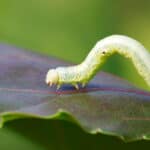
Next, the egg enters the larval or caterpillar stage. This stage lasts about seven weeks. Most caterpillars eat the shell of their egg because it contains protein and other nutrients they need to grow. Then, they start to chew on the plant leaves all around them.

Though caterpillars have limited eyesight, they use their sense of touch, smell, and taste to find more leaves to eat. They can walk around on the leaves of the plants. Caterpillars must eat leaves equaling 2,700 times their own body weight to prepare for the pupal stage.

A caterpillar moves into the pupal stage by spinning silk into a shell, or cocoon, where it stays until it becomes a moth. This stage lasts three weeks to a month. The caterpillar’s body lives on the plant leaves it ate before going into its cocoon.

Once the moth emerges from its cocoon as an adult, the average lifespan is 40 days. The specific lifespan of the insect depends on its species. An adult luna moth lives for just one week while a puss moth can live for 3 to 5 months. Hummingbirds and hawk moths can live for two or three months.

Population

There are more than 160,000 types of these insects that live throughout the world, however, their official conservation status of them is threatened. Keep in mind that some of these insects are more at risk than others. For example, the garden tiger and white ermine moth are categorized as endangered due to the loss of their woodland habitat and food sources.

Along with butterflies, bats, and bees, moths are pollinators helping plants to grow. Also, they are a food source for a variety of animals. They may be small creatures, but they are important to our ecosystem!

Similar Animals:

  • Comet Moth Want to learn more about moths? Check out why this moth is named for a celestial object.
  • Clothes Moth Not all moths are good to have around. Click here to learn about these wardrobe-eating moths.
  • Winter Moth Most moths need warm weather and migrate away from cold regions. How about the Winter Moth? Click here to find out.
View all 330 animals that start with M

Sources

  1. David Burnie, Dorling Kindersley (2011) Animal, The Definitive Visual Guide To The World's Wildlife / Accessed November 10, 2008
  2. Tom Jackson, Lorenz Books (2007) The World Encyclopedia Of Animals / Accessed November 10, 2008
  3. David Burnie, Kingfisher (2011) The Kingfisher Animal Encyclopedia / Accessed November 10, 2008
  4. Richard Mackay, University of California Press (2009) The Atlas Of Endangered Species / Accessed November 10, 2008
  5. David Burnie, Dorling Kindersley (2008) Illustrated Encyclopedia Of Animals / Accessed November 10, 2008
  6. Dorling Kindersley (2006) Dorling Kindersley Encyclopedia Of Animals / Accessed November 10, 2008
Rebecca Bales

About the Author

Rebecca Bales

Rebecca is an experienced Professional Freelancer with nearly a decade of expertise in writing SEO Content, Digital Illustrations, and Graphic Design. When not engrossed in her creative endeavors, Rebecca dedicates her time to cycling and filming her nature adventures. When not focused on her passion for creating and crafting optimized materials, she harbors a deep fascination and love for cats, jumping spiders, and pet rats.
Connect:

Thank you for reading! Have some feedback for us?


Moth FAQs (Frequently Asked Questions)

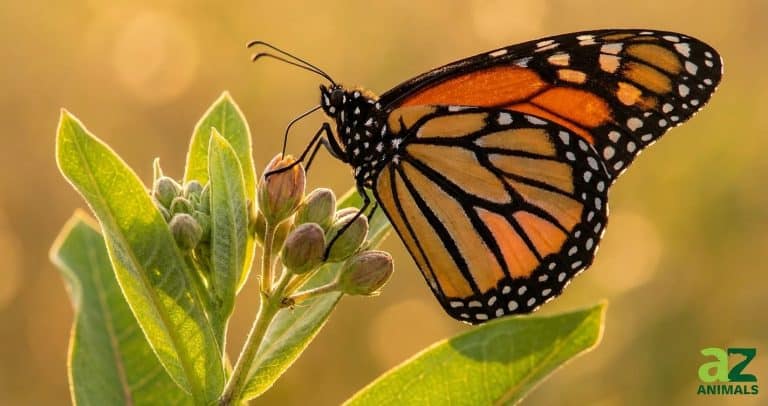
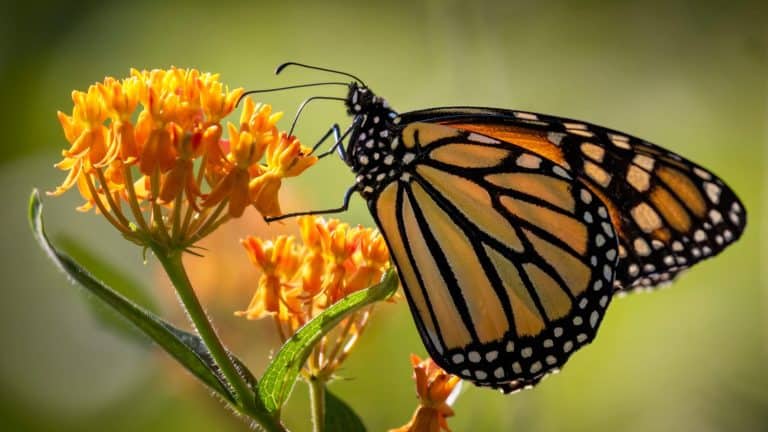
There are a few differences between moths and butterflies. One of the main differences is moths are active at night while butterflies move around during the daytime.

Also, when resting on a flower or other surface, a butterfly usually puts its wings together over its back. Alternatively, a moth spreads its wings out at its sides making it look like a tent. Another difference is a moth’s antennae have a feather-like appearance while a butterfly has thin antennae with a tiny ball on the tip of each one. A moth’s body is short and thick while a butterfly’s body is long and thin. Additionally, a moth’s upper and lower wings are joined together while a butterfly’s upper and lower wings are separate.