Salamander
Caudata
 Verified by: AZ Animals Staff
There are more than 700 different species!
Advertisement
Salamander Scientific Classification
Read our Complete Guide to Classification of Animals.
Salamander Conservation Status
Salamander Facts
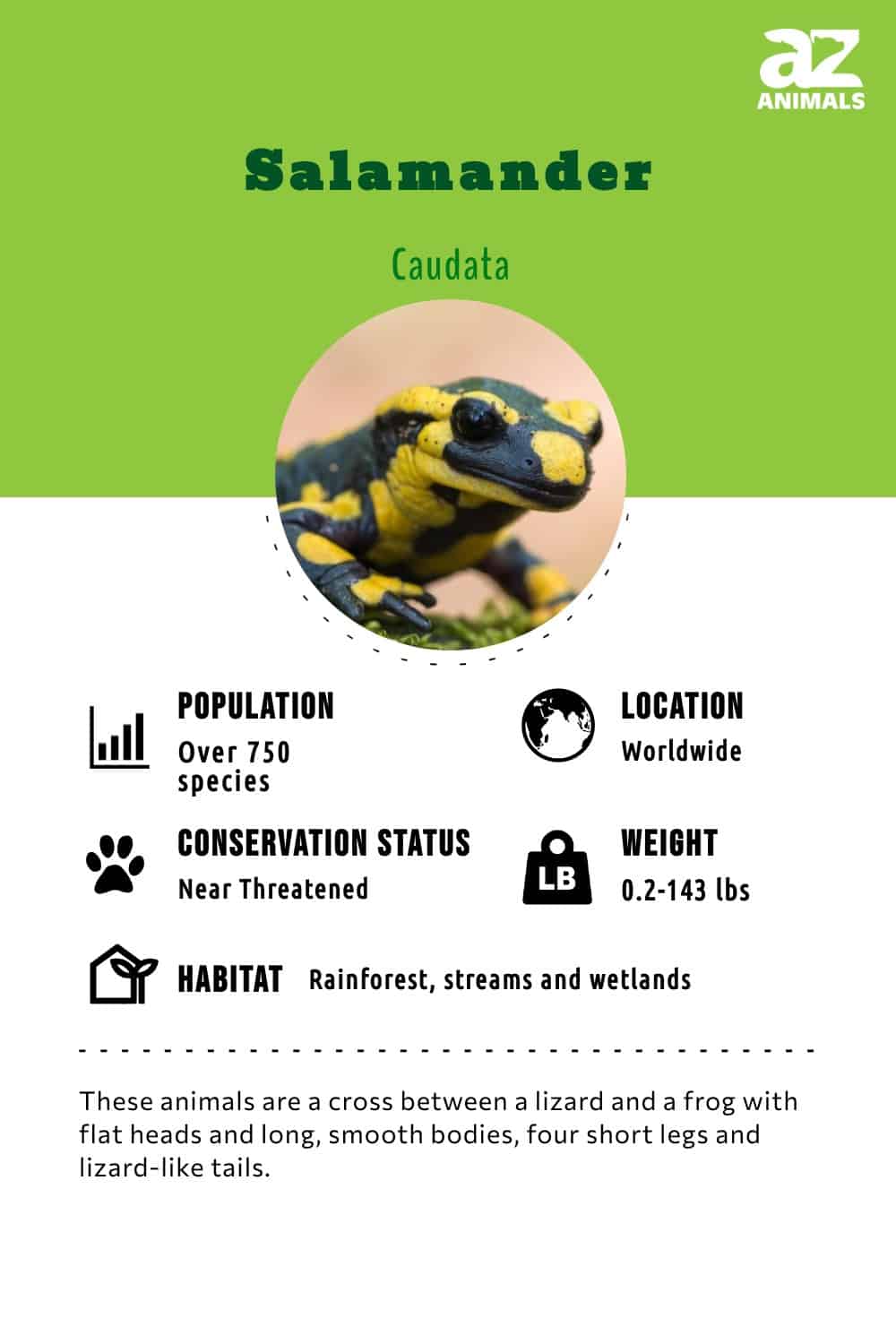
- Main Prey
- Fish, Mice, Insects
- Habitat
- Rainforest, streams and wetlands
- Predators
- Fish, Snakes, Birds
- Diet
- Carnivore
- Average Litter Size
- 300

 © tristan tan/Shutterstock.com
View all of the Salamander images!



How to Add Us to Google News


“Some species of salamander can lay up to 450 eggs at one time”
There are 600-plus species of salamander in the world. Salamanders are carnivores that are active at night. Many salamanders burrow in the mud to make their home under a rock near a body of water. Some species of salamander lay eggs while others give birth to live babies. Most salamanders live an average of ten years, but this varies according to species.
5 Salamander Facts
- All salamanders must keep their skin wet and cool to survive.
- Salamanders can’t hear sound, but they can feel vibrations in the ground to detect movements around them.
- A salamander can regrow a tail it has lost in an attack.
- Some salamanders live under rocks while others live in trees.
- Depending on its species a salamander can be less than an inch in length or as long as 6 feet. The largest salamander in the world is the Chinese giant salamander, which can grow to 130 pounds!
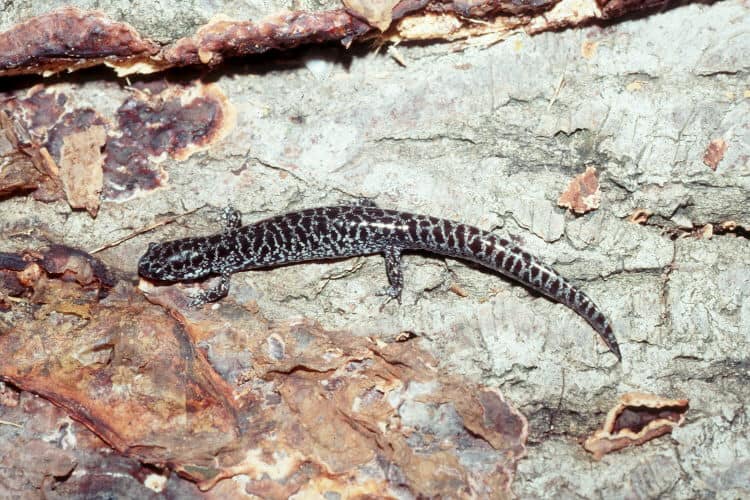
The frosted flatwoods salamander is found only in low elevations in Florida, Georgia, and South Carolina.
©USGS / public domain – License
Scientific Name
Salamander is the common name for this amphibian, while Caudata is its scientific name. Salamanders belong to the Salamandroidea family and belong to the class of Amphibia. Salamanders have several other names including mud puppy, water dog, triton, and spring lizard.
The word salamander comes from the Greek word Salamandra meaning fire lizard. This relates to an old belief that the yellow and black fire salamander has the power to live in fire.
There are several subspecies of salamander. The fire Salamander, the tiger salamander, the Chinese Giant salamander, the Mole salamander, and the Marbled salamander are just a few examples.
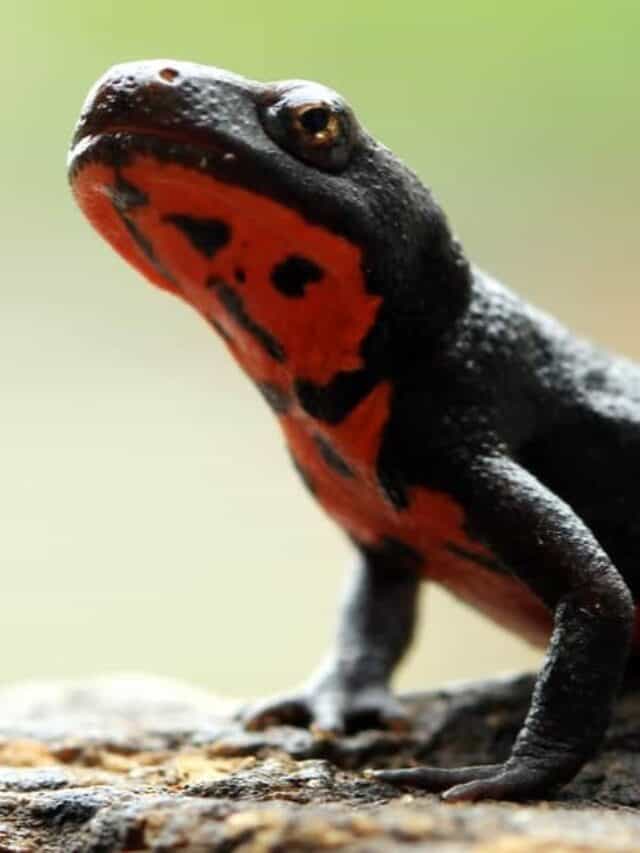
Salamanders have several other names including mud puppy, water dog, triton, and spring lizard.
©Kurit afshen/Shutterstock.com
History and Evolution
The salamander has been included into legends and myths from around the world. You can find giant salamanders in Japanese stories no doubt due to their large size and dragon-like appearance. Many other cultures associate salamanders as fire-dwelling creatures and claim that their skin is fire-resistant. The reason for these untrue beliefs probably comes from the tendency for salamanders to go into rotten logs in search for food, and then, when those logs are added to a lit fire for additional fuel, the salamander suddenly appears from the flames of the fire without humans realizing from where they came.
For their evolution, there are some discrepancies as to how and when salamanders evolved and diverged from common ancestors. There are two groups from which they descend. The Cryptobranchoidea family contains the giant and the Asiatic salamanders, while the Salamandroidea family holds all of the rest of the salamanders. Some researchers theorize that the siren salamanders, the Sirenidae, are an offshoot from the rest of the Salamandroidea family.
Appearance and Behavior
Next time you see a salamander, take a moment to study it. These creatures look like a cross between a lizard and a frog. Its flat head looks kind of like a frog’s head while its long, smooth body, four short legs, and tail look like a lizard’s. Though there are similarities between lizards and salamanders, a lizard is a reptile and a salamander is an amphibian.
A salamander’s color depends on its species. Many salamanders are solid brown or green. A fire salamander is black with yellow splotches while a tiger salamander has greenish-yellow skin with black stripes. A Chinese giant salamander has dark brownish-red skin with dark speckles.
A brightly colored salamander isn’t just pretty to look at, its bright colors are a signal to predators to stay away. These salamanders have glands in their neck or tail that release poison if the amphibian is grabbed by a predator. Instinctively, most predators know to steer clear of brightly colored salamanders. This is the same with other types of amphibians such as the colorful poison dart frog.
The majority of salamanders measure about 2 to 6 inches long and weigh in the range of 3 to 8 ounces. As an example, a salamander that’s 6 inches long is equal in length to a pencil you might use in school. Furthermore, a salamander weighing 8 ounces is the same weight as a hamster in a pet shop.
The largest salamander in the world is the Chinese giant salamander. It can grow to be almost 6 feet in length and weigh 110 pounds/ This salamander is equal in length to a full-size bed. At 110 pounds, this salamander weighs about the same as 4 bars of gold!
The largest salamander on record was found in 1920 and measured 5.9 feet long. The smallest known salamander is called the Thorius and grows to be less than an inch long. This salamander is smaller than a matchstick!
While many brightly colored salamanders can release poison from glands on their neck or tail, other salamanders have a skin color that blends in with their environment. Salamanders also have the ability to grow back their tail. So, if a predator captures a salamander it can drop its tail in order to escape! These are all excellent defensive features that protect salamanders from predators.
Salamanders are solitary creatures except when it’s mating season. These amphibians, especially the small ones, like to stay hidden. The only time a salamander may become aggressive is during the breeding season while males are competing for mates.
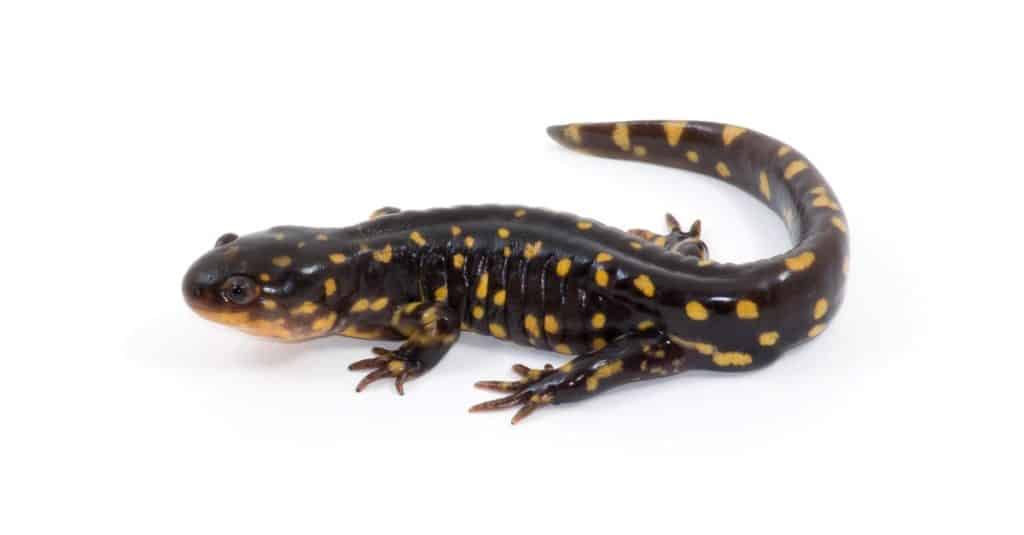
Salamanders look like a cross between a lizard and a frog, with a flat head that looks like a frog’s head while its long, smooth body, four short legs, and tail look like a lizard’s.
©Gerald A. DeBoer/Shutterstock.com
Types of Salamanders
There are over 700 different types of salamanders in the world, and they are organized into ten families, which are split into a few groups. Here are just a few examples of them!
Giant Salamanders
- Hellbender (Cryptobranchus alleganiensis) – These are one of the giant salamanders. Some giant salamanders belong to the Cryptobranchidae family. Cryptobrachus is Greek for “hidden gill” because these salamanders lose their gills when they become adults. Other giant salamanders are members of the Andrias genus. Andrias is Greek for “statue.”
- Hida Salamander (Hynobius kimurae) – Also called Hondo salamanders, this family is known as the Asiatic salamanders. These amphibians can be found in the forests of Japan, and they lay iridescent eggs.
Advanced Salamanders
- Marbled Salamander (Ambystoma opacum) – These fall under the category of Mole salamanders, which find their habitats in damp woodlands and under logs. They typically only go into the water to breed. To ward off predators, these salamanders have poison glands.
- Two-toed Amphiuma (Amphiuma means) – These aquatic salamanders are found throughout the southeastern U.S. and have vestigial legs that end in two toes. Interestingly, they can produce auditory clicks at short distances that are used as communication among other salamanders.
- Red-backed Salamander (Plethodon cinereus) – The Red-backed is on of fifty salamanders in this family. They are also known as Lungless Salamanders because they lack lungs. They obtain the air and gas that they need by absorbing it through their skin. Because of this, they must remain in a moist environment or else dryness will severely damage their porous outer layer of skin.
- Olm (Proteus anguinus) – One of the only strictly aquatic salamanders, are found in caves in the Alps. This family of amphibians are also referred to as Mudpuppies. Because they live their entire lives in darkness, they are sightless and their other sensory organs have evolved to help them survive underwater in caves.
- Southern Torrent Salamander (Rhyacotriton variegatus) – One of the Torrent salamanders, these are found in the Pacific Northwestern United States. They are one of the smaller examples of salamanders. Their bodies are somewhat fragile and susceptible to changes in their environment, so they dwell where the temperatures and humidity are just perfect for survival. They take an extraordinarily long time to reach sexual maturity.
- Alpine Newt (Ichthyosaura alpestris) – These colorful salamanders originally come from continental Europe, and, despite their name, exist in both high and low altitudes. They typically live in forests but move towards more wet environments to reproduce.
Sirens
- Greater Siren (Siren lacertina) – One of the largest salamanders, these animals can be found in the Southwestern United States coastal plains. They have small lungs and external gills that they rely on for their whole lives. Scientists believe that they also can sense electrical field disturbances and utilize a lateral line system and Jacobson’s organ to help them navigate their surroundings.
Habitat
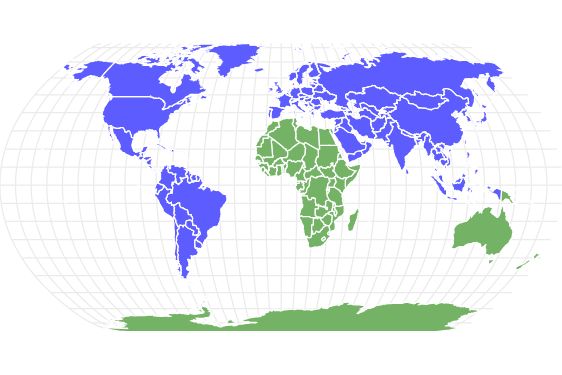
Salamanders live all over the world, including Europe, Asia, North America and South America. But, the United States has the largest population of salamanders.
Some salamanders live on land part of the time and in the water part of the time while other salamanders stay in the water. Many salamanders make their homes under rocks located near creeks, ponds and lakes. Others live in trees in a rainforest in the Amazon basin and climb down to visit a nearby body of water.
The giant salamander from China lives underwater in fast-moving rivers. Its brownish-gray, splotched coloring helps it to blend in with the rocks near the bottom of a river. Though this salamander lives underwater, it doesn’t have any gills like a fish. Instead, the oxygen it needs to breathe is absorbed through its skin.
There are even a few species of salamander such as the olm that live in caves and spend their lives in underground pools of water. The olm’s eyes have adapted allowing them to survive in such a dark environment.
Most salamanders live near water because that’s where they lay their eggs.
In early spring, many salamanders migrate from the trees down to the forest floor so they can make their way to the nearest body of water to breed.
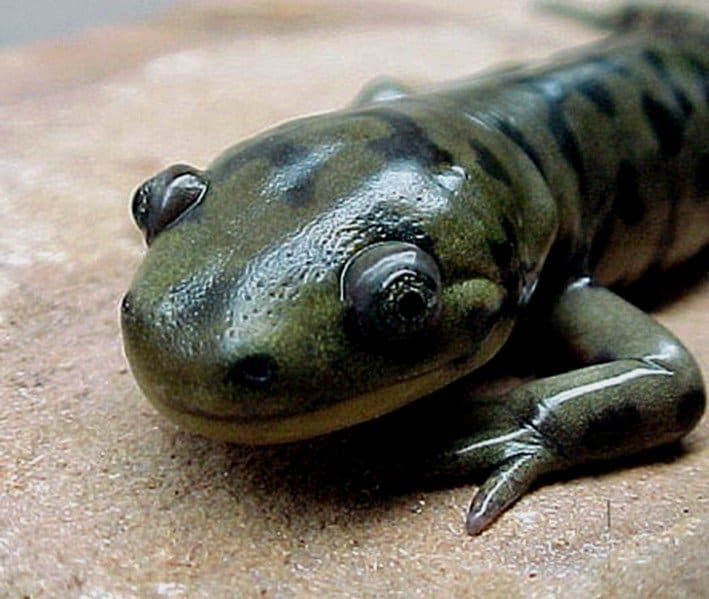
Most salamanders live near water because that’s where they lay their eggs.
Diet
What do salamanders eat? The answer to this question depends on what species of salamander you’re looking at. Though all salamanders are carnivores, some have larger items on the menu than others!
Small salamanders such as fire salamanders or spotted salamanders eat worms, spiders, snails, and slugs. A larger salamander such as the tiger salamander may eat small fish or crayfish. A really big salamander like the Chinese giant salamander dines on frogs, fish, shrimp, and crabs.
Salamanders are nocturnal so they hunt at night and may only eat a few times per week depending on their size. Generally, the larger the salamander, the more often it will need to eat. For a complete list of foods salamanders eat, check out our “What Do Salamanders Eat?” page.

Predators and Threats
As you may have guessed, the smaller species of salamander have more predators than the larger species. For instance, some of the predators that hunt the small spotted salamander include raccoons, skunks, snakes, and turtles. Raccoons and skunks spend time looking for food near creeks and ponds where they dig under rocks. This is commonplace to find salamanders.
Humans are predators to the Chinese salamanders. These large salamanders can end up in the nets of fisherman and sold for food or as pets.
Salamanders that live in the forests of the Amazon basin are at risk of losing their habitat when parts of the forest are cleared by humans. Also, water pollution that makes its way into lakes and creeks can affect the population of salamanders that live and breed there. Unfortunately, some salamanders try to cross busy roads to get to a nearby body of water and end up being killed by cars.
The conservation status of salamanders is Threatened. More efforts are needed to protect salamanders from losing their habitat and being taken from their environment and sold.
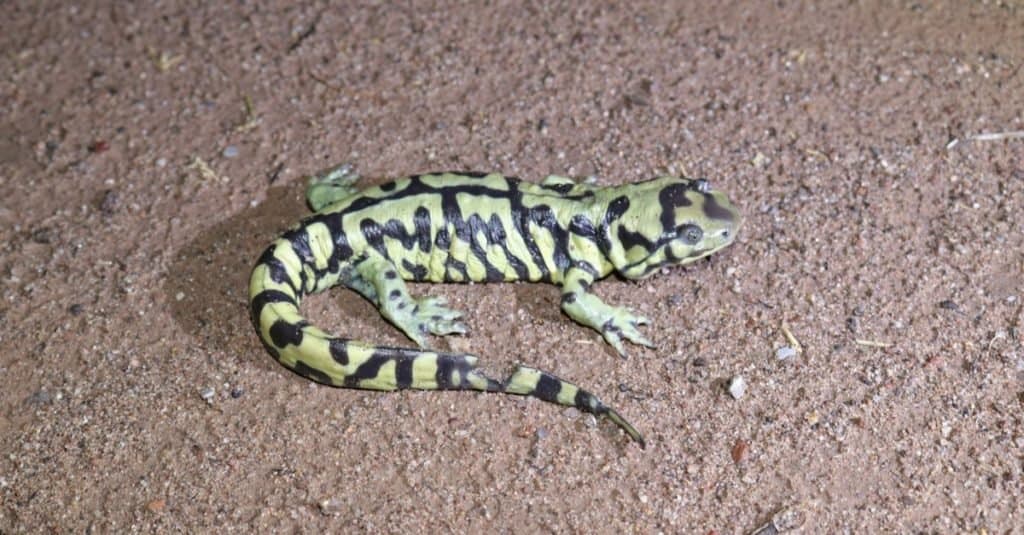
Animals that hunt the small spotted salamander include raccoons, skunks, snakes, and turtles.
©Creeping Things/Shutterstock.com
Reproduction, Babies and Lifespan
Male salamanders compete for the attention of females by releasing a scent. Once the male finds a suitable female, they mate resulting in fertilized eggs. The female lays the jelly-like, shell-less eggs in a body of water and the babies hatch in about 3 to 4 weeks. The average amount of eggs laid by a salamander is 300 though some species lay 450 or more.
There are some salamanders that give birth to live babies instead of laying eggs. The Black Alpine salamander and the fire salamander are two examples. The female Alpine salamander can be pregnant from 2 to 3 years and has just two babies.
The female salamander may stay and protect the eggs or leave after laying them. Once they hatch, the baby salamanders are on their own.
If you walk by a collection of baby salamanders near a creek you may mistake them for tadpoles or frog babies. Tadpoles and baby salamanders, also called salamander nymphs, look a lot alike. During the first three months of their lives, salamander nymphs breathe through gills, then slowly develop lungs. They survive by eating tiny insects floating by in the water. After about 3 months, the young salamanders make a home on land near the water.
Female salamanders lay hundreds of eggs in a creek, pond or other body of water. As you might expect, these tiny eggs are vulnerable to many predators including raccoons, skunks and fish. Just imagine a large fish or snake coming along and swallowing half or more of the eggs laid by a salamander! So, laying a large number of eggs helps increase the chances that at least some of the salamanders will survive into adulthood.
The lifespan of salamanders ranges from 5 to 20 years. A salamander with several predators is likely to have a shorter lifespan than a large salamander with a defensive feature such as the ability to release poison from its glands.
The two oldest salamanders on record lived in the Artis Zoo in Amsterdam. Both were Japanese salamanders that lived to be 52 years old.
An illness that can affect a salamander’s lifespan is a bacteria called Bsal. It is a fungus that spreads quickly among salamanders kept together.
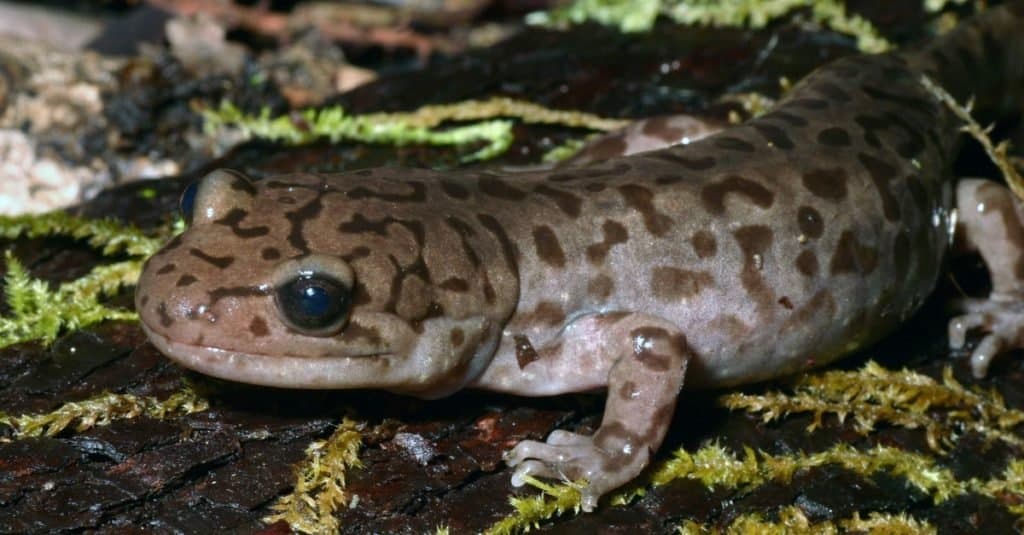
Some types of salamanders birth to live babies instead of laying eggs.
©Michael Benard/Shutterstock.com
Population
Though there are many species and millions of salamanders in the world, their population is still regarded as Threatened. Loss of habitat, water pollution, and poaching by humans all contribute to a decreasing population among the species.
View all 293 animals that start with S How to Add Us to Google News

Salamander FAQs (Frequently Asked Questions)
Salamanders vs Newts
While salamanders have adapted to live most of their life on land, news live almost exclusively in water. Other differences that separate newts vs salamanders include their lifespans, feet, and tails.
Are salamanders carnivores, herbivores or omnivores?
Salamanders are carnivores no matter how big or small they are. After a collection of salamander eggs hatch, the salamander nymphs eat tiny invertebrate insects floating by in the water. As adults, salamanders eat everything from snails and worms to crayfish, shrimp and frogs.
Where do salamanders live?
Salamanders live in North America, South America, Europe, Asia and Central America. Some of them live in trees while others live under rocks. Salamanders must keep their skin moist and cool, so they normally live near a creek, pond, river or other body of water.
Are salamanders dangerous?
They can be. Some salamanders can release poison through glands on their body that may be harmful to humans. A person may pick up a salamander, get a little poison on their fingers, then rub their eyes. This would likely cause eye and skin irritation. Eating salamanders is risky because parts of them are poisonous. However, there are countries where it’s common for people to cook salamanders and eat them. As far as their behavior goes salamanders like to stay in hiding and aren’t aggressive creatures.
Can you keep a salamander as a pet?
Yes, you can keep a salamander as a pet. But, a salamander requires special care unlike other types of pets. For one thing, they need to be kept in an environment ranging from 55 to 65 degrees. Plus, their skin needs to be cool and moist at all times, so they remain healthy. Sometimes salamanders sold in pet shops can carry bacteria and other illnesses. This means you may be buying a salamander that is in poor health to begin with due to the way it’s been kept and handled. Furthermore, these amphibians need a certain type of food to stay nourished. You shouldn’t handle a salamander too often because human touch can be hard on its delicate skin.
In the end, it may be better to learn all you can about these amazing amphibians and admire them from their proper home in the wild.
What Kingdom do Salamanders belong to?
Salamanders belong to the Kingdom Animalia.
What phylum do Salamanders belong to?
Salamanders belong to the phylum Chordata.
What class do Salamanders belong to?
Salamanders belong to the class Amphibia.
What family do Salamanders belong to?
Salamanders belong to the family Salamandroidea.
What order do Salamanders belong to?
Salamanders belong to the order Caudata.
What type of covering do Salamanders have?
Salamanders are covered in Permeable Scales.
What is the main prey for Salamanders?
Salamanders prey on fish, mice, and insects.
What are some predators of Salamanders?
Predators of Salamanders include fish, snakes, and birds.
What is the average litter size for a Salamander?
The average litter size for a Salamander is 300.
What is an interesting fact about Salamanders?
There are more than 700 different Salamander species!
What is the scientific name for the Salamander?
The scientific name for the Salamander is Caudata.
What is the lifespan of a Salamander?
Salamanders can live for 5 to 20 years.
How do Salamanders have babies?
Salamanders lay eggs.
What is the difference between a gecko and a salamander?
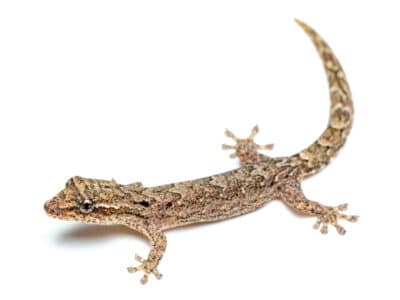
The main differences between a salamander and a gecko include their size, skins, diet, habitat, and training. Geckos may be very similar to salamanders in body shape and color patterns, but that is where their similarities end. Geckos are reptiles with over 1,500 species, while salamanders are amphibians with over 550 species. Since the two animals are from different classes, they are expected to vary in reproduction processes. Unlike salamander eggs with no shell, geckos produce shelled, amniotic eggs that prevent them from desiccating.
Thank you for reading! Have some feedback for us? Contact the AZ Animals editorial team.
Sources
- David Burnie, Dorling Kindersley (2011) Animal, The Definitive Visual Guide To The World's Wildlife
- Tom Jackson, Lorenz Books (2007) The World Encyclopedia Of Animals
- David Burnie, Kingfisher (2011) The Kingfisher Animal Encyclopedia
- Richard Mackay, University of California Press (2009) The Atlas Of Endangered Species
- David Burnie, Dorling Kindersley (2008) Illustrated Encyclopedia Of Animals
- Dorling Kindersley (2006) Dorling Kindersley Encyclopedia Of Animals