

T
Species Profile

Tasmanian Devil

Sarcophilus harrisii

Small island, huge bite.
Wayne McLean ( jgritz) / CC BY-SA 2.5

Tasmanian Devil Distribution

Click a location to explore more animals from that region

Endemic Species
Loading map...
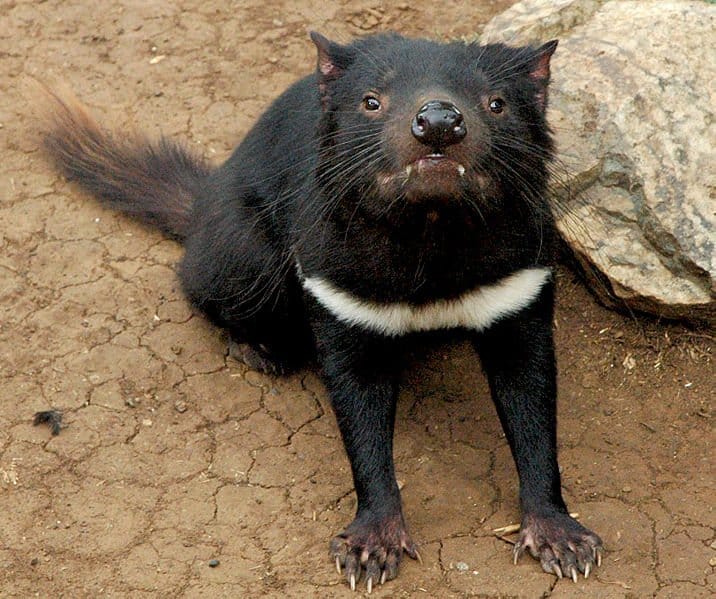
Tasmanian Devil with open mouth

At a Glance

Wild Species
Also Known As Devil, Native devil, Marsupial devil
Diet Scavenger
Activity Nocturnal+
Lifespan 6 years
Weight 12 lbs
Status Endangered
Did You Know?

Size: head-body length 57-65 cm; tail 24-30 cm (typical adult measurements reported in species accounts).

Scientific Classification

The Tasmanian devil is the largest living carnivorous marsupial, known for powerful jaws, loud vocalizations, and scavenging as well as active predation on small to medium prey.

Kingdom
Animalia
Phylum
Chordata
Class
Mammalia
Order
Dasyuromorphia
Family
Dasyuridae
Genus
Sarcophilus
Species
Sarcophilus harrisii

Distinguishing Features

  • Stocky, black-furred marsupial with a relatively large head and very strong bite force
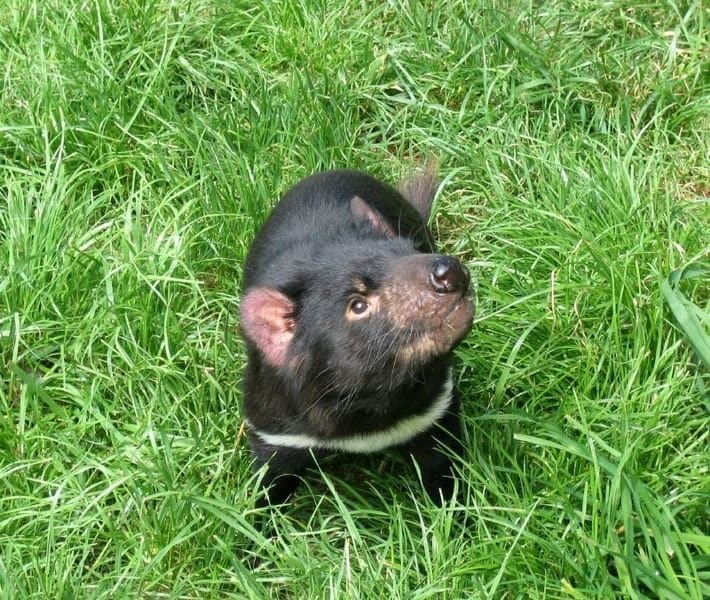
  • Often has a white chest patch and sometimes white rump markings
  • Nocturnal/crepuscular; emits distinctive screeches, growls, and ‘coughing’ calls during feeding interactions
  • Carrion-feeding behavior with robust teeth suited for crushing bone

Physical Measurements

Males and females differ in size

Height
♀ 11 in (10 in – 12 in)
Length
♂ 2 ft 11 in (2 ft 8 in – 3 ft 1 in)
♀ 2 ft 7 in (2 ft 5 in – 2 ft 10 in)
Weight
♂ 23 lbs (18 lbs – 31 lbs)
♀ 11 lbs (9 lbs – 13 lbs)
Tail Length
♂ 11 in (10 in – 12 in)
♀ 10 in (9 in – 10 in)
Top Speed
15 mph
running

Appearance

Primary Colors
Secondary Colors
Skin Type Short, coarse fur over thick skin; dense underfur seasonally; females have rear-opening marsupial pouch.
Distinctive Features
  • Largest living carnivorous marsupial; endemic to Tasmania; robust, low-slung body adapted for scavenging/predation.
  • Head-body length: 57-65 cm; tail length: 23-30 cm (adult).
  • Adult mass: males typically 8-14 kg; females typically 6-9 kg.
  • Stocky head with broad muzzle; exceptionally strong bite force for body size; large crushing molars for bone and carrion.
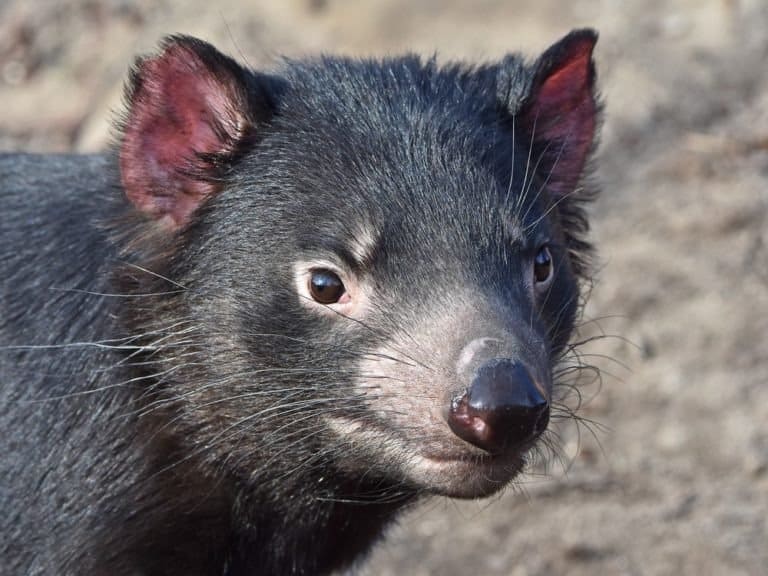
  • Large, rounded ears; often visibly redden; prominent vibrissae (whiskers) around muzzle.
  • Thick-based tail used for fat storage; tail condition reflects nutritional status.
  • Nocturnal/crepuscular; often feeds socially at carcasses with loud vocalizations (growls, screeches).
  • Frequent facial scarring from intraspecific biting during feeding and mating interactions.
  • Denning in burrows/log hollows/rock shelters; females nurse young in pouch, then in dens as they grow.
  • Key threat: Devil Facial Tumour Disease (DFTD) causes facial masses that can visibly deform appearance; conservation includes insurance populations and translocations.

Sexual Dimorphism

Males are substantially larger and more muscular, with broader heads and thicker necks; females are smaller and possess a rear-opening pouch with four nipples for rearing young. Both sexes share the same black-and-white patch pattern variability.

♂
  • Heavier build: typically 8-14 kg; broader skull and jaw musculature.
  • Thicker neck and shoulders; more pronounced head width and cheek musculature.
  • Often exhibits more extensive facial/neck scarring from competitive interactions.
♀
  • Lighter build: typically 6-9 kg; relatively narrower head and neck.
  • Rear-opening marsupial pouch; four nipples (limits litter size to four surviving young).
  • Mammary development and pouch enlargement during breeding/lactation periods.

Did You Know?

Size: head-body length 57-65 cm; tail 24-30 cm (typical adult measurements reported in species accounts).

Mass: males commonly 8-12 kg; females ~6-8 kg (sexual dimorphism is strong).

Lifespan: typically ~5-6 years in the wild; up to ~8 years in captivity (zoo records/species profiles).

Reproduction: gestation ~21 days; litters can exceed 20 newborns, but only 4 survive to attach-females have 4 teats (marsupial constraint).

Feeding power: devils have an exceptionally high bite force for their size (often reported as among the highest bite-force quotient of any mammal).

Disease story: DFTD was first detected in 1996 and has driven severe population declines across much of Tasmania; intensive management now includes insurance populations and releases.

Ecological role: a top scavenger that can also actively hunt small-medium prey; carcass-feeding helps recycle nutrients and can reduce carrion available to feral predators.

Unique Adaptations

  • Powerful cranio-dental build: robust skull and jaw musculature enable cracking bone and consuming tough tissues-an advantage for a carrion-based niche.
  • Expandable stomach and gorging strategy: can consume a large proportion of body mass in a single feeding, buffering against unpredictable food availability.
  • Marsupial reproduction: very short gestation (~21 days) followed by prolonged development in pouch/den-allows rapid return to foraging while young develop.
  • Tough digestive/feeding ecology: ability to process skin, cartilage, and bone lets devils exploit carcasses more completely than many competitors.
  • Disease-driven conservation genetics: managed "insurance" and wild populations are used to preserve genetic diversity and support resistance/tolerance research against DFTD (a rare transmissible cancer).

Interesting Behaviors

  • Nocturnal foraging: mostly active from dusk to dawn, traveling widely to locate carrion and live prey.
  • Social feeding at carcasses: multiple devils may converge and feed together; loud vocalizations (screeches, growls, coughing/snorts) help establish dominance and spacing.
  • Opportunistic hunting: besides scavenging, they ambush or chase prey such as small mammals, birds, reptiles, and can take larger prey (often as carrion).
  • Denning and maternal care: females use dens (burrows, hollow logs, rocky cavities) for rearing; pouch young remain attached, then ride in the pouch and later remain in the den as they grow.
  • Scent communication: strong scent marking (feces/urine and gland secretions) used to advertise occupancy, reproductive status, and reduce conflict.
  • Seasonal breeding: mating peaks in the austral autumn; competition and mate-guarding can be intense, with males roaming to find receptive females.

Cultural Significance

The Tasmanian devil (Sarcophilus harrisii) is a symbol of Tasmania and a key species for conservation. Its name comes from night screams and eating dead animals. It appears in tourism, branding, media, and drives public action against DFTD with captive breeding and reintroduction.

Myths & Legends

Colonial settlers in Van Diemen's Land (Tasmania) told 'night devil' stories about frightening, strange screams from the bush at night, linking the sounds to a devil and helping the name 'Tasmanian devil' stick.

The species name Sarcophilus harrisii honors George Prideaux Robert Harris, an early figure in the colony; this naming is often told in nature stories as part of the Tasmanian devil's scientific origin story.

Local bush yarns around carcasses: historical accounts and rural folklore commonly frame devils as uncanny graveyard/bush scavengers-appearing suddenly at carrion and 'arguing' loudly-turning real feeding behavior into campfire stories about nocturnal spirits of the scrub.

Looney Tunes' Taz created a global popular culture myth of a wild, spinning 'Tasmanian Devil' (Sarcophilus harrisii), loosely based on the animal's rasping calls and feeding behavior, used in casual stories.

Conservation Status

EN Endangered

Facing a very high risk of extinction in the wild.

Population Decreasing

Protected Under

  • Environment Protection and Biodiversity Conservation Act 1999 (Australia) - listed as Endangered
  • Threatened Species Protection Act 1995 (Tasmania) - listed and managed under state threatened species provisions
  • Nature Conservation Act 2002 (Tasmania) - provides framework for wildlife protection and management
  • State and national recovery planning and the Save the Tasmanian Devil Program (disease management, insurance populations, translocations)

Life Cycle

Birth 30 joeys
Lifespan 6 years

Lifespan

In the Wild
5–8 years
In Captivity
6–8 years

Reproduction

Mating System Polygynandry
Social Structure Solitary
Breeding Pattern Transient
Fertilization Internal Fertilization
Birth Type Internal_fertilization

Seasonal breeder (Mar-May). Males fight and temporarily guard females; both sexes mate with multiple partners, and litters show multiple paternity. Internal fertilization; ~21-day gestation, with up to four pouch young (four teats) reared solely by the mother.

Behavior & Ecology

Social Feeding aggregation Group: 1
Activity Nocturnal, Crepuscular
Diet Scavenger Carrion of wallabies and wombats (large carcasses that can be monopolized and consumed extensively)

Temperament

Typically solitary and avoidance-prone; individuals overlap spatially but minimize direct encounters (Jones et al., 2007).
Highly competitive and often aggressive at carcasses; frequent vocal threats, lunges, and biting (Guiler, 1970; Pemberton, 1990).
Context-dependent dominance: larger/older animals usually displace smaller ones during feeding (Pemberton, 1990).
Breeding season increases antagonism; mate-guarding and forced copulation attempts reported (Guiler, 1970; Jones et al., 2007).
High bite frequency during social interactions documented and linked to facial-contact transmission risk (Hamede et al., 2013).

Communication

Loud snarls, growls, and rasping coughs during feeding disputes Guiler, 1970
High-pitched screeches/"devil screams" in agonistic encounters and when startled Jones et al., 2007
Grunts and harsh huffs during close-range threat and submission interactions Guiler, 1970
Scent marking with anal gland secretions; also urine and feces at latrines/travel routes Jones et al., 2007
Visual threat displays: open-mouth gape, head bobbing, and stiff-legged postures at carcasses Pemberton, 1990
Tactile signaling: nips/bites used in dominance and access disputes; increases contact rates Hamede et al., 2013

Habitat

Biomes:
Temperate Forest Temperate Rainforest Temperate Grassland
Terrain:
Island Coastal Hilly Mountainous Plains Valley Rocky +1
Elevation: Up to 4921 ft 3 in

Ecological Role

Tasmania's dominant terrestrial scavenger and a native mesopredator that links carrion resources to higher trophic levels.

Rapid carcass removal and reduction of carrion persistence Nutrient recycling/redistribution via consumption and scat deposition Potential suppression of some scavengers/mesopredators at carcasses through interference competition (e.g., reducing access by feral cats) Support of ecosystem hygiene by reducing resources that can subsidize pest scavengers and some disease vectors

Diet Details

Main Prey:
Carrion of medium-sized marsupials Common wombat Tasmanian pademelon Brushtail possum and other small-medium mammals European rabbit Birds Reptiles Large invertebrates +2

Human Interaction

Domestication Status

Wild

Tasmanian devil (Sarcophilus harrisii) is not domesticated and has no known domestication path. All kept animals are wild stock held in captivity for display and conservation breeding. Human contact is mainly conservation work (especially for devil facial tumour disease), wildlife tourism, roadkill conflict, and occasional scavenging near towns. Dasyurids are not domesticated.

Danger Level

Low
  • Bite injury if handled or cornered (powerful jaws; frequent intraspecific aggressive biting behavior during feeding).
  • Scratches/lacerations during restraint or capture.
  • Potential exposure to enteric bacteria from carrion-associated feeding (general zoonotic hygiene risk when handling wildlife/carcasses).
  • Vehicle-collision risk to people indirectly via road hazards (devils are often struck while scavenging roadkill).

As a Pet

Not Suitable as Pet

Legality: Tasmanian devil (Sarcophilus harrisii) is usually not legal as a private pet. It is protected in Australia and Endangered (IUCN). Keeping or trade needs permits and is limited to zoos and approved conservation programs.

Care Level: Expert Only

Purchase Cost:
Lifetime Cost: $50,000 - $200,000

Economic Value

Uses:
Ecotourism and wildlife viewing Conservation breeding and reintroduction programs Research value (wildlife disease, cancer biology, immunogenetics, ecology) Ecosystem services (scavenging/carcass removal)
Products:
  • No legal commercial animal products; value is primarily non-consumptive (tourism, research, conservation programming).

Relationships

Predators 4

Wedge-tailed eagle Aquila audax
Tasmanian masked owl Tyto novaehollandiae castanops
Spotted-tailed quoll Dasyurus maculatus
Dog
Dog Canis lupus familiaris

Related Species 6

Pleistocene Tasmanian devil Sarcophilus laniarius Shared Genus
Moorna Tasmanian devil Sarcophilus moornaensis Shared Genus
Spotted-tailed quoll Dasyurus maculatus Shared Family
Eastern quoll Dasyurus viverrinus Shared Family
Western quoll Dasyurus geoffroii Shared Family
Tasmanian antechinus Antechinus swainsonii Shared Family

Ecological Equivalents 7

Animals that fill a similar ecological role in their ecosystem

Spotted-tailed quoll Dasyurus maculatus Nocturnal Tasmanian marsupial carnivore and scavenger that eats small to medium animals and carrion. Shares habitat and diet with the Tasmanian devil (Sarcophilus harrisii); quolls do more active hunting while devils crush bones, and they often feed together.
Eastern quoll Dasyurus viverrinus Tasmanian mesocarnivore occupying a similar nocturnal ground-foraging niche (invertebrates, small vertebrates, and carrion). It overlaps behaviorally with devils in scavenging opportunities, though it typically targets smaller prey and is more insectivorous than devils.
Thylacine Thylacinus cynocephalus Extinct Tasmanian apex/large mesopredator that likely overlapped historically with devils through scavenging and predation on similar vertebrates (wallabies, possums, birds). Devils fill part of the carrion-processing niche created by large predators but are smaller-bodied and more specialized for scavenging.
Dingo
Dingo Canis lupus dingo Ecological analogue on mainland Australia: a medium-sized mammalian carnivore that scavenges and preys on similar-sized vertebrates. Unlike devils (which are marsupials), dingoes are placental canids and typically hunt more cooperatively, enabling them to function as true apex predators where present.
Striped hyena
Striped hyena Hyaena hyaena Similar scavenger role: Tasmanian devils are sturdy-jawed carrion specialists that can crush bone. They are smaller than striped hyenas but have very strong bites for their size (bite force quotient ≈181) and feed loudly in crowded carcass groups, like hyenas.
Wolverine
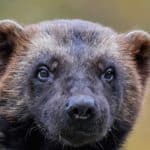
Wolverine Gulo gulo Convergent, solitary, wide-ranging scavenger-predator that exploits carrion and can subdue prey near its own size; both are known for strong cranial musculature, vigorous feeding behavior, and aggressive interactions at food resources.
Numbat
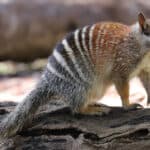
Numbat Myrmecobius fasciatus Shares membership in Dasyuromorphia but occupies a contrasting niche: a specialized diurnal termitivore. Included as a useful ecological comparator within the same order to highlight how Tasmanian devils are the order's large-bodied vertebrate carnivore/scavenger extreme.

“Tasmanian Devils let out a sneeze to scare away animals that want to fight”

A Tasmanian Devil is a marsupial. They are nocturnal animals, hunting for prey at night. These mammals are carnivores eating birds, insects, frogs, and carrion (dead animals). Tasmanian Devils live a solitary life. They can reach the age of around five years old in the wild.

Incredible Tasmanian Devil Facts!

  • These mammals live on an island called Tasmania
  • They sleep in caves and hollow logs during the day
  • This marsupial can open its jaws 80 degrees (very wide!) to consume its prey
  • Baby Tasmanian Devils are called imps or joeys

You can check out more incredible facts about Tasmanian devils.
Scientific Name

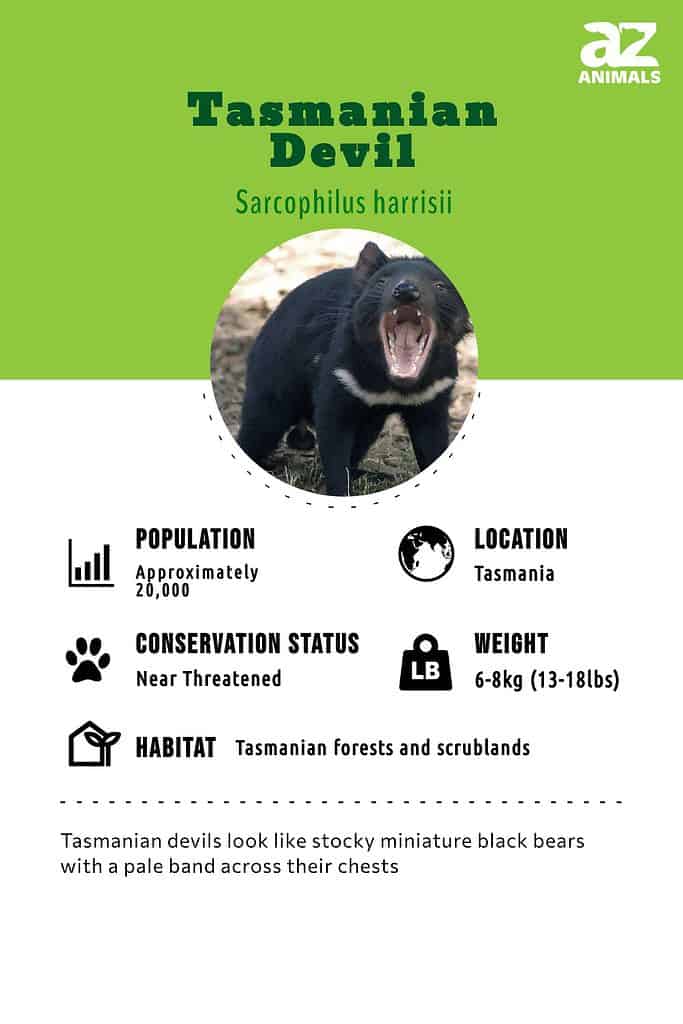
A Tasmanian Devil’s scientific name is Sarcophilus harrisii. They are sometimes called bear devils because they look like miniature bears. The first part of its scientific name, Sarcophilus, is a combination of a couple Greek words. Sarc means flesh and philus (philo) means love. This refers to these animal’s love for eating meat. Harrisii is Latin for Harris. George Harris was the name of the naturalist who first published a description of a Tasmanian Devil in 1807.

Its family classification is Dasyuridae and it’s in the Mammalia class. Tasmanian Devils are in the same family classification as another marsupial living in Australia called a quoll. Quolls are sometimes called native cats.

Evolution
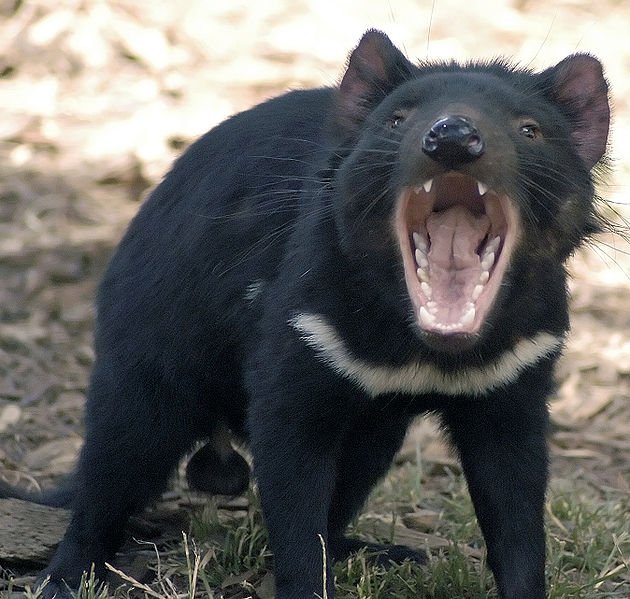
Tasmanian Devil with open mouth

Tasmanian devils were able to survive by moving to higher ground millions of years ago

According to experts a drastic drop in the marsupial population occurred about 14 million years ago. The result was the transformation of forests to woodlands.

Marsupials such as Tasmanian devils and quolls were able to survive the change in climate by moving to dryer wooded regions. About 80 other marsupial species were also able to survive in this manner.

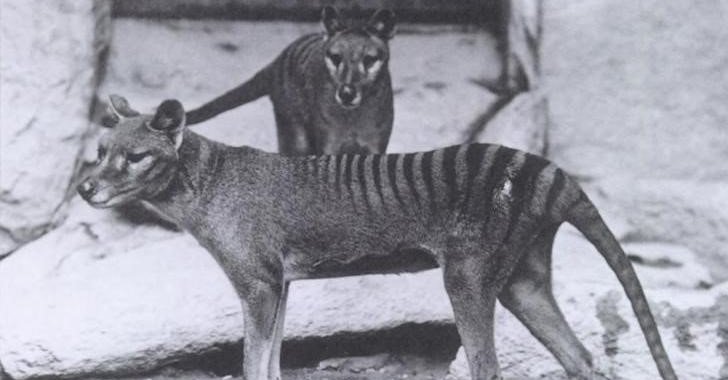
Today their descendants roam free in Australia and New Guinea. The thylacines, a group of carnivorous marsupials, weren’t that lucky and became extinct for the most part.

Appearance and Behavior
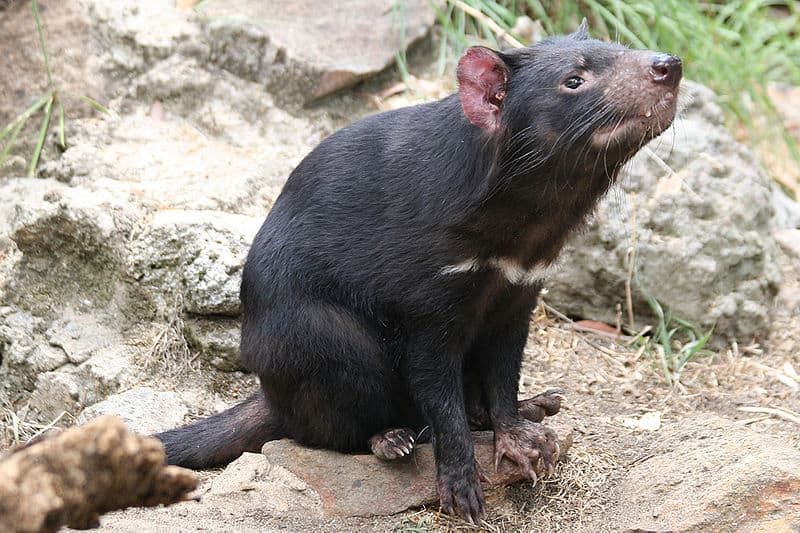
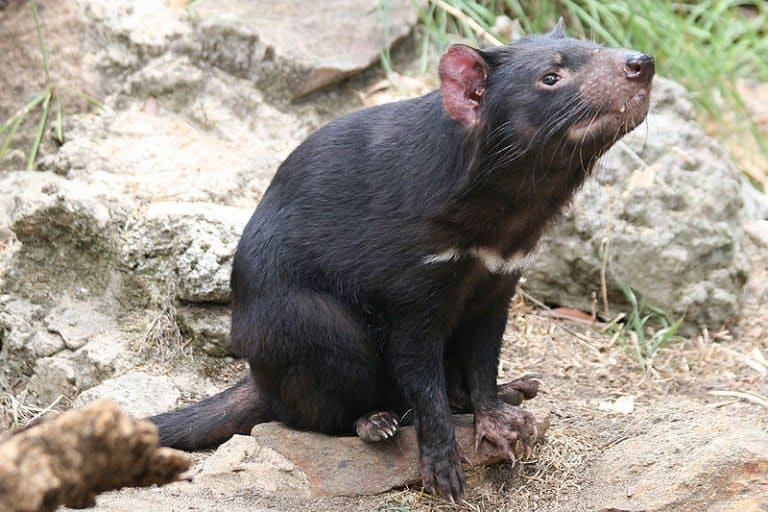
Tasmanian Devil sitting on rocks

Tasmanian devils hold the title of the largest meat-eating marsupials on the globe

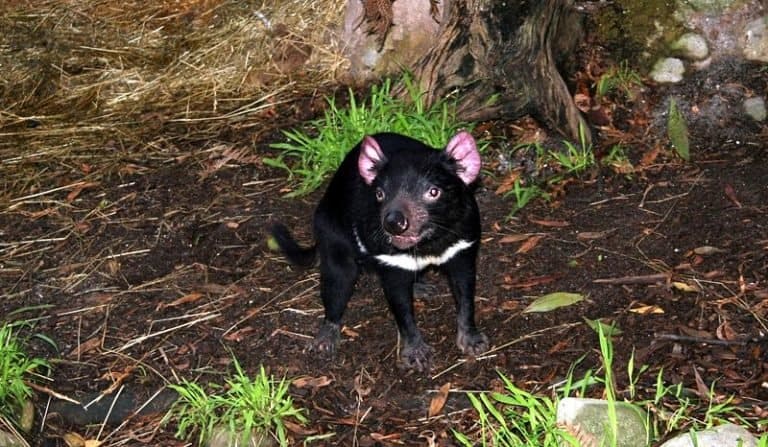
A Tasmanian Devil is a small animal with short brown or black fur with a stripe of white hair across its chest. Some of these marsupials have patches of white hair near their dark tail. This marsupial’s front legs are longer than its back ones. They have dark eyes and small mouselike ears. These animals have excellent sight and hearing allowing them to track down prey at night.

They are known for their very strong jaws. In fact, this marsupial’s jaws have a bite force of 94 pounds. That strong bite force allows them to easily consume the meat, hair, bones, and organs of the dead animals they find. Some scientists refer to Tasmanian Devils as environmental vacuums because they clean up the carcasses they find in their habitat.

Tasmanian Devils are the largest carnivorous marsupial in the world. They have held this title for over 80 years! Specifically, these creatures weigh between 9 and 29 pounds. A Tasmanian Devil weighing 29 pounds is as heavy as three one-gallon cans of paint. These mammals range from 20 to 31 inches long. Picture two bowling pins lined up end to end and you have the length of a 31-inch Tasmanian Devil. This mammal’s tail is equal to half of its body length. These animals store fat in their tail to use for energy. So, if you see one of these animals with a thick tail, you know it’s healthy.

One of this marsupial’s defensive features is it can release an odor if it feels threatened. This is similar to what a skunk does when it feels afraid. Young Tasmanian Devils are excellent at climbing trees to escape predators. These animals can run up to eight miles per hour which gives them a good chance at making it safely to a hiding place.

These animals are solitary mammals. However, they do have a reputation for being aggressive. You probably know the Tasmanian Devil from the popular Bugs Bunny cartoon. That rambunctious character never stood still! In reality, these animals are only aggressive when interacting with other Tasmanian Devils while feeding on prey. They snarl, screech, scream and growl at each other as they circle a carcass and try to steal the biggest piece. Every animal eating the dead prey wants to have dominance over the whole group. Can you imagine how noisy it gets when a large number of these animals gather for a meal?

When two Tasmanian Devils clash, they open their mouths to reveal their teeth, growl, and screech at one another. Their ears turn red when they’re nose to nose with another Tasmanian Devil. They may even let out a sneeze at their opponent. Why? Letting out a sneeze is an effort to scare off the other animal to avoid a fight. Their reputation for being fierce has a lot to do with the screeching noises they make at each other.

Tasmanian Devil Habitat
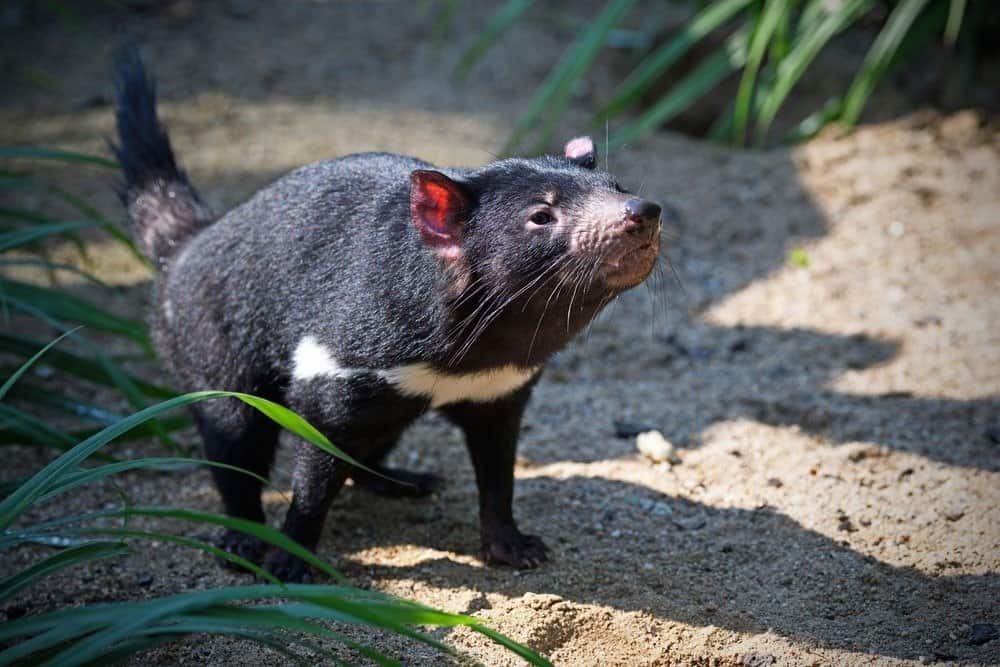
Tasmanian devil walks on path sniffing

Tasmanian devils are nocturnal and prefer to remain in a particular area

Tasmanian Devils live in Tasmania. Tasmania is an island state of Australia. They used to inhabit the continent of Australia, but their population decreased until none were left on the mainland. They live in the scrublands and forests of Tasmania. The climate is mild with low to moderate rainfall.

During the day, these animals sleep in hollow logs, dens, or burrows. At night, they come out to look for prey. Their dark fur helps them to blend into their environment while they move around outside of their shelter. These animals don’t migrate, staying in the same area throughout the seasons.

Tasmanian Devil Diet
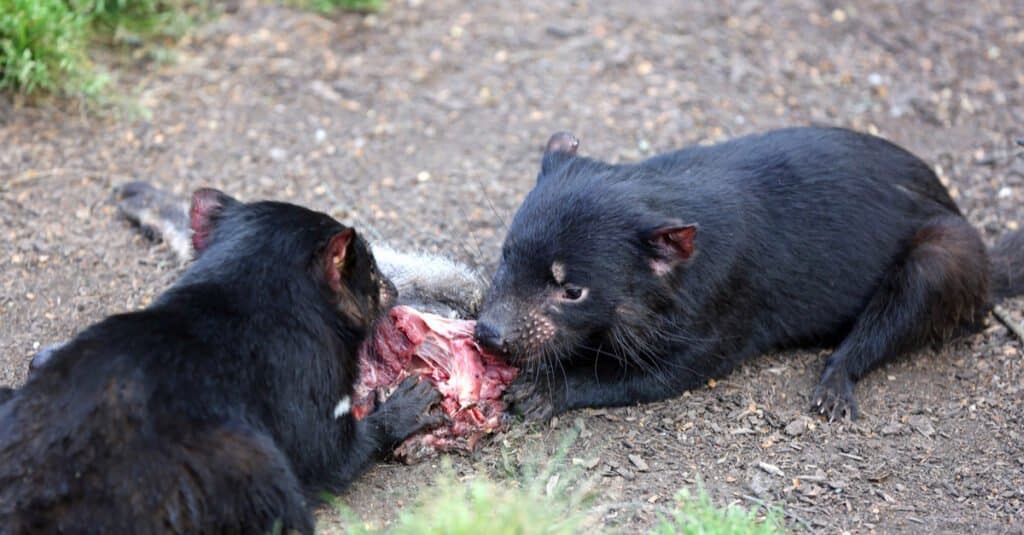
What do Tasmanian Devils Eat - Tasmanian Devils Eating

Tasmanian devils are extremely fond of meaty fare and can eat up to 40% of their body weight

What do Tasmanian Devils eat? They eat birds, frogs, and insects. They are known as scavengers meaning they eat prey that other animals have killed. Sometimes these mammals travel up to ten miles in search of food. They can eat all sorts of animals and are likely to consume the prey that’s most plentiful in their habitat. In short, these animals are not picky eaters!

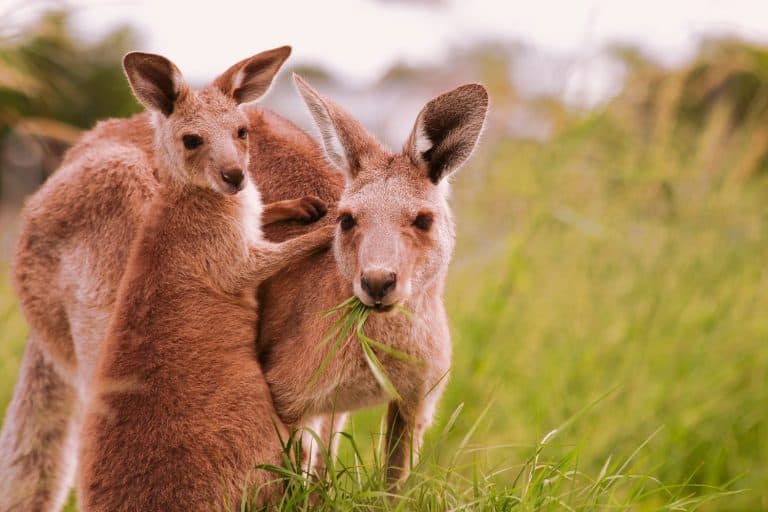
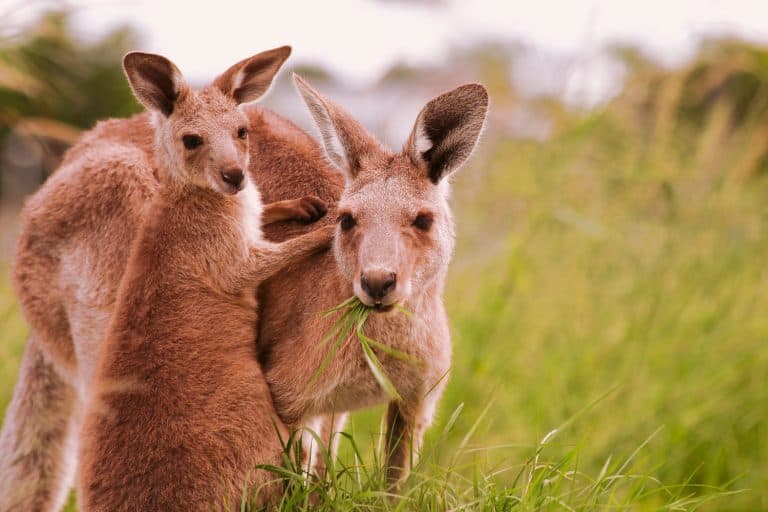
Carnivorous marsupial is the classification for Tasmanian Devils. This is a rare thing. Just think of some other well-known marsupials such as koala bears, wombats and, of course, kangaroos. All of those marsupials are herbivores. They have teeth designed to eat plants and grasses whereas a Tasmanian Devil has teeth and jaws made to break up meat, bones, etc.

Normally, a Tasmanian Devil eats about 20% of its body weight. So, a 20-pound Tasmanian Devil would eat around four pounds of food during a feeding period. Four pounds of food equals the weight of one-fourth of a bowling ball. Some of these animals can eat up to 40% of their body weight!

Tasmanian Devil Predators and Threats
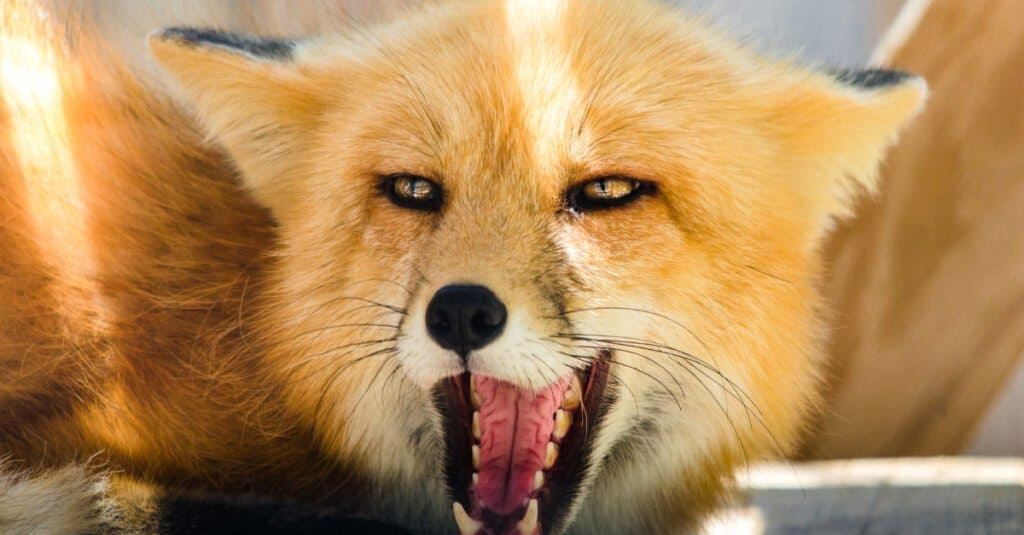
Fox Teeth- Barking Red Fox

Foxes may hunt Tasmanian devils

Foxes and domesticated dogs are predators of the Tasmanian Devil. Sometimes these animals wander onto farms in an effort to capture chickens or other small livestock. A large dog living on the farm is likely to attack a Tasmanian Devil it finds in its territory.

The Tasmanian wedge-tailed eagle shares the same habitat as this animal. The eagle and Tasmanian Devil may clash with one another when they are both trying to scavenge the same dead prey.

These animals are killed by cars while trying to cross roads. These creatures are active at night so a driver going down the road may not see them trying to cross. Also, these creatures are losing their habitat to construction and expanding farmlands.

These marsupials are vulnerable to deadly facial tumors that are passed when one of these animals takes a bite out of another. These rare cancerous facial tumors are the biggest health threat to these animals. The tumors that grow on its face and mouth prevent the animal from eating causing it to starve.

Considering all of these threats it’s no surprise that the official conservation status of the Tasmanian Devil is Endangered. Their population is decreasing. Fortunately, they are protected by Tasmania’s Threatened Species Protection Act.

Tasmanian Devil Reproduction, Babies and Lifespan
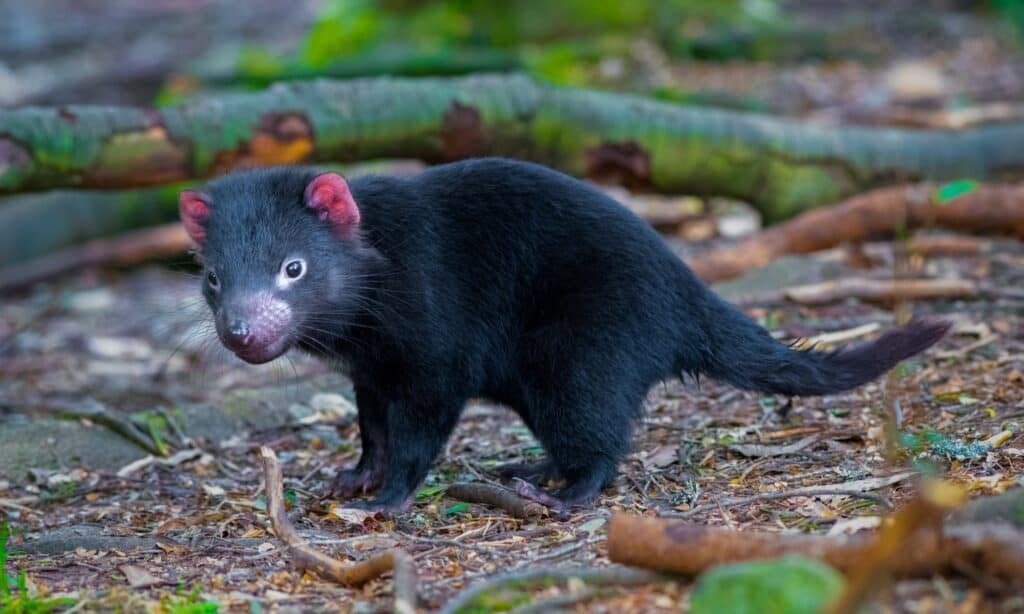
Baby Tasmanian devils are cared for by their mothers

The breeding season goes from February to April. When a female is ready to mate she leaves a scent on trees throughout the habitat for males to find. Males detect this scent and fight with other males for the attention of the female. The strongest, most dominant male wins. Male and female Tasmanian Devils have multiple partners throughout their lives.

The gestation period of a female is approximately three weeks. She can have up to 50 babies in one litter. Each baby is blind, hairless, and weighs about one-tenth of an ounce. This is about the size of a raisin! The newborns immediately crawl into their mother’s pouch. Most of the newborns will not survive. A female can only feed four newborns. So only the strongest and fastest babies have access to their mother’s milk.

Baby Tasmanian Devils are called imps or joeys. As a note, baby wombats, kangaroos, and koala bears are also known as joeys. These joeys stay with their mother for the first four months of their life. At 50 to 60 days old, each joey’s coat is growing quickly and at 80 to 90 days old their eyes open. When the joeys grow too large to stay in their mother’s pouch, they hang onto her back or tummy while she climbs trees and makes her way around the scrublands. It’s not unusual for a joey to drag along the ground as it clings to its mother’s belly!

Females care for the joeys on her own. After four months, they are left in the female’s burrow or den while they are weaned. At eight months, they are ready to leave their mother and live independently. Young joeys are fast and able to climb trees without a misstep.

Tasmanian Devils usually live to be about five years old in the wild. The oldest recorded one was named Coolah. Coolah was born in a zoo and lived to the age of seven years old in captivity.

The population of this animal is decreasing due to cancerous facial tumors called Devil Facial Tumor Disease (DFTD). This disease can be passed through a bite from another Tasmanian Devil. Fortunately, scientists are working on a vaccine that can treat this deadly cancer. When the vaccine is developed, scientists will capture these animals, give them the treatment, and then release them back into the wild. Vaccinating Tasmanian Devils means there will be fewer animals to spread this disease through a bite.

Population

The number of Tasmanian Devils has gone from 140,000 in the mid-1990s to approximately 20,000 today. The population is decreasing due to the contagious facial cancer known as DFTD. Their conservation status is: Endangered.

Tasmanian Devils in the Zoo

• These marsupials are on display at the San Diego Zoo
• Learn about them at the Saint Louis Zoo

Similar Animals

Similar Animals

  • Quolls: Deceptively cute, these marsupials are actually cousins of the voracious Tasmanian devil. Find out all about these reclusive, adaptable creatures, here.
  • Opossum: It’s the only marsupial which calls the United States and Canada home. Read all about this nimble scavenger here.
  • Quokka: It’s the smallest species of wallaby, and is incredibly adorably and tubby. Read all about the marsupial known as the happiest animal of all
View all 606 animals that start with T

Sources

  1. David Burnie, Dorling Kindersley (2011) Animal, The Definitive Visual Guide To The World's Wildlife / Accessed November 10, 2008
  2. Tom Jackson, Lorenz Books (2007) The World Encyclopedia Of Animals / Accessed November 10, 2008
  3. David Burnie, Kingfisher (2011) The Kingfisher Animal Encyclopedia / Accessed November 10, 2008
  4. Richard Mackay, University of California Press (2009) The Atlas Of Endangered Species / Accessed November 10, 2008
  5. David Burnie, Dorling Kindersley (2008) Illustrated Encyclopedia Of Animals / Accessed November 10, 2008
  6. Dorling Kindersley (2006) Dorling Kindersley Encyclopedia Of Animals / Accessed November 10, 2008
  7. David W. Macdonald, Oxford University Press (2010) The Encyclopedia Of Mammals / Accessed November 10, 2008
  8. The National Wildlife Federation / Accessed October 26, 2020
  9. National Geographic / Accessed October 26, 2020
  10. Animal Facts Encyclopedia / Accessed October 26, 2020
  11. Australian Museum / Accessed October 26, 2020
Dana Mayor

About the Author

Dana Mayor

I love good books and the occasional cartoon. I am also endlessly intrigued with the beauty of nature and find hummingbirds, puppies, and marine wildlife to be the most magical creatures of all.
Connect:

Thank you for reading! Have some feedback for us?


Tasmanian Devil FAQs (Frequently Asked Questions)

A Tasmanian Devil is a marsupial that lives on the island of Tasmania. This mammal is a carnivorous marsupial whose habitat is forests and scrublands. They can live to be around five years old in the wild. Though they have a reputation for being aggressive, they are only this way during feeding time while competing with other Tasmanian Devils for carrion.