Quick Take
- One blue jay lookalike will boldly eat right out of your hand, though it is not a blue jay at all. Meet the hand-feeding jay →
- Two of these birds share nearly identical wing markings with blue jays, making them the hardest to tell apart in the field. Compare the wing markings →
- Only one lookalike actually shares the blue jay's most iconic physical feature, though even that one still isn't a blue jay. See the crested lookalike →
- Some of these birds overlap with blue jays in the same territory, making location alone an unreliable way to identify what you're seeing. Check the overlapping range →
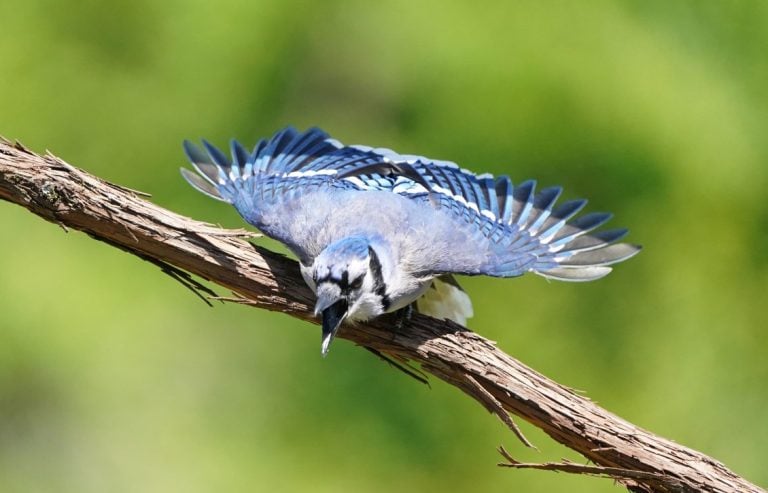
Despite their colorful appearance, blue jays (Cyanocitta cristata) are actually corvids, like crows and ravens. These birds are typically 9 to 12 inches long from beak to tail and weigh between 2.5 and 3.5 ounces. Their wingspans range from about 13 to 17 inches. Another characteristic of blue jays is a feathered crest on their heads, which they raise or lower depending on their mood. And of course, they get their name from their brilliant blue coloring. Most have pale gray underparts, blue upperparts, a blue crest, a black collar around the neck, and black barring on the wings and tail. Experts hypothesize that each blue jay has a slightly different pattern to help members of the same species identify one another.
Blue jays are widely distributed in the Eastern United States. Their range extends north into large portions of Southern Canada. While the Great Plains historically served as their western limit, blue jays have expanded farther west into Colorado, Wyoming, Montana, and parts of the Pacific Northwest. The Great Plains mark a transition zone where blue jay populations begin to thin. Though blue jays are highly recognizable, several birds do a good job of resembling them. Keep reading to learn about some of the top blue jay lookalikes and how to tell the difference.
California Scrub Jay
The California scrub jay (Aphelocoma californica) is easily mistaken for the blue jay. They belong to the same family (Corvidae) but to different genera. One way to tell them apart is by habitat. As their name implies, California scrub jays are found on the West Coast of the United States, which is outside of the blue jay’s typical territory.

California scrub jays closely resemble blue jays.
©Pierre Leclerc/Shutterstock.com
The scrub jay and blue jay are a similar size and color. However, there are a few subtle differences. The California scrub jay has grey and white patches on its stomach, while the blue jay has a distinctive black necklace marking. The California scrub jay also lacks the characteristic blue jay crest. Scrub jays tend to be bolder and have even been observed taking nuts directly from people’s hands.
Florida Scrub Jay
The Florida scrub jay (Aphelocoma coerulescens) is in the same family as the blue jay, so it is unsurprising that they look quite similar.
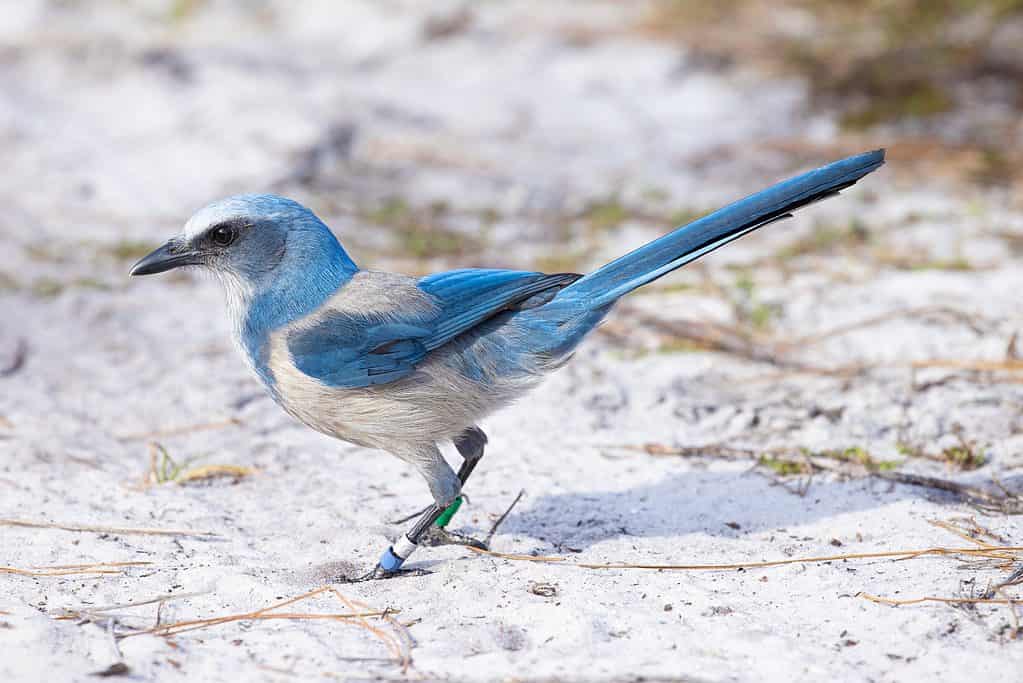
On the Florida scrub jay, the underside is grey, not white.
©Tommy Daynjer/Shutterstock.com
Like the California scrub jay, the Florida scrub jay is a similar length to the blue jay and has similar coloring. Both have long tails and lighter markings on their undersides. However, in the Florida scrub jay, the underside is grey, not white.
Florida scrub jays lack the blue jay’s black necklace and prominent black markings on their wings. Their feathers are also a paler shade of blue than the blue jay’s. Their most notable difference is their lack of a crest. Another distinguishing clue is habitat: the Florida scrub jay is only found in certain scrubland areas of Florida. If you’re not in the Sunshine State, you won’t spot one.
Steller’s Jay
The Steller’s jay (Cyanocitta stelleri) might be the most similar to the blue jay in overall shape, since it also has a crest on its head.

Steller’s jays do have similar black markings on their wings to blue jays.
©dimostudio/Shutterstock.com
However, the Steller’s jay’s coloring is quite different: its head is very dark grey or even black, while its body displays a gradient from gray to bright blue, with no white markings on the stomach. However, Steller’s jays have similar black markings on their wings to those of blue jays, making the two species harder to distinguish. Another distinguishing feature is that the Steller’s jay is slightly larger than the blue jay.
The ranges of the Steller’s jay and blue jay overlap widely. The Steller’s jay’s range stretches from parts of Canada to parts of Mexico, but because they prefer forested areas, they are not found throughout that entire range.
Woodhouse’s Scrub Jay
Woodhouse’s scrub-jays (Aphelocoma woodhouseii) are found mostly in the Southern Rocky Mountains and share some territory with blue jays. However, Woodhouse’s scrub-jays do not have the crest that blue jays are noted for, nor do they have blue jays’ black collar marking.

Woodhouse’s scrub-jays do not have the crest that blue jays have.
©Eivor Kuchta/Shutterstock.com
However, the Woodhouse’s scrub-jay’s coloring is distributed across its body similarly to the blue jay’s. To tell them apart, look for the slightly duller shade of blue that characterizes the Woodhouse’s scrub-jay. Blue jays also have some black markings on their faces, which Woodhouse’s scrub-jays lack.
Mexican Jay
The Mexican jay (Aphelocoma wollweberi) is found in Mexico and shares little territory with blue jays. If you spot a jay in Mexico, it is most likely a Mexican jay rather than a blue jay. The Mexican jay’s coloring is very similar to the blue jay’s, with blue on the back; however, its stomach is grey instead of white. The easiest way to tell this bird apart from a blue jay is that the Mexican jay does not have a crest or black markings. Their feathers are also slightly iridescent, unlike blue jay feathers.

Mexican jays are similar to blue jays.
©Cheri Alguire/Shutterstock.com
Pinyon Jay
The pinyon jay (Gymnorhinus cyanocephalus) is found mostly in the Western United States and shares some range with the blue jay.

The pinyon jay doesn’t have black markings like the blue jay.
©Agami Photo Agency/Shutterstock.com
Although pinyon jays have a similar body shape to blue jays, they are relatively easy to tell apart from blue jays. Pinyon jays have a fairly uniform, dull blue-gray coloring across their bodies, except for their deeper blue heads. They lack the color contrast of blue jays and the distinctive crest.