
Quick Take
- One bird on this list isn't actually a tanager, despite being named like one and looking like one. Western tanager's true family →
- Two of these birds have names tied to places where they don't actually live. Nashville warbler's misleading name →
- Not all bright yellow birds visit feeders, so knowing which ones don't can save you a lot of waiting. Where yellow warblers forage →
- One species on this list wasn't even supposed to be in North America, and its presence here has a surprisingly recent explanation. Saffron finch's introduced origins →
Bright yellow birds at your feeder are likely to grab your attention. They stand out against the background of any summer or winter scenery and bring a bright spot of color to your garden. Whether the yellow bird you’ve seen is a resident or a migrant, check out these different types of yellow birds, including pictures, descriptions, and locations, to help identify your backyard visitor.
Yellow Warbler
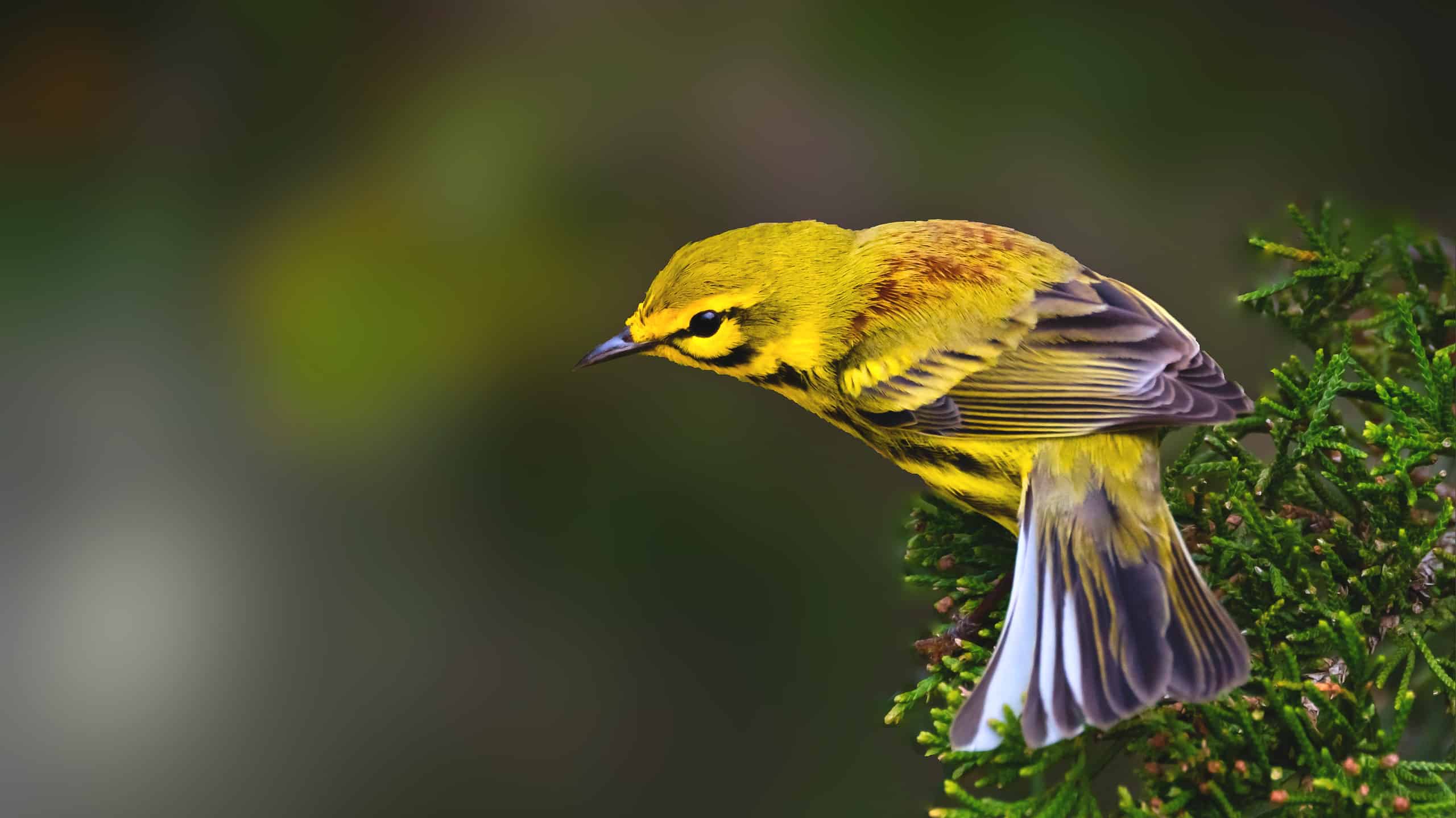
The yellow warbler (Setophaga petechia) is a New World warbler and the most widespread wood-warbler in the Americas. They fully embody the essence of yellow birds, with their buttery yellow plumage and sweet, whistling songs in summer. Males also feature chestnut streaking on their breasts and black streaks on their wings. Yellow warblers breed in Canada and most of the United States and winter in Mexico, Central America, and Northern South America. These birds eat insects and don’t visit backyard feeders, but you can find them in thickets, shrubby habitats, and areas of regrowth along streams.
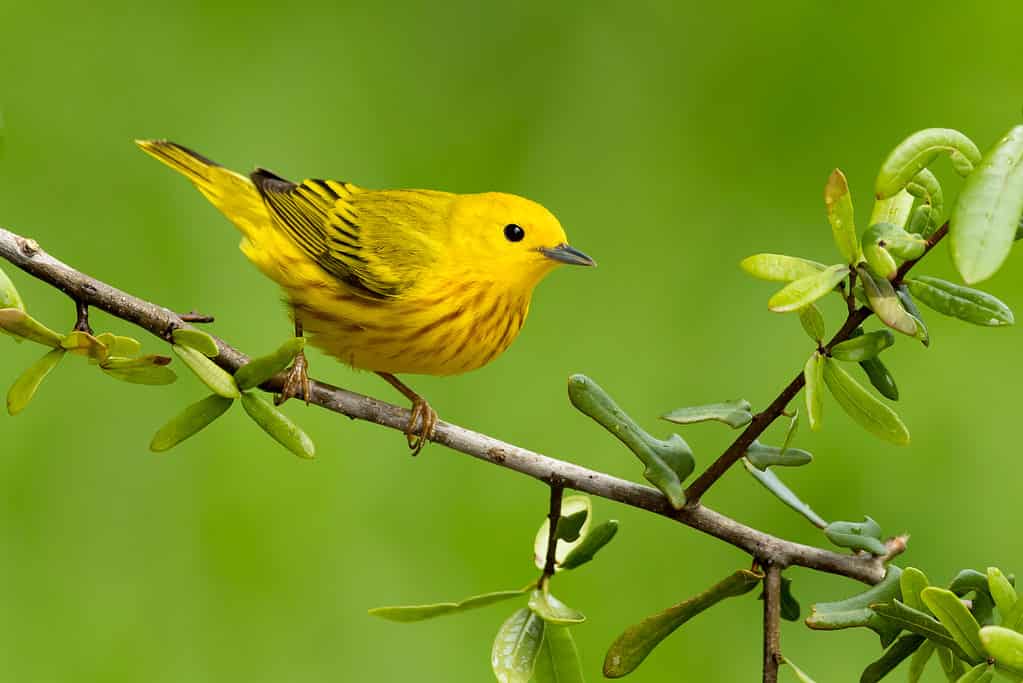
The most widespread warbler species in the Americas is the yellow warbler.
©Agami Photo Agency/Shutterstock.com
American Goldfinch
We can’t have a list of yellow birds without mentioning the American goldfinch (Spinus tristis). These small, North American finches undergo complete molts, during which males are vibrant yellow in summer and olive in winter. They also feature black caps and black wings with white markings. Females are dull yellow-brown. Populations in the northern United States stay in their environments year-round. However, those that breed across the southern and central regions of Canada migrate to the southern United States and Mexico for winter. You can find this bird in weedy fields, open floodplains, and overgrown areas.
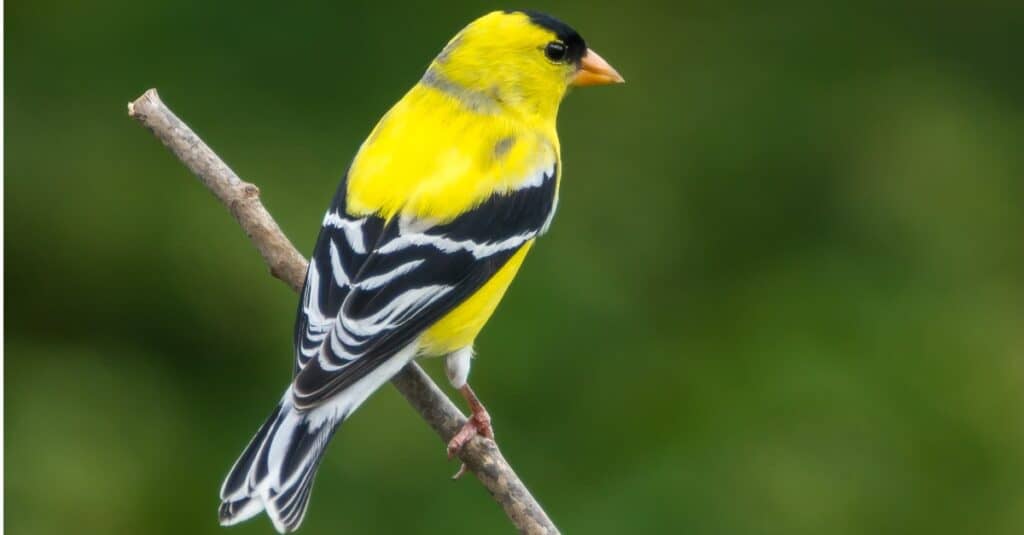
The American goldfinch has a diet that consists almost entirely of seeds.
©iStock.com/impr2003
Nashville Warbler
You can’t miss the Nashville warbler’s (Leiothlypis ruficapilla) bright yellow throat and breast. It has a grey head, an olive-green back, and a white lower belly. During the breeding season, they can be found across the northern U.S. and Canada, but they spend the winter in Mexico and Central America. They do not live or breed in Nashville, Tennessee, but they can sometimes be seen there during migration. These birds favor open-canopy forests and shrubby, second-growth mixed wooded areas.

The Nashville warbler was named after the location where the first specimen was collected during migration.
©Paul Reeves Photography/Shutterstock.com
Western Tanager
The western tanager (Piranga ludoviciana) is a medium-sized American songbird. While its name says tanager, this species is actually in the cardinal family, even though it resembles the tanager species. Adult males have bright reddish-orange faces, yellow napes, shoulders, and rumps, and black backs, wings, and tails. Females have yellow heads, olive backs, and dark wings and tails. Western tanagers breed in the western United States and Canada and winter in Mexico and Central America. You can find them in coniferous woodlands and aspen forests.
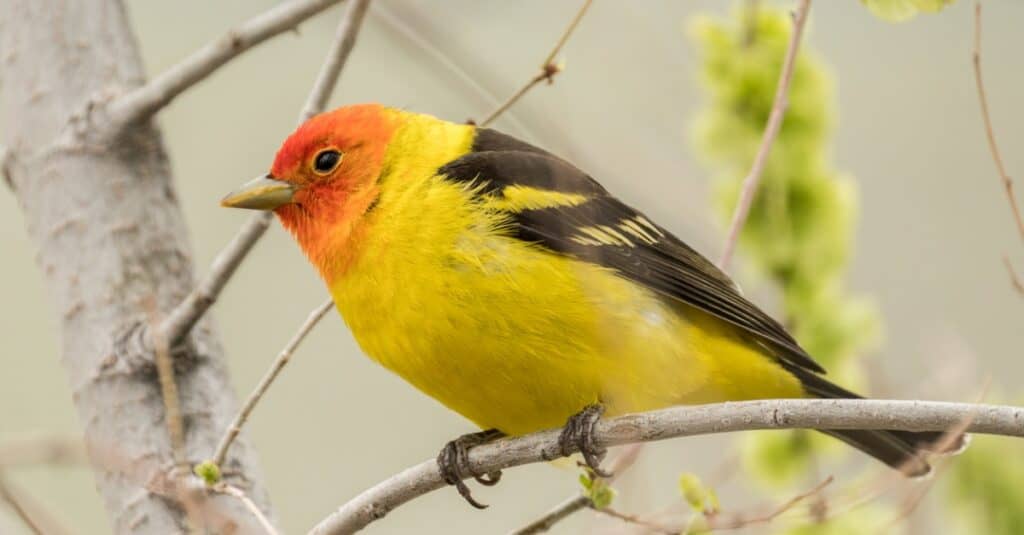
Male western tanagers are bright yellow with black wings and a reddish-orange head.
©iStock.com/mtnmichelle
Prothonotary Warbler
If you live in the southeastern United States, you can witness the prothonotary warbler (Protonotaria citrea) as it flits through its dim forest habitat. They are small songbirds from the New World warbler family and the only one of their genus. These birds have orange-yellow heads, yellow underparts, olive backs, and bluish-gray wings and tails. Females are similar in appearance, but they have dull yellow heads. The prothonotary warbler breeds in the southeast and winters in Mexico, Central America, and the northern tip of South America. Their preferred habitats include flooded bottomland forests and wooded swamps.
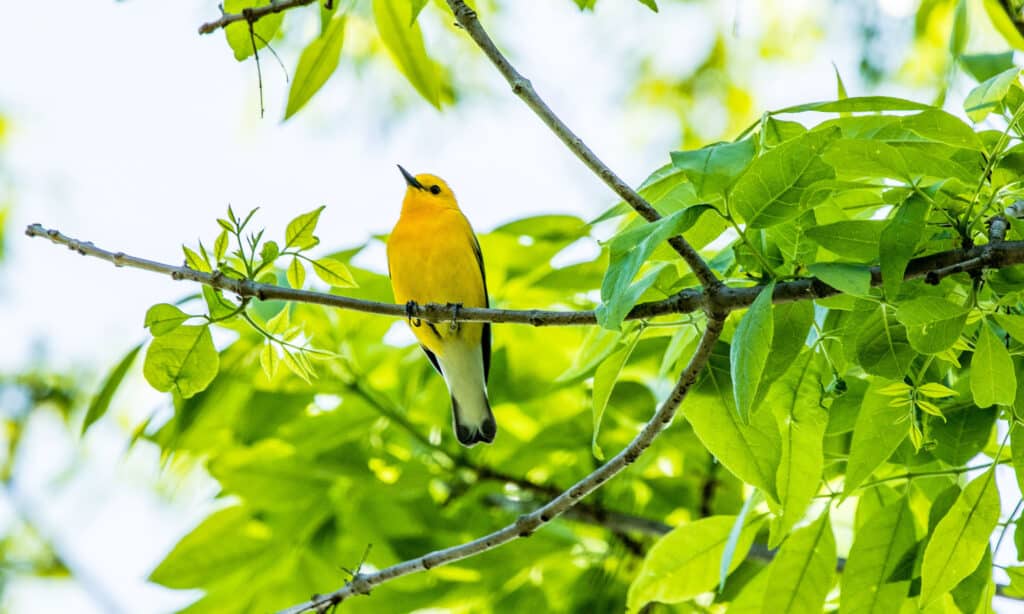
While they are from the New World warbler family, prothonotary warblers belong to their own genus.
©Mark C. Morris/Shutterstock.com
Wilson’s Warbler
The round-bodied Wilson’s warbler (Cardellina pusilla) is among the smallest warbler species, measuring less than 5 inches in length. They have bright yellow underparts, yellowish-olive upperparts, and males have a black cap. They spend most of their time in the forest understory, breeding in thickets near streams or along lake edges. During the breeding season, they can be found across Alaska, most of Canada, and the western U.S., but during migration, they are widespread across the U.S. and Mexico.
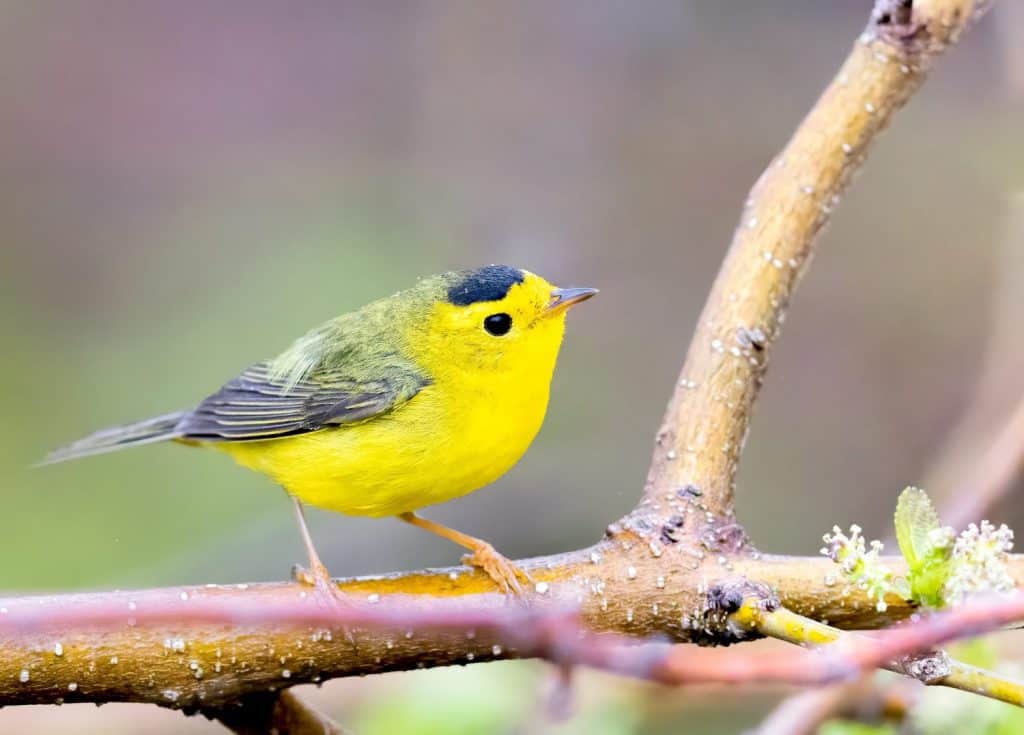
Wilson’s warblers are among the smallest warbler species at less than 5 inches in length.
©Rajh.Photography/Shutterstock.com
Prairie Warbler
Contrary to its name, the prairie warbler (Setophaga discolor) is not a resident of prairies. These small, slim songbirds have thin bills and long legs and tails. These warblers inhabit scrub forests, brushy clearings, and overgrown fields. They breed in the eastern U.S. from New England to the Gulf Coast, wintering in Florida and the Caribbean. There is also a year-round population in southern Florida. The prairie warbler has bright yellow undersides, heavy dark streaks, black eye lines, and chestnut patches on their backs.
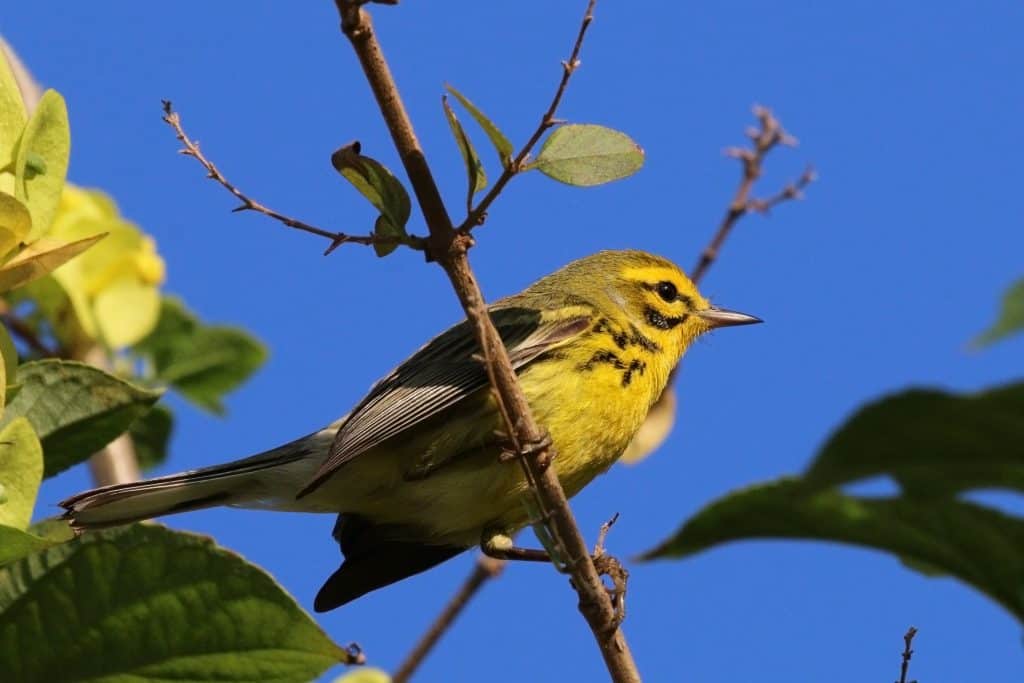
Prairie warblers are small songbirds measuring less than 5 inches in length.
Yellow-Headed Blackbird
As the name suggests, yellow-headed blackbirds (Xanthocephalus xanthocephalus) are medium-sized black birds with golden heads. Males feature bright yellow heads and chests with black bodies and white patches on their wings. Females have brown plumage with dull yellow heads. They spend their summers in central and western Canada and the United States and winter in the Southwest and Mexico. The best places to see these blackbirds are in wetlands in prairies, mountain meadows, and marshes.
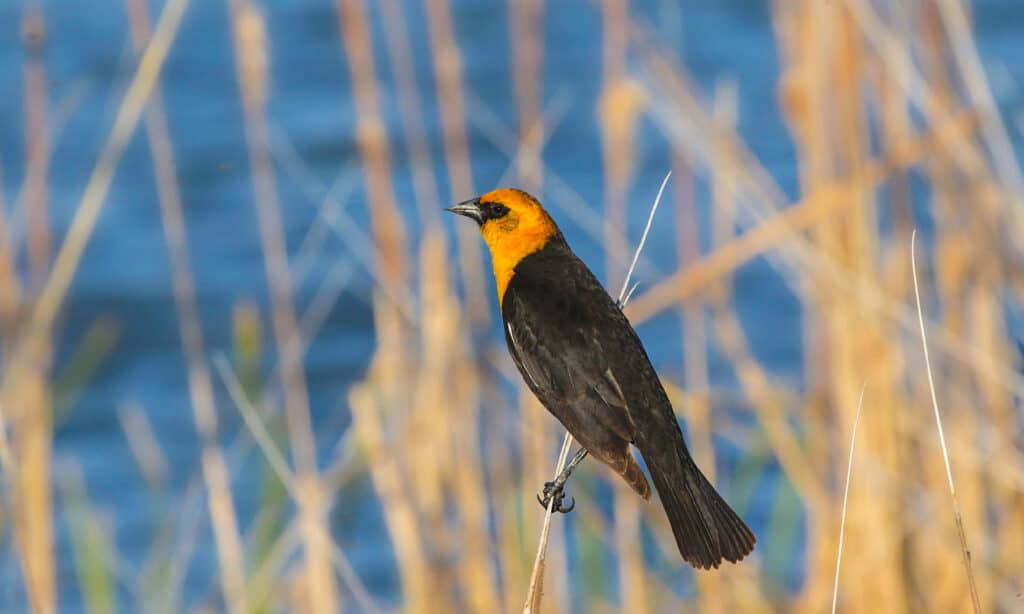
Like their name implies, yellow-headed blackbirds are black birds with yellow plumage on their heads.
©iStock.com/Nancy Strohm
Yellow-Breasted Chat
During the breeding season, yellow-breasted chats (Icteria virens) are widespread across the U.S. These songbirds are olive-green to grey above with bright yellow breasts. They have grey faces with white eye rings that extend to the bill. They are bulky birds with large heads, thick, heavy bills, and long tails. These birds favor low, thick brush such as thickets, brambles, forest edges, and shrubby habitats near rivers, streams, ponds, and swamps. Most of the yellow-breasted chat population winters from Mexico to Costa Rica.

Yellow-breasted chats are widely distributed throughout the U.S. during the breeding season.
©iStock.com/Warren_Price
Eastern and Western Meadowlark
The meadowlarks are a group of grassland birds native to the Americas. You can find eastern meadowlarks (Sturnella magna) in the eastern United States to northern South America, while the western meadowlark resides (Sturnella neglecta) in the west and central U.S. from southern Canada to Mexico. They both inhabit grasslands, prairies, pastures, and abandoned fields. Eastern meadowlarks have yellow underparts with a black “V” on their chests and brown upperparts with black streaks. The western species looks almost identical, except its plumage is paler with thinner black streaking.
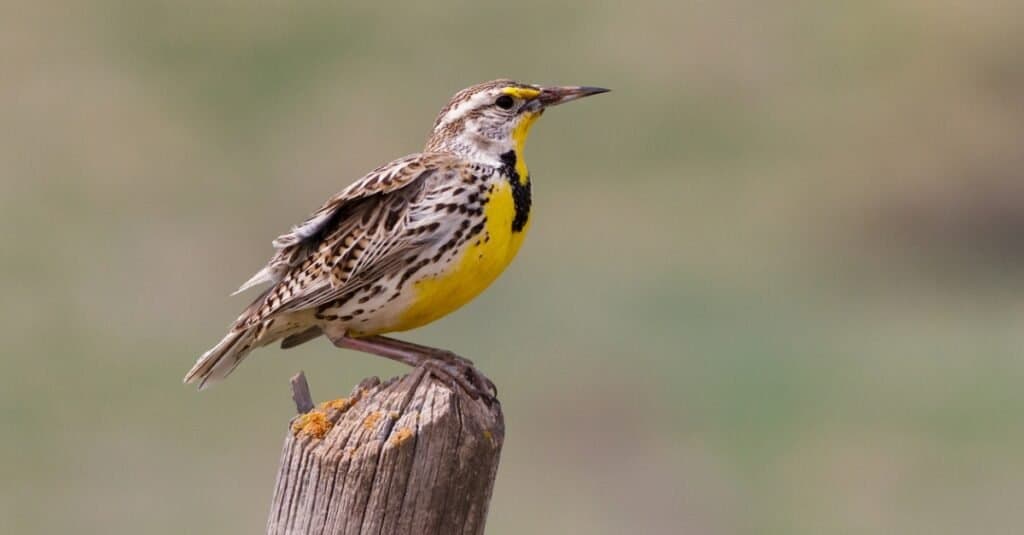
Western meadowlarks are nearly identical in appearance to eastern meadowlarks.
©iStock.com/Gary Gray
Yellow-Throated Vireo
The yellow-throated vireo (Vireo flavifrons) is a small songbird native to North and South America. They are one of the most colorful members of the vireo family, featuring yellow throats, olive heads, white bellies, and brownish-grey backs and wings. They also have dark irises with bright yellow rings around them, looking like spectacles. You can find this species in the eastern half of the United States during summer, but they spend winters in Mexico, Central America, and in the northern tip of South America.

Yellow-throated vireos have yellow throats, white bellies, and olive heads.
©JoshuaGoddard/Shutterstock.com
Western Kingbird
Western kingbirds (Tyrannus verticalis) are large tyrant flycatchers featuring more subtle yellow plumage than others on this list. They have grey heads, white throats and chests, and brown wings and tails. However, they have lemon-yellow bellies and flanks, and their underwings can appear yellow in flight. This species breeds in the western half of the United States and winters along the coasts of Mexico, Central America, and southern Florida. Their preferred habitats include grasslands, desert shrubs, pastures, fields, and savannas.

While most of the western kingbird’s plumage is grey and brown, its undersides are a vivid lemon yellow.
©Wildvet/Shutterstock.com
Common Yellowthroat
Featuring a distinctive black band across its eyes, the common yellowthroat (Geothlypis trichas) is unmistakable in its wetland habitat. These New World warblers, also known as the yellow bandits, have bright yellow plumage on their throats and chests. They also have white lines on their heads and olive-brown upper parts. They breed across Canada and the United States and winter in Mexico and Central America. Some populations live year-round in California and the southeast. Look for them in many habitats, such as wetlands, prairies, forests, and thickets.
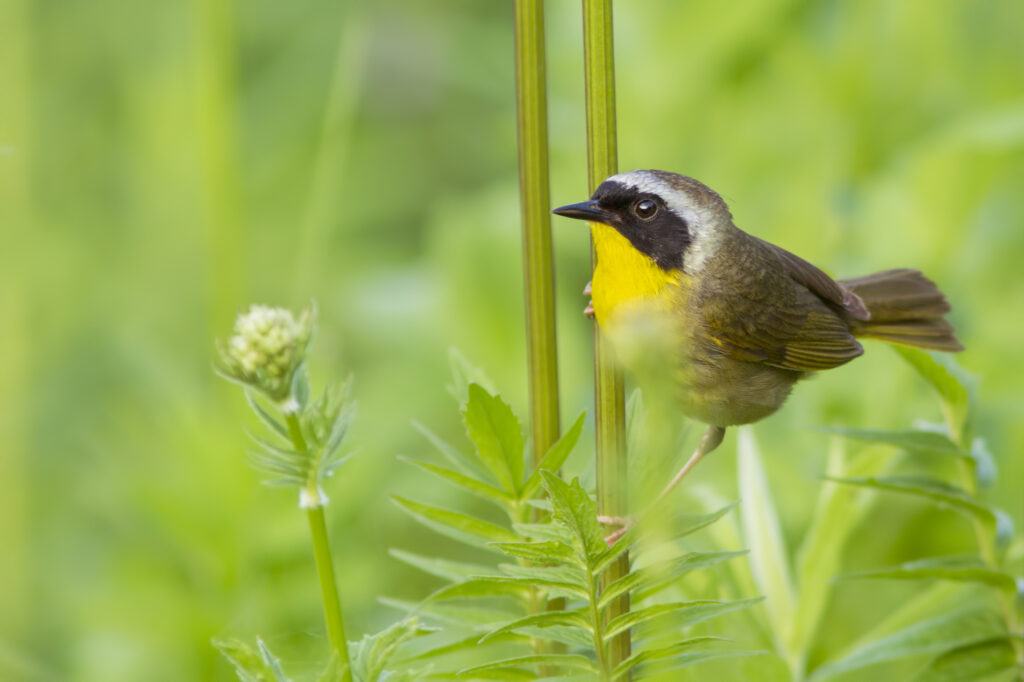
The common yellowthroat has a distinctive black band across its eyes.
©Mircea Costina/Shutterstock.com
Saffron Finch
The saffron finch (Sicalis flaveola) is a small, bright yellow songbird. Males are a vivid yellow with an yellowish-orange crown and a two-toned bill. They are common and widely distributed on Hawaii Island, particularly along the Kona coast, and on Oahu. These birds can be found in areas with short, coastal grasses and low-elevation brushlands. They are often seen in urban parks and on open lawns. The species was introduced to the Hawaiian Islands from South America in the 1960s, and they are year-round residents in the state.

Saffron finches were introduced to the Hawaiian Islands in the 1960s.
©samuel howell/iStock via Getty Images
Dickcissel
The dickcissel (Spiza americana) is a tiny, chunky bird native to North American grasslands. They have large, thick bills and short tails, yellow faces and chests, and their throats have a distinctive black “V” shape. Their heads and backs are brown and gray, with reddish-brown shoulders. You can find them in prairies and restored grasslands in the central US during the summer and in Mexico, Central America, and northern South America during winter.

Dickcissels have varied plumage on their bodies with yellow chests and heads.
©Harold Stiver/Shutterstock.com
Kentucky Warbler
Kentucky warblers (Geothlypis formosa) have bright yellow bellies and throats, olive-green upperparts, black crowns, yellow “eyebrows,” and black patches down the sides of the neck. They have longer legs, shorter tails, and heavier bills than many other warbler species. During the summer, they can be seen across the central and eastern United States. Kentucky warblers winter in Florida, along the Gulf Coast, Mexico, Central America, and the Caribbean. They favor lowland hardwood forests with thick understories, often near water.

Kentucky warblers have longer legs, shorter tails, and heavier bills than many other warbler species.
©Agami Photo Agency/Shutterstock.com